The Abridged Pecha Kucha

A couple of weeks ago, I mentioned I was invited to give a talk in Pecha Kucha format at the Dundee Rep theatre. I chose the topic of my Millennium Bridges tours from 2023 and 2025. It’s worth looking back at that previous entry to find out about my preparations.

A few days beforehand, I was told the running order. I didn’t mind where I would be placed on the bill, but going second allowed me to relax for the rest of the event. The theatre was set up like a cinema, with a large screen at the back of the stage, plus two TV screens at the back of the auditorium for

I was initially sceptical about being able to commit the entire speech to memory in such a short space of time. Assuming an average of 50 words per slide for 20 slides, that multiplies to 1,000 words. Instead of learning the script word for word, I found the pictures became an aide memoire, giving me a general idea about the next part of the speech.

There are legitimate times to learn by rote – such as acting roles – but I felt this wasn’t one of those occasions. As such, the script was slightly different each time and that gave it a more natural flow. There was no rule against reading from a page, and some of my fellow speakers did just that.

I also warned the organisers in advance that I would be performing while wearing my jacket and bag, as if I’d just come in from the cold, and I wasn’t about to run away.

The event was filmed, but the footage isn’t yet available. In previous years, the organisers would usually stream it online, but that didn’t happen this time. For now, all I can offer is a still image of the audience:
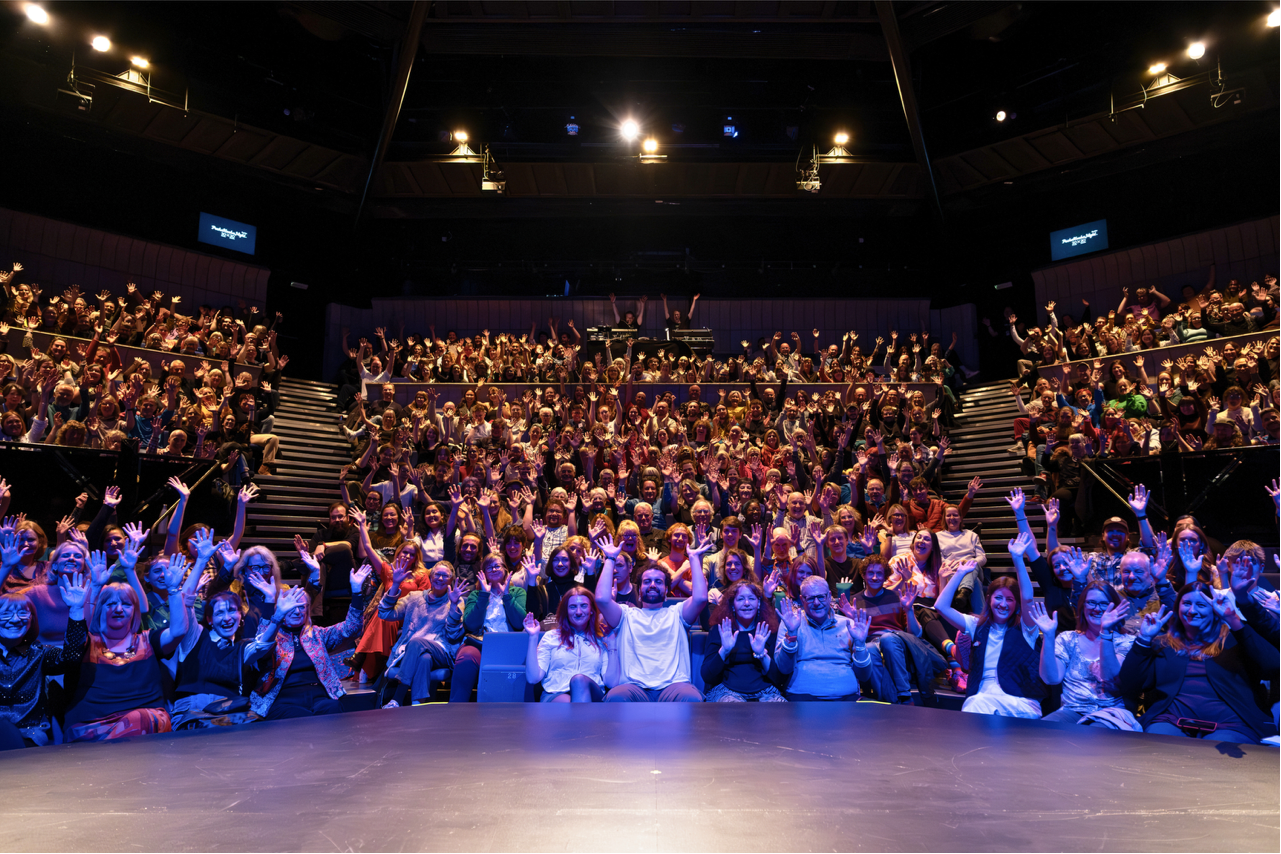
Credit: Aylish Kelly

Topics covered by other speakers included: gardening, pub quizzes, an assortment of community and social engagement projects, and even an interpretative dance to cap off the evening.

Afterwards, a few members of the audience congratulated me on the talk. One man noted that I’d managed to time the end of my speech for exactly when the last slide left the screen. I thanked him but emphasised that it was a coincidence and I could easily have overshot the mark.

A long-term ambition is to help people find the confidence to speak in public, whether it’s for a social event like Pecha Kucha or convincing a boardroom of directors to fund a business project. Heck, maybe that could be my next talk. For the moment, I’ll drip-feed you one piece of advice for free:

Going on stage produces a rush of adrenaline, especially if you’re not used to it. Since it can take up to 30 minutes for this to deplete, and up to an hour for the effects to wear off, it’s best not to go straight to bed. Instead, I recommend spending that time winding down: take a walk, read a book, or listen to the radio.

The Best Bad Poetry

A few days ago, I received an email from a blog I didn’t know I was following.

The author had just updated with a poem about the Ship Canal Bridge in Seattle that was heavily influenced by the William McGonagall verse The Tay Bridge Disaster. For the avoidance of doubt, only the style is lampooned; the Seattle bridge is in no danger of collapse.

I’m from Dundee, right next to the Tay, and McGonagall is closely associated with the city. As I read the Ship Canal Bridge poem, I found I had more and more I wanted to say about the poet and his output.

A major hallmark of his distinctive verse came from forcing clumsy descriptions into rhyming lines. It amused me to see the critically-panned film director Tommy Wiseau under the See Also section in his Wikipedia entry.

However, I’ve also heard McGonagall’s technique described as ‘journalistic’, as his words often give a factual insight into the subject. This is showcased neatly in The Tay Bridge Disaster.

To our eyes, such a poem might seem insensitive to its victims and their relatives. However, there appeared to be no public outcry 143 years ago; even in modern times, performances are often played for laughs.

I must credit Dundee Rep Theatre with making an exception in 2019. As part of a local history show called The A to Z of Dundee, one of the actors read an excerpt from the piece. Despite the overall show being comedic in nature, he gave it a poignant tone that I think was better suited to the subject matter.

One of my university tutors believed McGonagall was the only poet whose entire body of work had been published. Better still, his output has been in the public domain for decades, so it’s easy to find countless other examples of his style.

The Poetry, the Play and the Party

On Friday, I attended the Burryman festival in South Queensferry, a short train trip from Edinburgh. This is a tradition where a man from the town is dressed head to toe in burrs and marched around the streets, and it’s considered good luck to offer him whisky. The origin is unknown, but is believed to be around 400 years old.

Much as I’d like to devote the whole entry to this amazing day, I mention it only in the context of live events. This time last year, there was doubt over to whether it could go ahead because of crowd control regulations. It did happen, with the police making sure folks kept their distance.

This year was a different story, largely because early August marked the return of many live events in Scotland. As I knew I wouldn’t be too far away, my first event was Loud Poets at the Scottish Storytelling Centre in Edinburgh. I was particularly excited for this, as I knew a few folks taking part, either on stage or front-of-house.

Three poets and a host played in front of an auditorium at perhaps two-thirds capacity, and they seemed relieved to be back in person. One in particular, Paul Case, relied more on memory than written work, and it reminded me that this is a habit I need to relearn because I haven’t had a need to remember my work over the last 18 months.

Then on Saturday, I was invited to a dress rehearsal of a play at Dundee Rep Theatre: Hindu Times by Jaimini Jethwa. The rehearsal took place in a studio rather than the main stage, with no sets and minimum special effects. I enjoyed being part of this select preview group, and I’ll definitely recommend the play once it launches to the wider public.

The Storytelling Centre and the Rep both enforced distancing and face coverings, but Generator Projects took a more laissez-faire approach. To celebrate 25 years of workshops and exhibitions, they laid on an outdoor show of poetry, dance and music. I also had plenty of opportunities to catch up with others from the literary community before complaints from residents closed it down at 9pm.

I have a few more live shows lined up in the near future, and I hope they’re just as enjoyable.

Watching What You Wouldn’t Normally Watch

Not far from where I live is the Dundee Repertory Theatre, known locally as simply the Rep. The programme is a mixture of classic plays, contemporary works and local interest productions that appeal largely to a Scottish audience.

There was a time when I’d go there with my theatre buddy to see just about everything in the programme, but that hasn’t been possible for some time. Recently, however, the theatre has started the Rep Studios streaming service.

The first play to be streamed, Smile, is one of those local interest productions, about the football manager Jim McLean.

The tickets sold by Rep Studios are all timed like stage shows, usually for 2pm and 7pm, and that led me to think I’d be seeing a live performance transmitted from the theatre. Instead, the show is pre-recorded. I know this because I logged in early, expecting to see a countdown clock, yet it started straight away.

I’d waited until the last few days of its run because while I’d like the service to succeed, sport is not an area of interest to me. In fact, I didn’t mention it to my theatre buddy either as I knew she would feel the same. Ultimately, I’m glad I watched it, although I didn’t find it outstanding and I probably wouldn’t seek out a re-run.

The first time I encountered a streaming theatre production was not at home, but in a cinema, maybe seven or eight years ago. This was a National Theatre production – probably Shakespeare – and it was broadcast live.

Yet I felt a distinct vibe that they didn’t much like doing it this way. For a start, they could charge twice as much for an in-person performance, and the audience would have the draw of seeing Benedict Cumberbatch or Daniel Radcliffe live on stage.

The economics of this likely tell a different story. Cinemagoers were charged perhaps half as much as the theatre audience, with the trade-off that more than twice as many people could potentially see the play without any more performances being staged. I imagine the actors received extra pay for the broadcasts, although such transactions are typically kept confidential.

I’m going to keep an eye on how Rep Streaming emerges and evolves, and I look forward to the day I can next to my theatre buddy again.

Almost a Live Show

Regular readers will know that I run an open-mike evening called Hotchpotch, where members can come along either to read a poem or simply to listen to others. However, we haven’t been able to run in its classic form since March because of restrictions on live events.

So far, we’ve been using YouTube as a substitute, and posting members’ readings to our channel. However, we’re holding a one-off event called Hotchpotch Presents… next week.

For this, we’re moving to Zoom, and the most notable difference is that the line-up is advertised in advance, not comprised of those who turn up on the night. We have 11 performers ready to perform seven minutes each, and they’ll be introducing each other to keep the flow.

We have experience of this format before, having trialled it as a live show in April 2019 at the Rep theatre in Dundee. There was quite the vibe that night, and I do hope we’re able to channel for this second airing of Hotchpotch Presents… on Monday 19 October.

A Weekend of Shows

Regular readers will know that I run a monthly open-mike night called Hotchpotch; it’s for writers rather than musicians. This past weekend, we branched out and held two extra events that differ from our usual format.

On Friday, it was Hotchpotch Presents…, a 40-minute showcase of some of our regular members’ best work with no open-mike element. This was part of a festival called Stripped, organised by Dundee Rep Theatre. Our set finished off a cabaret-style evening that included the poet Imogen Stirling.

The staff there treated us well, even when we changed our technical requirements a couple of hours beforehand. I did feel the audience needed to be loosened up a little, but they had done by the halfway point. The best part was that we had a small budget, so the performers could be paid a fee.

This will certainly open the door for another members’ show in the future, possibly next March when Hotchpotch celebrates its 10th birthday.

On Sunday, we held Hotchpotch in Perth, around half an hour away by car. This was part of the Soutar Festival of Words, and we were given the use of the AK Bell library for 90 minutes. That event was modelled on the Dundee open-mike sessions, but performers were to be given five minutes rather than seven, and we allowed them to sign up in advance.

Although the audience was around half the size of what we would normally attract, it meant that everyone was allowed a second turn at the microphone if they wanted it. Among the crowd was Rana Marathon, who holds a regular spoken-word night in Perth called Blend In – Stand Out (BISO). Unfortunately, I didn’t manage to go to the BISO Slam the previous day because I was organising our event.

And there’s more to come. I’m currently in Wolverhampton on business where there’s an event tonight called PASTA, short for Poets and Storytellers Assemble. It seems to be similar to Hotchpotch, so I’m looking forward to taking part.