I’m pleased to report that my short story Amending Diabolical Acronym Misuse has been released today by Strange Musings Press in its Alternate Hilarities anthology, along with a number of other comedy pieces.
I’d also like to give thanks to the editor, Giovanni Valentino. Book publishing takes months of work, and throughout it all, he has been in regular contact with the contributors, and kept us up-to-date with its progress.
There’s no escaping the truth that writing is a solitary occupation. Authors can spend hours of their life alone in attics, sheds, and cafés, immersed in the land, world or universe they’re trying to create. It’s therefore tempting to imagine that this breed of people are shy introverts. Actually, of the majority I’ve seen, I’ve found the reverse to be true.
These days, it’s important for a writer to be able to self-promote, as many publishers’ marketing budgets are not massive. A prime example is Man Booker Prize winner Eleanor Catton, whom I had the privilege to see at a live event last week. She was interviewed about her book The Luminaries and gave some excellent, confident answers. Doug Johnstone also illustrates my point, as he’s forever looking for an opportunity to crack out his guitar. Chris Brookmyre dispenses entirely with an interviewer in favour of his own speech, while Iain (M) Banks usually invited questions from the word go.
This space reserved for Banksy’s next piece
Have you considered trying it yourself?
Public reading and question-fielding is not reserved exclusively for established authors. Anyone can do it, and I believe they should. Like many authors, I read my work out loud when there’s nobody around, as it’s a valuable tool for ironing out clumsy phrases and misplaced punctuation.
I also consider myself an extrovert. I might spend time alone in front of a PC churning out short stories, but I’m perfectly at home in front of a microphone or camera. I volunteered at hospital radio for a long time, and used to keep a video blog. I’m also lucky enough to have a writers’ open-mike night nearby, where I can try out new material. The audience is made up of fellow authors and poets.
That’s not to say I don’t find it terrifying standing in front of them. I’ve never made a complete hash of it, but I have stumbled, and that’s something I need to work on. But even if you’re an introvert, find a willing audience and push through that barrier. It’s valuable for seeing how well the piece goes down with the public, particularly if they’re laughing when they should be shocked, or vice-versa.If you do, your work will almost certainly improve, and if you become published, you’ll already have the experience of making public readings.
While I was writing this, I thought of one introvert who always causes a fuss whenever he exhibits a new piece. I refer you to Banksy in his iconic film Exit Through The Gift Shop. He seems uncomfortable with the camera being near him, but his self-promotion skills are second-to-none. I know he’s an artist, but if he were a writer, I wonder what type of work he would produce?
I intended to make only one entry on the theme of paper, which turned into a second post. This entry will be a short third and final update on this topic, as I just keep finding more material.
I’ve discovered more notebooks, including some early drafts from my second novel, and a review of Tron: Legacy for my old LiveJournal blog. Once again, I’ve never reached the last pages of these pads. I find this rather strange, as I’m not the sort of person to leave a job half-finished. Once, I would have preserved them as they were, but I’ll use the other pages in the future if I need to.
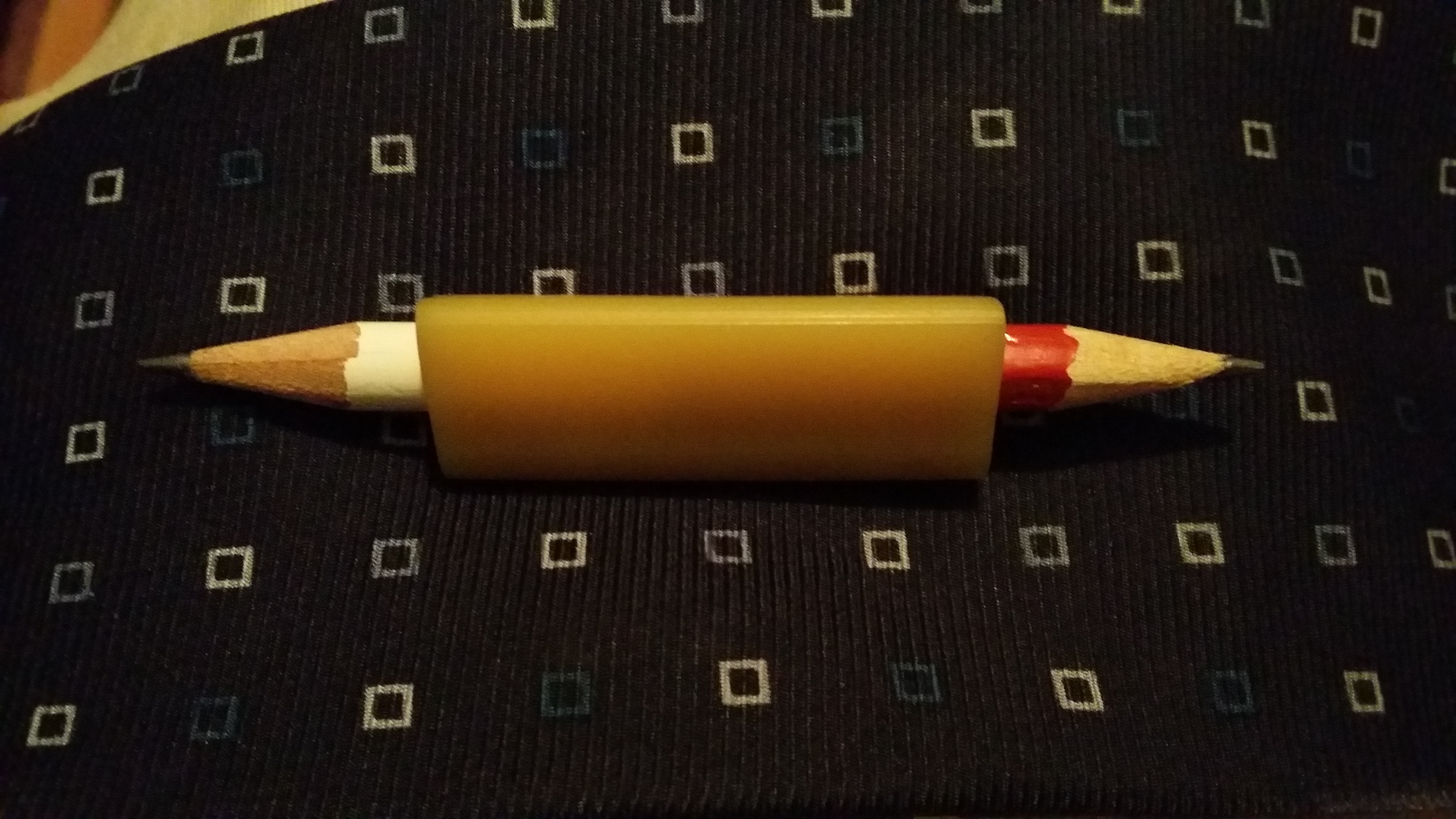
My pencils are a different story. I have dozens of them around the house, and I don’t like to waste them. In fact, here are my two smallest ones joined by a rubber grip. I’ll use them until I physically can’t hold them any more:
I’ve also discovered from Mental Floss that every new prime minister leaves a handwritten letter about what to do in the event of a nuclear conflict if both he and his assigned second-in-command are dead. It seems a little strange that such a format is still used. If I was PM, I’d make sure I spelled it out in 16-point Helvetica so the commanders aren’t standing around asking, “Does that say, ‘load weapons,’ or, ‘lower weapons?'”
More poignantly, ListVerse posted a collection of last words written by people facing certain death. Not all of them had the luxury of pen and paper, including the prisoner of war who scratched out a memorial on a rock, and a diver who wrote his on a slate.
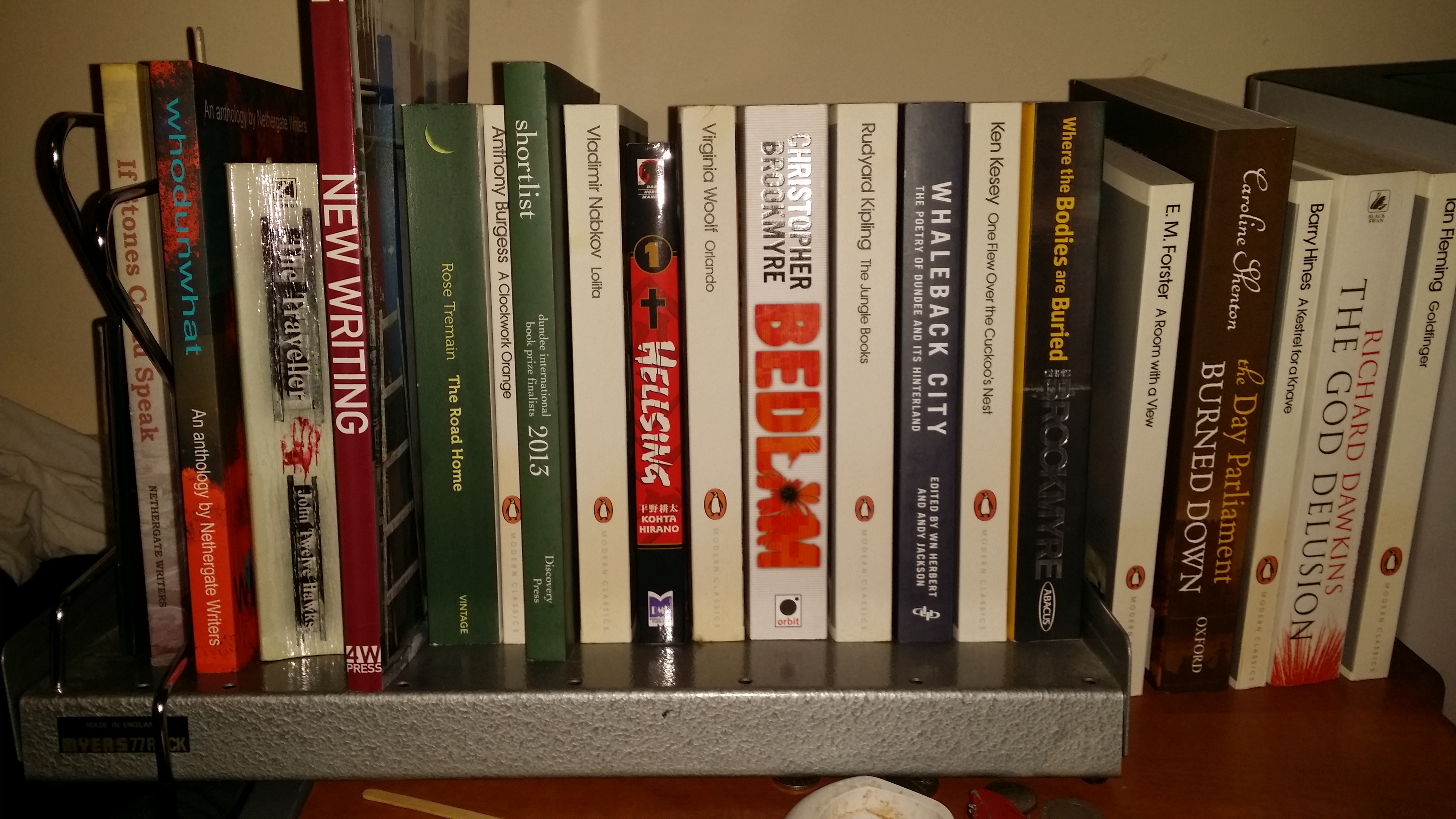
Lastly, I’d like to show you the paper books I plan to read throughout the rest of the year, including modern writers such as John Twelve Hawks and Richard Dawkins, a selection of Penguin Classics, and a number of local anthologies:
If you want more information on any of these, let me know.
Over the last few entries, I’ve posted that Strange Musings Press would be printing my story Amending Diabolical Acronym Misuse, subject to raising enough money through their Kickstarter page.
I’m pleased to report that the $1,100 target has been reached, and the anthology will absolutely and definitely be going ahead.
The Kickstarter campaign is still open, and there are extra bonuses for reaching $2,200 and above.
Around three weeks ago, I was pleased to report that I’ve had a third short story accepted for publication. Strange Musings Press of New York will be printing Amending Diabolical Acronym Misuse, subject to raising enough funds through their Kickstarter page.
There’s still around a week left to raise the $1,100 required for it to go ahead. You can donate at several different levels from $1 to $150, each of which buys you into the project with increasing levels of reward, including electronic and/or paper copies, autographs, and your name in the Contributors’ section.
My story is called Amending Diabolical Acronym Misuse, and it’s about a man who wants to rid the world of badly-constructed acronyms. Although I’m Scottish, my dialect is British English so that’s how most of my stories are written, including this one.
If I’m sending to an American publisher, I often change the grammar and spelling to suit; at least, I have a decent stab at it. In one case, I even wrote the whole story in US English because the character was so strong in my head: a cross between Jason Gideon from Criminal Minds, and Adrian Monk. In Amending…, I took the decision to keep it in my natural dialect as there are a number of references to British places and companies, and I felt it would look odd if I, “translated” it.
A couple of weeks ago, I began reading The Traveller by John Twelve Hawks. The narrative is written with a curious mix of dialects. For instance, the title is spelt with two Ls and there’s a reference to a pub, but the colour gray and an SUV appear in other parts. The SUV would be known as a 4-by-4 in Britain. The story is set in several countries so I expect it’s difficult to settle on one standard spelling, yet it’s not a distraction here, and I’m thoroughly enjoying the story.
Conversely, my mentor Zöe Venditozzi released her debut novel Anywhere’s Better Than Here in 2012. When a US edition hit the shelves, she told me there were no spelling changes made. When you buy a copy, watch out for the character whose initials match mine.
So is it important to adapt your dialect depending on which side of the Atlantic you’ll be published? I expect most Internet users will be accustomed to reading both, but at the same time, people will still write in whichever they feel comes most naturally.
Perhaps one day in the future, the two will merge and we’ll have one way of spelling each word, one form of grammar for all. It would be more practical, but probably rather dull.
It’s a rare occasion that Mostly Yummy’s blog topics will intersect in any way with mine, but today it’s happened.
I didn’t realise until this morning that World Book Day was such a big deal among the nation’s schoolchildren. They’re encouraged to dress up as their favourite fictional character.
The theory of this is quite sound. A child’s imagination can be sparked and expanded by his or her early reading choices. The other part of the theory is peer pressure. If a child knows that everyone else will be dressing up, they’ll likely want to do the same.
Like many children, I loved Roald Dahl’s slightly twisted novels, but I also enjoyed the stories from Antelope Books. I can’t find any relevant references to Antelope online, so do comment if you remember these guys.
But as Yummy points out in today’s post, the reality of the aforementioned theory can be very different. She tells us how she tried to cobble together outfits for two of her children, while making a valid point that the dressing up can overshadow the intention of World Book Day which is to read.
I must’ve mentioned this before, but being asked to do anything artistic scares the bejesus out of me; even seeing the words Daler Rowney brings me out in hives. I disliked the subject at school since I could never make the final product look anything like what the teacher asked. I did know what I wanted to draw, paint, or construct, but it became lost somewhere between my head and my arm. In essence, I sympathise a great deal with my fellow blogger.
I’ve been upfront from the start that I’m a latecomer to writing fiction. I didn’t pen a single piece between my last high school English class, when it was mandatory, and just before I turned 27. Despite the long gap, I find writing comes naturally to me, although I still had to learn the rules and conventions of the craft, whereas expressing myself with a paintbrush just isn’t me.
I recognise that some people won’t be able to relate to this as they have the exact opposite talents. I would like to learn, as it could complement my writing. Perhaps someone suitably gifted could put together a Complete Ninny’s Guide for me, and throw in a copy for Mostly Yummy.
I’m pleased to report that I’ve had a third short story accepted for publication. New York publisher Strange Musings Press will be printing Amending Diabolical Acronym Misuse. However, it will only go ahead if enough people contribute.
To this end, a Kickstarter campaign has been set up to raise $1,100 by Tuesday 25 March. You can donate at several levels from $1 to $150, each of which buys you increasing levels of acknowledgement, privilege, and general bragging rights.
I wouldn’t ask you to do something that I’m not prepared to do myself, so I’ve donated $22 under my legal name Gavin Cruickshank. That amount includes $10 overseas postage for a copy of the book, due out on Thursday 1 May. You can see my contribution on the backers’ page.
I would be most grateful if you could give whatever you can, and the editor Giovanni Valentino will be delighted. Don’t forget to share this blog post on WordPress and/or your preferred social networks.
If this comes off, I’ll have been published in the UK, Australia, and the US. Canada, I have my eye on you.
I met a woman last week who reads books in a particular manner. She’ll read the last few pages first, decide if she likes the way it ends, and if so, she’ll then start reading from page one. She added that this method allows her to know if there’s going to be a satisfactory ending before investing time in the main story.
I do accept her argument as logically sound, but there are books where the ending makes very little sense unless you’ve ingested the main text. I’m thinking of an epic novel, such as Moby Dick. Reading the conclusion without knowing the tensions between Captain Ahab and his crew, detailed in the rest of the story, you won’t fully understand why their voyage ended the way it did.
If you ever do tackle Moby Dick, incidentally, you can quite safely skip Herman Melville’s obsessive personal polemics about the whale.
Another problem with this system is that some books paint a picture rather than tell a story. Consider Breakfast at Tiffany’s; the novella, not the film, although the woman in question uses the same method with DVDs. Truman Capote explores the complex relationship between the narrator and Holly Golightly in such a rich manner that there is as much to be gained from the description as the plot.
I do enjoy including some historical context in my entries. Read the prologue of William Shakespeare’s Romeo & Juliet and those 14 lines give away the plot before any of the other actors say a word. Audiences expected to be given the precis at the beginning.
By the 20th century, the position was completely reversed. Agatha Christie understood this when she wrote The Mousetrap, at the end of which she specifically asks the audience to keep the secret. These days, there is still an expectation that endings will be kept under wraps, or clearly marked Spoiler Alert, with the odd exception such as Star Wars or The Sixth Sense, where it seems fair game to give it away. But there are also websites you can consult if you want the full plot.
I’ve created a poll to gauge how many WordPress users agree with my feelings on the matter. If necessary, do expand on your answer in the comments.
Nothing marks out a generation more than the slang it uses.
If we concentrate on right now, February 2014, you’ll hear people say they’ve, “taken a selfie,” or say, “because,” followed by a single word rather than an explanation. Back fifteen years, and it wasn’t unusual to, “tape that programme,” or answer the phone with, “WASSU-U-UP?”
So when writing a piece that’s going to hang around for a while, most notably a novel, it’s a good idea to decide whether you want to incorporate the slang of the day to make it a period piece, or create a more timeless tale by using more generic terms.
I recently wrote a story where a major plot element is a pager. This immediately sets it in the 1980s, and I felt safe using the term data bank to describe the device’s storage, rather than the more modern memory. I tried not to overload the piece with dated words, but I did allow myself a yuppie, as the pager’s owner described himself.
But while the eighties is over and we know what it was like, writing a story set in the future is different. One day, selfie and because _____ will be as embarrassing as fab and groovy. For my first novel, where the action takes place in the 2500s, I used, for instance, sound system rather than iPod or even MP3 player. I decided not to try predicting the future term, and write something a little more bland, as would distract from what I was trying to say.
There is an elegant solution to this problem, and those of you who write steampunk know what I’m talking about. This genre imagines modern or relatively recent technology as people in the 19th century might have seen it. There are many literary examples of this, but an accessible non-literary one is the TV series Warehouse 13.
Which leads me to wonder if there’ll be a genre of the future where writers of the 2110s envision their everyday gadgets as we in the 2010s might have viewed them. This decade’s most popular invention is probably the touchscreen computer. So, a hundred years in advance, I’m going to label this predicted genre as tabletpunk.
I’d like to be around to see the look on some geek’s face when they unearth this entry.
I’ve seen Chris Brookmyre twice already, and tonight was my third time. I’m a big fan of his work after All Fun and Games Until Somebody Loses an Eye, and most recently, a signed copy of Flesh Wounds. Tonight, he was promoting Bedlam, which also has his autograph.
Brookmyre does not fit the stereotype of the introverted author, much like the late Iain Banks, whom I had the privilege of seeing twice. Rather, Brookmyre takes centre stage and spills out anecdotes full of swearing. He’s so well known for it that he’s now been forced to apologise in advance. Indeed, the first time I saw the guy, he read out an e-mail he’d received by a previous organiser, effectively banning him from appearing several years ago.
Tonight, he brought along a guest. Barry Phillips started a parody blog of a local footballer and found it attracted the attention of readers around the world. Now he’s written a book called The Tartan Special One about a 17-year-old who is snapped up by Dundee FC. I don’t follow the game, and I didn’t buy a copy tonight, but it still appeals to me so I might so do in the future.
I’ve started back at two writing classes: a short course in fiction run by published author Zöe Venditozzi, and Level 2 of the Life Writing course at the University of Dundee. A couple of new people have joined us, one of them from Life Writing, and she says she’s having trouble thinking of ideas for passages in the five- to ten-minute exercises we’re given in class.
By coincidence, I was discussing this issue with one of the other short course stalwarts earlier the same evening. We realised we’re so used to thinking on our feet that we don’t even hesitate over it any more. But when we began in 2011, it would be tiring trying to think of stories.
Most of our Life Writing class knew each other from Level 1, and we really bonded over this week’s homework, which was to write a summary of our life, then pick one part and make it into a vignette. The ideas for this class also come to me rather quickly, and I can sometimes think of one before I’m on the bus home.
Finally, I didn’t realise until tonight that there’s a reminder feature on WordPress. If you want to post at least once a week, or once a month, it’ll send you an e-mail.



 Gavin Cameron