An Abundance of Apples (Part 3 of 5).

For the five Mondays in June, I’m taking a break from my own angst and introspection to make one of my stories available free online. We’re now up to part three of An Abundance of Apples.

In part one, we meet an orchard owner who starts off with too many apples, and begins to trade them for other items, each one letter higher in the alphabet than the last. Part two sees him trade four more items beginning with F, G, H and I, while his bratty younger brother constantly stands in his way. In part three, below, he’s now in possession of a jigsaw.

Jigsaw

The publicity generated by the paper showed little sign of slowing down, so in quick succession, I received a jigsaw from another well-wisher.

Not a jigsaw puzzle, an actual saw that’s used to cut the pieces.

King Kong stills

The wealthy-looking man who offered me the Grand Prix programme wrote back, offering to swap the jigsaw for some rare stills from the classic film King Kong.

I decided to start photographing the items, starting with the saw, as they were becoming more interesting.

Around the same time, a woman called Kelly, around my age, requested to be mutual friends on You & We. We had three people in common and I recognised her face, although I couldn’t remember where I’d last seen it.

Laserdisc player and discs

The things people keep in their attic. Someone swapped me the King Kong stills for an obsolete laserdisc player and four Jean-Claude Van Damme films on discs the size of bicycle wheels. What’s more, it still worked, and we spent the evening watching Universal Soldier.

For the first time since being in the paper, I had a little trouble finding a trade. My inbox still filled up daily, but only with offers of cheap items, including a map, a family bag of M&Ms, and half-a-dozen marbles.

Mink coat

I finally traded my retro technology for a mink coat. A fake one, of course.

I stood back and took stock. I’d come so far in less than a month, and all after an off-the-cuff observation. All my life, I’d been a trader in one sense or another, and I still saw it as an achievable challenge.

The national British newspapers ignored me, except one rag who reported that Margaret Jeffrey had given me the idea. Then I received an e-mail from a researcher at an Australian radio station asking me to contact them. They wanted to speak to me live on air when I reached the letter P.

Necklace

Just as I celebrated reaching the halfway mark, the mysterious Kelly wanted to see the coat, and offered a sterling silver necklace in return. After a few minutes’ online conversation, I realised her true identity: Irene’s daughter.

I asked why she wished to get rid of the necklace. She told me her father had given it to her one birthday. I didn’t ask directly, but I came away with the distinct impression that she and Irene wanted nothing more to do with the man.

I couldn’t stay angry at Daniel forever and I brought him along when I went round to complete the exchange. She tried on the coat and it fitted her neatly. We chatted for ten minutes, which turned into an hour, which turned into a very bored little brother.

I’d driven nearly all the way home when he said from nowhere, “Did she ask you out?”

“No,” I replied.

“But she asked you if you wanted to have dinner with her some time.”

I’d dismissed it as a rhetorical question, but thinking back, I realised she’d been serious. For a selfish brat, he could be astoundingly perceptive. I rang up to accept when I got in the house.

I thought a necklace would be snapped up, especially as it bore a hallmark, but I hit a wall. The effect of the newspaper article had almost worn off. I began to doubt my ability to reach O, never mind Z.

Obsidian pig

It took nearly a week, but I arranged to swap it for a decorative pig made from obsidian.

The snag? Kelly and I had already booked a table at a popular restaurant for 6:30pm, but the swapper could only meet me at 7pm. Kelly understood the magnitude of my project, but the other diners thought I’d run out on her.

Another week passed, and another date, but nothing to swap for this pig. I sat down and wrote a plea on You & We. I read it back the next day, and it sounded quite desperate, but Kelly had passed it onto her friends.

Power supply unit

In less than six hours, a hire shop in town swapped my obsidian pig for an ex-rental industrial battery, designed to provide emergency power in the event of an electricity failure.

“That’s my mum’s birthday present sorted,” commented the manager, examining the pig.

I immediately notified the Australian radio station, who arranged to make a voice call to me over the Internet as it would be higher quality than a normal phone, and free of charge. Daniel set it all up the previous evening, and bored me stiff with the technical details.

Evening drive-time in New South Wales is breakfast time in Britain. I’m accustomed to getting up at that time, in fact I’d kept working in the orchard all through the project, but I was not accustomed to having my voice broadcast to half a million listeners from my kitchen.

I honestly can’t remember a large chunk of our conversation, and wouldn’t let anyone play me the recording, but I gave out the You & We address and they made me an offer I couldn’t refuse.


Next week: Qantas air tickets.

An Abundance of Apples (Part 2 of 5).

For the five Mondays in June, I’m taking a break from discussing and analysing the world of writing, and make one of my stories available free online. This one is called An Abundance of Apples.

Last week in part one, we met an orchard owner who started off with too many apples apples, traded them for blackberries, and the blackberries for carrots, and he wants to continue up the alphabet in this manner. In part two, below, he is in possession of a flask.

Flask

I checked You & We the next day. More people had shared the link, and I found an e-mail waiting for me. Tom Jeffreys offered to swap my egg cup for a flask. If I wanted it, I only needed to go around there at my convenience.

I must’ve spoken to him on the porch for less than two minutes. During this brief time, Margaret didn’t say a single word to me, but continued her dusting in the hallway behind him, sighing at least twice and making sure she saw me checking her watch.

Golf club

It took further days and a couple of online updates before I could trade again. This time, a friend of a friend offered me a golf club she’d been left in a divorce settlement.

It turned out to be a large, expensive driver, and I asked Irene several times if she felt sure about this, as I could only offer her a flask that held barely a cup of coffee.

“I’ve no use for it. Neither did he, that’s why he didn’t take it.”

I thanked her, and spent the rest of the evening at the driving range before advertising it for swaps.

Throughout this time, I’d still been working in the orchard all day, but instead of reading at night, I would update my Web presence. I decided to merge all my activities from the home-made Web page onto You & We as I seemed to get a lot more reaction there.

Unknown to me, another user had tipped off the local press. I received an e-mail from a journalist who wanted to interview me and arrange another swap.

Helicopter trip

The journalist introduced me to a businessman who ran experience days, and who wanted to give me a voucher for a short helicopter trip in exchange for the golf club and an article in the paper. I gladly accepted it.

When Mum and Dad read the article out, Daniel immediately danced around the room and told all his You & We contacts he would be going up in a helicopter.

Once he’d calmed down, I took great delight in reminding him I would be exchanging the the voucher for something beginning with I.

“But that’s not fair. That’s my reward for helping you.”

“Helping me? How did you help?”

“Well, I said you’d swapped apples and blackberries, then them for carrots, then that for a doorstop.”

“And?”

“And what?”

“And the egg cup. I seem to remember you couldn’t care less about that, or the flask, or the golf club. And now because it’s something you want, you expect me to hand it over to you.”

“It’s only fair.”

“All you’ve done for the last fortnight is watch football. You haven’t lifted a finger to help, so don’t expect me to give you anything.”

“But that was then and this is now.”

I ignored him. I turned to my parents, who were now re-reading the article to themselves with smiles on their faces. Before I could say anything to them, Daniel had bounded over to me and punched me in the shoulder. He hadn’t done this for years, but my reaction remained as sharp as ever. I kicked him in the shin.

“Stop it,” shouted Mum, “don’t you dare do that. Daniel, get to your room now, it’s way past your bedtime.”

“Yes, Daniel, you just get to your beddy-weddy.”

“And you stop winding him up,” she shouted at me.

“Hate you all,” stated Daniel as he slammed the door shut.

“How am I winding him up? He knows I’m going to swap it and he hasn’t done anything to earn it.”

“He’s only young,” soothed Mum, now calmed down from her shouting.

“I had more sense than that at his age.”

They both laughed.

“You were exactly the same,” said Dad.

“No I wasn’t.”

They laughed even harder.

Now the paper had published my You & We address, my one e-mail every few days became half a dozen a day. I had to sort through them.

I first deleted those who failed to grasp the concept, offering items that didn’t begin with I, such as bookshelves. I then put them in order of relative value, disregarding any below the value of the voucher, such as a model igloo. I narrowed it down to two possible items.

Italian Grand Prix programme, signed

I decided against the offered iPhone from an electronics dealer because it had been used. But after a few inquires, it seemed the signed Italian Grand Prix programme was worth more than the helicopter trip, although I’d never heard of the driver.

I arranged a meeting with the seller. He appeared smartly dressed and wealthy, and we exchanged items.

On opening the envelope containing the helicopter voucher, ripped-up pieces of paper fell out. I’d left it near the door so I wouldn’t forget it. I could only apologise to the seller, who told me he understood, and would hold the programme until I obtained a replacement.

I drove home, ignoring every speed limit sign, to find my parents watching TV while my brother played his football game. I grabbed the computer from his hands, threw it across the room and gave him an overdue beating. It would have been worse if Dad hadn’t pulled me off him.

I told Mum and Dad what he’d done, and showed them the ripped pieces of paper. They expressed disappointment with him rather than anger, while I spelled out to him exactly what it had cost me, not just in monetary terms, but wasted time.

Daniel said a pitiful, “I’m sorry.”

“You will be,” I countered.

Happily, the helicopter company saw the funny side and replaced the voucher, allowing me to swap it for the programme.


Next week: Jigsaw.

An Abundance of Apples (Part 1 of 5).

For the five Mondays in June, I’m going to take a break from discussing and analysing the world of writing, and make one of my stories available free online. This one is called An Abundance of Apples, and it totals 4500 words. Part one commences below.

Apples

Last year, we ended up with too many apples. We experienced just the right weather conditions, we harvested at the optimum time, and we ran out of storage space. The supermarkets would take the bulk of the crop, but as a family-run orchard, we wanted to sell as much as possible.

Blackberries

I phoned around the other farms to ask if they needed or wanted any of our surplus. Only the blackberry growers did. They said they couldn’t pay us, but offered to swap for some of their surplus. Mum agreed, so my brother and I drove there.

My brother Daniel is 13. Even before I reached his age, I’d been collecting and trading items: cards, coins, books, tokens from cereal boxes, anything I could. The skills I’ve built up over the years have stood me in good stead, so I’ve tried to pass on as many as I can to the boy.

Mum looked again at the three large boxes of blackberries as we unloaded them from the car. “I can’t use all these. I thought you said they only had a few left.”

“They did. This is it. Their yield’s been good as well.”

“By the time I make jam with the first box, the rest of them’ll be rotten. You’ll have to get rid of the rest.”

“How?”

“Phone Margaret Jeffreys. See if she’ll take some off your hands.”

“Oh, not Margaret Jeffreys,” Daniel and I complained in unison. We dreaded seeing, phoning or dealing with this family friend and her gruff, short attitude.

Carrots

However, her son Tom answered the phone. He was the polar opposite of his mother, and happily agreed to pay for the berries, throwing in half a dozen misshapen carrots from his vegetable patch. Mum wouldn’t complain about vegetables.

On the way home, Daniel stared out of the window in a thoughtful manner. “Did you know we’ve gone up the alphabet?”

“What do you mean?”

“Well, we had too many apples, so we swapped them for blackberries. Then we had too many blackberries, so we swapped them for carrots, so we’ve gone A, B, C.”

I thought about this, “I suppose we have.”

“So what are we going to swap them for?”

“The carrots?”

“It has to be something beginning with D. A doorstop, darts, maybe even a dog.”

“You begin with D; I’ll swap you for them. No, but let’s not get too carried away.”

“But can we? It would be great if we kept swapping for bigger and bigger and bigger things and got to Z and got a zebra.”

Doorstop

Mum never got to see the carrots. As I drove Daniel into town the next day, I told him I knew a bloke who owed me a favour.

We walked into the ironmonger, where we told him about our adventures in swapping items alphabetically. He hesitated and asked us a few questions, but gave us a doorstop in exchange for the carrots, bursting Daniel’s hopes of obtaining a drill.

The shopkeeper played his part perfectly. Although we’d made a genuine exchange, I’d arranged it with him the previous evening.

Egg cup

A few days later, I received an e-mail with the subject line Offer to swap doorstop for egg cup. It couldn’t possibly be spam with such a specific heading, so I opened it. The sender made reference to a website, which I didn’t click on. The message had been sent to my address and Daniel’s, so I confronted him.

He excitedly showed me a page he had made, detailing our swaps so far and appealing for help with the next letter.

“What have you done that for? Get that down right now,” I ordered.

“But I thought you wanted help with it. It’s a great way of telling people, and they can give us all sorts of things.”

We argued about this for some time and we came to a compromise. He could keep the page up, provided he removed our details. I contacted the woman who offered the egg cup and explained the situation. As she had taken the time to write, I decided to take the time to meet her in a café and arrange a trade.

Despite his initial eagerness, Daniel’s interest faded in the space of a week, and he became engrossed in football. I didn’t share his enthusiasm for the game, so I left him to it.

I started to consider the egg cup meeting again. It felt like being a kid, when you had two identical trading cards and finally found somebody who also had duplicates. You’d work out which you could swap, and what you had to buy. It’s how youngsters learn the value of items without risking large sums of money.

I chose to make a go of it.

Daniel gladly handed over the password to the site. I rewrote his posts in adult-speak, adding an appeal for something beginning with F. I opened a fresh e-mail account that I didn’t mind getting spam into.

But after another week, I had no replies, and the hit counter hardly rose. I asked him how it had come to the attention of the woman who offered the egg-cup after 24 hours, yet I’d had nothing for seven days.

He’d posted the link to our page on an apparently massively popular website called You & We. His list contained over three hundred contacts. I hesitated to say friends because I doubt even the Pope knows that many people personally, although he insisted he did. He’d posted the link, two people had given it to their contacts, and it spread exponentially from there.

I’d never previously paid attention to these sites as I would usually be working, reading or asleep, but I joined You & We out of curiosity. Once I added Daniel, the site made suggestions based on his contacts about people I might know. In just under two hours, I’d connected with more than fifty people from real life.

Next week: Flask.

Situation Comedy.

Last night, while stuck for something to watch on TV, I came across an old Rich Hall DVD. I’ve been a fan of his for some years, whether as himself or in the guise of country musician Otis Lee Crenshaw. This DVD featured both personas. In the Crenshaw part, he performs a couple of template songs using the details of audience members to fill in the blanks.

English: Rich Hall performing live on November...
Rich Hall performing live on November 1, 2007 at Knabrostræde in Copenhagen, Denmark. (Photo credit: Wikipedia)

Regular readers will know that I encourage every writer to stand up and read their work in front of other people, and one area I like to explore is customising the material to that particular situation. Writers can easily use those same principles of comedy at a reading.

Not too long ago, I saw a poet walk on stage with a rucksack. He started his act, and midway through, he took off the rucksack and walked through the audience, giving out small bars of chocolate to everyone who had performed before him and to anyone involved with organising the event, adding briefly why he considered each individual to be, “awesome.”

The last time I tried a tailored act, I read out a story consisting of six passages from six viewpoints. I placed each passage in an envelope, marked each one with a letter from A to F, and passed a beanbag around the audience. Whenever it was caught by a new person, I asked them to shout out a letter and that would determine the order of the story.

Some acts thrive on audience embarrassment, but that’s not to my taste unless anyone is heckling or generally being difficult. When I threw the beanbag, I made it clear that whoever caught it would not be hauled up on stage or embarrassed in any way. And with regard to the rucksacked poet, who doesn’t like free sugary treats? These two approaches kept the audience on-side, while allowing the performer to customise the reading to that particular location on that particular night.

In fact, even this entry is situation-specific, as the subject would have been totally different if I hadn’t seen that DVD last night. Rich Hall is also responsible for one of the most bizarre situation-specific incidents I’ve seen on stage. At the Edinburgh Fringe a few years ago, he unexpectedly brought Radio 4 stalwart Barry Cryer on stage as a guest vocalist.

What Are the Chances?

On 4 December 1956, an extraordinary coincidence happened. Elvis Presley, Jerry Lee Lewis, Carl Perkins and Johnny Cash all happened to drop by Sun Record Studios in Memphis, which resulted in an impromptu jam session. The engineer had the foresight to record the session, and it’s now a celebrated event among rock ‘n’ roll fans.

On Wednesday of last week, I experienced a similar such meeting. I arrived 15 minutes early for a particular class, but nobody else had arrived after a five-minute wait. I then doubted myself and thought I should perhaps be in another class on the other side of the campus. I immediately headed there.

I had to excuse myself through hundreds of other students, coming the other way, aware that time was ticking away rapidly. When I reached the entrance, I happened to meet Classmate A and explained the situation. As we made our way through the crowds, we met Classmate B by chance and brought him with us. As we approached our destination, we happened to see Classmate C, who joined our small group.

Had you written either of these situations into a novel, the reader might have some difficulty suspending their disbelief. In short, coincidences don’t work particularly well in fiction, even though they happen all the time in real life. It’s related to the broader deus ex machina, when a seemingly unsolvable problem is abruptly resolved by some unexpected intervention.

One way to help the reader maintain that disbelief is to set a few parameters. This could be as simple as dropping a few hints earlier in the story. To demonstrate this, let’s break down my classroom anecdote.

My three classmates and I knew we could only be in one of two particular classrooms, so Classmate D had gone to the second room first, since she was just as unsure as me. And although the rooms were at opposite sides of the campus, there is a main thoroughfare that most students would use to travel from one to the other. So the crowds were not a hindrance to the four of us meeting, rather they were subconsciously leading us to each other.

If I included this incident in a fictional story with that background detail worked into it – Show, don’t tell, said Elmore Leonard – it’s more likely that the reader would see the meeting as quite a reasonable coincidence. It might even be possible to deconstruct the Million Dollar Quartet in a similar fashion. For a start, the label’s owner had brought along Jerry Lee Lewis as an instrumentalist for Carl Perkins, and Johnny Cash later wrote that he had already planned to see Perkins’ recording session that day.

Identify the parameters to help the reader believe those coincedences.

This blog has been available at http://www.gavincameron.me.uk since it began last year. But from today, if you type http://www.gavincameron.scot into your browser, it’s no coincidence you’ll also end up here.

Taking Care of Business Cards.

At the end of June, I ordered a set of 500 business cards. I realised I needed a quick way of letting people know how they could reach me if the situation arose. I could write down my details but it’s less memorable, and often less readable, than a proper card.

image
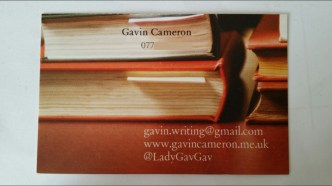
The card in question

It contains my phone number, e-mail address, Web address, and Twitter handle; the former is censored in the photograph as it’s a personal number. I chose not to include a, “job title,” such as writer, poet, blogger, &c, as I didn’t want to make people feel as though they could only contact me in connection with these skills. Instead, the general sense of what I do is conveyed by the books in the background.

I bought the cards from Vistaprint, who threw in a metal holder free of charge, although there are more expensive services such as Moo.com. Just a couple of weeks later, I did indeed need one to tell a fellow blogger about this page. I currently earn very little money from writing, but I felt like a professional as I handed it over.

The Update to The Update.

Alternate Hilarities

Over the last few entries, I’ve posted that Strange Musings Press would be printing my story Amending Diabolical Acronym Misuse, subject to raising enough money through their Kickstarter page.

I’m pleased to report that the $1,100 target has been reached, and the anthology will absolutely and definitely be going ahead.

The Kickstarter campaign is still open, and there are extra bonuses for reaching $2,200 and above.

An Update on @Strange_Musings, and Some Transatlantic Translations.

Alternate Hilarities

Around three weeks ago, I was pleased to report that I’ve had a third short story accepted for publication. Strange Musings Press of New York will be printing Amending Diabolical Acronym Misuse, subject to raising enough funds through their Kickstarter page.

There’s still around a week left to raise the $1,100 required for it to go ahead. You can donate at several different levels from $1 to $150, each of which buys you into the project with increasing levels of reward, including electronic and/or paper copies, autographs, and your name in the Contributors’ section.

My story is called Amending Diabolical Acronym Misuse, and it’s about a man who wants to rid the world of badly-constructed acronyms. Although I’m Scottish, my dialect is British English so that’s how most of my stories are written, including this one.

If I’m sending to an American publisher, I often change the grammar and spelling to suit; at least, I have a decent stab at it. In one case, I even wrote the whole story in US English because the character was so strong in my head: a cross between Jason Gideon from Criminal Minds, and Adrian Monk. In Amending…, I took the decision to keep it in my natural dialect as there are a number of references to British places and companies, and I felt it would look odd if I, “translated” it.

A couple of weeks ago, I began reading The Traveller by John Twelve Hawks. The narrative is written with a curious mix of dialects. For instance, the title is spelt with two Ls and there’s a reference to a pub, but the colour gray and an SUV appear in other parts. The SUV would be known as a 4-by-4 in Britain. The story is set in several countries so I expect it’s difficult to settle on one standard spelling, yet it’s not a distraction here, and I’m thoroughly enjoying the story.

Conversely, my mentor Zöe Venditozzi released her debut novel Anywhere’s Better Than Here in 2012. When a US edition hit the shelves, she told me there were no spelling changes made. When you buy a copy, watch out for the character whose initials match mine.

So is it important to adapt your dialect depending on which side of the Atlantic you’ll be published? I expect most Internet users will be accustomed to reading both, but at the same time, people will still write in whichever they feel comes most naturally.

Perhaps one day in the future, the two will merge and we’ll have one way of spelling each word, one form of grammar for all. It would be more practical, but probably rather dull.