Going Off-Script

From 2002 to 2005, I studied for a BSc Music Technology degree at what is now called the University of the West of Scotland. The course taught us how commercial music is recorded, along with related skills such as composition, Web design, and making promotional videos.

Last week, I had cause to rake out a short film I’d made as part of the degree. It dates from around 2003 or 2004, but nobody had thought to write the date on the box.

Although DVD was fast becoming the dominant format, we had to submit the piece on VHS. I wish I’d at least kept a disc-based copy. I can’t say for sure whether the tape has been partially wiped or whether my video recorder is at fault, but the picture is almost unwatchable.

The sound, by contrast, is more or less intact. Hearing this for the first time in years unexpectedly reminded me of the scriptwriting process. I distinctly remember sitting in the student union discussing ideas before someone flippantly said, ‘Why don’t we make it about four students who fall out making a film?’ That flippant suggestion became the backbone of our script.

At this point, I wasn’t routinely writing any fiction, but I recall enjoying the process. This should have been a foreshadowing of where my interest would ultimately lie in the future.

Some of the lines were a little clunky, aside from gems like He’s about as much use as a mic stand, yet the structure was spot-on. Each character blamed one or more of the others for the failure of the film, whether it was the director having a go at the others for not understanding his vision, the technician who kept forgetting to charge up the camera batteries, or an unseen ex-girlfriend who split up with one character to date another.

It really does leave the viewer guessing, and I’d be pleased if I managed to pull off that complexity in a current piece. What’s more, the action takes place in a span of well under five minutes. I vaguely recall our brevity cost us some marks, but it was a self-contained story.

I haven’t yet returned the tape to the cupboard, so my plan is to find someone with another video recorder to test whether my equipment or the tape is at fault. At a minimum, it would be prudent to make a safety copy of at least the audio portion and figure out whether the drama could be adapted into a longer piece.
Not Lost, But Hard to Find

A couple of weeks ago, I made an entry about keeping an archive of pieces and how I found one particular poem that wasn’t stored in OneDrive with the rest of them. A few days after writing that entry, my backup system was put to the test.

On Sunday 2 June, the town of Leven was finally reconnected by railway after 55 years. Along with a couple of pals, I was one of the first passengers on the revived service, and we decided to head for a coffee. One minute, I was using my phone to tell people about my day; the next, it went completely black and wouldn’t react to any button pushes nor attempts to charge it.

Fortunately, there were a lot of services I could still access, such as the aforementioned archive. However, some relied on two-factor authentication, which requires using a phone as verification, like I used to secure WordPress.

The short version of the story is that my old phone was beyond recovery, but I now have a new one, and I have full access to all my services again.

In all that excitement, I didn’t have much of a chance to think of a writing-related entry. But I do wish to reiterate the advice of backing up all your work, both locally and online, so you don’t fall victim to an unexpected loss.

Lost and Perhaps Found

When I started writing around 2010, I made a point of keeping an archive of my work.

Every story and poem has its own directory, and dated revisions are kept within each one. Plain text doesn’t take up much storage space, so there’s plenty of scope to keep doing this into the future.

About two or three years ago, I was looking for a particular poem I’d written; I knew its title, many of the words, and roughly when it was written. So when the archive showed no results after several attempts, I realised my system had broken down somewhere and wrote it off as a loss. I could have reconstructed it with a little effort, but I never did.

There’s a common misconception about Snapchat that it deletes every picture you send. In fact, you can set it to keep a copy of every picture you add to the My Story feature.

Fortunately, I’d not only set this up, but I’d taken a clear picture of the original handwritten verse four years earlier – and I’m not in the habit of doing that. In February 2022, while looking for something else, I found that picture. The original verse had almost certainly been shredded along with other papers. I swiftly copied the words into a Word document and placed it in the archive.

Luckily this was only a 16-line poem. Other writers have suffered far greater losses. Jilly Cooper, for instance, lost the original manuscript of Riders on a London bus and it took her years to rewrite.

Not all losses are accidental. A significant quantity of drama has been wiped from BBC and ITV archives, including episodes of popular shows like Doctor Who and Dad’s Army. Before the advent of home video, there was little incentive to keep old programmes except to resell them overseas.

In some cases, collectors and members of the public have discovered recordings; some in great condition, others needing significant restoration. The BFI used to hold an annual screening called Missing Believed Wiped, featuring a selection of recovered footage, but I’m unable to find any recent events.

It remains a mystery whether I typed out the poem in 2018 then lost it, or whether it was never typed up in the first place. I’ve nonetheless started backing up my archive locally and online so no further mishaps should happen.

Building an Archive

Just before I settled down to write this, I spotted I’ve published exactly 400 blog entries since beginning in 2013.

On the one hand, that’s not surprising as it equates to approximately one post per week, yet it’s still a powerful demonstration of how regular and consistent writing can help to build a useful archive.

Let’s take my own work as an example. In the folders containing my poetry and short stories, I have more than 320 distinct pieces. I also like to keep revisions, so many of them house multiple copies showing the evolution of each piece: some complete and others abandoned.

If you’re a new writer, I strongly advise you to keep all your work, even if you don’t like it at the time. If there’s one lesson I’ve learnt from a decade of writing, it’s that some pieces need to be left in a drawer for a while and looked at again with fresh eyes.

Last year, I tasted this from the other side when I started taking art lessons last year. One recurring problem – especially at the beginning – was when I knew something was wrong with my drawing, but I didn’t know how to fix it. Perhaps one day I’ll be able to go back and see what’s wrong.

I’ve also had a hand in creating an archive of other people’s work.

Since March of last year, my open-mike night Hotchpotch has maintained a YouTube account in lieu of live events. I was initially disappointed that we receive perhaps five submissions per month compared to the 25 or so who would perform in person. But those small contributions each month have steadily built up to a library of 73 videos at last count.

When people now ask what our event is like, we can now direct them towards that page. For that reason, I’m keen to maintain it even once we can meet up again.

A Short Piece About Short Pieces

Ten years ago next month, I joined my first writing class with the author Zoe Venditozzi.

In each lesson, she would give us a prompt, which might comprise a sentence, a few words or even a photograph. We’d then have five or ten minutes to write a paragraph or a passage inspired by it, sometimes with extra restrictions like using a particular viewpoint or writing a certain number of words. Many actors take improv classes to hone their skills, and this was the writers’ equivalent.

Since then, I’ve built up a considerable volume of short pieces, many of which have been revised over the years, but nothing that forms a larger cohesive work on a single theme.

Some time ago, I wanted to change this, and add some longer-form pieces to my archives. These turned into stage plays: one is ready to go, the other needs to be redrafted. I also have in mind a radio play that is mapped out but needs to be written.

Now, I’m ready to go back and write shorter pieces. I’m in a poetry monthly group that keeps me focussed on producing work for the next meeting, and I wrote another original poem for the purposes of performing to a virtual audience yesterday.

Along with this, I also need to return to the habit of responding to publishers’ requests for pieces. I used to aim to send an average of one a week, and that still seems like a manageable target.

The Long and The Short of It

This week, I’ve been looking through some of my old short stories and flash fiction.

I started exclusively prose in 2010 before moving gradually to poetry. As a result, I have an archive of pieces that are complete but are unedited.

Looking through them, I can now immediately spot where I’ve told the reader what was happening instead of showing it through action or dialogue, and any clumsy phrases that I’d now strike down. Here’s an example:

“How much have you had to drink?” she laughed, as he picked himself up. They had enjoyed only a small wine before heading out.

Today, I would probably have shown the character picking himself up in a different way, and placed the information about the small wine into dialogue.

However, I did spot a piece of flash fiction that I still wouldn’t edit very much. This is You’re Going Down.


The referee in the first boat shouted to the other two.

“The race is from here to that island. I want a fair competition, no funny business, no putting each other off. Understand?” They agreed, not quite in unison. “All right. On your marks, get set.” He blew a loud horn.

As soon as they picked up their oars, the man on the left began to regret his drunken bragging the previous week. Still, he felt sure he would win. The small hole he had drilled in his opponent’s boat would take care of that.

Some Salvaged Scribbles.

A few days after my handwritten entry last week, I was looking for something in my bottom drawer, when I discovered an old notepad. It’s nothing special; it’s a Tesco Value spiral-bound A4 pad with a slightly ripped cover.

I’ve used a quarter of its 80 pages, and most of it is taken up with attempts to expand on a fragment of poetry that I tried to expand into a song, although there is also a brief novel idea, pages of free writing, and a poem on the topic of my own handwriting.

Of these, I only consider the poem be a decent piece of work. As for the rest, I know what I was trying to express, but I didn’t have the techniques at my disposal to do it properly. But looking at the content, I’ve calculated that I last wrote in this notebook in September 2009, more than a year before I began writing. I’m therefore not surprised about the quality.

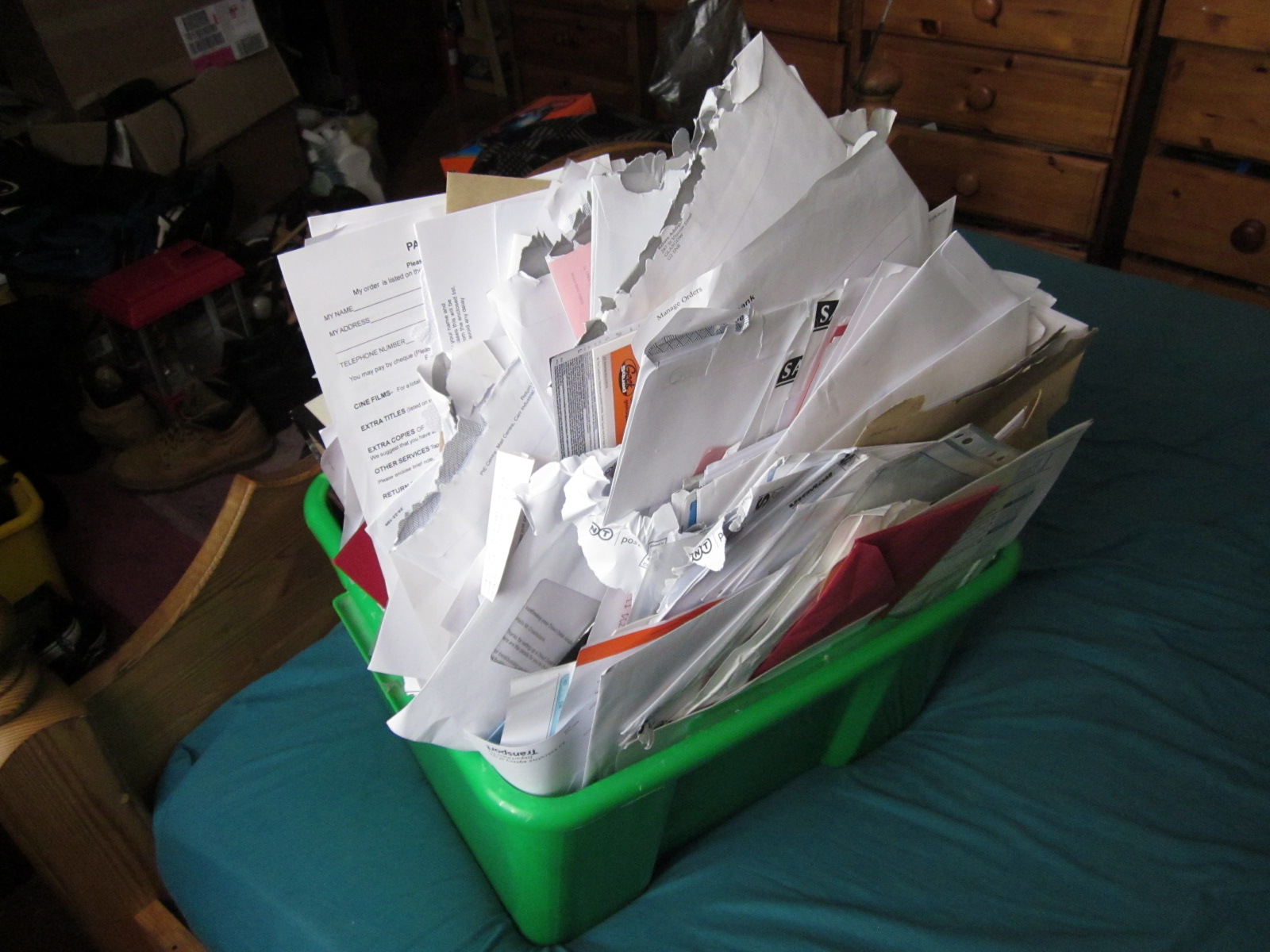
My filing system
My filing system

Yesterday, I discovered other half-completed notebooks, but none as full or detailed as this one. I’ve noticed I rarely reached the last page, although I’m more than likely to complete my current ones. Also, there are hardly any drawings or even doodles, just text.

But the one notebook I would like to look at again is missing, believed lost. At my very first National Novel Writing Month meeting, my laptop battery died. I had to rush out and buy a notepad and mechanical pencil so I could continue my story. I had it about a year before its disappearance, and it contains drafts of my first novel, and some of my earliest stories. I don’t think I’ve lost anything, but I might have.

I know I’m not the only writer with notepads dotted about, and I’d like to hear about yours. Do you have any hidden in a drawer somewhere? What did you discover when you pulled them out again? Have you misplaced an important story you wish you could recover?