Derailed

I mentioned last week I would be spending a lot of time on trains, thus giving me time to read.

File:Fraud.jpg
By Nick Youngson – http://www.nyphotographic.com/ Alpha Stock Images – http://alphastockimages.com/ – CC BY-SA 3.0 (https://creativecommons.org/licenses/by-sa/3.0) – via Wikimedia Commons

When travelling by rail, it’s always prudent to expect delays. In this case, another train broke down near Penrith station and the passengers on mine were allowed onto the platform while the obstruction was cleared. This gave me time to finish one of my books, but I also needed to work on a presentation.

Every month, Creative Dundee holds an event called Make / Share. This is a night where people such as designers, artists, computer programmers, or anyone who creates something, are invited to speak about their work. The next event is on Tuesday 10 July and I’ve been asked to speak on the theme of impostor syndrome.

I’m not a lifelong fiction writer and certainly not a lifelong poet, and I’ve always been upfront about this. Even so, it’s difficult not to feel an outsider when you’re among people who’ve been creating fictional universes since they were in primary school. I’ll be telling the audience about five times I felt I didn’t belong on the writing scene.

I also mentioned this a couple of weeks ago, when I appeared on  The Beans Podcast. This is a weekly show compèred by my friends Valerie Mullen, Erin Farley and Sam Gonçalves. Like Make / Share, which Sam hosts, the podcast also invites creative people to give their story; indeed, it’s also worth listening to their previous episode about learning to like poetry.

But until the real writers figure out I’m one massive fraud, I’ll keep doing what I’m doing.

Ring-Fenced Reading

By the time you read this entry, I’ll be on a train between Edinburgh and Preston. It’s a long journey, so I’m going to use the time to read two borrowed books.

"Derek Robertson [CC BY-SA 2.0 (https://creativecommons.org/licenses/by-sa/2.0)], via Wikimedia Commons
Derek Robertson (CC BY-SA 2.0 (https://creativecommons.org/licenses/by-sa/2.0)), via Wikimedia Commons
The first is ‘Hong Kong’ Full Circle 1939-45 by Alexander Kennedy. The author was a lieutenant commander who had 500 copies privately published to tell the story of his service. Although it’s not something I would pick myself, I’ve flipped through some of the pages, and it promises to be an engaging story.

The second is The Lighthouse Boy by Craig Mair, about the construction of the Bell Rock Lighthouse off the coast of Arbroath. I originally intended to read the book in the town, ideally on the cliffs overlooking the water, but my plan didn’t work out. Although the overall book is a work of fiction, its characters are based on real people and the plot is based on actual events.

There used to be a Silent Reading Party nearby, modelled upon an event in New York, where readers would sit together and read silently for an hour; attendees were allowed to converse beforehand and afterward. Unfortunately, the organiser hasn’t run the parties for some months now and I have too many commitments to revive it.

I enjoyed attending because the time was specifically set aside for reading. If I’d decided to do it myself at home or even in a cafe, I would probably have become distracted, but the presence of the other attendees kept me what your organiser has focused. So I hope I’m able to employ some self-discipline on this train journey.

Keeping a Cabinet

When you lead a group, it’s tempting to give orders and expect others to fall in line. There are situations where this is appropriate, particularly in the military.

But in a writing group, a dictatorial attitude only stirs resentments and makes people want to leave. On the other hand, discussing the matter with everyone in the group often leads to a jumble of individual opinions with no consensus. So what is a good way to make a decision on behalf of a group?

File:The Cabinet Office MOD 45155536.jpg
Photo: Sergeant Tom Robinson RLC/MOD [OGL (http://www.nationalarchives.gov.uk/doc/open-government-licence/version/1/)%5D, via Wikimedia Commons
In many democracies, only a small percentage of politicians comprise the Cabinet and make most of the decisions. It’s not a perfect system, but it does reduce the number of opinions to a manageable figure, and that’s why I like keeping a group of representatives for advice.

For example, I lead the Dundee & Angus region of National Novel Writing Month. This a challenge to write a 50,000-word novel in November, and we also meet up unofficially all year round. There are 520 members who have our region as their home region, but only 1% to 2% come regularly to meetings.

Most day-to-day issues can be solved by speaking to my co-lead, yet the input of the members is particularly valuable in the months leading up to the November challenge.

In those 30 days, we’re required to arrange a launch party, a ‘Thank Goodness It’s Over’ party, and to encourage members to donate money and/or buy merchandise. On our own initiative, we arrange two meetings per week instead of the usual one, we make sure we’re contactable online and by phone, and we tell members how to protect their physical and mental health during the challenge. And on top of that, we’re all trying to reach the 50,000-word goal.

Thanks to this level of involvement with the co-lead and the active members, it’s been a joy to manage this region each year.


When to Stop; When to Start

In April, I began to redraft a novel that I originally wrote in 2011. In the intervening years, I’ve learnt a lot more about the principles of structure and how to raise the stakes in a narrative, so I was pleased with the way the redraft was turning out.

By Tom Murphy VII [ GFDL (http://www.gnu.org/copyleft/fdl.html), CC-BY-SA-3.0 (http://creativecommons.org/licenses/by-sa/3.0/) or CC BY-SA 2.0 (https://creativecommons.org/licenses/by-sa/2.0)], from Wikimedia Commons
By Tom Murphy VII [GFDL (http://www.gnu.org/copyleft/fdl.html), CC-BY-SA-3.0 (http://creativecommons.org/licenses/by-sa/3.0/) or CC BY-SA 2.0 (https://creativecommons.org/licenses/by-sa/2.0/) ] from Wikimedia Commons
However, there came a point where I’d pushed the main character through as many hoops as I could conceive until he’d achieved his goal. At that point, there wasn’t much to keep him from doing anything he wanted without resistance, so the narrative began to stall. At around the same time, I began to pull together a spoken-word show. I therefore made the decision to leave aside the novel, so for the last month, I’ve been concentrating on the show.

When I stop thinking about a work in progress, I find that’s the time to leave it. The novel is currently handwritten, so I’ll start typing that up once I’m finished with the show, then see where we can take the main character from there.

Other highlights this week include performing at Inky Fingers in Edinburgh on Tuesday and listening to some cracking poets, including the featured Rachel Plummer.

And on Thursday, I heard Caroline Bird performing from In These Days of Prohibition. This is the second time I’ve heard her on stage, and it was again a wonderfully absurdist experience.

Gibson and Goodfellow

On Wednesday, I saw one of my idols at The Mash House in Edinburgh. Andrea Gibson is a non-binary poet who uses the singular ‘they’ pronoun. This was the very city where I’d been introduced to their work.

It seemed to be the convention that the audience sat on the floor, so I was battling with needles and pins for much of the evening, not to mention a wet patch where someone had accidentally kicked over my wine.

But in spite of the setbacks, the gig itself was amazing. I enjoyed Gibson’s often dense wordplay and imagery, which engaged and touched us in equal measure. Many of the poems were accompanied by recorded music.

Just about everyone in the audience queued up to have merchandise signed after the gig. I didn’t, but I wanted to tell them how much their work had helped me write mine. From nowhere, I found myself ready to cry as I spoke. They seemed to be genuinely appreciative of the thought.

The support act was Suky Goodfellow. I’d heard of her before but this was the first time I’d encountered her poetry. She commanded the stage as she spoke about wealth creators and why swear words shouldn’t be rude.

If I have the opportunity to see Gibson and/or Goodfellow again, I shall definitely take it.

Passing the Microphone

I feel as though I’m giving you a cop-out entry this week because it exists only to link to other posts.

This is partly because I haven’t had much time; I’ve spent a lot of it on a new long-form piece. And it’s partly because another poet has put together some excellent advice that I’d like to share.

A microphone
A microphone. It seemed like the best picture to illustrate this entry. (Photo credit: Wikipedia)

A couple of weeks ago, Andrew Blair asked his friends what advice they wish they’d known before taking part in their first open-mike night. The advice he received – including mine – appear in his entry So…you want to do an open mic night.

Additionally, this seems a prime opportunity to dust off my own advice for speaking in front of an audience from earlier this year.

News Round-Up

My normal method of writing blogs is to pick one subject and write a few paragraphs about it. However, nothing major has happened over the last week so no single topic could be extended to a full entry. Instead, here’s a round-up of what’s been occurring.


At the end of last month, I spoke about the open-mike night I run for writers and that we’d found a new venue. I’m pleased to report we had a marvellous time, with a record 17 people reading stories and poetry, and many more eager ears in the audience. It would be great to see this sustained over the coming months.


Last week, I mentioned I was redrafting a one-woman play I originally wrote for my Masters dissertation. Since then, I’ve boosted the word count to 11,000 and it now lasts for an hour, even delivered at a reasonably fast pace. This means it can be stripped back if necessary.

In the same entry, I mentioned I was redrafting a short story. I haven’t had a chance to send this away yet, but I will soon. I have an annual target to submit 53 pieces to publishers – an average of one a week, plus one for good measure – and I’m nowhere near on par.


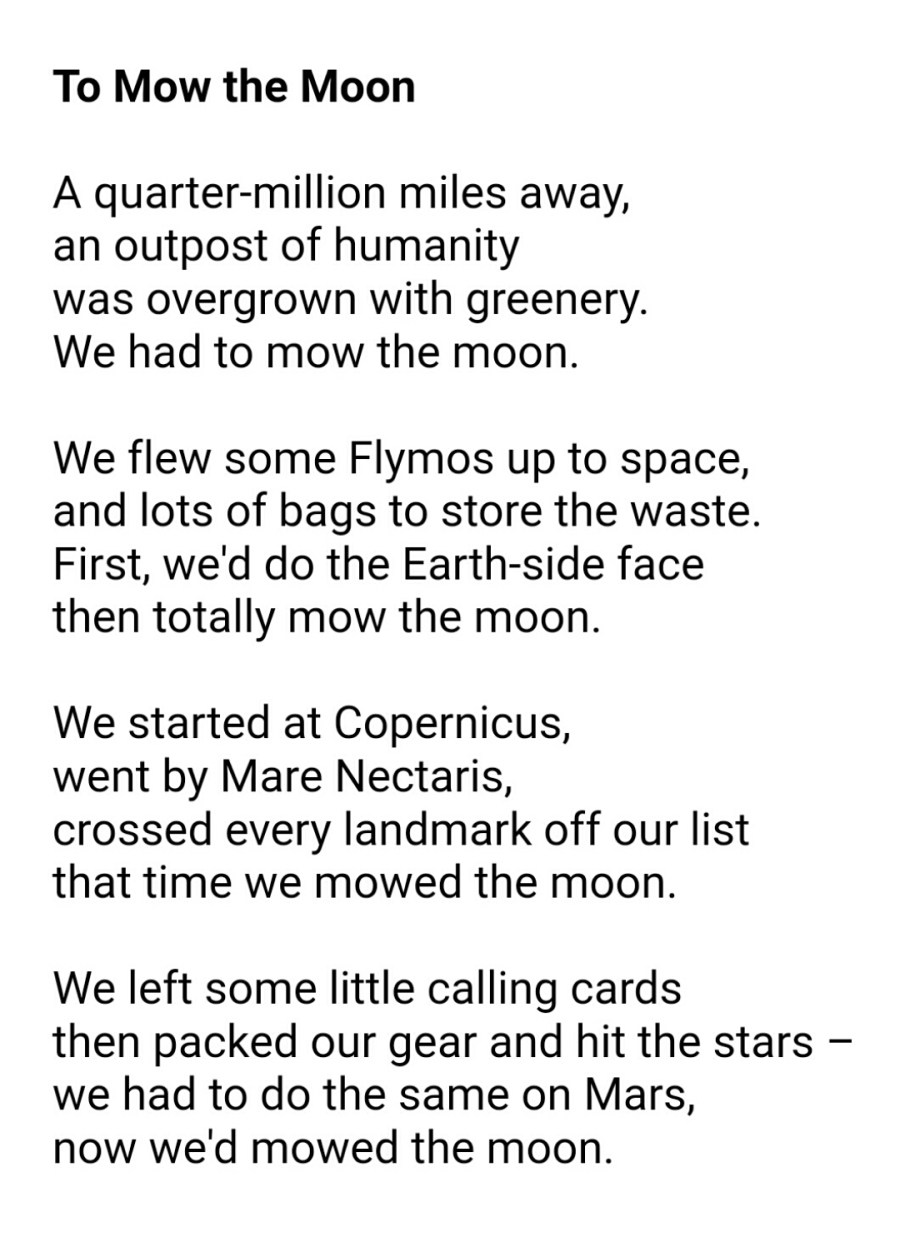
Yesterday, a friend reposted a short piece called Humans Are Adorable, written from the point of view of an alien looking at the human race. Number 12 is about reaching the moon, described as humanity having ‘made it to the end of their yard’. A mutual friend then quipped, ‘Thank [goodness] I don’t have to mow it.’ And this image stayed with me, so I simply had to make it into a poem:

In With the Old

Over the last week, I’ve been revising two pieces of prose.

The first piece was a 1500-word short story about a female soldier returning home after conscription into an unnamed war. I first wrote this in 2013, but I’ve periodically returned to it, most recently to submit it to a publisher who might appreciate the sentiment.

File:Colouring pencils.jpg

The second is an overhaul of the piece I wrote for my Masters dissertation in 2016. I subsequently turned it into a one-woman play, but the last revision didn’t reach the 60-minute mark. Over the weekend, I’ve been lengthening the script by unpacking and exploring some of the plot points that the original doesn’t address. In two weeks’ time, I have the opportunity to have an extract read by an actor at a new playwriting evening.

When I read back over those two pieces, there were no major problems, but I could find a number of minor ones. Perhaps I’d used a clause too many in the sentence; perhaps a vital piece of information could be shown rather than told.

Whatever the problem, I’ve enjoyed fixing them. I feel the two pieces are better overall now. I keep all my drafts, so I was able to look back at previous versions and I can see that my writing has improved over the years. It’s entirely possible that I’ll revisit these pieces in the future with more experience and be able to improve them in ways I can’t imagine right now.

And Yet the Pencil Moves

Four weeks ago, I mentioned that I’d been rewriting a novel I started in 2011. I’m pleased to report that I’ve had enough momentum to keep going until now.

I’m following a chapter-by-chapter breakdown with the key points and word counts. In my experience, planning is never a waste of time, even if the plan is eventually amended or abandoned. Indeed, I don’t know of any major novelist who doesn’t plan to some degree.

English: Signature of Charles Scrivener
English: Signature of Charles Scrivener (Photo credit: Wikipedia)

In this case, the plot has been amended substantially, but I believe it’s for the better. In the first few drafts, the main character achieved his goals too easily, whereas now there are a number of obstacles in his way. My favourite tight corner so far is where he catches a taxi to pick up millions of pounds, but doesn’t have enough immediate cash to pay the fare.

Like many of my drafts, this one is written in pencil into a notebook; even my plan is written on the back of scrap paper. I find this method more satisfying than typing it. When it is finally entered into Scrivener, I’ll edit it, so that becomes the next draft.

Writing a novel is a time-consuming process, and even more so are the rewrites to produce a tighter story, but it can be a rewarding endeavour.

The Local Circuit

Last week, I talked about an open-mike night that I run in Dundee. However, the majority of the events I attend happen in Glasgow or Edinburgh. These cities are not prohibitively far away; I can reach either one by bus or train.

The problem is that I have an office job and I’m generally required to work until 5pm. I’m often obliged to take the train to arrive on time, even though bus travel is almost always cheaper. Coming back on the same night poses other challenges: do I book a cheap late-night bus where I need to hang around after the event finishes, or do I spend more on a train ticket I can use at any time?

Scottish Poetry Library, Crichton's Close, Can...
Scottish Poetry Library, Crichton’s Close, Canongate, Edinburgh Designed by Malcolm Fraser Architects, shortlisted for Channel 4’s Building of the Year 2000 (Photo credit: Wikipedia)

Many poets do make a point of stopping in Dundee, but it would be great to have more of a home-grown scene. There’s a well-established poetry circuit between Glasgow and Edinburgh where acts from one city will regularly perform in the other, and so it would be great to have Dundee contributing to that route as well as being an equal player.

Among other initiatives, a couple of folks I know want to host a cabaret night, and a third is proposing a regular playwriting evening, so I think there’s definitely an appetite for doing something right here. I don’t know much about the scene in other major Scottish cities, but the potential is enormous.

Regardless of the logistics, it’s often a rewarding experience to be at spoken-word events.

A couple of weeks ago, I saw the Jenny Lindsay show This Script & Other Drafts  in Glasgow; on Friday just gone, I was back in the city for a trans and non-binary event. On both occasions, I had an excellent time and I caught up with people I haven’t seen for a while. Leyla Josephine’s Hopeless is on the cards for Friday coming.