I’ve had little time to put together a full entry, but there is something I want to show you.
A few weeks ago, I attended writing workshops run by the poet Imogen Stirling, who took the theme of the lockdown as inspiration for her prompts. I’m pleased to report that the amalgamation of the work done by the class has been featured in The Scotsman Sessions.
It was a pleasure taking part in these classes because that’s exactly how I started writing a decade ago: here’s a prompt, and you’ve got five minutes to write something inspired by it.
Come to think of it, that’s much how this entry has been put together.
When I first began writing in 2010, my output was exclusively prose. I was in a writing prompt group where I would regulary produce short stories. Around the same time, I was producing longer works through National Novel Writing Month, normally known as NaNoWriMo.
My step into poetry happened around three years later. It coincided with being single for six months after a long-term relationship, but I can’t say how much that influenced me. Since then, I’ve crafted my poetry more and more to the point where I almost exclusively write verse.
Recently, however, that has started to reverse, perhaps because my poetry group is taking a one-month break. I’ve drafted one piece that will probably end up being no longer than 150 words, and I’m planning another with five characters who will likely dictate the length of the story before I know it myself.
NaNoWriMo is a contest to write 50,000 words in November. It’s not widely known outside this circle that there is a less formal contest at other times of the year known as Camp. April saw the last one, and we’re currently in the July edition. In these months, you pick your own word count and type of long-form piece.
However, I’m not writing these stories as part of Camp as I don’t intend them to be terribly long. What I’ll be doing instead is keeping aside my existing longer pieces and working on them during November.
What I have to do now is find a way to keep up my prose momentum from now until then. That said, the excitement in the group tends to swell around November, and that helps a lot.
I haven’t had time to write a proper blog entry this week. Instead, have a look back at my entries from this time in years gone by and I’ll write something for next week.
It came to my attention this week that Kirkton Community Centre in Dundee is on the market and there is a petition to stop the sale. The building also houses the local library. I haven’t been in for years, but only because it’s the wrong side of town for me.
My grandad lived around the corner and he would take me there every week. This was the first half of the 1990s, so I would have been aged between about seven and 12. As such, this was also before the Internet, so there were only books, newspapers and a small selection of video tapes.
I did read the occasional novel, especially those by Roald Dahl and Enid Blyton, but I don’t recall borrowing any from Kirkton library.
Instead, I always headed for the non-fiction section, where I’d borrow books about any and all subjects: building models from cardboard, how the weather behaves, running a shop, the ancient Egyptian way of life, &c. It never occurred to me to look at the catalogue system. My literary kicks came from simply rummaging around the shelves.
I could even find enjoyment in pure reference books. My grandad owned a thick Chambers dictionary from the 1970s that also contained a wealth of other data: the etymology of given names, ready reckoners for unit conversion, a guide to musical terms, &c. I still posess a copy, although mine is dated 1990. Even the BT Phonebook occupied much of my attention, with its pages of crisis helplines, or instructions about how to call a ship at sea.
All of which reminds me it’s been the longest time since I’ve visited my nearest library, just five minutes’ walk away. That’s only partly because of the lockdown; I’d used it only a handful of times even when it was open.
My favourite feature is the separate reading room, making it an ideal spot to work without the distractions of home. It would be entirely possible to set aside regular time to visit and to take out some books there once it’s open again. I could brush up on my knowledge of ancient Egypt.
In June 2018, the comedian Hannah Gadsby debuted her show Nanette, causing an immediate sensation. For a time, it was hard to turn left or right without someone quoting her words or reacting to what was said.
Exactly two years on, with all the hype gone, I listened to the show with the intention of making up my own mind about it. I knew some of the gags in advance, and I knew that during the gig, she announces she’s quitting comedy.
By the end, there was a lot to chew over. I liked the content: I thought the gags were observations were spot-on, and I that Gadsby’s reasoning for quitting was a sound one, but I found it difficult to formulate a comment about it. I felt utterly indifferent.
It took more than a week to figure out what was so jarring: it was the structure of the show.
There isn’t a standard structure to stand-up comedy. As a general rule, however, a show will begin with more tried-and-tested gags, and any unifying theme or narrative will be introduced. Between the halfway and three-quarters points, you’ll often find more experimental or riskier material, which will build up to a climax near the end, often referring back to earlier in the show.
In drama, the action will usually begin with a major event, slow down a little, perhaps include some comedic elements, then the plot will thicken and thicken until the climax near the end.
What Nanette did was to switch to a drama-style structure at around the three-quarters mark.
It’s not in question this was deliberate. At one point, Gadsby actually tells the audience, ‘That was your last joke,’ before finishing her monologue, so they don’t hear the payoff they were expecting. It takes confidence to carry this off, or a sense there’s nothing to lose
Despite working through my feelings about Gadsby’s routine, I still have that indifferent reaction. It’s not dramatic enough for drama, it’s not comedic enough for comedy.
As such, I’m also hitting a wall as I try to end this entry. At least if I’d hated every minute, I’d have some kind of conclusion to draw.
At the end of last week’s entry, I mentioned I’d watched the Fifty Shades of Grey screenplay from 2015. I enjoyed it marginally better than the book, but I would not seek out either the novel or the film again.
Some people find enjoyment in reading the same novel multiple times over several years, or watching the same film on a regular basis. I know of one colleague who revisits The Wasp Factory annually, and another who views Casablanca every month.
By contrast, I’m not normally inclined to go back to a book or a screenplay, even if I’ve enjoyed it. I can think of only two novels I’ve read more than once: Starter for Ten by David Nicholls, and the Chris Brookmyre book All Fun and Games until Somebody Loses an Eye. I’m not even certain I finished the second of these for a second time.
Yet on the film front, there are more contenders, and some belong to an elite called the Thrice-Over Movie Club. It’s also great to air the word ‘thrice’ from time to time.
Inductees of the Club include It’s a Wonderful Life (1946), Home Alone (1990), Romeo + Juliet (1996), Being John Malkovich (1999), The Matrix (1999), The Phantom Menace (1999) and most recently The Greatest Showman (2017).
So what is it about these particular films that make them stand up to repeated viewings? The short answer is that I have no idea, and I’ve redrafted this entry several times trying to find a common thread. Even the three released in the 1999 have little in common with each other:
With Home Alone and The Matrix, it’s because I’ve owned the video or DVD.
It’s a Wonderful Life has become a Christmas staple and is frequently shown around that time.
I’ve seen Being John Malkovich mainly by introducing it to others.
And I first saw The Phantom Menace at the cinema when I was about 15. It was with a girl I was trying to impress, and it turns out that’s the very much the wrong film to do it with.
A few weeks ago, I mentioned that I was reading the E L James novel Fifty Shades of Grey as part of an Instagram project. I’d heard it was badly-written, so I wanted to find out exactly what made it that way.
The series of posts gives much more detail, including spoilers and the ending. Yet the main points can be summed up with three pieces of advice:
—
Trim, cut and discard
There’s a principle in writing known as ‘show, don’t tell’. A more powerful image is created when a character is shown wrapping up against the wind rather than the author telling the reader it’s a cold day.
This book is written in first-person, so the story is told through the eyes of Anastasia Steel who falls in love with Christian Grey. As such, her inner thoughts are ever-present, and they frequently state or repeat what could be shown more fluently through other description.
A case in point is the contract that Grey presents to Anastasia. Rather than picking out the relevant parts in dialogue, the entire document is dumped in front of the reader.
Cutting and discarding also applies to characters who don’t forward the plot in any way. Grey, for instance, has a housekeeper called Mrs Jones who appears for a few scenes then is never mentioned again.
The only time it might be useful to focus on a minor character is where a murder mystery writer wants to throw the reader off the scent.
Characters’ wants
Once you’ve decided which characters to keep, they need to be put to work. The screenwriter Aaron Sorkin advises writers to think about not who a character is, but what they want.
I’ll give E L James some credit for Christian Grey: we know exactly what he wants, and it remains constant throughout the book.
Anastasia’s best friend Kate, by contrast, is highly consistent. One moment, she’s excitedly helping her friend pick out a dress for her dates with Grey; the next, she’s apparently suspicious of him. At one point, this change happens within the same page.
Jack up the drama with conflict
Storytelling convention dictates that the drama should start relatively small or minor and gradually ramp up as the narrative progresses. Most stories also have subplots, or even two or main plots intertwined.
In Fifty Shades of Grey, however, the stakes are never particularly high and no real subplots are established. Nothing untoward would happen if they split up at any point, except that Anastasia would mope for a while and Grey would find another woman.
Yet the potential for drama was tantalisingly there. She signed a non-disclosure agreement early in the book and stuck to its terms. So much could have happened if she’d broken that: her family might have found out, the authorities might have been involved, Grey’s business might have suffered, &c.
As an author, never be scared to ask ‘But what if this happened?’, then make your characters live it.
A small caveat: an experienced novelist might be able to subvert these rules by taking characters on an emotional journey rather than a dramatic one. However, this technique tends to be more suited to the short story form.
—
Having read the book, I decided to give the screenplay a watch as well.
What a relief not to have Anastasia’s inner monologue, with the action shown rather than explained. The dialogue is clipped back and the character of Kate is also made consistent.
That’s not to say the film is good, though. Remarkably, it sticks closely to the novel, but that also means a lack of subplots to keep us engaged.
Last week, I mentioned that I’m not a lifelong fiction writer nor poet, having started in 2010. However, I had kept a non-fiction blog for some years before this.
Although WordPress was around in 2003, the most popular blog host at the time was LiveJournal, known among its users as LJ. My first entry was on 19 December of that year, when I was studying at what is now the University of the West of Scotland, although my profile has – for some reason – always said my account was created on 15 March 2004.
I was reminded of my these days though my pal Katy Jones, who not only joined a year or two before me, but still uses it. She was interviewed for a podcast recently, in which she spoke about the appeal of LJ compared to other sites.
However, we’d actually become acquainted through a media forum, entirely separate from LJ, as we were active in different hospital radio stations around the same time. In fact, we’ve never met and I don’t think we’ve spoken by phone or video chat, yet Katy remains one of my most enduring online friendships. We might even be starting pen-pal correspondence soon.
So what of my old LJ account? It still exists, and it served as a good sandbox in which to practice for this WordPress blog, which began in 2013. At that time, the paid-for features of LJ matched the free features of WordPress, so it was an obvious choice to switch for me.
But there were also duds along the way, like this one that’s disjointed and uninteresting, asking a question about football and then rambling about Firefox and the bit-rates of MP3 files. Years later, we see a desperate attempt to keep the LJ page alive with tedious #MusicMonday entries.
So one thing I’ve learnt over the years is to look at my entries from outside of my own head. If a topic only makes sense to me, then there’s no point in making it public.
Judging by the reactions and the viewing statistics I receive from this WordPress page, I do manage to engage people. I can even look back at entries from six years ago and still be satisfied with them, other than spotting an occasional sentence that needs rephrasing.
I do hope I’ll be able to read this in May 2026 and feel the same way.
I periodically remind people that I’m not a lifelong fiction writer nor poet. I started in 2010, when I was around 27 years old.
As such, I’ve now gained an decade of intensive experience that I reckon brings me up to a similar level compared to those who have been writing for far longer.
That said, I don’t ever want to be that writer who feels they’re too good to learn something new. When I took part in Imogen Stirling’s classes recently, I knew I could manage the work, yet I was still pushed in new directions that I wouldn’t have walked by myself, such as kennings and univocal poetry.
In the same spirit, I’ve been taking art lessons from my pal Ana Hine over the last couple of months, who is offering weekly classes via Patreon. This is a major deal for me because I’ve always had a mental block with art: I wouldn’t do it because my drawing wasn’t of a high standard, yet it wasn’t of a high standard because I wouldn’t draw.
I had a problem with the way I was taught at school. The focus was on making a finished work rather than going through the process or making a rough draft first. Yet that same criticism also applied to my poetry teaching. I should note that I’m talking about the 1990s, so their methods might have improved since then.
I have once before attempted drawing lessons with another pal, Jen Robson. Last year, she ran an afternoon class called Scared of the Paper, and my picture is still on her website. That was a great experience, and I learnt techniques that I’ve carried over to Ana’s lessons, such as correcting mistakes by adding lines rather than erasing them, and listening to music as I work.
However, I didn’t ride the wave of enjoyment and instead let the mental block build up again. Now, with being asked to stay indoors, I decided to give art another shot.
With six of Ana’s lessons under my belt, I’ve only once burst into tears and I’ve only once thrown away my eraser in frustration, so that’s progress. I’m still clouded by The Dread before I start, and it’s something I need to fight through.
When it comes to poetry, I no longer care whether people see my half-done work as I know I can go back and improve it. With art, by contrast, I sometimes can’t properly capture a particular scene and I don’t know how to fix it, so I’ve shown only Ana and my partner thus far.
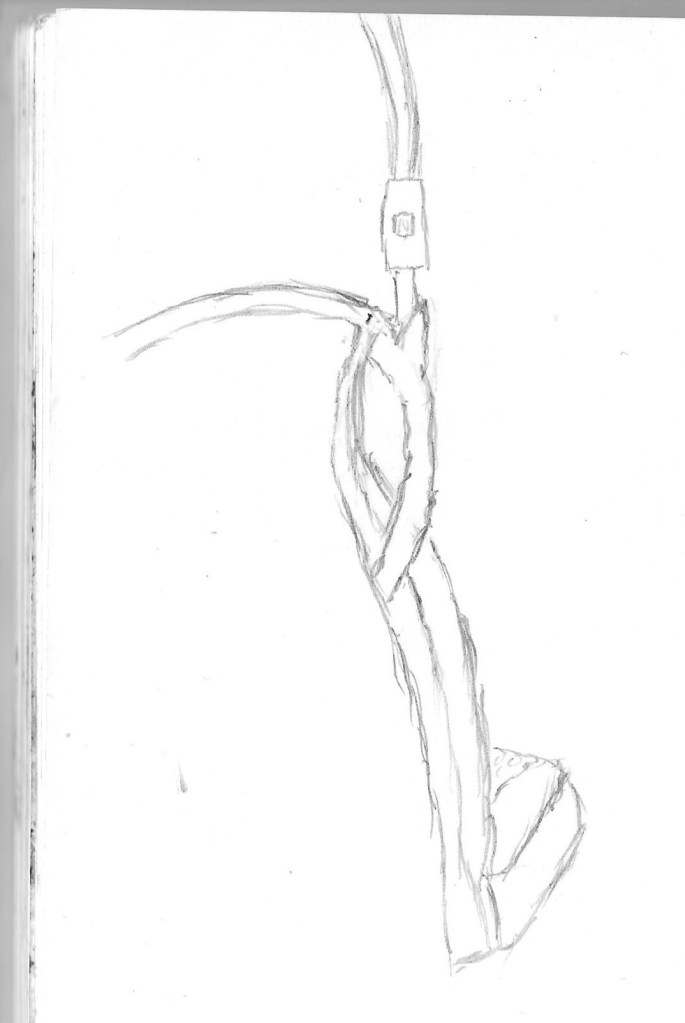
Indeed, there’s only one drawing I’m willing to pull out in public just now. This is a drawing of a bus seat done while on the bus:
Sketch of bus seat
It’s a fluke that everything looks roughly the same here as it did in real life, so I need to work on achieving a decent image by skill rather than luck.
Be advised that today’s deviation from writing is a one-off event, and that this page will not turn into an art blog. Meanwhile, as I’m shining the spotlight on pals, Eilidh Morris is a visual artist who doing the opposite of me by including more spoken word in their practice.
For the last three years, I’ve lived in a block of flats just out of town, and I’ve become rather well acquainted with my neighbours below me and beside me.
Just after the lockdown was announced on 23 March, I recieved notes through my letterbox from both households, offering assistance if necessary. I didn’t require any help, but it gave me an opportunity to write letters back to them.
Since then, I’ve also received notes from two other neighbours that I’d seen en passant but didn’t know by name. One of them apologised for dropping soil onto my balcony, while the other wanted to talk about a noise issue from another flat.
I keep a special notepad for letters, styled as ‘nu:elite‘. The pages are ringbound A5 sheets that tear off along perforations, leaving a smooth edge. It’s also a heavier weight of paper, which I favour, although I do have a lighter weight, styled simply as ‘nu‘. if I’m not trying to impress the other person.
While I had the notepad to hand, I penned one to a friend in Florida, enclosing some commemorative David Bowie stamps that I rediscovered while clearing up. Shortly after that, a pal in California wondered whether I could send her a pen I’d had custom-made for my open-mike Hotchpotch.
Then I had a birthday card returned undelivered from Dublin; this had been posted before the lockdown. I’d bought and printed my postage online rather than visit the Post Office, but I’d messed it up. Reading back the letter I’d originally enclosed with the card, it seems I’d been pushed for time and hadn’t written much. I therefore decided to send it back with a longer letter, as the first had gone out of date because of the movement restrictions. I was sure to learn how to properly affix self-printed postage.
The letter-writing bug must also have hit my Canadian pen-pal, whom I met through National Novel Writing Month. She apologised via a private Twitter message that she hadn’t managed to write back. I, of course, said not to worry about it.
I remember learning at school how to write letters by hand in the mid-1990s. Looking back, it seemed a little dated even then: word processing software was near-universal, though e-mail was not.
In sixth year, however, I learned how to touch-type and to format a document correctly. The teacher was near retirement age, but she’d moved with the times: there were no double-spaces after full-stops.
Despite my love of letter-writing, I’m also doing it sparingly, as we don’t yet know exactly how the current virus is transmitted. The aforementioned neighbours now have my phone number, so as to reduce physical contact as soon as possible.

 Gavin Cameron