I apologise for not updating over the last few weeks. I’ve been on my back with illness and been in no state to write anything. The good news is that I’ve had plenty of ideas for topics during this time, which I’ll explore over the coming weeks.
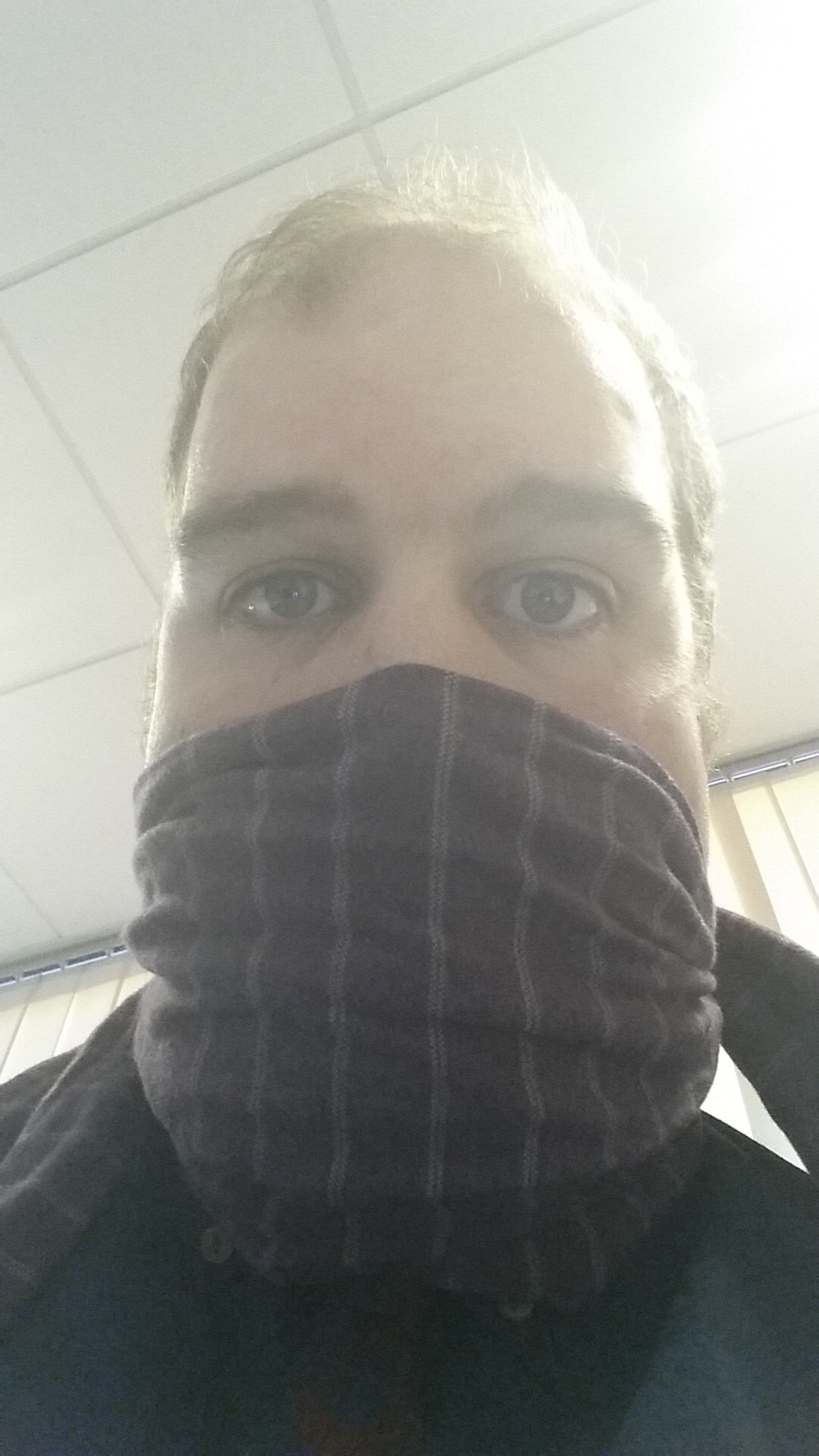
In the meantime, here’s a picture prompt of me in my scarf to inspire your own writing:
Sometimes after posting an entry, I decide or realise I should have added some more information. To that end, I have addenda for two recent posts.
After putting together last week’s top tips for public speaking, I think I should slot an extra one after Think about your introduction.
Avoid too much alcohol and/or a heavy meal before speaking. Both of these slow down the thought process. I recognise the meal often comes before the entertainment so try to leave sufficient time for it to digest. Being drunk at an organised event rarely makes a good impression on the audience, and is inexcusable if you’re paid to perform. I often have one coffee before I speak, which speeds up the thought process.
A few entries ago, I also discussed how to set or avoid setting a story in a particular era. Yesterday, I finished the Anthony Burgess classic A Clockwork Orange, written in 1962 and set in a near-future society relative to that year.
To avoid the problem of including dated slang, Burgess opts instead to invent his own jargon partly based on Russian. It’s easy to see why he chose that language, as the Cold War was at its height then. Many of the words have to be inferred through their context, as most editions deliberately omit a glossary.
He does, however, also use English words in an uncommon manner. A couple of these words have made their way into modern slang and these passages read as though they’ve been written recently. A case in point is like, with which the main character Alex peppers his speech not only as a comparison but when he’s struggling to remember the words he means.
There is another example, but I’m not sure whether it’s intentional, when he describes a stereo, “playing a very sick electronic guitar veshch,” the last word meaning thing or stuff. There is only one instance of it in this context, and it sounds as though it has the modern slang meaning that’s used alongside wicked and cool. For the rest of the book, Alex only uses the word sick when he’s feeling physically ill, and the Wikipedia appendix doesn’t list it.
Finally, yesterday marked the birthdays of three very famous writers. Robert Burns is the most obvious – I read To a Mouse to an audience in honour – but Virginia Woolf also burned candles on 25 January, and one of my major influences John Cooper Clarke turned 66.
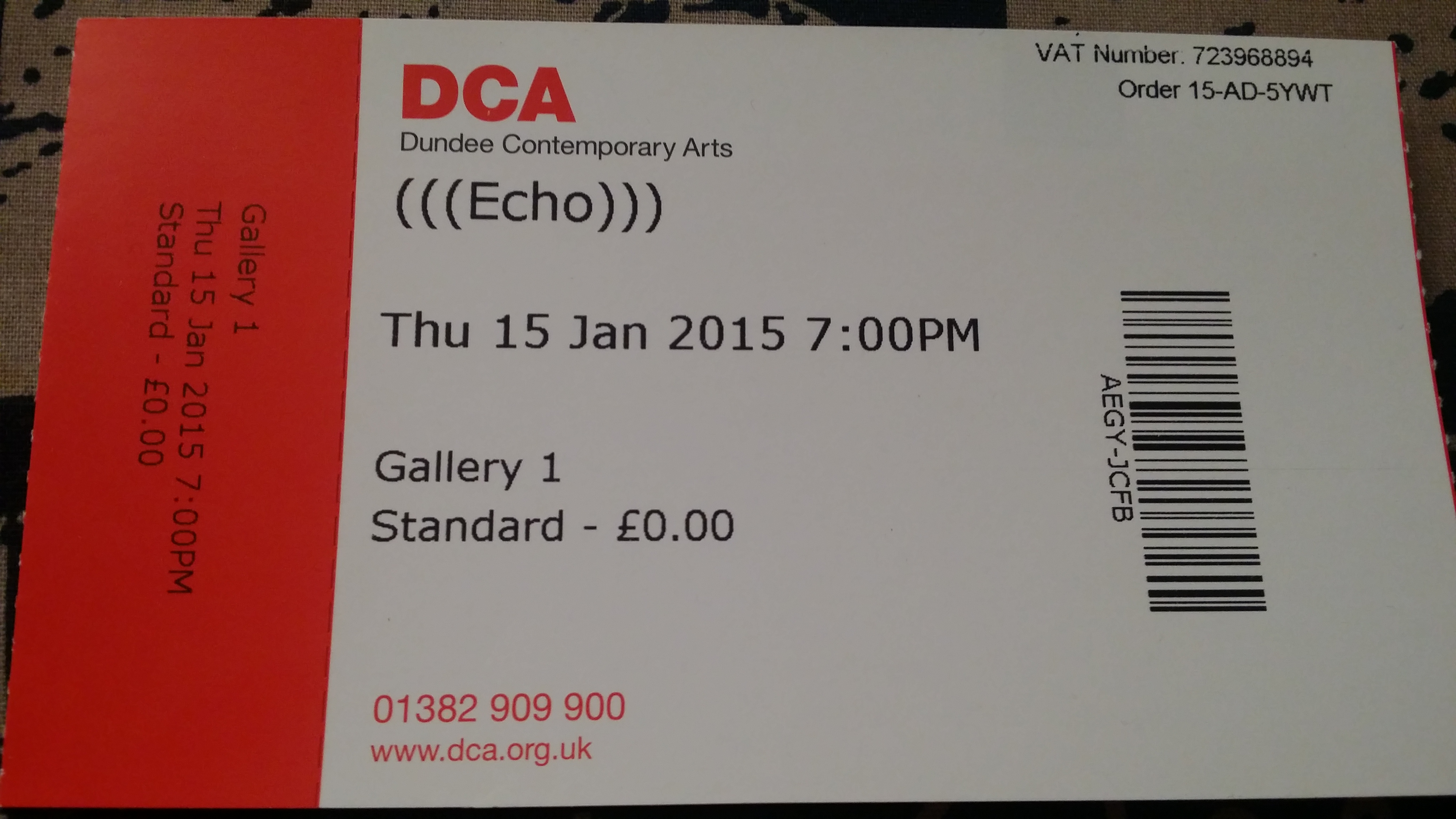
I’m pleased to report that I’ve been asked to respond to the Jim Campbell exhibition currently showing at Dundee Contemporary Arts. Until now, only other artists had been invited to do this, but there will also be poets and prose writers this time. The event takes place on Thursday the 15th, 7pm, Gallery 1; tickets are free of charge.
Something that fascinates me about the creative arts is the ability for writers and artists to respond to each other through their work, often very quickly. A recent example is how cartoonists around the world reacted to the Charlie Hebdo shootings. I’ve previously taken inspiration from the Michael Brown riots in November. In the BBC News report, there was a snippet of a police officer shouting, “Stop trying to turn over the vehicle immediately,” through a megaphone. I responded with a 340-word piece, but only to that fragment of speech, not to the rest of the events in Ferguson.
But it doesn’t always take tragedy to provoke a response. In 2000, Tony Blair lifted his arm at the end of a speech and inadvertently revealed a sweaty armpit. A day or two later, a deodorant company used the image in a press advert.
This isn’t the first time I’ve responded to an art exhibition, although I wasn’t asked to do so last time – I was simply inspired. A friend’s solo show opened on a Friday in summer 2013. By the time I caught the bus home, I was beginning to develop the idea. I spent the weekend typing it up and changing the names to ensure it was definitely fictionalised, and I sent it to her on the Monday.
On Thursday, it’ll be a different type of response. I’ve spent weeks working on it and had time to explore different options such as using props. All I need to do now is keep rehearsing so the response is as fluent as I can make it. Next week, I’ll be offering click save draft my best tips about public speaking.
I’ve been keeping a log of all the books I finished in 2014. Note that these were finished in the last year, and that the top one or two might have been started in 2013. Here’s that list in full:
Number
Author
Title
1
Ella Cheever Thayer
Wired Love
2
Nethergate Writers
If Stones Could Speak
3
John Twelve Hawks
TheTraveller
4
Nethergate Writers
Whodunwhat?
5
Rachel McCrum
The Glassblower Dances
6
Jenny Lindsay
The Eejit Pit
7
Luke Wright
Mondeo Man
8
Various authors
Alternate Hilarities
9
Adam Gopnik
Paris to The Moon
10
Virginia Woolf
Mrs Dalloway
11
Carson McCullers
Ballad of The Sad Café
12
Jayne Anne Philips
Quiet Dell
13
Raymond Carver
Elephant and Other Stories
14
Kohta Hirano
Hellsing
Not all of these were traditional novels. Numbers 5, 6 and 7 were poetry chapbooks, 9 was a collection of essays, while 14 is my first foray into reading graphic novels.
My favourite of these had to be number 1. It was published in 1880 and was ahead of its time both in terms of the technology used in the story and that the main characters are all women, with the men in supporting roles. My least favourite was number 10. This choice will rub up two of my lecturers the wrong way, but while the quality of her writing is high, her books never form much of a story. I had to wait until page 168 for anything major to happen.
Since I became a writer, I’ve tried to finish any book I’ve started even if I find it hard going. I’m currently trying to plough through the abstract concepts in Mein Kampf by Adolf Hitler, and I tackled Crawling Round South Oakwood by Stephen Slaughter a couple of years ago although it read like an unedited first draft. Before then, I would give up after a short time; I didn’t make it past the first few pages of Road to Mars by Eric Idle, nor A Brief History of Time by Stephen Hawking.
Mathematician Jordan Ellenberg has developed a formula based on the latter of these books called the Hawking Index to estimate how far people are reading before giving up. It uses the five passages in each book most highlighted by Kindle users. However, in the time since the publication of the formula, the title of least-read book is no longer Hawking’s masterpiece, but Capital in the Twenty-First Century by Thomas Piketty. You can read the full list here.
A few weeks ago, I was listening to Sleeper’s 1996 track Sale of the Century, and the following lyrics jumped out at me:
Let’s take a photograph
We’ll burn all the negatives
These days, very few photographs are taken on film, but that’s how it would have been done at the time of the CD’s release nearly 19 years ago. As we fast approach New Year, it started me thinking about how the language we use can inadvertently place a piece of writing in a particular era.
For instance, I own a computing book published in the late 1970s or early 1980s in which the author writes, “When I was a young hacker…” But he’s not talking about accessing any systems illegally; the term hacker originally meant someone who was merely proficient at using computers.
I’ve just finished reading Quiet Dell by Jayne Anne Phillips. The story is part fiction, but based on a series of murders that happened in the 1930s. She uses newspaper sources from the period. One of these talks about the matrimonial bureau the killer used, and another mentions a colored porter working at a hotel. Although the actual date is mentioned at the beginning of each chapter, this sets the action in a social context. These days, of course, there are no matrimonial bureaux left while the latter term has become widely unacceptable.
It’s very difficult to know how language will change and it’s therefore difficult to adapt accordingly. You might write a story today about a character who watches a Netflix film on her tablet device, but within a decade, she might have it streamed directly into her head by BrainMoviez. Indeed, the word film itself is an anachronism, as it was part of the same technology mentioned in the Sleeper track.
One way around this potential obsolescence is to mention that a character is, for example, listening to music or driving a car without mentioning the source of the sound or the type of car. Yet that can deprive the reader of a sense of location. Even when a writer tries to create a sense of timelessness, there are often hallmarks that signal when the piece was written. Most readers will realise this and take it into account.
I’m now going to back up this entry to a floppy disc, dial into the Web, and post it.
Part of me thinks a real writer should sell their television set and denounce anything audio-visual. Yet another part thinks that screenplays are a great way to learn and improve our writing techniques, and I’ve seen many this past week.
The first on my list was Christmas classic It’s a Wonderful Life. There is not a wasted word or action over the whole two hours, and the number of back references is staggering. From the bell at the very beginning to, “I wish I had a million dollars,” to where Mr Welsh punches George Bailey, each one of these is a set-up to a later plot point. A tight script is the accepted Hollywood convention, but Quentin Tarantino is one of the few writers who allows his characters to speak about matters unrelated to the plot.
Dog DayAfternoon runs to a similar length but takes place almost exclusively in one location. Yet there are so many characters interacting that it lends the film a rapid pace and never feels as though the director is padding out the action. It’s also worth a look at the more recent Phone Booth.
2001: A Space Odyssey — Three of the Discovery One crew are in a state of hibernation, ostensibly to conserve resources for the voyage. (Photo credit: Wikipedia)
I went to a special limited-run screening of2001: A Space Odyssey on Saturday. I’m still trying to work out fully what happened at the end, but the journey there was a masterclass in show-don’t-tell. There must have been about 600 pages of stage directions and two of dialogue. It would do little justice to describe it on the page, so try watching even just ten minutes to gain a sense of Stanley Kubrick’s style.
Incidentally, it’s only one of two films I’ve ever seen where the cinema has provided an intermission. I don’t know why these fell out of favour, as it’s quite handy for nipping to the bathroom, and also for the house to make money from bar sales.
As well as the above-mentioned films, I also had an opportunity to see new short films made by 16- to 19-year-olds. The screening was at Dundee Contemporary Arts and made with the assistance of Duncan of Jordanstone College of Art and Design. Each one was inspired by an archive of experimental films from the 1970s to the 1990s, and the one that appealed to the individual the most was played before their piece. Almost all of them, old and new, explored ideas beyond the conventions of ordinary filmmaking, from a lonely girl in a room full of friends and balloons to two musicians swinging guitars by the neck while playing them.
I managed to chat with Scott Funai, the director, producer and star of Road to Nowhere. This short piece is abouta schoolboy who doodles on his exam paper, effectively ruining the chances of him finding a job, with the title repeated in voice-over by him and the other characters. He told me he takes the Mike Leigh approach to scripting, preferring improvisation over dictation. Scripts are supposed to be a bare outline and the director fills in the rest, but Leigh doesn’t even begin writing one until he’s confident the actors fully inhabit their characters.
Although the approaches from the above writers may be different from each other, the end result is the same in the sense that the approach works for that particular screenplay. And that principle can be applied to any type of writing, from a 50-word poem where each phrase must have significance to a novel written purely in stream of consciousness. The approach will have a great influence over the result.
Have you considered changing your approach? I said before that I tend to think about my pieces for a long time, then write them very quickly. But when I was about 15, I wrote a fragment of a song lyric. I revisited it over the years and tried to compose the rest of the song, but it wasn’t coming together. It was only when I was twice that age that I decided to treat it as a poem and it slowly came together into six verses. I now consider it a finished work but it was written over a much longer period than I would normally devote to a piece.
Albert Einstein is attributed with saying, “Insanity: doing the same thing over and over again and expecting different results.” As far as I know, he never wrote a screenplay, but he makes a good point.
When I talked about short-form writing last week, I failed to mention the My Two Sentences blog, where Edward Roads writes a complete story in that number of sentences. Most recently, it’s a timely argument around the Christmas dinner table.
Speaking of few words, it’s been another busy week and I haven’t had much time to think of an entry built around one theme, so let me give you a few.
On Friday, it was my office party. I always think it’s a good idea for a writer to have a ‘day job’. It started me thinking of a particularly brilliant piece of writing on this theme: the last episode in series two of Drop the Dead Donkey. The first half focuses on the party itself while the second deals with the aftermath the next morning. The episode is available on 4OD, and it quite rightly won Andy Hamilton and Guy Jenkin a BAFTA award.
Yesterday evening, I was listening to playwright Alan Bissett on Pulse 98.4, a community station broadcasting from East Renfrewshire. I’ve seen him live a couple of times, and he likes to put issues and controversies on the stage, so I half-expected the conversation to turn to politics straight away. It did, particularly regarding the question of Scottish independence.
Screenshot of Jimmy Stewart and Donna Reed in It’s a Wonderful Life (1946). (Photo credit: Wikipedia)
Tonight, I’m seeing the classic It’s a Wonderful Life on the big screen for the fourth time. This will be the black and white version, which satisfies my inner purist, although the artificially coloured version I saw is incredibly well done. You might not be aware how many films are based on short stories, as filmmakers can still extract almost as much as they can from a novel. Total Recall and Brokeback Mountain are two such examples, and the source for Frank Capra’s masterpiece is a story of 4400 words.
Later in December, I’m off to see a stage adaptation of James and the Giant Peach. I haven’t read Roald Dahl’s book since I was a child, so I’ve forgotten much of the plot and I’m looking forward to being surprised.
Someone asked me recently which authors I liked to read when I was younger, and I could only name him and Enid Blyton. With a little thought, I added Sue Townsend’s Adrian Mole series. I did used to read quite a bit, but from all over the place. My grandad used to take me to the library: I would pick books I liked the look of, and I can’t remember any of the authors’ names. I’ll report back if that changes.
Until 25 January 2015, Dundee Contemporary Arts are showing an exhibition by time-based artist Jim Campbell. Whereas a TV or computer screen has a resolution up to about two million pixels, he uses software to reduce the quality of a normal video to no more than around 1000 pixels. The viewer is expected to fill in the gaps; fortunately most viewers are particularly good at this.
Look at the graphic on the right, for instance. There are only three small black circles with notches cut out of them, but your brain imagines a large white triangle just from the information it’s given.
Using this principle, his work Home Movies 1040-3 presents amateur footage so the figures are recognisable as people, but the faces are deliberately obscured. Tilted Plane gives the impression of birds or bats flapping overhead by lightbulbs momentarily switching off in sequence. Meanwhile in Gallery 2, pulsating lights reflect the emotion behind the fragments of text displayed around the walls, and those fragments tell a story.
Telling a tale in just a few words is a long-established challenge among writers. One of the most famous examples is attributed to Ernest Hemingway: For sale: baby shoes, never worn. The reader must infer what happened to the baby and why the shoes are being sold. With the advent of SMS and then Twitter, limits of 140 to 160 characters are also popular. My very first writing prize was a £20 Odeon voucher for the following: “Get down from there,” said his mum. For the first time in his life, he listened to her, the noose tightening around his neck as he jumped.
Even with slightly longer works, pulling back the word count or simplifying the action can make for a better story, as the reader has to do some of the work. In one case, I’d written a 1000-word story starting with a man being woken up by a noisy neighbour, him going to the door to investigate and finding the police there, then the police interviewing the woman and her son. The first two thirds of the story just weren’t working, so I eventually removed them. The result was a much tighter story that made the twist ending more shocking as we didn’t see the events leading up to it.
And with all that in mind, I’m going to shorten this entry by letting it end abru
You were expecting an entry on Monday, weren’t you? Douglas Adams commented, “I love deadlines. I like the whooshing sound they make as they fly by.”
While I normally frown upon such a laissez faire attitude, I completed National Novel Writing Month on Sunday 30 November at 1:13pm with 50,123 words. As Municipal Liaison, I wanted to set a good example, but I was keen to stress to the members that there’s no shame in not reaching the target.
From there, it was straight into the folio for my MLitt module, comprising two short stories, two poems and a poetic monologue, representing a variety of styles. I’d done most of the work, so it was a matter of pulling together the threads into one document. I submitted that at lunchtime yesterday, the day it was due.
Which left today to craft an entry, and I’ve had plenty of time to do so, as I’ve been awake since 1:50am after approximately four hours’ sleep.
This will be my blow-out weekend before I dive straight back into other projects and catch up on my reading. On my coffee table lies Quiet Dell by Jayne Anne Phillips and Raymond Carver’s collection Elephant and Other Stories, both of which need to be returned to the library in under a fortnight. The former is a weighty volume, but I shall tackle it before that deadline.
For this, I’d like to introduce Binge Reading™. It’s similar to the more familiar binge drinking or binge watching, but better for you than both of these activities. Use Binge Reading™ as you please, but remember to mention you read it here first.
When I’m writing a new story, I have a particular manner of approaching it. I tend to let it churn around and around in my head, and then when I think it’s ready, I’ll write it in one sitting. From conversations I’ve had recently, it seems I’m not the only one who works this way.
Yet when I was asked to write a monologue recently – which I performed on Thursday – I approached it in the manner suggested by the person who set the challenge. That was to think of somewhere that means something to you, either good or bad, and write about this place for 15 minutes without stopping. Then think of somebody striking, whether someone you know personally or who is in the news, and write about them for 15 minutes without stopping. Finally, put them together and use that as a jumping-off point.
At first, I didn’t know whether I could do anything with the place and person I chose, but after those 15 minutes of writing, I found a lot of usable material, which I then assembled into a poetic monologue. Instead of writing from the top to the bottom, I worked on the second part first, setting my ideas to an iambic rhythm; then worked on the first part second, using a dactyl meter.
(Photo credit: Wikipedia)
It produced a piece with which I’m very happy and went down well with the audience. I wonder whether I should approach more of my pieces like this?
I’m tackling National Novel Writing Month at the same time, where the aim is simply to write the raw material for a first draft and worry about the editing at a future date. As always, I’m finding unusual twists and turns simply by the process of writing. For instance, the novel was originally to be a series of newspaper reports about an inventor, with a historian filling in the gaps. However, more and more of the inventor’s own words started to creep in, and now it’s written almost entirely from her point of view with only a little help from the historian.
The next time I work on something original, I might try writing it out instead of just thinking about it, but I’ve learned a little lesson on that front as well. NaNoWriMo was planned out on three sheets of paper the size of newspaper pages. This is fine to refer to when writing at home, but inconvenient to take along to a cafe.