In 2014, there was a referendum on whether Scotland should be an independent country, in which 55% of the voters wanted to remain part of the UK. Over the last week, the issue has again raised its head.
Image of Scotland in the UK (Photo credit: Wikipedia)
At almost every literary event I attended ahead of the poll, I found the issue raised again and again in prose and poetry. Some of what I heard was heavy-handed polemic, while others crafted nuanced satires of the situation.
Regardless of quality, though, it encouraged all sorts of people to express their views through the spoken word and to believe that others might be influenced by their writings.
In my experience, much of the creative work was pro-independence. Such was the mood in the country that the National Collective sprung up, bringing together different types of artist to campaign for a Yes vote under one umbrella.
So the prose and poetry that stems from a potential second referendum will likely be even more passionate: from Yes voters who’ve been granted a second chance and from No supporters who believe the question was settled in 2014.
And further to my last entry, the 18-to-22 age group was considered to be the most apathetic generation when I first attended university in 2002. Maybe it was because we had a Labour government back then; maybe it was because George W Bush hadn’t yet invaded Iraq.
Whatever the reason, the situation today couldn’t be more different. Some of the most active campaigners are those of college age, and I barely go a week without seeing a university literary event responding to current affairs.
At Christmas, BBC Four broadcast the last stand-up show by Bob Monkhouse before his death in 2003.
He was already one of my favourite comedians, but my respect for him increased as it became clear he liked to look to the next generation as well as his own. At one point, he made a complimentary reference to The League of Gentlemen. The invited audience at the gig included comics such as Mark Steel and Jon Culshaw, who were both breaking into television at the time.
Franciabigio’s Portrait of a Young Man writing (Photo credit: Wikipedia)
As I only began writing when I was nearly 27, I’ve frequently met others who are younger but had been expressing themselves that way since they could hold a pen. In 2016, I completed a Masters degree. I found most of my classmates were in their early to mid-20s, so up to ten years younger than me.
Yet the work they produced was often outstanding, even from those who hadn’t completed an ordinary English degree: some created elaborate fantasy worlds, others wrote short pieces with incredible punch. My favourite writer in the class would produce prose and poetry on themes such as feminism or family. These themes wouldn’t normally excite me, but she’d been writing for a long time and had personal experiences to draw upon. Shortly before we graduated, I told her how much I enjoyed her work.
Incidentally, the course leaders’ personal library was stocked with at least as many contemporary books as classics, partly because they were sent for the student magazine to review.
Last week, I was invited to operate the microphone for a group of 14- and 15-year-old writers as part of Dundee Women’s Festival. The girls – and one boy – read stories written by themselves and their friends. Despite their age, what struck me were the heavy topics they chose to cover: suicide, kidnap, the care system, and so forth. I do think many of the stories needed redrafting and editing, but each had potential and none of them shied away from speaking to the audience.
As some writers age, they declare that anything written after a certain year is rubbish, often without so much as looking at it. Conversely, I’m excited about the authors of the future. Of course it’s important to look back at the classics, but times change and I’m satisfied there are young folk out there ready to document that new world through their storytelling.
For a few years now, I’ve been going to the StAnza poetry festival in St Andrews. On Saturday, I was invited to compete in the Slam, hosted by Paula Varjack. Although I’d applied some time ago, I was only told that week I’d been granted a place.
There are a few simple rules:
The running order is drawn from a hat.
In round one, everyone is allowed to read a poem for up to two minutes. You’ll be stopped if you run over.
In round two, after the interval, the top four scorers from round one are given 2½ minutes each to read another poem.
The 2017 Slam Champion is crowned.
English: Textbox at the Casa Encendida (2008) – Textbox is a performance space for spoken word poetry and literature. (Photo credit: Wikipedia)
The first poem was always going to be Crossing the Road, published last year; it’s punchy and takes less than a minute to perform. The strength of this Slam is that there’s no ‘house style’, so the contenders spoke on subjects as diverse as ageing, love, insomnia and contemporary politics. Just about everyone put in a sterling performance, including the other first-timers, and I thought I made a good job of mine.
The exact number of points given by the judges were not revealed, but five people progressed to round 2 because two contenders had scored exactly the same, none of which where me. The ultimate victor was Kevin Mclean, who goes on to compete in the Scottish Slam.
I’m not disheartened by my placing. I’m accustomed to performing in front of large audiences, but not with a competitive element. So what I want to do now is sharpen my skills even more by studying what other poets do and how they appeal to the audience.
Elsewhere at the festival, I witnessed excellent performances from Jackie Kay and Sarah Howe, and I chatted to the latter for a while. I also bought Paula Varjack’s book, and filmed performances from poets inspired by looking around St Andrews.
Hark! An unscheduled entry, as I wanted to post this while it was still relevant.
In February, I went to an art exhibition that included a friend’s work. I was so taken by what was on display that I wrote a short story in response. The Fun a Day blog explains the rest:
Gavin Cameron thoroughly enjoyed the recent Fun A Day Dundee exhibition at Wasps artist studios, stating that so many pieces of art appealed to him. So much so, he wrote a short story titled: ‘Green Camels’ in response to Jennifer Robson’s work; ‘Cloudscapes‘ (Number 10.). It was only intended for her eyes, and includes many in-jokes between them, but we feel it’s too good not to share! Gavin is a prose and poetry writer, and we will hopefully be sharing more of his work next year as part of Fun A Day Dundee 2018!
__________________________
Green Camels By Gavin Cameron
__________________________
Jayne affixed her final painting to the wall and checked the clock again. Almost ten past seven. A few folk had come in, but not many. Hadn’t the Collective advertised enough?
A tap on the shoulder made her jump. “So this little event thingy is for DAfaM?”…
Almost every writer who wants to be published will have to face rejection somewhere along the line. Perhaps it’s not what they’re looking for at that time; maybe they liked it, but other work was of a higher standard.
Last week, though, I was in the position when I had to turn down an offer. I have a friend – let’s call her Alice – who runs community engagement activities for a historic trust. This time, she was running an event for people aged 60 and over to share their memories for a children’s’ book. Unfortunately, one of the participants had fallen ill, but she had an unusual story of World War II that deserved to be told.
Wounded soldier (Photo credit: Wikipedia)
Alice furnished me with the important points. I considered the offer for six days, but I found it impossible to shape a poem or a story around the facts I was given.
The difficulty with biography is that when you don’t know the individual personally, it’s necessary to conduct a lot of research. There was a Middle Eastern leader some years ago who would carry out an hour of research for every minute he planned to spend with a visitor; inconveniently, my own research has not turned up this guy’s name.
I need to stress that this wasn’t Alice’s shortcoming, but from the information I was given, I felt I’d be unable to do justice to her story. So I made the decision to decline the offer, but not before referring Alice to a tutor friend who teaches life writing. I do hope the participant’s story can be told in a suitable manner.
Of course, if there’d been no requirement to tell a true story, I could easily have taken the available facts and fictionalised the rest. It would have been very different, but probably rather compelling.
A few weeks ago, I started a subscription to Grammarly. As I sometimes churn out my writing work quickly, especially blog posts, it’s a useful tool to pick up any spelling or grammar errors that creep in.
There’s already a proprietary checker in Microsoft Word, and it’s possible to download browser extensions that perform a similar function. But Grammarly software is consistent in Word, in your browser, and anywhere else you type on your computer. It doesn’t, however, seem to be available for mobile devices.
Every week, I’m sent a summary of how well or badly I’ve performed in my spelling and grammar. Here are selected stats from 06 February to 12 February.
You wrote more words than 96% of Grammarly users did.
You were more accurate than 82% of Grammarly users.
You have a larger vocabulary than 97% of Grammarly users.
So far, I feel like a latter-day Shakespeare. However, it’s not all happy news:
Top 3 grammar mistakes
1. Missing comma in compound sentence: 44 mistakes.
2. Incorrect use of comma: 15 mistakes
3. Missing comma(s) with interrupter: 10 mistakes
Grammarly and I can’t seem to come to an agreement on this issue.
Sometimes it allows the use of the Oxford comma in a list, but sometimes I’m told to take it out. Similarly, I’m often shouted at for placing a comma before and in a sentence, but it’s occasionally required to stay in.
I’ve also discovered a problem with the verb form in the following sentence:
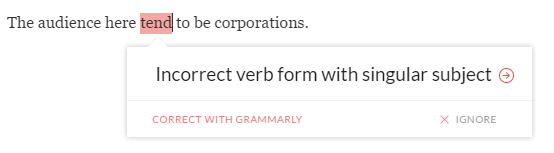
The audience here tends to be corporations.
I’m advised this isn’t correct:
So I duly drop the final letter to make the verb agree with the plural subject corporations. Then I’m told:
Now the verb form is incorrect because it doesn’t agree with the singular audience. And so we go around in a loop. There is a facility to add custom spellings or to ignore a suggestion, but no way to let the software learn your writing style or to flag up false positives.
Ultimately, the writer has to determine whether the words that are written, or the way in which they’re written, are suitable for the intended purpose. Grammarly is a tool that uses algorithms to apply the conventional rules of English; it’s not a textbook that must be followed precisely.
Tonight I’m hosting a spoken-word evening called Hotchpotch. This is an informal monthly event where writers and poets can read out their own work without judgement or criticism. In recent months, we’ve seen many new faces, a trend we would like to maintain.
To keep our events at the forefront of people’s minds, I’ve made it a priority to communicate with members regularly, also to cross-promote other literary events and the venues we use. I send a bulletin every couple of weeks on Facebook and Twitter, and by e-mail.
The last time, though, there were some problems with the reminders, and it was up to me to fix them.
Facebook
A lot of our regulars subscribe to the Hotchpotch Facebook page. This is the easiest update to make: it can be done on a PC or a phone, subscribers are notified immediately when a new post appears, and there’s a facility to tag the pages of related literary groups. The posts can also be edited, and people can ask questions in the comments.
On Facebook pages, administrators have the option to post under their own name or to post under the name of the page. The last time, I forgot to change the option and posted as myself. People could still see the message if they happened to look at the page, but they wouldn’t be individually notified.
The post had been up for a few hours before I noticed. Fortunately, all I had to do was copy it, make sure the related events were correctly tagged, and repost it in the correct mode.
Teh interwebz. (Photo credit: Wikipedia)
Twitter
After posting on Facebook, I send out the link on Twitter using HootSuite software. This can calculate the times of day that people are most likely to see your updates; in our case, it typically posts at 9am the following day.
Shortly after I’d corrected the Facebook error discussed above, I saw our Twitter post had a spacing error which meant the venue wasn’t properly credited. To add to the problem, the message had already been retweeted by two followers and later a third. One of these is the Scottish Poetry Library, which has an extensive audience and is great exposure for us.
The question was how to correct this error in the least disruptive manner. I didn’t want to leave the post as it was because it looked unprofessional, yet I didn’t want to take it down because users had already engaged with us. I’ve learnt a few things from managing literary groups, and one of them is to admit when you’ve made a mistake.
I posted a corrected version with the venue properly credited. I then sent private messages to the three users explaining what had happened and asking whether they would do me a favour and retweet the correct version. And they did. This move ended up working in our favour, as more Library followers engaged with our new message than the original.
E-mail
A significant proportion of our members don’t use Facebook or Twitter, so we also maintain a mailing list.
The bulletin I’m most worried about is this one; once an e-mail has been sent, it’s not usually possible to recall or amend it. So when I send Hotchpotch updates, I’ve set up a 30-second delay so it can be cancelled if necessary before it leaves my outbox. Gmail users can find this feature in the Settings.
But despite the problems with the Facebook and Twitter pages, the e-mail was sent without any mistakes.
Exactly 12 months ago, I was given a chance to attend a masterclass at the Scottish Poetry Library in Edinburgh.
Performance poet Francesca Beard led the weekend class, with the aim of helping the participants form a full-length spoken-word show. Like many performers, she believes revealing part of your inner self on stage – or indeed on a page – makes for compelling work.
One year on, I’ve completed a few projects as a result of that fabulous weekend:
The Purple Spotlights EP
Before I had enough material for a full-length show, I did have enough poetry for a four-track EP.
I chose three existing pieces around the theme of friendship. Additionally, I wrote Seven Months especially for the release, which takes more than five minutes to perform. In print, that would be too long for most magazines, but ideal for audio.
The recording process taught me a little about performance and a lot about packaging my work for an audience who aren’t in front of me.
The EP was released in April 2016 and is available on Amazon, iTunes and Spotify, plus many other outlets.
Scottish Poetry Library, Crichton’s Close, Canongate, Edinburgh Designed by Malcolm Fraser Architects, frequented by many excellent writers. (Photo credit: Wikipedia)
Crossing the Road
On the second day of the masterclass, Beard asked us to identify the subject or theme we were scared to write about. Then she asked us to write about it, and I did. We all did.
This gave me the confidence to interest the publisher in a previously-written work called Crossing the Road that deals directly with my bisexuality. It was then included in the Aiblins: New Scottish Political Poetry anthology; the first publication I approached. I was pleased to be invited back to Edinburgh, then to Aberdeen, for the launches.
I felt this poem would have more impact if it weren’t read from a sheet of paper, so I committed it to memory. From that point on, I’ve tried to do the same with all my performed work.
Sir Madam
Over the weekend, I became acquainted with the other participants, and I remain friends with most of them. One introduced me to the intense and angry work of Andrea Gibson and, by coincidence, I happened upon the Kate Tempest poem The Woman the Boy Became.
These influences helped me to shape an idea I’d had for years, but hadn’t been able to commit to paper. Sir Madam is a character who identifies as somewhere between male and female. Owing to the subject matter, I was particularly nervous about performing it. However, I received several positive comments afterwards, some from quarters I hadn’t expected.
Jennifer Goldman’s Electric Scream
The main aim of the workshop was to form a full-length spoken-word show. I’ve used some of the techniques taught to write a series of monologues that I’m seeking to turn into a one-hour play.
That isn’t finished yet, but it might not exist at all if it hadn’t been for that weekend with Francesca Beard.
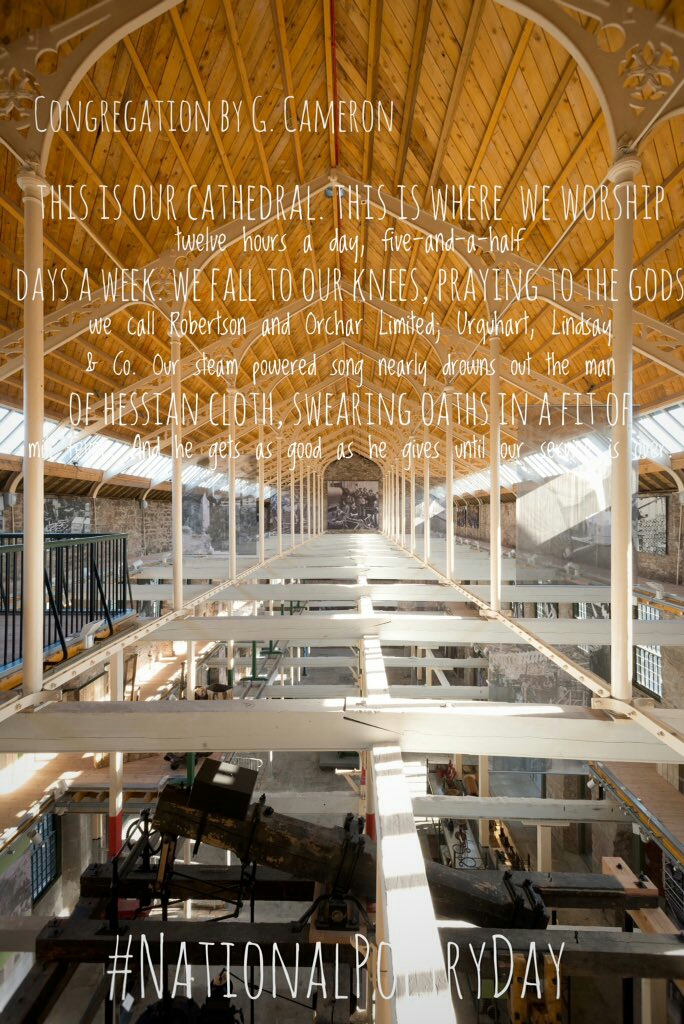
A couple of years ago, I was invited to pen a poem inspired by the former jute mill Verdant Works. I wrote the piece in situ. I later edited it, gave it the title Congregation, and sent it to the mill’s current owners to use as they wished.
Many months afterwards, the poem was published online for National Poetry Day. My original line breaks had been removed, however, so the piece was laid out more like prose. The image is below; the partially obscured words in the bottom line are mill fever and service is over.
I decided I liked this format better than the original.
Fast forward to the present day, and the question of typographical layout has occupied me again. Generally, I steer clear of contests with an entry fee, but I make the occasional exception, this time for the NYC Midnight Short Story Competition.
There are three rounds. At the starting whistle, every entrant is assigned a genre, a character, and a situation. In my case: a comedy about an art teacher and a mid-life crisis. We’re then given eight days to construct a story around these elements, and the winner progresses to the next round.
I struggled to start a story with my elements as they failed to inspire me. So I began to write down some thoughts as poetry, but using paragraph breaks rather than line breaks. I’ve also limited the number of rhymes that appear.
The final piece treads a line between prose and poetry that I would like the judges to pick up on. The other notable feature is that it runs to only 131 words, although there’s no minimum specified in the rules, only the maximum of 2,500.
Moreover, I’m happy with the result, especially since I now have something out of virtually nothing. If it’s enough to make it into the second round, all the better.
I’ve recently finished the James Bond novel Goldfinger, the first Ian Fleming work I’ve tackled.
On the whole, I enjoyed the book. There’s a certain calculated calmness across its three acts, in which Bond plays cat-and-mouse, not to mention golf, with Auric Goldfinger. Unexpectedly, I didn’t imagine Bond as any of the actors who’ve played him on film. Rather, he became his own character with his own personal quirks.
Unfortunately, there are elements of his personality that age the novel badly.
Pussy Galore (Photo credit: Wikipedia)
In one scene, we’re told that Bond considers the Koreans – at least those who aid Goldfinger – to be lower than apes, an opinion that’s peppered throughout the rest of the narrative. In 1959, this might not have caught much attention, but it stands out today.
Furthermore, the female characters have barely any conflict with Bond; when he tells them to do something, they don’t question his orders. There is a hint of progressiveness as Pussy Galore is described as the leader of a Lesbian organisation – Fleming’s capital – but other casual digs set it firmly in a past era. These come to a head in the paragraph starting on page 221 of the Penguin Classics edition, in which it’s almost gleefully explained that:
Bond came to the conclusion that Tilly Masterson was one of those girls whose hormones had got mixed-up. He knew the type well and thought they and their male counterparts were a direct consequence of giving votes to women and “sex equality.” As a result of fifty years of emancipation, feminine qualities were dying out or being transferred to the males. Pansies of both sexes were everywhere, not yet completely homosexual, but confused, not knowing what they were. The result was a herd of unhappy sexual misfits – barren and full of frustrations, the women wanting to dominate and the men to be nannied. He was sorry for them, but he had no time for them.
To me, the length and detail in this particular passage suggest the views aren’t simply the thoughts of James Bond but an authorial intrusion. As the protests surrounding the recently-elected US president have shown, they’re views that are no longer prevalent for many people. For further reading on this topic, I recommend the Grayson Perry book The Descent of Man.
Fleming has millions of fans around the world who read the books and watch the films, but would it right to remove these passages for a modern audience? It has been done relatively recently with a very different author.
In 2010, Enid Blyton’s Famous Five were given a 21st-century makeover. The term housemistress became teacher, mother and father were changed to mum and dad, and in a more extreme case, dirty tinker was amended to traveller. Anne McNeil from Hodder also made it clear that the publisher would continue to release the classic editions of the Famous Five books with unchanged text.
I think the important factor to remember is that times always change and that nobody could’ve predicted how it would happen. Perhaps in 100 years, all of society will accept several gender identities without question, or perhaps eating meat will be seen as shocking. So when we read archive material, we don’t have to agree with the views of the day, merely acknowledge them.