Publish and Be Careful

As I’ve no urgent writing projects on the go right now, I’ve turned my attention back to submitting work to publishers. There are never any guarantees in publishing, but I have a few tips to help ensure the process is as painless as possible.

Keep a close eye on what you submit and when

I maintain a spreadsheet with the following columns: Publisher, Submission guidelines, Closes, Date entered, Decision notified, Title(s) entered, Entry method, Overall submission count (target 52 per year).

Most short story and poetry publishers insist that you don’t submit a given piece to any other place until they’ve accepted or rejected it. If a piece is rejected, I use the strikethrough font effect so I know it can be sent elsewhere; if accepted, it’s noted on a separate spreadsheet. Note that agents looking for novelists usually don’t mind if you send to several places at once.

Be early

Right now, we’re heading into the Christmas and New Year period. Publishing lead times can be so lengthy that it’s far too late to submit festive pieces, as editors will now be planning for Easter or even summer. Yet there’s also an opportunity here: if you’re inspired to write a piece this December, there’s plenty of time to refine it and submit it in summer next year for next December.

Unless instructed otherwise, use a standard manuscript format

On his website, writer William Shunn offers a range of templates that contain all the information publisher needs, such as your contact details and pen name. Occasionally, you might be asked to use a certain font or a different layout. In those instances, always read the instructions carefully and follow them precisely.

A printing press in Kabul, Afghanistan
A printing press in Kabul, Afghanistan (Photo credit: Wikipedia)

Be selective about entering competitions

This is perhaps a contentious point, but it’s a purely personal point of view.

When you send work to a publisher, there is almost never a charge. For a competition, there’s almost always a fee, and it can be up to £5 or sometimes more. Assuming an average fee of £3, entering even one competition a week can cost more than £150 per year. Aside from the financial aspect, I’ve had experiences where competition rules have been badly phrased or even self-contradictory, leaving me unsure how to enter.

That said, there are a few competitions I make a point of entering because they’re so prestigious or because the potential payoff would be worth it, which brings me to my final point.

Look at the reward offered

It’s a fact of a writer’s life that some publishers want your work without payment or other reward, usually with the well-worn line that they can offer exposure. If you do simply wish to make your name known, then by all means enter your work, but be clear about this from the beginning. I generally take no payment only when it’s for someone I know personally, or if it’s for charity.

Otherwise, the least I’d expect is a contributor’s copy of the finished book and/or a cash fee, however nominal. It takes a lot of effort and a lot of time to create a publishable piece, so never be afraid to charge for your work.

Where Do You Want to Write Today?

For the last month, you might know I’ve been taking part in National Novel Writing Month as well as leading the group. I’m pleased to report I passed the 50,000-word target on 29 November.

Because the project took up so much of my time, it now feels like there’s something I should be doing, except that there isn’t. The manuscript is tucked away in a drawer, and its dawning on me that I’m free to pursue other projects. At the moment, there’s a non-urgent opinion piece I want to write, plus an idea for another novel tangentially related to the one in the drawer. That, and it’s fun to use the word tangentially.

When you’re writing to a deadline, or even if you’re not, it’s sometimes necessary to write wherever and whenever you can. I was tackling my novel at break times and lunchtimes, and sometimes in front of the TV at night. But how difficult is it to find your optimum writing spot?

English: Mist over Aberfeldy A band of mist al...
Mist over Aberfeldy A band of mist along the Tay covers Aberfeldy at dusk. (Photo credit: Wikipedia)

I’ve heard about a number of authors who have cleaned out their spare room, installed a desk, ensured they have no distractions, yet went back to an old favourite spot because the created one simply wasn’t conducive to writing. I once experimented with sitting right behind the front door. There was plenty of light, the noise level wasn’t excessive, and I knew nobody was going to barge in, but something about that place made me feel uncomfortable.

These days, I do the majority of my typing while standing with my back to my bedroom window, and my laptop or Freewrite on the end of the bed. When writing by hand, I can do that in a café, on a train, or during a dull literary event trying to look like I’m avidly taking notes. I find it difficult to be in a silent place, because even the noise of the pencil or a page turning sounds like a terrible racket.

By far, though, my favourite writing place of recent times was in the town of Aberfeldy overlooking the mountains. The piece in question was my dissertation rather than fiction or poetry, but I would consider going back there if I had another big project to tackle.

The Last of The Short Measures

National Novel Writing Month ends this week, thus potentially freeing me up to make longer blog entries.

However, I woke up to the news yesterday morning that our main meeting venue – a Wetherspoon’s pub – closed permanently on Saturday night. As such, we’ll need to find a new place; this is a problem I’ve encountered before, and I’m sure it’ll work out for the best.

For the moment, I’ll leave you with a poem I wrote on the day that Donald Trump was elected. It’s called Hell’s Marksmen.

Our satire
can fire
more shells
than Hell’s
marksmen.
And when
deployed
sweetly,
can vanquish
completely.

Jack of All Words

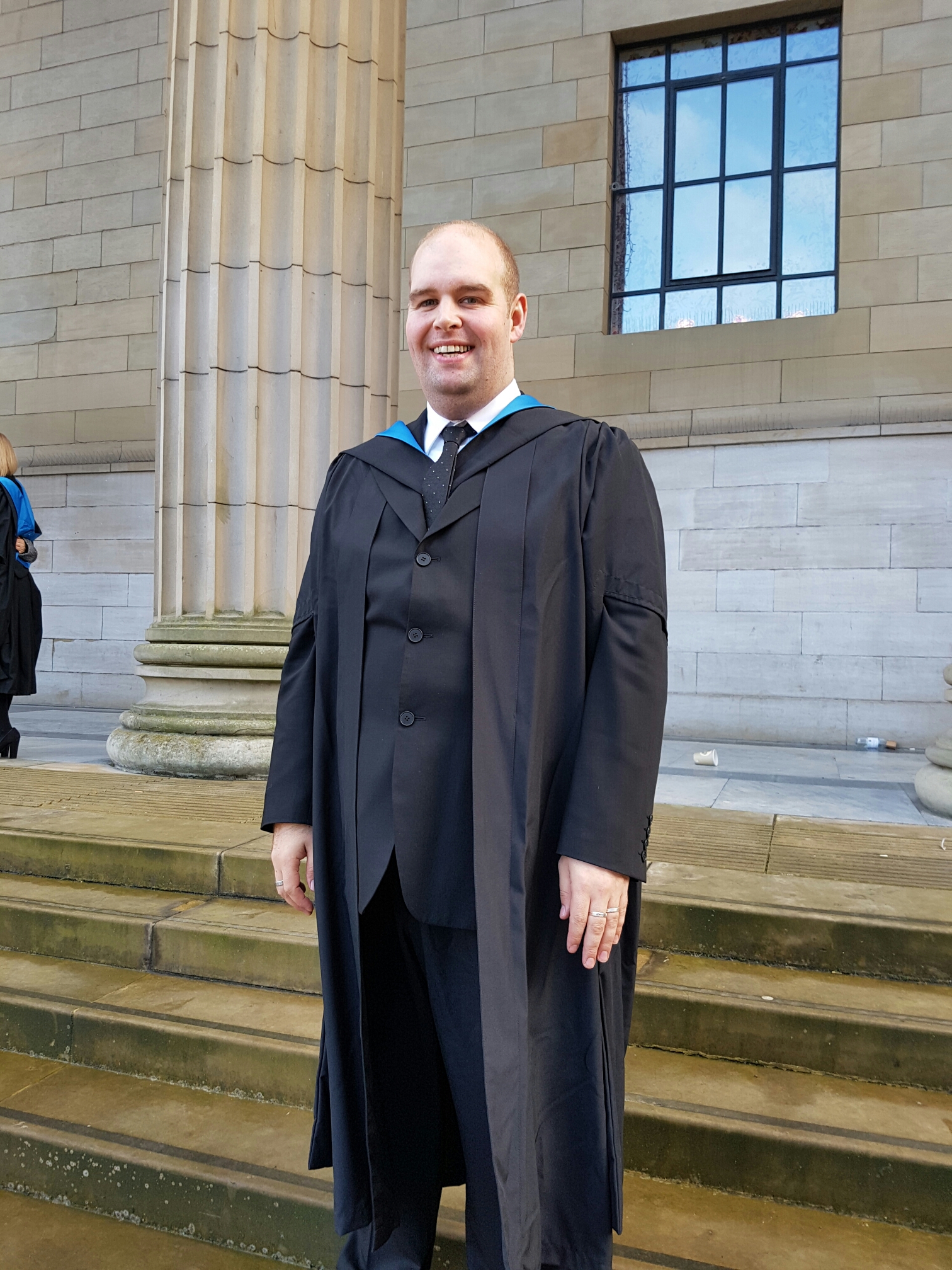
For those of you who haven’t read it elsewhere, I’m pleased to report that I’ve now graduated with an MLitt in Writing Practice and Study. I’ve become a jack of all words, and master of letters.

The logistics of the ceremony has left me behind with my other work, so I’m afraid it’ll be another short entry.

The end.

Caught up in My Busyness

We’re now into the thick of National Novel Writing Month. The Dundee & Angus region alone collectively ended 11 November at well over half a million words, and the total is rising every day.

But other literary events are still happening. Tonight, I’m going to a Silent Reading Party, then a Spanish-themed poetry night. And on 25 November, I’ll be seeing the actor Alan Cumming in conversation with Muriel Gray about his latest book.

I would like to take this opportunity to plug a couple of events. You might be aware that my poem Crossing the Road has been included in the anthology Aiblins: New Scottish Political Poetry, which officially launched in Edinburgh last month. There is also to be a Glasgow launch tomorrow 15 November where I can’t be present, and an Aberdeen launch on 21 November where I’ll be performing.

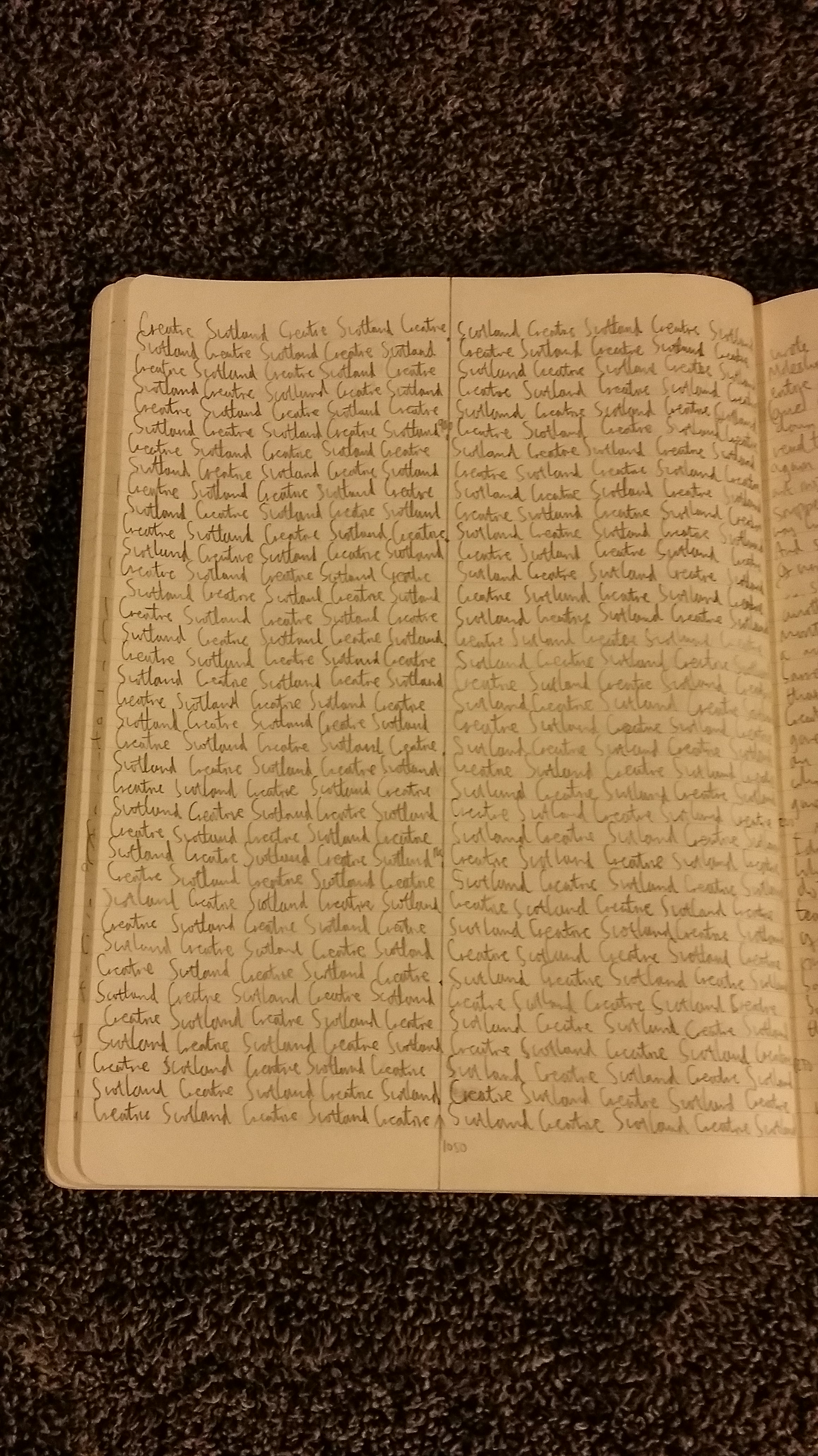
For now, though, it’s back to NaNoWriMo. I didn’t know where I was going with this year’s story – in some respects, I still don’t – but I now have a character who loves to fill notebook pages with the same phrase, much like Jack Torrance in The Shining. Here’s what happened when she was turned down for an arts grant:

The writings of a character in my NaNoWriMo novel

NaNo Seconds

Every November, I take part in National Novel Writing Month – aka NaNoWriMo – which is a challenge to draft a 50,000-word novel in a month. Along with an assistant, I’m also a Municipal Liaison (ML) for the Dundee & Angus region in Scotland. We arrange regular meet-ups for members, encourage and support them, and persuade them to donate to the project.

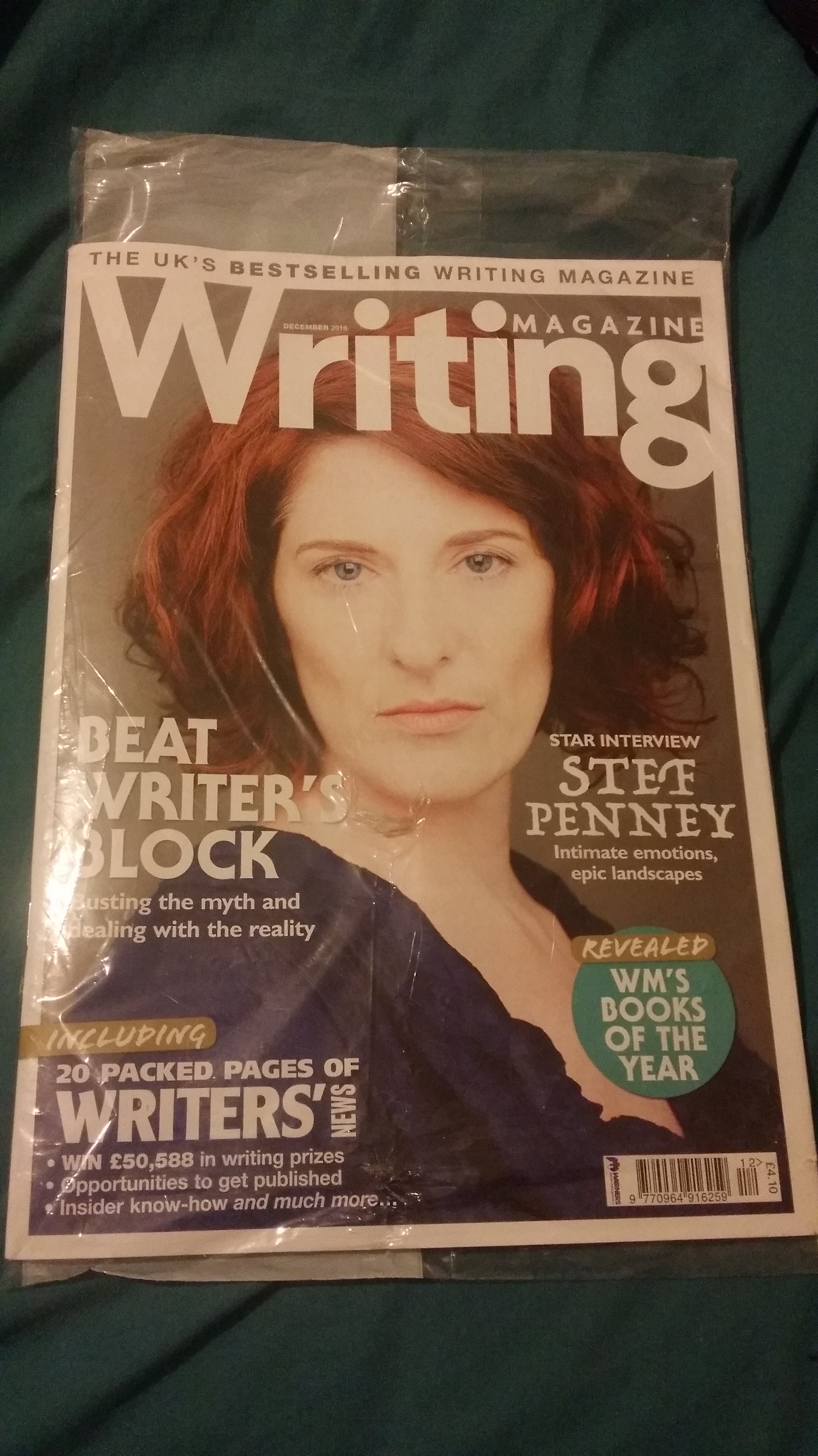
As such, some of my other projects have to be scaled back or placed on hold. This includes submissions to publishers, reading books, and updating this blog. In fact, my current issue of Writing Magazine is still in the cellophane. However, I’m making good progress, having written more words than required every day so far; in fact, the whole region is doing a sterling job.

Writing Magazine still in cellophane

Five Poems from Edinburgh

This weekend, I was at the launch of Aiblins: New Scottish Political Poetry, where I performed my piece Crossing the Road at the Out of the Blue Drill Hall in Edinburgh. Every reader did a fantastic job and nearly every seat was full.

As I was staying over the weekend, I decided to post a video of the poem performed in the city. That one poem turned into three, which turned into five.

It’s rare that I post work online, as most publishers won’t then accept it. But two of the poems are already available, and two are site-specific clerihews, so I’ve made an exception .

So in today’s entry, if you’ll excuse the high winds and tourists chatting, I’m presenting these five poems.

Gavin ‘The Brand’ Cameron

Fans of the BBC TV show The Apprentice will remember a candidate who styled himself as Stuart ‘The Brand’ Baggs. While his idea of branding was certainly misguided, it was nonetheless a memorable gimmick. As a writer, it is similarly important to consider how you’ll be perceived by your readers.

Next time you’re in a bookshop or a library, have a look at some of the book covers. You’ll often find that books by the same author share certain elements: perhaps the author’s name is written in a particular typeface, or perhaps a certain style of artwork is common between them. But branding goes so much deeper than a cover. It can include the personality or values that you want to convey to the reader.

Bronco branding in the Top End.
Bronco branding in the Top End. (Photo credit: Wikipedia)

My own branding begins with my moniker: Gavin Cameron is actually my first and middle names. My real last name is Cruickshank, but I don’t use it because there are several possible variations in the spelling, and it serves as a small distinction between my real life and writing life. Not to mention that Crookshanks is Hermione Granger’s cat in the Harry Potter series.

There is a long literary tradition of pseudonyms, and this is catered for in the standard manuscript format. Your real name goes in the address at the top left-hand corner, while your pen name is included in the byline underneath the title. I also mention it in the body of the e-mail or on the cover sheet.

Even so, the issue does occasionally cause problems. A couple of times, show organisers have thought that Gavin Cameron and Gavin Cruickshank were two different people. One organiser recently made publicity material in the name of Cruickshank instead of Cameron, and it’s now being corrected.

In an attempt to stop this from happening again, I’ve now made it clear in my e-mail signature:

Gavin Cruickshank
writing as Gavin Cameron.


http://www.gavincameron.co.uk/
@LadyGavGav
http://www.purplespotlights.com

On the same subject, you might have noticed my Twitter name @LadyGavGav. Although I’ve never liked my first name being shortened to Gav, and still don’t, I felt I had to take that Twitter name as it was available and was an improvement over my previous handle @Knaw_Says.

Upcoming Gigs

Over the next couple of months, I’ve been asked to read poetry at a few events. Each one is free to attend. Here’s a handy cut-out-and-keep guide to them:

Livewire; Wednesday 19 October; Bonar Hall, Dundee. I’ve just finished an MLitt Writing Practice and Study course at the University of Dundee. This is one final showcase for our class, where I’ll be reading a piece called Sir Madam from my dissertation.

Launch of Seagate III; Sunday 23 October; Bonar Hall, Dundee. As part of the Dundee Literary Festival, Seagate III will be launched. I’ll be performing the two poems of mine that appeared in the anthology.

Launch of Aiblins; Saturday 29 October; Out Of the Blue Drill Hall, Edinburgh. I have a piece called Crossing the Road included in Aiblins: New Scottish Political Poetry. I’ll be performing along with some excellent contemporary poets as part of the 20th Edinburgh International Radical Book Fair.

Launch of Aiblins; Monday 21 November; Underdog, Castlegate, Aberdeen. This launch is for the same book discussed above, but in a different city. The event is still being finalised, and I’ll give you more information when I have it.

Paper View

Last week, a friend was complaining about a major writing competition that still only allows postal entries. I’d also submitted work because it’s a prestigious publication, but I agree with her point of view. Considering the hundreds of manuscripts that must be received – versus the tiny portion that makes the final cut – this seems a colossal waste of paper, not to mention the needless postage time and cost.

Many competitions offer the postal route as an alternative to an online submission, and there’s nothing wrong with that. Nor is there any issue with posting work that must be physically held to be appreciated. But there are still a bunch who want normal prose and poetry to be sent on paper.

English: A stack of copy paper.
English: A stack of copy paper. (Photo credit: Wikipedia)

Until the 1990s, this was how submissions were made. Internet access and e-mail accounts were generally the domain of academics and computer enthusiasts. Come the next decade, however, and newer technology began to creep into people’s homes. Nearly 17 years after the millennium, online access is nearly universal in the Western world, and postal submissions now look incredibly outdated.

That’s not to say I don’t like a paper book. In fact, some recent research has concluded that sales of e-books are falling. But a book is the final product; the process of gaining the interest of an editor or a competition judge ought to be as quick and cheap as possible.

Yet I would like to understand the other side of the argument. Do you run a publication that only wants submissions on paper? How does it benefit you? What would make you consider accepting online entries?