Changing Times and a Change of Time

I’ve left it until the last minute to write this entry. It’s not entirely because I’ve been busy – although that’s a factor – but because I wanted to hear the announcement today from the Scottish First Minister, Nicola Sturgeon.

Tomorrow is the next instalment of my open-mike evening Hotchpotch, and it was expected that new restrictions would be brought in today on account of the Omicron variant of COVID-19. Happily, nothing in the announcement affects our ability to hold the event tomorrow, even if more members might choose instead to attend our virtual event on Sunday.

Last week, we were also able to run a new version of our gameshow The Literal Flow Test, involving Christmas-themed topics, as part of a wider programme of events. I might come back to this topic in a future week as there’s a story to be told there as well.

The one event that isn’t back in person is National Novel Writing Month (NaNo). As that organisation has a largely top-down approach, all the regions in the world have been advised not to meet except online, even if our local authorities allow it. Which brings me to a point about the timing of my weekly blog posts.

When I started writing this blog, I was able to update regularly at 5pm on a Monday. This evolved into 6pm on a Tuesday, and that lands squarely during the NaNo meetings. That used to make sense because I would talk to people around a table while using my PC to type the entry.

Because I’m now using my PC to talk to members and write at the same time, it’s not so simple. As such, from next week, I’ll be updating this blog at 8pm on a Tuesday. The time is still subject to a trial run, but expect my entries to appear a couple of hours later.

When The Muse Strikes

As I sit down to write, it feels like a continuation of the last entry, where I talked about inspiration appearing at 5am. This time, however, the inspiration happened near the end of the day.

I’ve been asked to provide a poem for a 12 Days of Gratitude project. As late as Saturday of last week, I’d absolutely run dry of ideas. There were plenty of people to thank, but nothing that fitted into a structure.

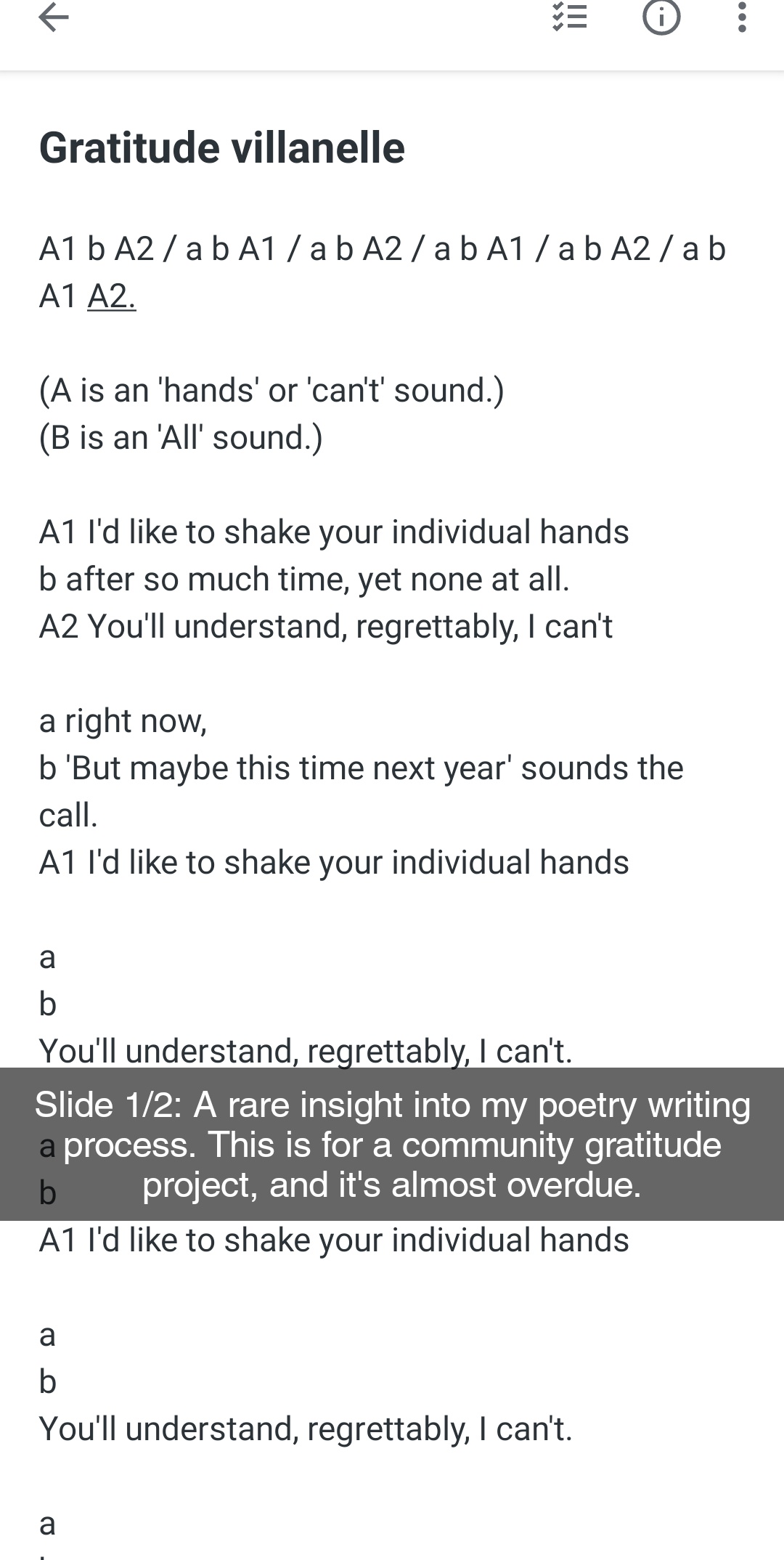
While I do find walking helps with the process, I wasn’t having much luck – and over an hour later, I thought of my first line and the structure. I even took a couple of pictures to document this. It’s rare that I would show such an incomplete draft so early, but it happened by surprise.

Half-completed villanelle about gratitude

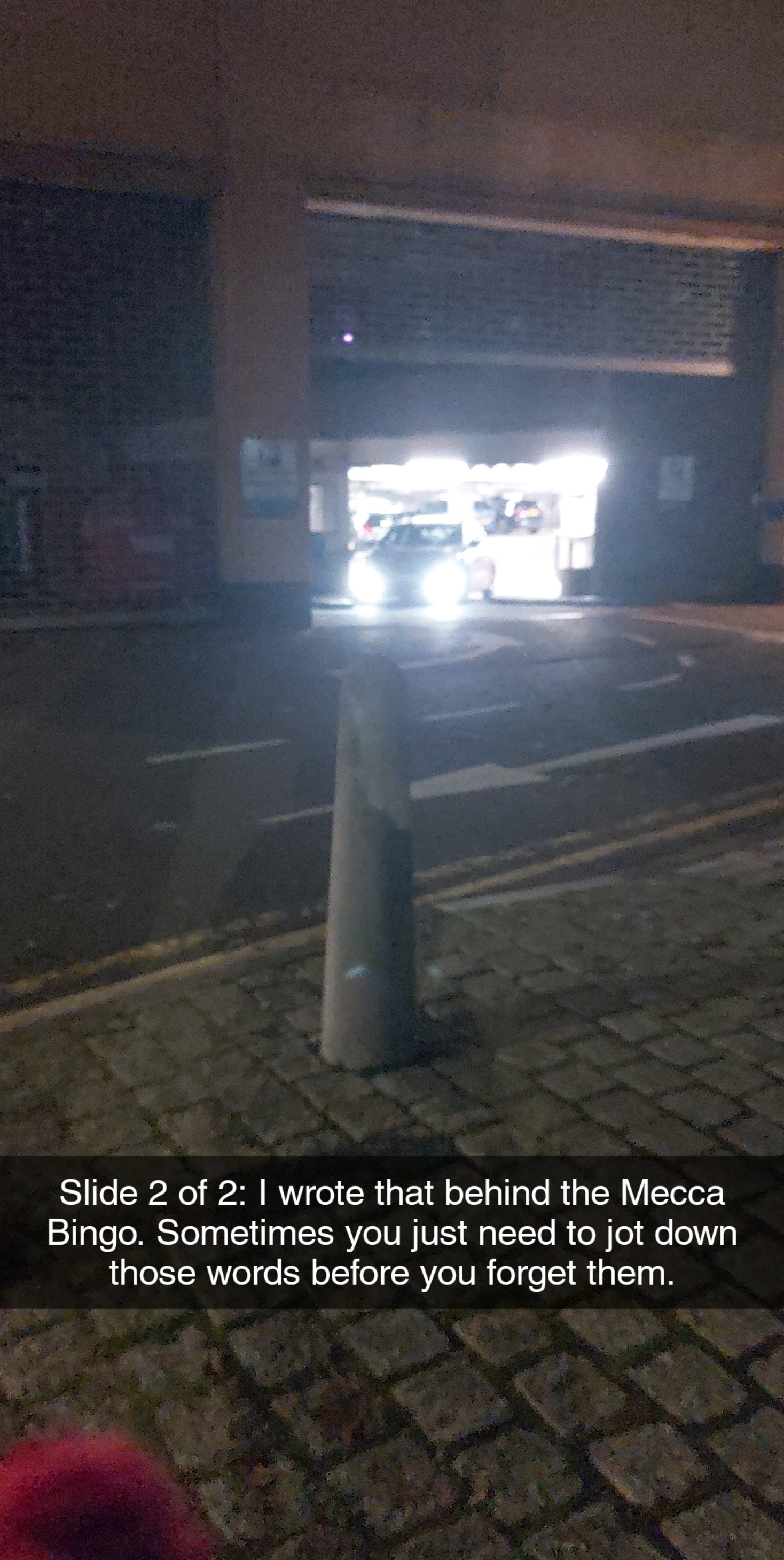
My walk had taken in river views and grassy areas, but when I wrote those lines, I was probably the least inspiring place I’d been that evening: behind the Mecca Bingo.

Picture of Mecca Bingo where villanelle was written

What I need to do now is finish the piece and make a recording of it, but arguably the hardest part is over, so the rest should be plain sailing.

The 5am Story

One of the pieces of advice often given to beginner writers is to keep a notepad and pen by your bedside to write down any ideas that occur in the middle of the night. I’ve said a few times on here that this has never worked for me. Yet something happened last week that helped me with a current project.

I woke up before 5am on a couple of occasions last week, and was unable to get back to sleep. It’s a dangerous distraction to switch on your computer at that time, but I decided to give it 20 minutes, then head back to bed.

Instead, I ended up solving a problem with a story that wasn’t coming together properly. There were a lot of solid plot points that were difficult to arrange into a logical narrative. This was also part of a series, so there needed to be a little explanation for those who hadn’t read the previous instalment, but not so much that it slowed down the pace.

The breakthrough came after about ten minutes, and once I’d arranged the first few paragraphs into the right order, the rest followed. It’s now up to more than 1,300 words with more to follow, and the next story in the sequence will include the points I had to leave out of this one.

Murder, She Implied

Turn on the TV any given afternoon, and chances are you’ll find what may be termed a cosy crime drama, from Quincy ME via Midsomer Murders to the relatively recent The Doctor Blake Mysteries.

Yet despite the deaths that are central to the storylines, they remain PG-rated, and would never be categorised alongside – for example – NCIS or Criminal Minds. So why is this?

The answer lies in what’s portrayed onstage and offstage. Whereas CSI can show graphic violence or injuries front and centre, the most you’ll see in Murder She Wrote is a dead body slumped over a desk with no visible blood.

Offstage events are an underrated tool in a writer’s arsenal. They can help to further the plot without slowing it down.

Let’s say a character has a meeting to discuss the details of a project. Rather than writing page upon page of negotiation, it can be more effective to show the person going into the meeting at the end of one chapter, then summarising to someone else over coffee in a subsequent chapter.

Some publishers even ask that certain themes are kept offstage. The fiction guidelines for The People’s Friend require that themes such as divorce are kept away from the main narrative.

Sprinting Like a Champion

Yesterday, I volunteered to take over one of the Twitter accounts for National Novel Writing Month for an hour. NaNoWordSprints provides nearly 50,000 subscribers with writing prompts and encouragement to reach their chosen goals.

When I first started writing, I went to classes with an author who would give us five or ten minutes to write a passage inspired by a snippet of text or a photograph, or occasionally an object.

My approach to this hour-long stint was similar, except that shorter prompts and longer writing periods seem to work better on Twitter. I’d thought about the prompt topics in advance, but the structure was constructed largely on-the-fly. In minutes, the four sessions were: 10, 15, 15 and five. The third of those had a photograph as a prompt instead of text.

On top of this, you need to keep an eye on any replies coming in, and answer accordingly if it was warranted. However, I found the pace manageable, and once I was in the swing of presenting the exercises, I enjoyed the experience so much that I signed up to take over on the three coming Mondays.

Taking You Places

Although it’s bad form to take people away from your own website to visit others, I’m making an exception this week.

Creative Dundee asked me to make a blog post, which I’ve spent a few weeks working on, and you can read it on their page.

Join me here next week, where I promise not to send you elsewhere.

The Evasive Verse

This week, I’ve been trying to write a piece for my poetry circle. Specifically, it had to be in some way related to the author Robert Duncan Milne, a forgotten contemporary of H G Wells.

As the reading for this has taken up so much of my time, I don’t have a full-length entry for this site.

However, I’ve often advised that going for a walk is a great way to sort out the ideas in your head, and that’s exactly what happened here. After days of reading, and trying to tie together a few of Milne’s concepts into a single verse, it was a lunchtime trip outside that gave me the final verse.

I’m about to read it over just now, maybe tweak it, and send them my work.

Hesitation

A few weeks ago, as part of the inaugural Dundee Fringe, I hosted the premiere of an experimental game show called The Literal Flow Test. It borrows elements of the Radio 4 show Just a Minute, asking five players to speak for up to two minutes without stopping, and pairing that with the knockout stages of a poetry slam.

I was pleased to find that we had attracted nearly a full house; the official paperwork shows 27 out of 30 seats sold. Most of the topics were picked at random from a pool, but part of the fun was asking the audience for topic suggestions in the last round, and they joined in with enthusiasm, with subjects ranging from ‘Stonehenge’ to ‘Cybernetic enhancement’.

I’m aware that despite this show being all about avoiding hesitation, it’s taken a few weeks to write about it. However, I wanted to bring you pictures as well. You can find them all on the PPG Photography Facebook page, but below is one of the poet Fin Hall.

The poet Fin Hall standing up taking his turn as part of The Literal Flow Test.
The poet Fin Hall taking the Literal Flow Test. Credit: https://www.ppgphotography.com/.

The playwright Jen McGregor emerged as victor after a tense five minutes of tiebreaking. With a few minor tweaks to the rules, it would be grand to run it again at some point, possibly for charity.

All the players, and the judge, were members of the Hotchpotch open-mike night. But unlike Hotchpotch, which is run entirely on a voluntary basis, each act at the Fringe received a share of ticket sales. This meant each participant could receive a little cash towards their travel or drinks on the night.

Of course, I nearly forgot to give Jen her envelope, and had to chase her up the street at the end, but we’ll move on from that.

Not Raining, Just Pouring

It sometimes happens that a number of writing projects need to be completed at the same time, and that’s exactly what’s happened over the last week.

Some of these are self-imposed, like two job applications and writing a private blog entry for a closed group. But the others have been opportunities like supporting a funding application for an Edinburgh poetry organisation, and an invitation to write a public blog post for Creative Dundee.

This deluge has been a prime lesson in prioritising, some pieces due on sequential dates. I’m making headway, with only the Creative Dundee post still outstanding, but at the time of writing, I haven’t been given a definite submission date.

It does, however, pay to hit a deadline. Just yesterday, I heard I’ve had a piece selected to appear in Poetry Scotland and I can’t wait to see it in print.