Over Your Shoulder.

A couple of weeks ago, I went to see a special screening of Local Hero. It’s an excellent film, and if you have the opportunity, you should see it.

The director Bill Forsyth was brought in at the end to hold a question-and-answer session with the audience. He mentioned at the beginning that he hadn’t seen the film in years, and an audience member asked why this was. He answered that he wasn’t ashamed of his work, simply that he wasn’t interested in looking back, and questioned whether – for example – a writer would be interested in rereading their old stories.

Contrary to the director’s opinion, my answer is a definite yes. I openly admit that being a writer wasn’t a childhood dream, and I therefore don’t have notepad upon notepad of embarrassing teenage musings. Rather, I wrote my first fiction in late 2010, just before I turned 27, and looking back enables me to keep a weather eye on how I’ve improved.

Even if I come across an old piece that I find jarring, I know I only need to rewrite it, or in extreme cases, deconstruct it, to bring it up to my current standards.

A prime example of such a jarring piece is one of the first poems I wrote, called The Cooler, a short verse about a character’s self-imprisonment. Looking at it now, it needs to be longer to fully convey the situation, as it’s currently unclear, and the clumsy language needs to be trimmed, eg, “It stays cold all night like a fridge.” Now I’ve looked back at it, I can think about these issues and improve the work.

In my next entry, I intend to cover the issue of rewriting in a more in-depth fashion.

I mentioned I’ve been writing fiction for less than four years, but I was a blogger long before that, discussing the issues on my mind at that moment, much as I do here. That writing is a little embarrassing, but it’s only by looking back that I can see how much I’ve moved on. Here’s a typical entry from almost exactly ten years ago.

There are many writers who started later in life, and I found out recently that John Grisham is one of them. He didn’t write his first novel until he was in his 30s, and didn’t give up his work as a lawyer until his second was published.
Alt.Format.

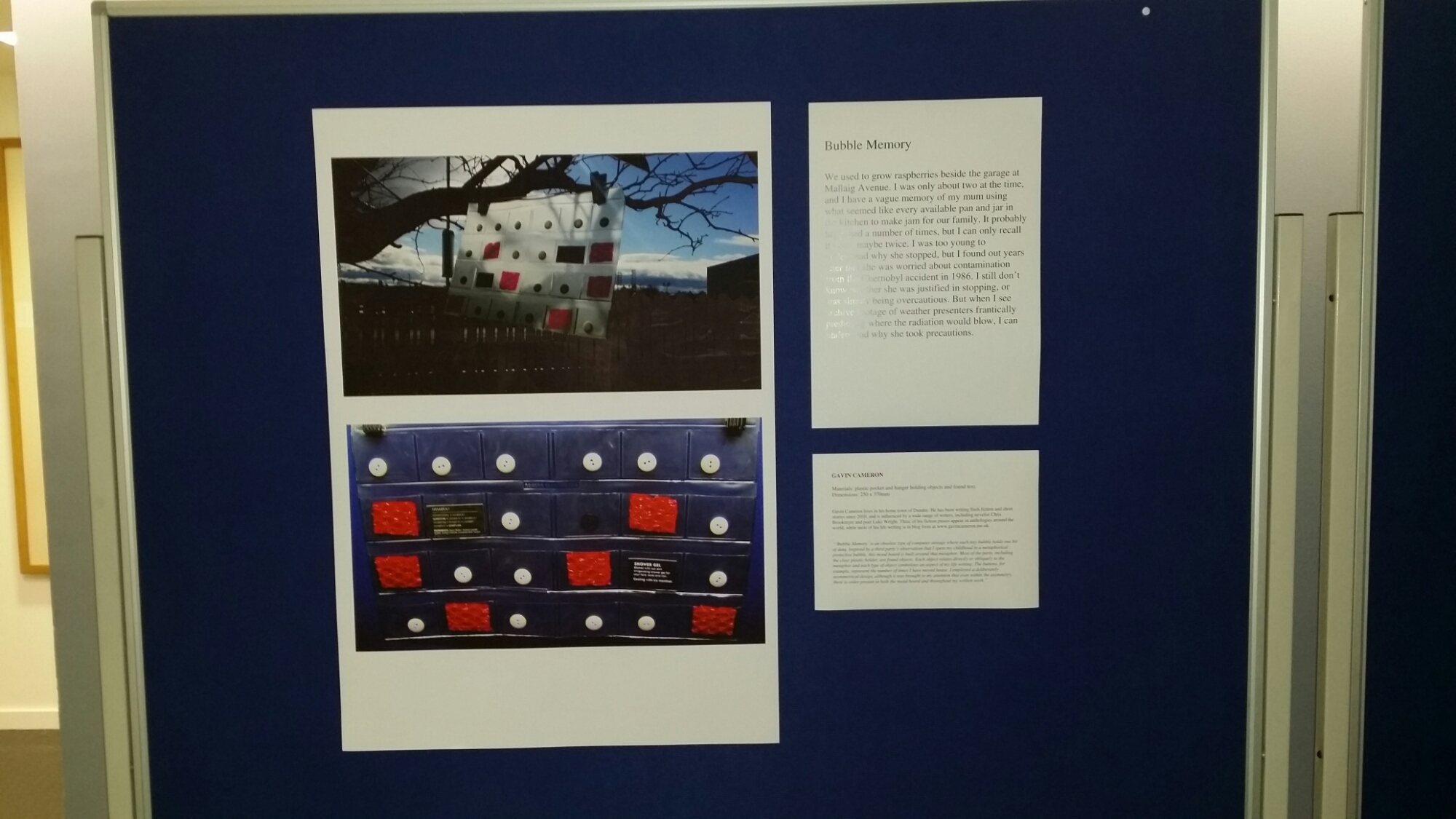
Last year, I joined a Life Writing class at the University of Dundee. One week, the tutor asked us to make mood boards to represent the themes of our writing. I didn’t look forward to this at all. As I’ve mentioned in previous entries, I’m not naturally gifted in visual expression.

But having consulted an artist for advice, I acquired materials from a nearby recycling plant, and pieces gradually fell into place. This task led to a short exhibition at the University where most of the class displayed their boards, with explanatory text and a personal story alongside each one.

The mood board in question
In the mood

My mood board came to be titled Bubble Memory, constructed of a 35mm slide holder with buttons and other found materials in each pocket. The photograph shows how it was displayed in the exhibition, which closed on Friday of last week, although we are in talks to extend it. Despite my initial dread, I was pleased with the all-round results.

This is not the first time I’ve experimented with alternative formats. Text-based artist Gerry O’Brien was also a member of the Life Writing class, and submitted a piece of homework on a thumb drive. It contained a PowerPoint presentation that told the story of meeting a man from Honduras in text, interspersed with photographs. The presentation runs automatically at a slow savoury pace, allowing the viewer to absorb every detail.

Inspired by this, another class member created a similar project, speaking about the dolls she makes and collects. And inspired by both their achievements, I converted an existing poem of mine into the format, but with no pictures and no audio. The text is displayed to the reader at approximately the speed I would speak it, but there is freedom on their part to imagine the emphasis and inflections.

I started experimenting with formats a couple of years ago when I took part in the Sketchbook Project at Brooklyn Art Library. I broke down one of my short stories into fragments of one or two sentences, then converted each fragment to a QR code. This is a square barcode that can be read by many mobile devices. When it’s scanned, the device shows the fragment of text.

I then glued each of these codes into the sketchbook in the right order to tell the story, and sent it back to the Library. It was then scanned and placed online, while the original sketchbook was taken on a tour around America. This is the finished sketchbook. The following year, I submitted an apology for the artwork in that first book.

I don’t think I will ever move completely away from text on paper, but the occasional piece in another format or another medium can engage the reader in a different way. I’ll leave you with the story of the world’s first hypertext novels, a form that would be challenging to reproduce on paper.

Taking Care of Business Cards.

At the end of June, I ordered a set of 500 business cards. I realised I needed a quick way of letting people know how they could reach me if the situation arose. I could write down my details but it’s less memorable, and often less readable, than a proper card.

image
The card in question

It contains my phone number, e-mail address, Web address, and Twitter handle; the former is censored in the photograph as it’s a personal number. I chose not to include a, “job title,” such as writer, poet, blogger, &c, as I didn’t want to make people feel as though they could only contact me in connection with these skills. Instead, the general sense of what I do is conveyed by the books in the background.

I bought the cards from Vistaprint, who threw in a metal holder free of charge, although there are more expensive services such as Moo.com. Just a couple of weeks later, I did indeed need one to tell a fellow blogger about this page. I currently earn very little money from writing, but I felt like a professional as I handed it over.

Game over. Try again?

Over the last three weeks, I’ve received two similar e-mails from two completely different publishers. They were both rejections, but each invited me to submit another piece for their respective next issues.

The first of these was a bulk message, but sent only to selected writers. This group invite experimental and unclassifiable work, so while I’m particularly pleased they liked what they saw, I’m unsure if I’ll have anything else quite so nonconformist. The other place sent a personal thanks, and as it’s more mainstream, it shouldn’t be too difficult to resubmit.

I’m reminded of when I submitted one of my novels to a publisher. They liked the first three chapters enough to ask for the rest of it. They ultimately turned me down as they felt the plot didn’t place the character in enough peril. But they did it in such a constructive manner that I felt I could raise my game and resubmit it, even when I thought it couldn’t be improved upon.

Sometimes it’s just a matter of waiting before a second chance comes along, although James Jones didn’t live to see his reprieve. In 1951, he fought to keep the swearing and gay content in his novel From Here to Eternity, but his publishers wouldn’t allow it. By 2011, times and attitudes had changed, and the uncensored book was finally made available.

The Other 75%.

Just before I begin, a couple of an announcements for people in and around Dundee. Hotchpotch, the writers’ open-mike, is next Monday, 4 August between 7pm and 9pm at The Burgh in Commercial Street. I’m afraid I can’t make that meeting, but there’s a similar event for poets between 12pm and 4pm in Baxter Park on Sunday 10 August, to which I plan to go.

In an interview with the BBC, literary agent Johnny Geller stated that in a survey of self-published authors, 75% of those asked said it was a hobby and that he was interested in the other 25%. I think that’s a fair comment from an agent, as he needs his authors to make a full-time commitment. But I wonder how many of the other 75% would be willing to turn that hobby into a career if they were offered the right publishing deal? It can be a big step to give up the fabled day-job.

For me, it’s a trade-off between a permanent office job with a regular income versus handing in my notice and freeing up those 37 hours per week to write. There would need to be a compelling offer to give it up because if a book deal didn’t materialise, the organisation isn’t replacing lost workers so I would need to look elsewhere for another regular income.

The other consideration is how long to continue trying before finding another regular income. Six months? Two years? Until I feel as though I’m suffering for my art?

It is possible to combine the two. Oscar Wilde and Philip Larkin both worked other jobs throughout their writing careers, and I know an author who is currently employed by a major bookstore chain. The next time I have the opportunity, I’ll ask him whether he considers it a help or hindrance.

Hey hey, I wanna be a rock, er, film star

Finally, I took part in a low-budget film on Saturday as an extra. It’s called Shooting Clerks, about the making of the 1994 Kevin Smith movie Clerks. We were asked to dress in fashions of the period, so I wore a T-shirt, jeans, and a backwards baseball cap. By good fortune, I was meant to attend an open-air Grease singalong later that day. It was cancelled due to the weather, but I could have become John Travolta simply by removing my headgear.

There was no script available to have a nosy through so I don’t know too many specifics. We were simply given instructions when to laugh and applaud as if we were at a film premiere. But keep an eye out around its scheduled release date of 13 April 2015.

Between Two Stools.

I don’t think Rebecca Woodhead reads this blog, but in August’s Writing Magazine, she covers the subject of extroverts and introverts, as I did in a previous entry. But she takes it one step further, adding a middle category of ambivert.

My research shows this is not a horrendous neologism – in fact the term was invented in the 1920s – but I still hadn’t hitherto heard about this third way. It also turned up a wonderful WordPress post that goes into more depth about the subject than I will.

In the article, Woodhead argues that writers should aspire to be ambiverted and that few fall into the extrovert category. Yet in my experience, I’ve found that many already are extroverts; indeed I can think of a number who actively invite audience questions, or can’t wait to offer their views on a hot topic.

I can identify with the needs of an ambivert or introvert, as I’m quite fond of solitude. This is generally because I’m tackling a task that requires it, such as typing, editing, or reading – the very activities that make me a writer. But often, I’d much rather be reading my work out on stage, or answering audience questions, or negotiating with publishers.

Quite independently of the -vert spectrum, but not unrelated to it, I’ve been mulling over the notion of right- and left-brained people. It seems this theory is now outdated, as research shows that both halves of the brain generally work in tandem. Yet I still think my ‘dominant side’ has shifted at some point over the four years I’ve been writing fiction.

I have a BSc Music Technology degree because when I left school, I wanted to be in the music business or the radio industry. I used to delight in recording the perfect sound level, learning MIDI Commands, or editing video footage. In other words: what used to be termed left-brained activities. These days, I’m more inclined towards my fiction, speech-based radio stations and podcasts, and appreciating others’ artistic expressions. These were considered right-brained activities.

Perhaps I’ve always been at least partly right-brained but I hadn’t unlocked it until I discovered fiction. Alternatively, it’s maybe because I’ve had more success with writing, or at least more external validation, that I’m now subconsciously inclined towards chasing these rewards.

That external validation is a classic extrovert trait, and why I still place myself in that camp.

Julyish.

We’re midway through July now. In some respects, this is a troubling month for me.

Firstly, there’s the weather. I can’t speak for anywhere else, but I’m from Scotland and it can fluctuate wildly. Thursday brought the sort of weather for lying in a hammock and listening to the Isley Brothers. I took the opportunity to walk to the seaside and enjoy a round of crazy golf and a trip on the road train. By Saturday, the rain was tipping down in the least Julyish fashion you can imagine.

Secondly, the daylight. Regardless of the weather, near-perpetual daylight does things to the brain. I find myself waking sometimes an hour or two before my alarm, which does nothing for my concentration.

Thirdly, it’s holiday season for many people. You’re out of your normal routine and writing might not feature as highly as it does during your normal day.

But there are ways to keep your writing flowing even through the least Julyish July. A gloriously warm day or a change of scenery might provide you with fresh ideas. I make it a habit to carry a pencil and notebook with me, and I recommend taking a sharpener as well. And if it’s practical, perhaps a 5am writing session would work for you, or at least give you an opportunity to catch up on your reading, and that can be as important as writing.

Just remember that if you’re writing about summer and you plan to interest a publisher in your work, it might be up to a year before you see it in print as lead times are months long. Right now, editors are planning for Halloween and even Christmas, and probably won’t take you on until the New Year. So if you have any festively-themed stories, this would be a prime time to dig them out, even if it seems a very long time away.

Performances and Housekeeping.

On Monday of last week, I debuted a new poem at Hotchpotch. This is a local open-mike night for writers. While I’m far more of a prose writer than a poet, I thought this particular piece would go down well.

I’ve been to enough live events to know the standard housekeeping message that’s given before the performance. This poem was a version of the announcement that made it sound as though the speaker was having a mental breakdown. It did indeed attract a positive response, while a second poem and a short story were also well-received.

At last month’s Hotchpotch, I had a picture taken of me. I didn’t particularly like it because my neck was too far forward reading the piece. This time I was sure to stand up straighter and look up at the audience from time to time. I’m not saying my pieces came across better because of it, but I certainly felt better by paying attention to these factors.

I’m an advocate of people reading out their work in public, and of course in private while proofreading. If you know of a nearby group, go along and support it. There are actually two such groups around here, but I didn’t take to the other one since the focus there is mainly on folk tales, whereas Hotchpotch has a more literary flavour. Some groups even allow you simply to listen without contributing for the first meeting.

But what if there isn’t a group, or it’s not the right style for you? Have you ever thought about starting your own? There’s no reason why you should wait for someone else to do it, as it probably won’t happen.

The meeting place doesn’t have to be anywhere with a stage. We meet on the upper floor of a café, and we create an informal Poets’ Corner near the top of the stairs. Some pubs and coffee shops are happy to donate their space provided the participants are putting money in the till, so we hold at least one break during each evening. Just bear in mind that the venue could back out or change their terms at any time. A pub we used to use free of charge suddenly wanted £50 a session, even though we probably spent double that in drinks alone.

The other element you need to decide is the ethos. Should the audience offer constructive criticism to the readers, or is it solely for writers to try out new material? At Hotchpotch, the latter approach is taken, although there’s nothing to stop people giving feedback to each other privately afterwards.

But above all, it’s for writers to meet and talk to each other. Every time we meet up, I usually hear about an upcoming event or two that I wouldn’t otherwise have known about. The actual writing process is generally a solitary pursuit, but we all still need that connection.

Ready to Play.

Having been flat on my back with illness last week, I missed the chance to go to a play on 25 June called Shape of a Girl at the Little Theatre in Dundee. It tells the story of a Canadian girl who was bullied and subsequently found dead. I’d been invited by a friend, playwright Mark McGowan, who is involved with Dundee Dramatic Society.

By last Friday of that week, I was feeling much better, and Mark invited me on a backstage tour of the theatre used by the society. It really is a little place: more like a large house than a venue. The auditorium seats just 100 people, and I saw the actors holding an intense rehearsal session there for a show that opens in August. Backstage is upstairs in the attic space, accessed by wooden staircases at the sides of the stage, yet it houses a green room, costume store, sewing room, and a coffee bar.

As Mark persuaded members of the company to sign up for his latest production, I spoke with one of the actors. The theatre group has lasted around 90 years, and we discussed how it has managed to remain in its own niche against comparable venues in the city, and the potential threat from a cinema that is due to open across the road.

I also flipped through an index of plays, each with a summary of the plot and required number of actors. Between the ages of twelve and 14, I had a brief acting career through the National Youth Music Theatre. It now strikes me just how difficult it must have been to find a suitable script so we all had a part. Similarly, Dundee Dramatic Society are volunteers, so there is little control over the age and gender of the players.

I’ve only once tried my hand at playwrighting, and I enjoyed the process. The group that runs National Novel Writing Month used to run a similar event in April called Script Frenzy where participants were challenged to produce a 100-page script during the month. Many of my local SF group chose to produce screenplays, but I elected to write for the stage as it needs only two actors.

I haven’t redrafted the script since it was written. But I’m confident I’ll one day return to it, tighten up the dialogue, iron out any plot holes, and see it performed.


Pepto-Dismal.

My Stats page tells me that hardly anyone reads blogs on a Saturday or in the morning, but it scarcely matters as I’ve nothing to say.

This week, I’ve been flat out in bed with sickness, and I’ve been unable to think of a topic, let alone write an entry.

I aim to be back on track by next week. In the meantime, as it’s Independent Booksellers’ Week, I encourage you visit your nearest one and buy something.