Click image to enlarge.
Weekly updates with a prose and poetry focus

Click image to enlarge.
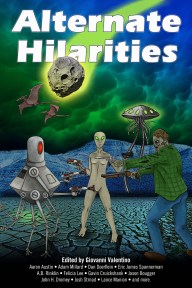
Over the last few entries, I’ve posted that Strange Musings Press would be printing my story Amending Diabolical Acronym Misuse, subject to raising enough money through their Kickstarter page.
I’m pleased to report that the $1,100 target has been reached, and the anthology will absolutely and definitely be going ahead.
The Kickstarter campaign is still open, and there are extra bonuses for reaching $2,200 and above.
Around three weeks ago, I was pleased to report that I’ve had a third short story accepted for publication. Strange Musings Press of New York will be printing Amending Diabolical Acronym Misuse, subject to raising enough funds through their Kickstarter page.
There’s still around a week left to raise the $1,100 required for it to go ahead. You can donate at several different levels from $1 to $150, each of which buys you into the project with increasing levels of reward, including electronic and/or paper copies, autographs, and your name in the Contributors’ section.
My story is called Amending Diabolical Acronym Misuse, and it’s about a man who wants to rid the world of badly-constructed acronyms. Although I’m Scottish, my dialect is British English so that’s how most of my stories are written, including this one.
If I’m sending to an American publisher, I often change the grammar and spelling to suit; at least, I have a decent stab at it. In one case, I even wrote the whole story in US English because the character was so strong in my head: a cross between Jason Gideon from Criminal Minds, and Adrian Monk. In Amending…, I took the decision to keep it in my natural dialect as there are a number of references to British places and companies, and I felt it would look odd if I, “translated” it.
A couple of weeks ago, I began reading The Traveller by John Twelve Hawks. The narrative is written with a curious mix of dialects. For instance, the title is spelt with two Ls and there’s a reference to a pub, but the colour gray and an SUV appear in other parts. The SUV would be known as a 4-by-4 in Britain. The story is set in several countries so I expect it’s difficult to settle on one standard spelling, yet it’s not a distraction here, and I’m thoroughly enjoying the story.
Conversely, my mentor Zöe Venditozzi released her debut novel Anywhere’s Better Than Here in 2012. When a US edition hit the shelves, she told me there were no spelling changes made. When you buy a copy, watch out for the character whose initials match mine.
So is it important to adapt your dialect depending on which side of the Atlantic you’ll be published? I expect most Internet users will be accustomed to reading both, but at the same time, people will still write in whichever they feel comes most naturally.
Perhaps one day in the future, the two will merge and we’ll have one way of spelling each word, one form of grammar for all. It would be more practical, but probably rather dull.
I hadn’t written a response blog for years, and now this is my second in a fortnight. But this time, it was requested.
Scott Graham runs Suited Sorted on Blogspot, where he has recently re-focused on Android technology, although he has back entries discussing music, television, holidays, and weight loss. He has asked for some constructive criticism about the page, and with ten years’ blogging experience, I reckon I’m qualified to pass on some tips.
Tone, spelling, and grammar
Scott wonders if he’s a little too conversational. There’s a certain style that many bloggers go for, whether they mean to or not. The closest off-line equivalent is an opinion column in a newspaper. You’re telling the reader your view on a particular matter, but using everyday spoken words. For instance, you’ll say asked for rather than requested, or use contractions like can’t instead of cannot.

But this isn’t a licence to spell words any old way, or leave out punctuation where it’s needed. Almost every piece of blogging software has a spellchecker. Spelling extensions are available for Firefox and Chrome, most mobile phones have the facility built-in, and the latest edition of Microsoft Word even lets you post to WordPress directly. If the reader doesn’t have to decode what you’re trying to tell them, your message will come across much stronger.
Scott, you’re doing fine on that front.
Layout
Newspapers and magazines learnt early on that long articles do not translate well to the Web. When you’re reading a three-page printed interview, your neck automatically moves downwards as your eyes follow the text, where scrolling down with your hands requires more conscious effort. A normal screen – not an e-ink display – is also brighter than a page, so it’s harder to read from.
That’s why I restrict my paragraphs to about three to six lines, and leave a clear line between each one. A lot of people will give up reading a wall of text, if they attempt it at all.
Your paragraphs can be quite long, Scott, but certainly not the dreaded wall.
Attracting attention
Using the site analytics tools on WordPress, I’ve found that my posts attract more attention and reaction if I post them between around 6pm and 10pm Monday to Friday. Entries made at any time on Saturday or Sunday simply don’t seem to be noticed. Certain tags also seem to generate interest, while others have no effect.
For years, I posted with LiveJournal and tagged my entries. I very much accepted that hardly anyone except my friends read the page, as they were the only ones to comment. But when I moved to WordPress, I realised I’d been missing out on this vital piece of analysis. Everyone will be different, and some will find that daytime or weekend posts work for them.
So keep tagging your entries, Scott, and have a look at Blogspot’s analysis tools to find out exactly when people are reading you. I hope you’ve found this critique helpful.
To everyone else, I’ll be pleased if any of my suggestions help you with your own blogging.
It’s a rare occasion that Mostly Yummy’s blog topics will intersect in any way with mine, but today it’s happened.
I didn’t realise until this morning that World Book Day was such a big deal among the nation’s schoolchildren. They’re encouraged to dress up as their favourite fictional character.
The theory of this is quite sound. A child’s imagination can be sparked and expanded by his or her early reading choices. The other part of the theory is peer pressure. If a child knows that everyone else will be dressing up, they’ll likely want to do the same.
Like many children, I loved Roald Dahl’s slightly twisted novels, but I also enjoyed the stories from Antelope Books. I can’t find any relevant references to Antelope online, so do comment if you remember these guys.
But as Yummy points out in today’s post, the reality of the aforementioned theory can be very different. She tells us how she tried to cobble together outfits for two of her children, while making a valid point that the dressing up can overshadow the intention of World Book Day which is to read.
I must’ve mentioned this before, but being asked to do anything artistic scares the bejesus out of me; even seeing the words Daler Rowney brings me out in hives. I disliked the subject at school since I could never make the final product look anything like what the teacher asked. I did know what I wanted to draw, paint, or construct, but it became lost somewhere between my head and my arm. In essence, I sympathise a great deal with my fellow blogger.
I’ve been upfront from the start that I’m a latecomer to writing fiction. I didn’t pen a single piece between my last high school English class, when it was mandatory, and just before I turned 27. Despite the long gap, I find writing comes naturally to me, although I still had to learn the rules and conventions of the craft, whereas expressing myself with a paintbrush just isn’t me.
I recognise that some people won’t be able to relate to this as they have the exact opposite talents. I would like to learn, as it could complement my writing. Perhaps someone suitably gifted could put together a Complete Ninny’s Guide for me, and throw in a copy for Mostly Yummy.
I’m pleased to report that I’ve had a third short story accepted for publication. New York publisher Strange Musings Press will be printing Amending Diabolical Acronym Misuse. However, it will only go ahead if enough people contribute.
To this end, a Kickstarter campaign has been set up to raise $1,100 by Tuesday 25 March. You can donate at several levels from $1 to $150, each of which buys you increasing levels of acknowledgement, privilege, and general bragging rights.
I wouldn’t ask you to do something that I’m not prepared to do myself, so I’ve donated $22 under my legal name Gavin Cruickshank. That amount includes $10 overseas postage for a copy of the book, due out on Thursday 1 May. You can see my contribution on the backers’ page.
I would be most grateful if you could give whatever you can, and the editor Giovanni Valentino will be delighted. Don’t forget to share this blog post on WordPress and/or your preferred social networks.
If this comes off, I’ll have been published in the UK, Australia, and the US. Canada, I have my eye on you.
I originally posted this on 17 February. However, it never posted to Facebook, Twitter, or Google+. Here’s what you missed.
What is the collective noun for hyperlinks? If there isn’t already one, may I suggest the term clique, a play on click? It’ll be a quick entry today, with four links I’d like to share with you. I’ve ranked them, starting with what I believe to be most interesting and useful first. If you have any further suggestions, place them in the comments. Here is my clique.
I use this site quite a lot, and there are always articles discussing the use, abuse, and disuse, of our language. It’s updated most days, and offers something for even the casual linguist to think about.
Further to my Tabletpunk, suggestion a couple of weeks ago, this Buzzfeed article lists some genres you might have heard about, like the Penny Dreadful, and some that are new to me, including Wuxia.
Gender-neutral pronouns in English
In the Mandarin language, there isn’t much to distinguish between the pronouns he, she, him, and her. But English is the opposite, with very few ways to hide the gender of a person. This in-depth article explores the problem and possible solutions. You might have to close an advert to read this article.
The chances are that you already know this, but there is something here for those who have always used blogging software off-the-shelf, as it were, without any tinkering. It focusses particularly on WordPress, which I found a comfortable duvet after nine years with the scratchy blanket of LiveJournal. You have my author friend Wendy Jones to thank for this.
I met a woman last week who reads books in a particular manner. She’ll read the last few pages first, decide if she likes the way it ends, and if so, she’ll then start reading from page one. She added that this method allows her to know if there’s going to be a satisfactory ending before investing time in the main story.
I do accept her argument as logically sound, but there are books where the ending makes very little sense unless you’ve ingested the main text. I’m thinking of an epic novel, such as Moby Dick. Reading the conclusion without knowing the tensions between Captain Ahab and his crew, detailed in the rest of the story, you won’t fully understand why their voyage ended the way it did.
If you ever do tackle Moby Dick, incidentally, you can quite safely skip Herman Melville’s obsessive personal polemics about the whale.
Another problem with this system is that some books paint a picture rather than tell a story. Consider Breakfast at Tiffany’s; the novella, not the film, although the woman in question uses the same method with DVDs. Truman Capote explores the complex relationship between the narrator and Holly Golightly in such a rich manner that there is as much to be gained from the description as the plot.
I do enjoy including some historical context in my entries. Read the prologue of William Shakespeare’s Romeo & Juliet and those 14 lines give away the plot before any of the other actors say a word. Audiences expected to be given the precis at the beginning.
By the 20th century, the position was completely reversed. Agatha Christie understood this when she wrote The Mousetrap, at the end of which she specifically asks the audience to keep the secret. These days, there is still an expectation that endings will be kept under wraps, or clearly marked Spoiler Alert, with the odd exception such as Star Wars or The Sixth Sense, where it seems fair game to give it away. But there are also websites you can consult if you want the full plot.
I’ve created a poll to gauge how many WordPress users agree with my feelings on the matter. If necessary, do expand on your answer in the comments.
Nothing marks out a generation more than the slang it uses.
If we concentrate on right now, February 2014, you’ll hear people say they’ve, “taken a selfie,” or say, “because,” followed by a single word rather than an explanation. Back fifteen years, and it wasn’t unusual to, “tape that programme,” or answer the phone with, “WASSU-U-UP?”
So when writing a piece that’s going to hang around for a while, most notably a novel, it’s a good idea to decide whether you want to incorporate the slang of the day to make it a period piece, or create a more timeless tale by using more generic terms.

I recently wrote a story where a major plot element is a pager. This immediately sets it in the 1980s, and I felt safe using the term data bank to describe the device’s storage, rather than the more modern memory. I tried not to overload the piece with dated words, but I did allow myself a yuppie, as the pager’s owner described himself.
But while the eighties is over and we know what it was like, writing a story set in the future is different. One day, selfie and because _____ will be as embarrassing as fab and groovy. For my first novel, where the action takes place in the 2500s, I used, for instance, sound system rather than iPod or even MP3 player. I decided not to try predicting the future term, and write something a little more bland, as would distract from what I was trying to say.
There is an elegant solution to this problem, and those of you who write steampunk know what I’m talking about. This genre imagines modern or relatively recent technology as people in the 19th century might have seen it. There are many literary examples of this, but an accessible non-literary one is the TV series Warehouse 13.
Which leads me to wonder if there’ll be a genre of the future where writers of the 2110s envision their everyday gadgets as we in the 2010s might have viewed them. This decade’s most popular invention is probably the touchscreen computer. So, a hundred years in advance, I’m going to label this predicted genre as tabletpunk.
I’d like to be around to see the look on some geek’s face when they unearth this entry.
It must have been about fifteen or so years ago that I was listening to a portable radio – perhaps tuned to Radio 2 – and the DJ played an incredible track. It was simply a wall of words shouted by an incredulous, angry voice. I caught the name of the artist: one Gil Scott-Heron with his poem The Revolution Will Not Be Televised.
I use the word poem very deliberately, as that’s how he wrote it. It contains many of the elements of performance poetry, being light on metaphor but heavy on wordplay. Today, it would probably be classed as rap because it also embodies many of the hallmarks of a modern rap track, with repetitive backing music and rapid spoken words.
Even if you don’t remember the racial tensions of the 1970s, he conveys the spirit of the time in just over three minutes. I also have the rest of the eponymous album on vinyl. If you seek it out, do listen for Whitey On The Moon as well.
I was just as surprised listening to Radio 1 in 2002 as some ska-like sounds started to play. The trumpets of Let’s Push Things Forward made me a fan of The Streets for their first two albums. I recommend avoiding the last two, as Mike Skinner appeared to have run out of ideas by then.
His first CD Original Pirate Material (OPM) was hailed as ‘Shakespeare for clubbers’ as he spoke about urban life in the UK, painting an uneasy sense of civil unrest bubbling under the surface. For this, the BBC also made the comparison to Never Mind the Bollocks, an unfair comparison because Skinner is far more intelligent than that.
For a start, each track on OPM quotes a lyric from another track, while his second album A Grand Don’t Come For Free is a proper concept album, each track adding a little more to the story arc. Between the machine-gunning internal rhymes, Skinner also surprises with the beautiful ballads It’s Too Late and Dry Your Eyes.
More recently, Rizzle Kicks burst onto the scene with Stereo Typical. I can’t get enough of their second album Roaring 20s. It’s the hooks that draw you in, but the lyrics keep you there.
Even when you move past the radio-friendly Skip to The Good Bit and Put Your Two’s Up there isn’t a duff track among them. I Love You More Than You Think is about unrequited love, while Me Around You explores the awkwardness of acting normally around an ex-girlfriend. It’s hard for lads to talk about things like that, yet they acknowledge this difficulty while expressing themselves in such a fluent way.
The point I’m trying to make is that not all rap should be dismissed as rubbish spouted by overpaid bigheads. If you know where to look, there is some good quality writing out there that we can all learn from. At the very least, it can help bring on the right mood or give just a small suggestion to expand upon. I openly admit that poetry is my weak point, so I mainly listen in awe of how these artists construct their words and phrasing.
Of course, inspiration can come from the strangest of sources. I have a short story that came from watching an RSPB advert, and a poem that was helped along by Corona’s dance track Try Me Out.
And that’s a wrap.
 Gavin Cameron