Never has Earsham been so lauded.

There’s a reason you rarely see my work on the Web. When you send work to publishers or competitions, their rules normally stipulate that the work must not have been published elsewhere, including paper books and online. This entry is a rare exception.
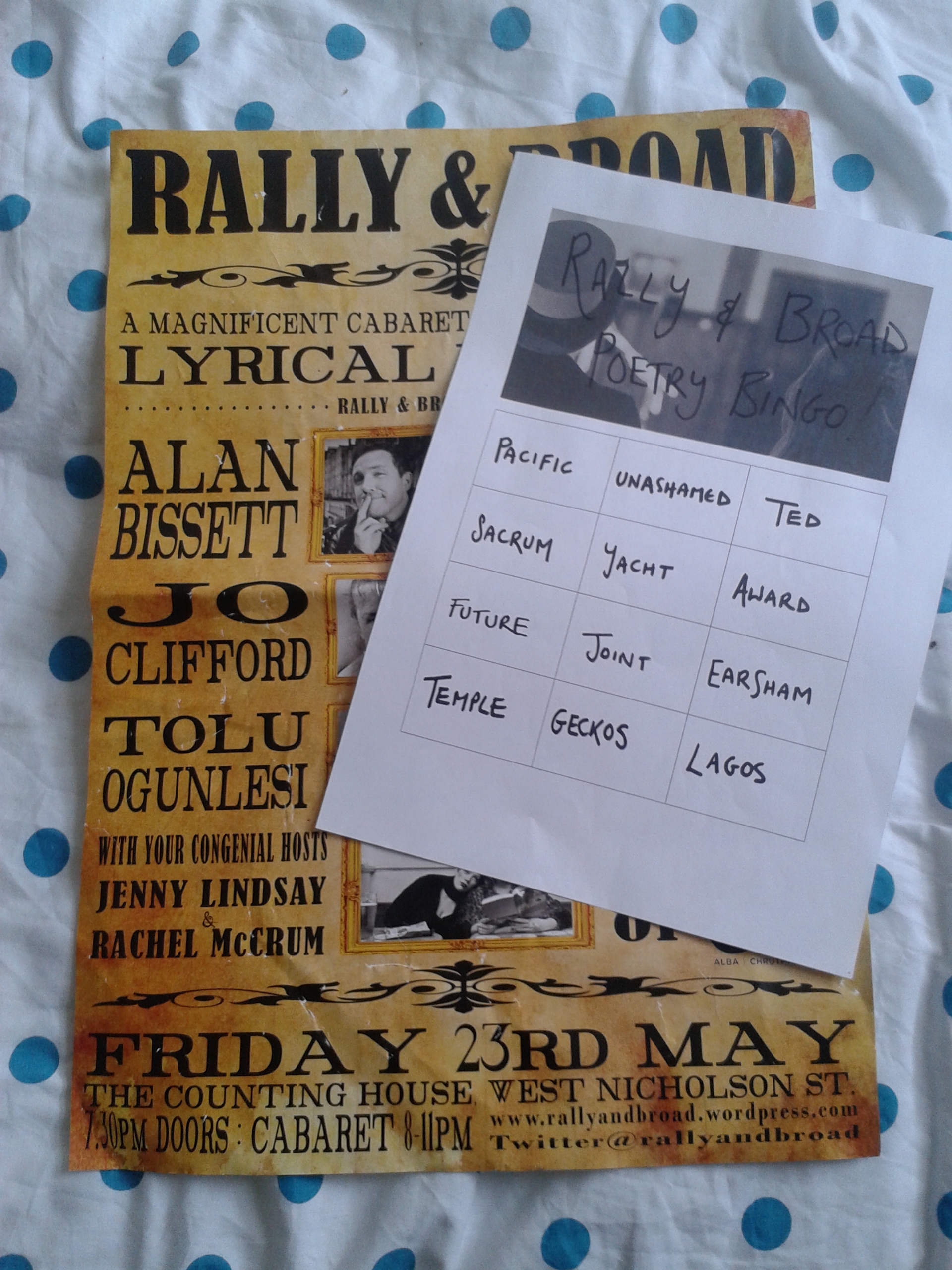
On Friday 23rd May, I had the privilege to see Rally & Broad, Luke Wright, Lake Montgomery and Alan Bissett for the second time, plus others for the first time. At the event, the organisers ran a Poetry Bingo competition, encouraging the audience to circle off twelve words as they heard them in the show. In addition, there was a challenge to use these twelve words in an original poem, and the winner would receive a ticket to the last show of the season. I’m pleased to report I was one of three winners, and my effort is below.

Note that the last four lines are slightly incorrect because my handwriting was terrible, but I actually quite like the published version. Those few words lend it a different tone. The correct words are:

He could make up the
how, where, why and when of it.
So the unknown rescuer
could keep his sickness benefit.

See which one you prefer.

Rally & Broad's avatarRally & Broad

We do love to stretch our audience’s artistic glands. At Rally & Broad’s last outing, ‘Ye Dancin’?’ (May 2014), we went for a bit of good ol’ poetry bingo – our esteemed poets and artists gave us some words that would be guaranteed to pepper their sets, and waited for ‘HOUSE’. And just to flavour it further, we promised a free ticket to our season finale to the best* poem that could be made up from the words on the bingo cards.

*best proved a tricky concept for us to qualify. Oh we tried, readers, we tried, but Rally & Broad are different and passionate beasts in their own fiery ways and had to agree to differ before fur flew. Thus, we have three winners: Rally’s Favourite, Broad’s Favourite and Definitely Most Amusing. 

Anyway. Thanks to all! You are most marvellous. xx
Poetr

Rally’s Favourite 

I wrapped my dreams up long…

View original post 423 more words

Long May It Last.

A couple of entries ago, I riffed upon the art of shortening the short story. But having thought a little more about it, I’ve come to realise a lot of the short stories I’m most proud of are actually longer than 2000 words. I have written novels, but they’re a different class entirely.

My longest short is called An Abundance of Apples, clocking in at around 4500 words. This tells the story of a man who trades 26 items, each beginning with a different letter of the alphabet. This was always going to be the approximate length, and it gave some room to manoeuvre when telling the story.

Another of my favourites is The Cracked Goldfish Bowl, about a man with an amazing memory but no self-confidence. The final word count was 4300 words, but that’s merely because I kept thinking of new challenges to face the main character rather than creating an overarching plan.

I tend to approach my short stories from the top downwards. Sometimes I know where I’m going to end up, but often I let the story wander as it wishes. An artist I know, Jennifer Robson, prefers the meandering approach to her sewing, as she doesn’t feel challenged if she knows what the end result will be.

I’m a strong believer in writing a proper ending to a story, whether that ending is known beforehand or not. Sadly I’ve read too many ‘two-thirds’ pieces with a great set up, and enjoyable narrative, but the writer has omitted a satisfactory conclusion, leaving it to flop out with a vague sentence or two. That final third might have made all the difference.

What I’m saying is that some stories need cut down to size, as discussed in that last entry, while others require some room to breathe. The question is which approach is the best one to take for that particular story.

What a So-and-So.

I once heard digital information compared to a greasy pig. You can hold on to it for so long before it slips from your grasp. Despite this, I’m unable to find a recording of the BBC Breakfast news item about the use of the word, “so,” at the beginning of sentences. I can only find their Twitter update from Friday:

Nonetheless, I’ve found a great example from last year, when the boss of BlackBerry failed to explain adequately how the company lost direction. Stephen Bates uses the conjunction at least four times at the beginning of answers, and several more throughout.

I think we all know people with verbal tics. I probably have one I’m not aware of. I once had a conversation with someone who kept saying, “He/She turned around and said…” By the end of the conversation, I imagined the other party with a nail in one foot, frantically turning round and around with the other.

On the page, a fictional character with a pet phrase can be a useful device in dialogue. If they always start with, “Well, the thing is, you see,” or call everyone, “love,” it eliminates the need for an identifier when multiple people are speaking. Even a gesture can be effective. I have a novel where a character shrugs when he doesn’t know an answer, and that’s a lot of the time.

But, well, the thing is, you see: balance is key. It’s enough to, like, give a flavour of the character’s go-to words. Including it in every, like, sentence or clause will only, like, annoy the reader.

The Final Cut.

Further to the publication of the Alternate Hilarities anthology, I’ve been interviewed by Strange Musings Press. I’ve also received two paper copies of the book, but I’ll read the electronic version and keep the physical copies pristine and flat.

The story in that anthology is 1,160 words long, but in fiction, as in food, it’s sometimes necessary to cut down. I’m a great fan of reading work aloud. It’s a very good way of finding where one clause would be better than two, or where a semicolon could replace several words.

I only half-follow Elmore Leonard’s advice to Kill your darlings. In other words, to cross out any lines you particularly like. I think that’s fair game if the line in question has been squeezed in where it’s inappropriate, but if it’s the perfect means of expressing what you mean, I say jolly well leave it in.

But what if the problem is not just a line or two, but whole chunks of text? I encountered this problem with a 1,000-word story I wrote well over a year ago. I simply couldn’t make it work to my satisfaction. I shuffled round a few of the characters, who are all introduced as they enter a house, but I still couldn’t make the story flow.

In the end, I cut out the first 700 words, and I’m much happier. All the characters are still there, but it works by starting when they’re already in the house. The dialogue explains the immediate situation, and the twist makes the reader fill in the gaps.

But what to do with the cut part? Don’t delete or bin it, whatever you do. You’ve worked your hardest on it, and it deserves to be seen. I’ve recently started to maintain a list of story stems, those ideas that have thus far gone nowhere. Some are mere seeds, others are massive chunks, but they’re waiting with their jackets on in case the right alternative idea comes along.

Since constructing my list, I’ve used three of the stems. Once I use them all, I’ll need to start actually thinking again.

Alternate Hilarities Released by @Strange_Musings Press.

I’m pleased to report that my short story Amending Diabolical Acronym Misuse has been released today by Strange Musings Press in its Alternate Hilarities anthology, along with a number of other comedy pieces.

It’s available in both paper and electronic formats. You can buy a copy from Amazon UK, from Amazon US, or from Smashwords. Find out more about the book, and enter their Rafflecopter gift card giveaway, at the official website.

I’d also like to give thanks to the editor, Giovanni Valentino. Book publishing takes months of work, and throughout it all, he has been in regular contact with the contributors, and kept us up-to-date with its progress.

A Sense of Time

I’ve recently started watching old episodes of the comedy show Drop the Dead Donkey. At the beginning of each episode, an announcer now explains some of the topical references. As the series ran from 1990 to 1998, it’s likely a lot of them will have been forgotten.

A similar rule applies to fictional writing. If you want to set a story in a particular era, there might need to be some explicit or implicit reference to the timeframe in which the story is set.

For instance, one of my novels is set in 1964. This is introduced to the reader when a 21-year-old character is revealed to have a birth year of 1943. There are plenty of other era references throughout, but this avoids the dull initial statement that, “The year was 1964.” In one of my short stories, the 1980s is drawn more subtly, since the main character possesses a Filofax and a pager. It falls under Elmore Leonard’s classic advice to show, not tell.

To me, it’s important to avoid jarring the reader by letting them assume the story is set in the modern day if it isn’t. If a character is described as arriving home by car, then watching TV, that could have happened any night in the last fifty years. But tell the reader that the character arrived home in a Ford Capri, or watched Popstars: The Rivals, and that says they belong to the 1970s or the 2000s, especially when they go on to look up a number in the Yellow Pages and dial it from a wall phone. There will, of course, be occasions when you’re already aware the author lived in or wrote about a particular era.

The alternative is to make this story timeless. It’s hard to do in an urban environment since architecture and technology change, but it can still be done very successfully. If you’re describing a natural scene, it’s much easier to imagine it being any time over the last thousand years.

For anyone reading this well beyond 2014, this entry was set at a time when David Cameron was Prime Minister, coffee-lovers went to Starbucks for their fix, and people still thought Twitter was a good idea.

Extrovert Through The Gift Shop.

There’s no escaping the truth that writing is a solitary occupation. Authors can spend hours of their life alone in attics, sheds, and cafés, immersed in the land, world or universe they’re trying to create. It’s therefore tempting to imagine that this breed of people are shy introverts. Actually, of the majority I’ve seen, I’ve found the reverse to be true.

These days, it’s important for a writer to be able to self-promote, as many publishers’ marketing budgets are not massive. A prime example is Man Booker Prize winner Eleanor Catton, whom I had the privilege to see at a live event last week. She was interviewed about her book The Luminaries and gave some excellent, confident answers. Doug Johnstone also illustrates my point, as he’s forever looking for an opportunity to crack out his guitar. Chris Brookmyre dispenses entirely with an interviewer in favour of his own speech, while Iain (M) Banks usually invited questions from the word go.

This space reserved for Banksy's next piece
This space reserved for Banksy’s next piece

Have you considered trying it yourself?

Public reading and question-fielding is not reserved exclusively for established authors. Anyone can do it, and I believe they should. Like many authors, I read my work out loud when there’s nobody around, as it’s a valuable tool for ironing out clumsy phrases and misplaced punctuation.

I also consider myself an extrovert. I might spend time alone in front of a PC churning out short stories, but I’m perfectly at home in front of a microphone or camera. I volunteered at hospital radio for a long time, and used to keep a video blog. I’m also lucky enough to have a writers’ open-mike night nearby, where I can try out new material. The audience is made up of fellow authors and poets.

That’s not to say I don’t find it terrifying standing in front of them. I’ve never made a complete hash of it, but I have stumbled, and that’s something I need to work on. But even if you’re an introvert, find a willing audience and push through that barrier. It’s valuable for seeing how well the piece goes down with the public, particularly if they’re laughing when they should be shocked, or vice-versa.If you do, your work will almost certainly improve, and if you become published, you’ll already have the experience of making public readings.

While I was writing this, I thought of one introvert who always causes a fuss whenever he exhibits a new piece. I refer you to Banksy in his iconic film Exit Through The Gift Shop. He seems uncomfortable with the camera being near him, but his self-promotion skills are second-to-none. I know he’s an artist, but if he were a writer, I wonder what type of work he would produce?

The Paper Trilogy.

I intended to make only one entry on the theme of paper, which turned into a second post. This entry will be a short third and final update on this topic, as I just keep finding more material.

I’ve discovered more notebooks, including some early drafts from my second novel, and a review of Tron: Legacy for my old LiveJournal blog. Once again, I’ve never reached the last pages of these pads. I find this rather strange, as I’m not the sort of person to leave a job half-finished. Once, I would have preserved them as they were, but I’ll use the other pages in the future if I need to.

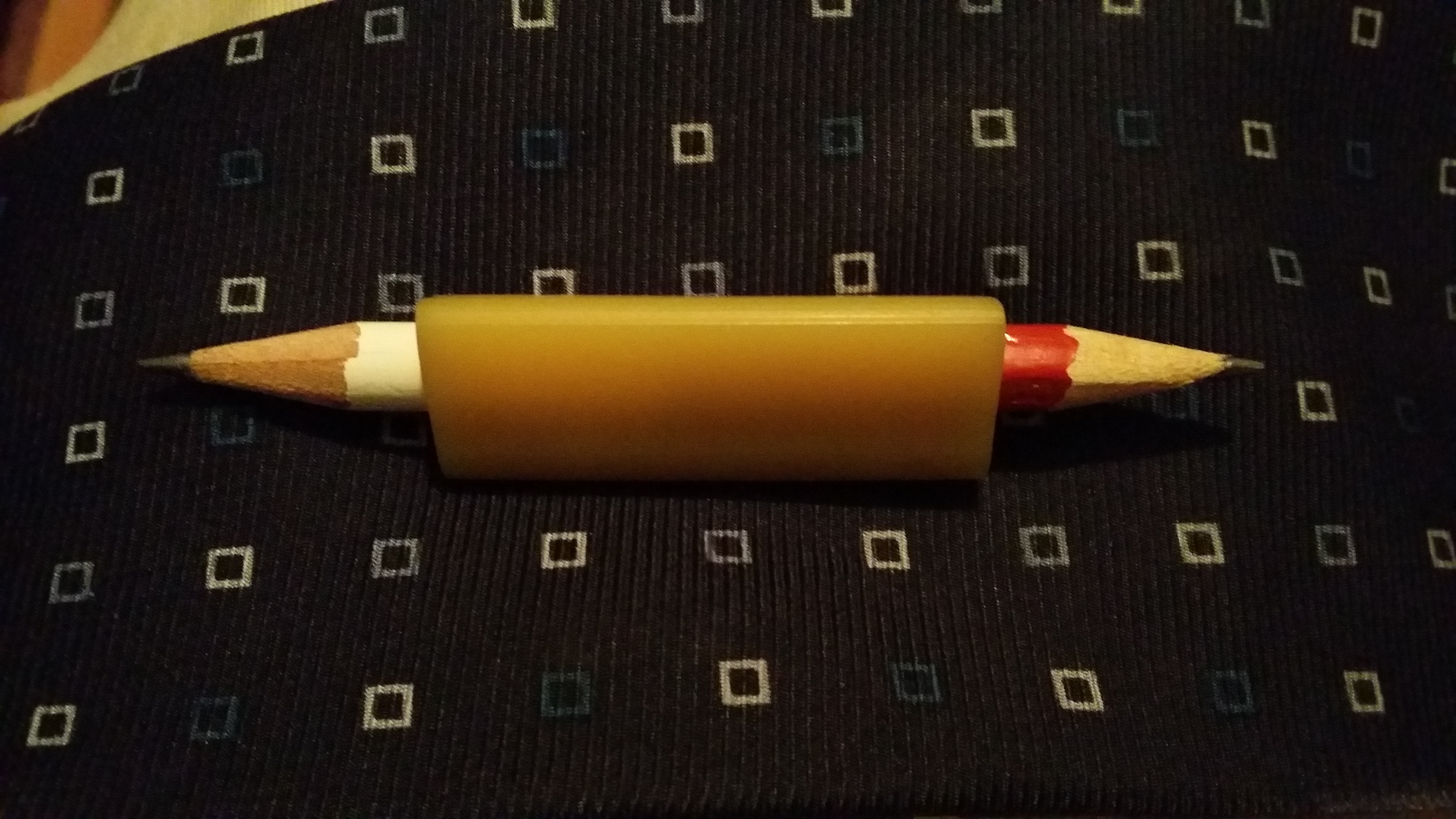
My pencils are a different story. I have dozens of them around the house, and I don’t like to waste them. In fact, here are my two smallest ones joined by a rubber grip. I’ll use them until I physically can’t hold them any more:

The world's smallest pencil

I’ve also discovered from Mental Floss that every new prime minister leaves a handwritten letter about what to do in the event of a nuclear conflict if both he and his assigned second-in-command are dead. It seems a little strange that such a format is still used. If I was PM, I’d make sure I spelled it out in 16-point Helvetica so the commanders aren’t standing around asking, “Does that say, ‘load weapons,’ or, ‘lower weapons?'”

More poignantly, ListVerse posted a collection of last words written by people facing certain death. Not all of them had the luxury of pen and paper, including the prisoner of war who scratched out a memorial on a rock, and a diver who wrote his on a slate.

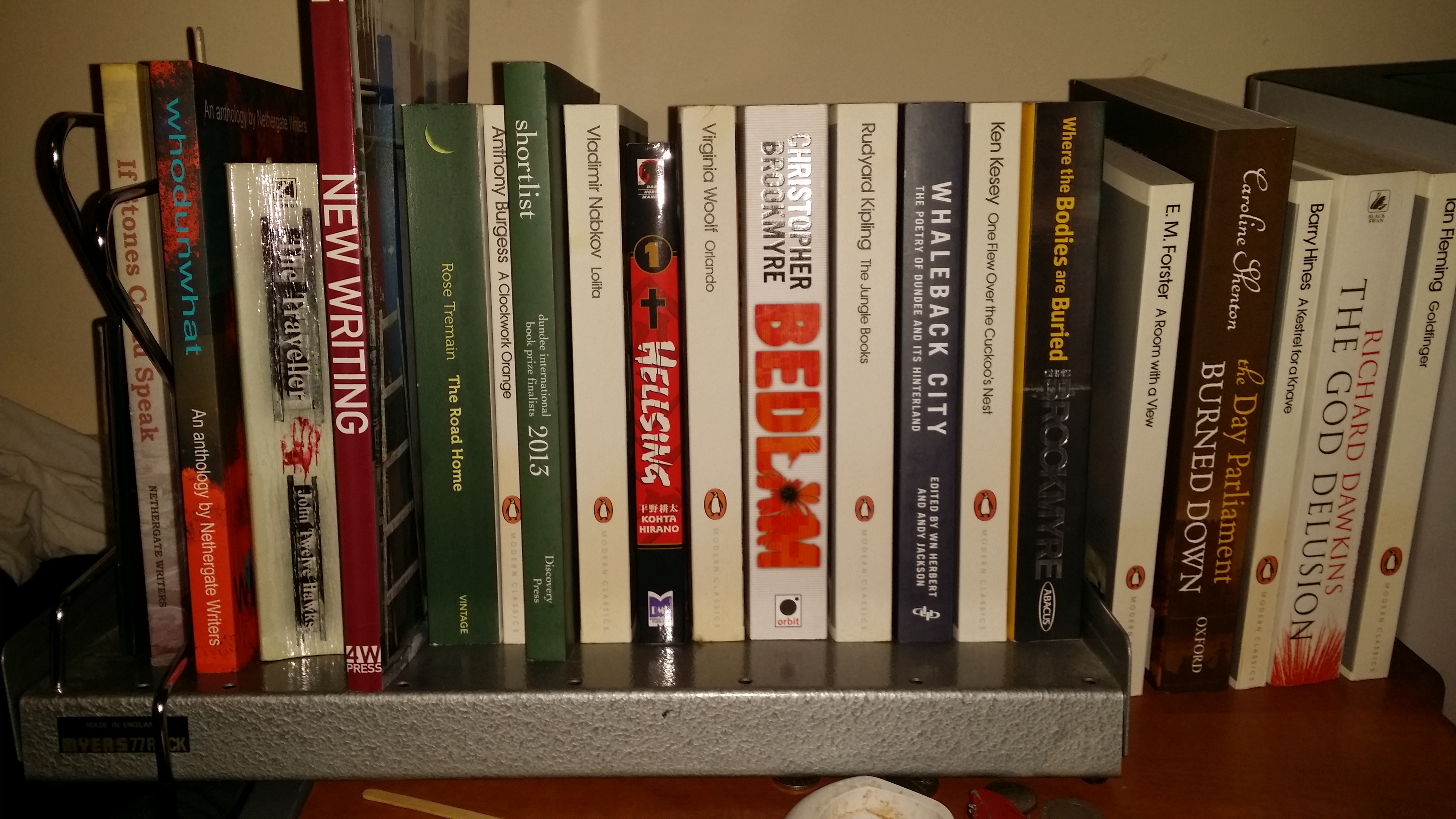
Lastly, I’d like to show you the paper books I plan to read throughout the rest of the year, including modern writers such as John Twelve Hawks and Richard Dawkins, a selection of Penguin Classics, and a number of local anthologies:

Paper books to read this yearIf you want more information on any of these, let me know.

Some Salvaged Scribbles.

A few days after my handwritten entry last week, I was looking for something in my bottom drawer, when I discovered an old notepad. It’s nothing special; it’s a Tesco Value spiral-bound A4 pad with a slightly ripped cover.

I’ve used a quarter of its 80 pages, and most of it is taken up with attempts to expand on a fragment of poetry that I tried to expand into a song, although there is also a brief novel idea, pages of free writing, and a poem on the topic of my own handwriting.

Of these, I only consider the poem be a decent piece of work. As for the rest, I know what I was trying to express, but I didn’t have the techniques at my disposal to do it properly. But looking at the content, I’ve calculated that I last wrote in this notebook in September 2009, more than a year before I began writing. I’m therefore not surprised about the quality.

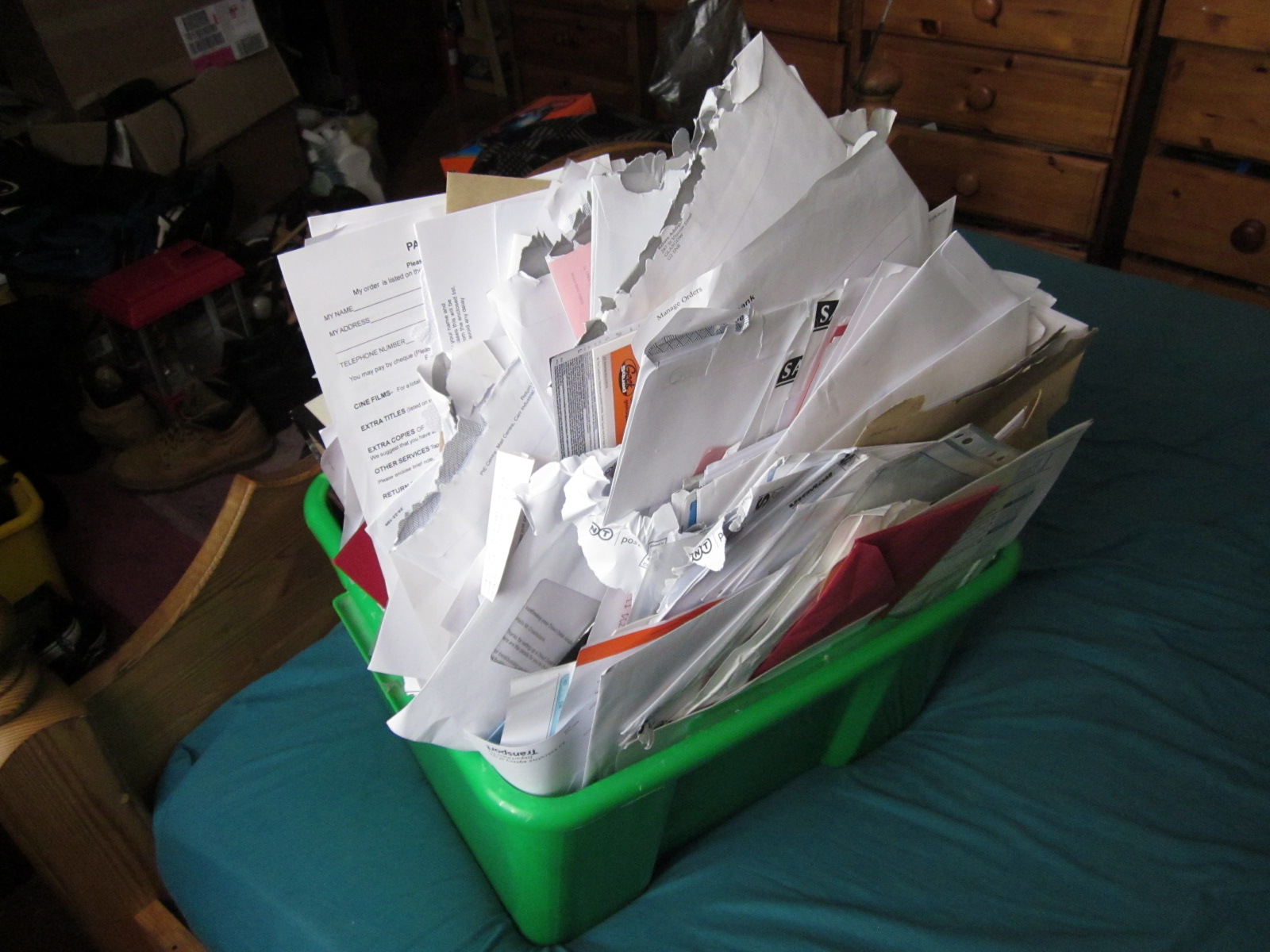
My filing system
My filing system

Yesterday, I discovered other half-completed notebooks, but none as full or detailed as this one. I’ve noticed I rarely reached the last page, although I’m more than likely to complete my current ones. Also, there are hardly any drawings or even doodles, just text.

But the one notebook I would like to look at again is missing, believed lost. At my very first National Novel Writing Month meeting, my laptop battery died. I had to rush out and buy a notepad and mechanical pencil so I could continue my story. I had it about a year before its disappearance, and it contains drafts of my first novel, and some of my earliest stories. I don’t think I’ve lost anything, but I might have.

I know I’m not the only writer with notepads dotted about, and I’d like to hear about yours. Do you have any hidden in a drawer somewhere? What did you discover when you pulled them out again? Have you misplaced an important story you wish you could recover?