When you simply don’t like it.

I recently visited the D’Arcy Thompson Museum at the University of Dundee, where a young girl was being shown around by her mother. The collection is full of animal specimens from Sir D’Arcy’s work, but this girl was having none of it, constantly saying, “This is boring, there’s no dinosaurs.” There have been a couple of occasions recently where I’ve felt like doing this myself.
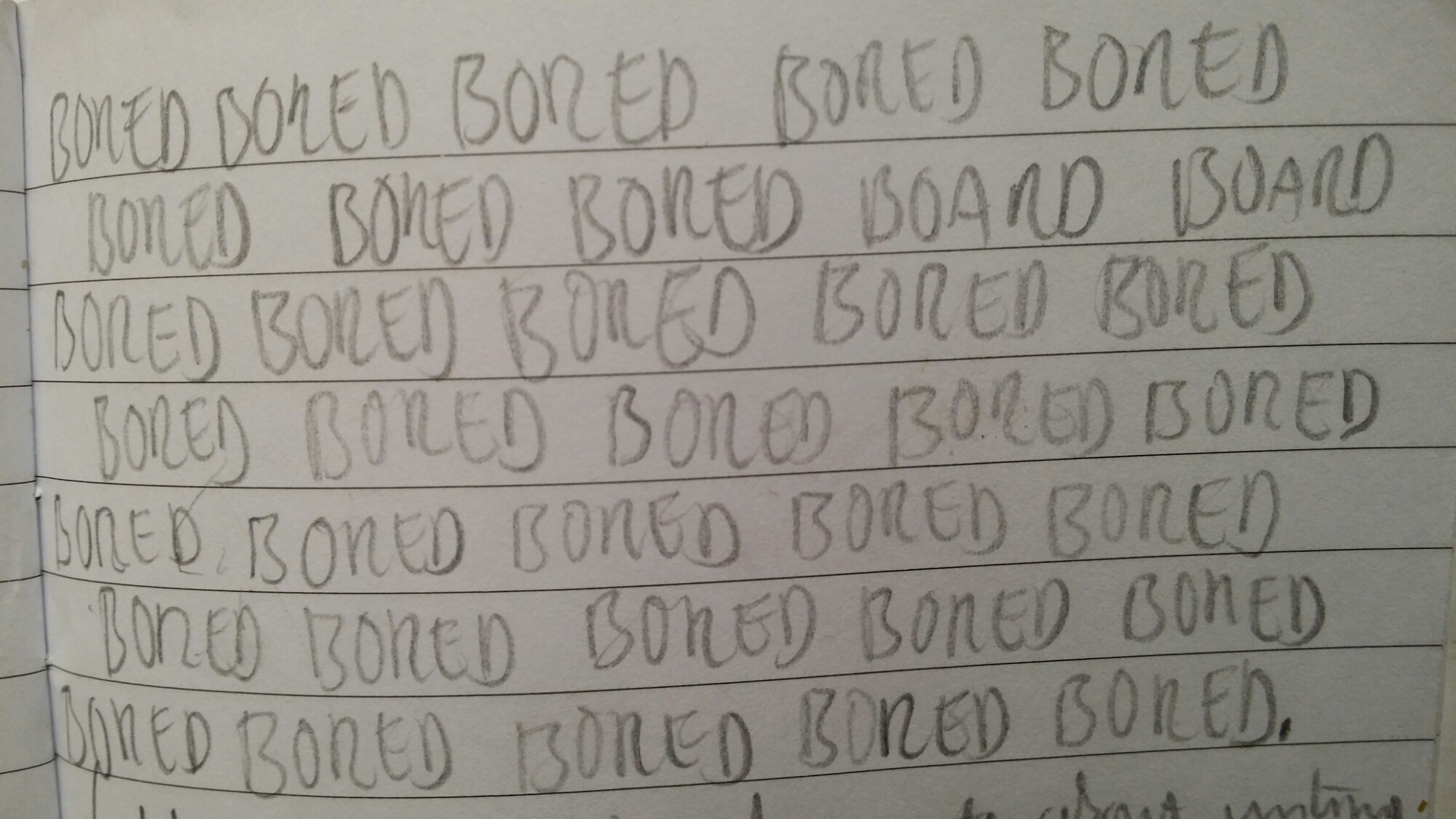
A genuine extract from my notebook upon seeing Jeanette Winterson

One of them was at a talk by Jeanette Winterson to promote her latest novel The Gap of Time. The majority of the event was spent showing videos about Shakespeare and speaking about his life. It wasn’t obvious at first that she was referring to the structure of her book, but even when it became clear, it felt rather disjointed and rambling. Thankfully, once Winterson began answering questions, her own personality shone through; much more engaging than the showmanship that had gone before it.

I also recently began reading E M Forster’s A Room with a View, one of the ten Penguin Classics I have on my shelves. However, I was soon overcome by some confusion. Much of the first couple of chapters is about the two sisters, then other characters appear, but it isn’t clear where they’ve come from or where in Italy they’re currently located.

My puzzle is what to do if I don’t like an event or a book, or what should I have done.

In the case of Jeanette Winterson, I probably would have left the room if I hadn’t been seated in the middle of a row of about two dozen people. By the same token, I would have missed the excellent question session if I’d gone. As for the book, I’m still reading it because I’ve been gripped by the dialogue, but the appearance and disappearance of characters is rather jarring and I’m debating whether or not to abandon it.

So my question this week is: what would you have done if you were at an event you couldn’t take to, or reading a book that didn’t fully engage you?

Connections.

Before I begin the entry proper, I need to ask a question of the WordPress community.

Whenever I post an update, a link is sent to three social media sites. The Twitter and Google+ connections have worked from day one, but the Facebook one needs to be refreshed at least once every couple of weeks or the link isn’t posted. Every so often, I also remove the WordPress app from Facebook and reauthorise it, but that has no long-term effect either.

How do you fix this permanently? I’m fed up of having to make a manual post to Facebook.

Last week, I mentioned I was attempting stand-up comedy for the first time through Bright Club. It was, for a while, looking like it might be a disaster. When I was rehearsing at home. I kept forgetting to say important lines. At the rehearsal on the day, I forgot which section came next and had to ad-lib until I remembered.

During that final rehearsal, a lot of my material hadn’t received much of a reaction, probably because I was speaking to the other comics and they’d heard much of it already. But at the end of that rehearsal, the organiser wanted to check the microphone level, so I recited a limerick that wasn’t part of the act. It went down so well with the others that I was persuaded to slot it in.

English: Empty stage for a stand-up comedy sho...
This is not the venue I was in. It’s merely a generic representation of it. (Photo credit: Wikipedia)

There were six acts performing; I would be fifth on the bill. I chatted to the MC before the show and in the interval and we agreed it was going well. All I would need to do was remember all my lines, plus the limerick, plus the other tweaks that were suggested, plus a prop I needed, plus to speak slowly enough so everyone could catch my words.

When I walked on, I began with a joke that referenced the previous act, then launched into my own material. Most of it got the reaction I wanted, and the limerick even earned a round of applause. Indeed, everyone was a hit with the audience.

Would I do it again? Of course I would. Bright Club is slightly limiting in that you have to talk about your research; I could have crowbarred twice as many gags in there if I’d been free to discuss anything.

The performance was captured on camcorder, but it’s not yet available as it needs to be edited. I’ll make sure you’re the first to see it, Facebook connection permitting.

… and be counted.

This Friday coming, I’m going to try my hand at stand-up comedy. I’m quite comfortable with reading prose and poetry out loud, and I tell jokes on Twitter. However, this’ll be the first time I’ve combined these two skills, and it’ll be in front of an audience comprising students and academics. If you’re in Dundee, Bright Club starts at 8:30pm at The Braes on the Perth Road. At the time of writing, there were still tickets available.

Stand-up is a stream of consciousness art form and needs to be delivered from memory. I don’t have a great track record with memorised pieces. If you’ve been a long-term subscriber, you might recall the time I crashed and burned when trying to recite my opening piece:

But Bright Club looks after its comics. I attended a four-hour training session with Susan Morrison from The Stand and came away with a book titled Be a Great Stand-Up. There is also a rehearsal session tonight.

At first, I had some difficulty writing enough material for the eight-minute slot, but by using the techniques imparted in the training, I’ve added parts and cut others, and more or less made it the correct length. And I’m not having as much difficulty recalling it as I thought I might.

I sometimes forget not everyone is comfortable speaking in front of an audience; this was brought home to me during a discussion with classmates on the MLitt course I’m taking. I’d like to share with you, therefore, three great pieces of advice about posture, emotion, and focus. I’ve learnt two of these from experts, while the other is from me.

  • Posture, Giles Brandreth. In his Edinburgh fringe show Word Power!, former MP Brandreth imparts a wealth of advice. My favourite tip was a rather rude one to help you assume correct posture on stage: nipples leading. In other words, make sure they’re pointing straight forward and your posture will look after itself.
  • Emotion, Jenny Lindsay. During the summer, I attended a session run by one half of Rally & Broad. She related a story about a writer who was becoming upset every time she reached a certain part in a monologue. She asked the rest of the cast to write positive messages on the paper to help her through it. This is an extreme case but it is a useful way to remember everyone else wants you to succeed.
  • Focus, Gavin Cameron. This is general advice, so I’m hijacking it and sticking my own name upon it. For most of the time, I avoid looking at individual members of the audience. Instead, I pick a point of focus beyond the back row of the audience and address it. For a change in focus, I look between two audience members; the person on the left assumes you’re looking at the person on the right, and vice-versa. This allows you to concentrate on the words without being distracted by the listeners.

The only real way to improve is to keep doing it. I often ask to have my pieces videoed – as Bright Club will be – and watch it back. I’ve long reached the stage when I’m able to watch and listen back to myself without wanting to turn away. From doing this, I’ve learnt I say ‘um’ a lot without me even realising it, and that’ll be the next fault I work on.

I’d like to leave you with a video of me reading my poem Textbook. It’s one I had difficulty writing, but has proved so popular that it was used to promote the MLitt course along with the work of my contemporaries. I was most pleased I managed it in one take, and I hope Friday’s gig goes just as smoothly.


25/5.

Pomodoro is Italian for tomato. Did you know that? (Photo credit: Wikipedia)

If you’re a regular reader of these words, you’ll know I like to be productive. A few weeks ago, I began to use the Pomodoro technique to improve my time management.

At its most basic, you set a timer for 25 minutes and carry out your main task until it sounds. Then you set it for five minutes, during which you carry out a different task. This can be repeated up to four times.

Dividing up like this makes it easier to plan both mentally and physically. Mentally, it’s easier to imagine 25 minutes of writing than a four hour slog; physically, it prompts you to change position regularly. It’s often surprising what you can do in this apparently short time. So far in this period, I’ve proofread and sent a bulk e-mail, written two paragraphs of this entry, and I still have 3½ minutes to go.

If you try this yourself, here are a few tips I’ve developed:

  • Once you’ve started the timer, turn it around so it doesn’t distract you.
  • Make your five-minute activity totally different from your 25-minute work. I use the computer a lot, so in my rest time, I’ll go and load the washing machine.
  • Use a different timer for each period to avoid having to reset it. I use a kitchen timer for 25 minutes and my watch for the other five.

Let me know if that helps you.

Education, education, education.

In a couple of weeks, I’ll be returning to the University of Dundee to complete the MLitt in Writing Practice & Study. Some people have asked why I need to take a course when I’ve already been published and read aloud at as many events as possible. To answer this, allow me to draw an example from the movie industry.

There is a group of older A- and B-list actors who used to be at the top of their game. If they were in a film in the 70s, 80s, perhaps even the 90s, you knew it was probably going to be good. If these guys show up in a picture nowadays, it feels like they’ve stopped making the effort to improve their craft. I use the word guys deliberately here, as this phenomenon doesn’t seem to affect actresses nearly so much.

Michael Rosen (Photo credit: Wikipedia). Yes, I know it's grainy, but if I use a Getty Images photo, that would be huge and can't be resized.
Michael Rosen (Photo credit: Wikipedia). Yes, I know it’s grainy, but if I use a Getty Images photo, that would be huge and can’t be resized.

I don’t want to suffer from that sloppiness. However much I know, there’s always one more lesson ready to be learnt. In fact, I drafted this entry on a train ahead of a talk by children’s author Michael Rosen, and he happened to make a similar point.

I think you can always learn something new, however minor, from every event – especially if it’s through necessity. For example, I spoke last week about reviewing books for the first time, and I learnt a lot from that, including: the DURA house style, some of the editors’ preferences, and even how to use the Track Changes feature in Microsoft Word. My third and final review was published yesterday.

Even if the only lesson you take away is not to repeat the same action, your time is never wasted. That’s especially true if you also come away with a great anecdote or a free pen. Or a Masters degree.

Review of the week.

Recently, I’ve been trying my hand at book reviews. It’s markedly different from ordinary reading and from fiction writing, as you’ve to make notes as you go along. From these notes, you then have to identify themes and techniques, and explain why the author has or hasn’t delivered a successful product.

The first volume I reviewed was In the Catacombs by Chris McCabe, which appears on the website of Dundee University Review of the Arts (DURA). I had some difficulty writing it, not only because this was one of my first pieces, but because I found the author’s research to be less focused than I would have expected. That point is reflected in the final piece.

One of the DURA editors then handed me Play with Me by Michael Pedersen, which I duly opined about. I found this one so much easier as I enjoyed his writing and the themes that emerged from it. It turned out after I’d submitted the review that the editor had given it to me purely for personal interest, but it was accepted anyway. I’ve heard the book publishers liked it as well.

Scrymgeour Building, University of Dundee
Scrymgeour Building, University of Dundee (Photo credit: Wikipedia)

There will also be a third review published in a few weeks, as each one goes through a rigorous edit. By that time, I’ll have returned to the MLitt Writing Study & Practice course at the University of Dundee. Part of your final mark depends upon carrying out a review of a live event, so this is prime practice. It also gives me an insight into how editors think and how to resolve any disputes that might arise.

A secondary benefit of writing reviews is exposure. The more publications in which you can place your name, the higher the chance that someone will have heard of you; like Jack Sparrow in Pirates of the Caribbean, I’m always pleased when this happens to me. Last week, I was recognised by an art student who had heard me at an event in May and enjoyed the two poems I read. I was especially pleased because I also enjoyed her Masters art installation so much.

That said, I forgot to ask DURA whether these reviews could be published under my pen name, as my real one is harder to spell, but I’m not bothered by it. It never hurt Peter Serafinowicz’s career.

I want to be a book star.

In the early 1980s, Van Halen famously requested a bowl of M&Ms at each gig with all the brown ones removed. This was reported in the press as typical rock star behaviour, but the request fulfilled a practical purpose.

The band carried so much equipment on tour that they were worried about accidents from roadies failing to set it up correctly. By including the M&Ms clause deep in the technical part of the contract, they reasoned that if the bowl wasn’t set up as requested, there was a good chance the rest of the technical setup had been ignored as well.

While writers and poets don’t need nearly as much gear as musicians, I think I’ve been to enough literary events to know what I would like and wouldn’t like if I were ever to launch my own book. It’s not to be a diva, I’m merely thinking of practical matters.

I’ve narrowed it down to five key points:

Disabled access

When I’m organising NaNoWriMo events, one of my prime considerations is accessibility. At my hypothetical book launch, this would be a dealbreaker. Everyone ought to be able to come in and hear all about my hypothetical book.

Standing up

Many studies have shown that sitting down for extended periods is a Bad Thing. Sure, most book launches rarely last more than an hour, but multiply that figure by however many launches you’re doing, and the time soon mounts up.

I’d therefore prefer to stand up as much as possible, especially while signing. This has the added advantage that I would be physically on the same level as the reader and it feels more of a two-way conversation. Speaking of signings…

Clearly signposted queue

I went to a launch in July that was so well attended, the bookshop ran out of seats. However, when the time came for the author to sign copies, nobody thought to direct people about where to queue up. Two queues were formed, and the author had to take turn about to keep the wait as fair as possible.

Short questions

I saw a cartoon a few months ago where an academic was being interviewed on stage and the caption read something like We’ve just got time for one rambling self-indulgent question. Unfortunately, I’ve been unable to find it again.

I would have no problem answering questions, but we’d all like to remember what the start of it was by the time we reach the end. One breath, one question, or we move on to the next person.

Red wine available to all attendees

Writers and red wine go together like rock stars and cocaine. I’m sure Van Halen would agree.

The bare necessities.

One of the best ways to edit a story is simply to give it time, much as wine tastes better when it’s allowed to breathe. But there will be times when there’s not a minute to lose and you’ve got to produce something out of necessity, and sometimes that leads to some excellent work.

I was once given a homework exercise from a writing class that was a fragment of a poem. Nothing was immediately coming to mind and I wanted to complete the exercise as I’d paid for the class. After sitting in the library then writing and writing for an afternoon, I eventually produced a rather short piece called A Big Leap but one I was fairly pleased with.

TimeOut
TimeOut (Photo credit: Wikipedia)

Some time later, the tutor alerted me to a flash fiction competition just three hours before it was due to close. I collated what were my best flash pieces at the time, gave them a quick edit, then sent them in. A Big Leap became my first published piece.

I’ve done this a number of times with my work. A looming obligation or a lack of time has a way of forcing you down an unusual path, or to come up with ideas that are unconventional.

This happened most recently in November when I was asked to write an original piece for performance later that month. After a slow start, it ended up being based upon someone I knew many years ago, but I probably wouldn’t have used him if I’d had more time to think about it.

On another occasion, I was all set to read out a particular piece at Hotchpotch, when I was inspired to write another one by a topical event on the news. If I’d left it until the following month, the impetus would be lost, and that gave me just three or four days to concoct the new piece. I’ve subsequently edited it and it now stands alone without the audience needing to know the topical references, and it’s one of my favourites.

But necessity, however superior a result it might produce, isn’t always to a self-imposed goal. When Anthony Burgess found out he had an inoperable brain tumour, he wrote several novels to provide an income for his widow after his death.