I’m Falling Further Behind

It’s an implicit expectation from you, the reader, that I’ll post an entry every Monday at 5pm. This means you should have seen it here yesterday, and it wasn’t. Since yesterday was a public holiday, it felt like a Sunday and it slipped my mind until after the due time. But that’s an excuse rather than a reason.

To this end, I owe you an apology and an entry, and I think an appropriate punishment for missing the deadline would be to would be to whip my own back with a knotted rope. I have, however, settled for making a second entry of at least 500 words on Friday at 5pm. Then I’ll update as normal from Monday of next week.

Last time, I promised to make a little progress on each of my outstanding works. Let’s go through them all.

“I can’t remember the last time I sent something away to a publisher”

On checking my submissions tracker, I found it was 23 February, or nearly eight weeks ago when I last send something away. It was difficult to find a publisher who was accepting submissions; I looked right through my usual sources, and most of the reading periods were closed.

However, I did find one publisher who would accept up to five poems. By coincidence, I’d sent five poems to another publisher in December who had turned me down at the beginning of March. With only a few minor changes, I was able to send them to the new place. Even better: my aim is to send away an average of one piece per week, and this submission brought me bang up-to-date.

“I can’t remember the last time I typed up something from my notebook”

It’s virtually a truism that inspiration strikes in the most bizarre of places; in my case, in McDonalds at 9:30am on a Friday. I found myself able to finish two poems – one of which I’d been struggling with for a while – and I typed them up later that day.

“I’m tackling Camp NaNoWriMo. … I have around half as many words as I should”

I’m not up-to-date with this, plus I’d increased my word target from 10,000 words to 11,000 as an extra challenge. I intended to write a series of interlinked stories, but I changed my project name to Any old nonsense to reflect the diverse pieces I’ve actually written. Despite this, there is now a ray of hope as I’ve figured out a structure for one of the stories that I was finding difficult to write, and it’s practically pulling itself along.

During Camp, you can enter an online virtual cabin with up to 11 other participants to help and encourage each other. I have only one other person in our regional cabin, and an honourable mention must go to them. I relayed the thoughts I expressed in last week’s entry and they helped me to regain my focus and perspective.

“I need to finish a stage play I’d like to bring to the Edinburgh Festival or Fringe in 2018”

Last week, I happened to meet the university tutor who was going to help me bring this to the stage. Unfortunately, the theatre he wants to use was undergoing a change of management and he was uncertain when we would have a chance to go there.

The play is a one-woman sequence of monologues that looks back over her university days. The running length is currently around 30 minutes to give a potential test audience a flavour of its content. To reduce it to that length, I had to cut out the poetry supposedly written by the character. I’d like to extend it to between 50 and 55 minutes by reintroducing the poetry and unpacking it in other areas. Having looked at the manuscript again a few days ago, I now have an idea how I’m going to achieve the expansion.

Tonight, after this entry should have been published, I received an e-mail from another tutor who wants to include a brief excerpt in a promotional leaflet for the MLitt course I studied. I’m more than happy to give that permission.

“I need to rewrite that novel I’ve been working on since 2010.”

The bad news is that there’s a scene in the novel which simply isn’t working, and it’s a pivotal scene because the main character needs to be left in an unknown location to fend for himself. I’m probably finding it difficult as I’ve never experienced this myself, so maybe I’ll need to go on a training weekend.

The good news is that I’ve finally fixed an annoyance. When I first wrote Fifty Million Nicker, the novel Fifty Shades of Grey was released a little while later. It was a coincidence, of course, but the number has become so iconic that I wanted to end the association. So I’ve now gone through the manuscript and changed it to Sixty Million Nicker to reflect that the main character is now competing for £60,000,000.

“I’d rather like to put together a poetry collection around a single theme”

I have been working on a few poems along the same theme, and they do fit well together. I’m still working on one of them, and I took it along to a new poetry group that a friend is starting. I received useful feedback, particularly on one point, and I implemented the relevant change.

If I hadn’t gone along, I might not have met the tutor who’s helping me with the play. And one of the pieces I finished in McDonalds was the homework for the next meeting.


And thus, I’ve done what I set out to do in the last entry, albeit 24 hours later than scheduled. Whatever happens between now and my next one on Friday, I promise you the title will not be I’m Falling Even Further Behind.

I’m Falling Behind

I’m falling behind with my writing. I can’t remember the last time I sent something away to a publisher; I can’t remember the last time I typed up something from my notebook.

Train wreck at Montparnasse Station, at Place ...
Train wreck at Montparnasse Station, at Place de Rennes side (now Place du 18 Juin 1940), Paris, France, 1895. (Photo credit: Wikipedia)

At the same time, I’m tackling Camp NaNoWriMo. Camp is a spin-off of the main November contest, but with your own flexible goal rather than a 50,000-word challenge. Since I lead the group, I should be setting an example and keeping up with my daily word count, yet I have around half as many words as I should.

On top of all this. I need to finish a stage play I’d like to bring to the Edinburgh Festival or Fringe in 2018. I need to rewrite that novel I’ve been working on since 2010. And I’d rather like to put together a poetry collection around a single theme; I can never seem to stick to one topic for any length of time.

I’ve even been struggling to catch up with my blog entries. Last Monday’s entry was still being edited at 2pm – three hours before it was due to be published. That might sound like a long time, but when you’re a writer who writes about writing, you need to make sure the spelling and grammar are correct, and that it’s structured in a coherent way.

Speaking of structure, I drafted this entry in a single 15-minute session starting at 11pm on Saturday night. It was more than 300 words long with no paragraph breaks, but some rather raw emotion. My initial plan was to leave it as a wall of text with the minimum of editing. On waking up Sunday morning, however, I elected to extract the best parts and construct a more user-friendly entry.

The main reason I’ve fallen behind is that I’ve moved house over the last couple of weeks. Yet I’ve completed the vast majority of the move now, so I need to pull my finger out and start the aforementioned tasks.

So I’m harnessing the power of peer pressure by posting my to-do list in a public place. By next week, I want to have looked at everything I’ve mentioned above and made a tiny fragment of progress on it, even if it’s only a sentence of two. I consider this an almost embarrassingly achievable goal.

If there’s one good thing that can come from falling behind, it’s the thought that there’s only one way to go from here: forward.

Public Liability

I’m watching the acclaimed TV series The West Wing at the moment. The characters frequently have to change their plans or meet earlier deadlines at short notice. Similarly, I’ve recently had to make tough decisions about what to tell an audience.

A week ago, I attended a poetry event called Interconnected Issues jointly run by the University of Dundee’s LGBT+ Society, Feminist Society, and Mental Health Society. I expected simply to be a punter watching a line-up of poets, but the organiser called on people to stand up and read. Regular readers know I’m a big fan of performing my work, so I didn’t wish to pass up the opportunity. On the other hand, I hadn’t prepared anything, plus I’d already finished a red wine and my first rule is never to drink before a performance.

With encouragement from my friend Ana Hine, I stood up to read Sir Madam. Although it fitted the theme of the evening, I was scared to read this one because it tells the life story of a character who is either intersex or transgender – it isn’t made explicit. As I’m neither of these, I was worried that an LGBT audience might take offence at my portrayal.

However, I’d tested it out at last year’s Dundee Literary Festival where it received a positive response from the general public. If there was any anger at Interconnected Issues, I didn’t hear it. Encouraged by this, I cobbled together three other pieces that were not as risky to be read later that evening. One was from memory, one was a draft from a notebook, and one was read hipster-like from a phone screen.

As I’d already broken my no-alcohol rule, I decided to order another wine. This led to me peppering the rest of my performance with a little more personal detail than I intended, albeit related to the content of the poems. Yet it’s also rewarding to leave yourself figuratively exposed on stage and let it be infused into your work. I’ve heard it described as making the personal into the political.

Dundee Contemporary Arts, Dundee, UK
Dundee Contemporary Arts, Dundee, UK (Photo credit: Wikipedia)

The first time I heard that phrase was at a weekend poetry workshop in Edinburgh. On the final day, I climbed Arthur’s Seat to watch the sunrise and came down with the idea for a short poem about a character on a cliff who intends to jump but changes their plans when they’re captivated by the sunrise.

I was looking for a title and I’d just heard about the suicide prevention charity The Semicolon Project, so it was named Semicolon. In a poignant parallel, it was reported last week that its founder Amy Bleuel had died.

I have no mental health conditions myself, but Semicolon is one of a few pieces where I’ve found the subject creeping into the narrative, particularly where I’m looking in from the outside. In February, for instance, I took part in a Q&A with Dundee Contemporary Arts after making a poetic response to one of the artworks on display.

My piece, called Surprise Attack, had already been written. The artwork was a pastiche of the Commando comic books but with Army mental health policy in place of the dialogue. Studying the pastiche helped me to finalise my poem after well over a year of redrafting.

I’m finally pleased with Surprise Attack, while I believe Sir Madam needs more testing, Yet both pieces have shown me that a little personal exposure can bring a rich reward.

It’s Fun to Stay at the ALCS.

Some time ago, On the advice of Writing Magazine, I joined the Authors’ Licensing and Collecting Society (ALCS). If you’ve ever had an article, script or book published, or if you’ve made a contribution to a book, this not-for-profit organisation collects and pays the secondary royalties. Two-thirds of the money is generated by photocopying, scanning and digital copying.

English: A small, much used Xerox photocopier ...
English: A small, much used Xerox photocopier in the library of GlenOak High School in Canton, Ohio, USA. (Photo credit: Wikipedia)

Lifetime membership of the ALCS costs a one-off fee of £36, but you don’t have to pay anything upfront as it’s deducted from your royalty payments. Likewise, you won’t pay anything if they don’t collect any money for you.

The payments are sent out twice a year, and the March one arrived last week. I was surprised to find I was in profit from the three works I’d registered up to that point.

I debated whether or not to reveal the actual figure. I’ve decided to do so on this occasion by way of encouraging others to register. After the £36 fee was deducted, I was left with £84.12. This isn’t a massive sum, but it’s money that would otherwise have been given to someone else or never have been paid. By contrast, The Purple Spotlights EP has only earned me a total of £7.10 from sales, most of that from the first month after release.

I therefore urge you to join the ALCS today and potentially start receiving those missing payments for your work.

The Stories of Secession

In 2014, there was a referendum on whether Scotland should be an independent country, in which 55% of the voters wanted to remain part of the UK. Over the last week, the issue has again raised its head.

Image of Scotland in the UK
Image of Scotland in the UK (Photo credit: Wikipedia)

At almost every literary event I attended ahead of the poll, I found the issue raised again and again in prose and poetry. Some of what I heard was heavy-handed polemic, while others crafted nuanced satires of the situation.

Regardless of quality, though, it encouraged all sorts of people to express their views through the spoken word and to believe that others might be influenced by their writings.

In my experience, much of the creative work was pro-independence. Such was the mood in the country that the National Collective sprung up, bringing together different types of artist to campaign for a Yes vote under one umbrella.

So the prose and poetry that stems from a potential second referendum will likely be even more passionate: from Yes voters who’ve been granted a second chance and from No supporters who believe the question was settled in 2014.

And further to my last entry, the 18-to-22 age group was considered to be the most apathetic generation when I first attended university in 2002. Maybe it was because we had a Labour government back then; maybe it was because George W Bush hadn’t yet invaded Iraq.

Whatever the reason, the situation today couldn’t be more different. Some of the most active campaigners are those of college age, and I barely go a week without seeing a university literary event responding to current affairs.

Let’s see what happens next.

Looking Forward, Not Back

At Christmas, BBC Four broadcast the last stand-up show by Bob Monkhouse before his death in 2003.

He was already one of my favourite comedians, but my respect for him increased as it became clear he liked to look to the next generation as well as his own. At one point, he made a complimentary reference to The League of Gentlemen. The invited audience at the gig included comics such as Mark Steel and Jon Culshaw, who were both breaking into television at the time.

Franciabigio's Portrait of a Young Man writing
Franciabigio’s Portrait of a Young Man writing (Photo credit: Wikipedia)

As I only began writing when I was nearly 27, I’ve frequently met others who are younger but had been expressing themselves that way since they could hold a pen. In 2016, I completed a Masters degree. I found most of my classmates were in their early to mid-20s, so up to ten years younger than me.

Yet the work they produced was often outstanding, even from those who hadn’t completed an ordinary English degree: some created elaborate fantasy worlds, others wrote short pieces with incredible punch. My favourite writer in the class would produce prose and poetry on themes such as feminism or family. These themes wouldn’t normally excite me, but she’d been writing for a long time and had personal experiences to draw upon. Shortly before we graduated, I told her how much I enjoyed her work.

Incidentally, the course leaders’ personal library was stocked with at least as many contemporary books as classics, partly because they were sent for the student magazine to review.

Last week, I was invited to operate the microphone for a group of 14- and 15-year-old writers as part of Dundee Women’s Festival. The girls – and one boy – read stories written by themselves and their friends. Despite their age, what struck me were the heavy topics they chose to cover: suicide, kidnap, the care system, and so forth. I do think many of the stories needed redrafting and editing, but each had potential and none of them shied away from speaking to the audience.

As some writers age, they declare that anything written after a certain year is rubbish, often without so much as looking at it. Conversely, I’m excited about the authors of the future. Of course it’s important to look back at the classics, but times change and I’m satisfied there are young folk out there ready to document that new world through their storytelling.

Slam

For a few years now, I’ve been going to the StAnza poetry festival in St Andrews. On Saturday, I was invited to compete in the Slam, hosted by Paula Varjack. Although I’d applied some time ago, I was only told that week I’d been granted a place.

There are a few simple rules:

  • The running order is drawn from a hat.
  • In round one, everyone is allowed to read a poem for up to two minutes. You’ll be stopped if you run over.
  • In round two, after the interval, the top four scorers from round one are given 2½ minutes each to read another poem.
  • The 2017 Slam Champion is crowned.

    English: Textbox at the Casa Encendida (2008) ...
    English: Textbox at the Casa Encendida (2008) – Textbox is a performance space for spoken word poetry and literature. (Photo credit: Wikipedia)

The first poem was always going to be Crossing the Road, published last year; it’s punchy and takes less than a minute to perform. The strength of this Slam is that there’s no ‘house style’, so the contenders spoke on subjects as diverse as ageing, love, insomnia and contemporary politics. Just about everyone put in a sterling performance, including the other first-timers, and I thought I made a good job of mine.

The exact number of points given by the judges were not revealed, but five people progressed to round 2 because two contenders had scored exactly the same, none of which where me. The ultimate victor was Kevin Mclean, who goes on to compete in the Scottish Slam.

I’m not disheartened by my placing. I’m accustomed to performing in front of large audiences, but not with a competitive element. So what I want to do now is sharpen my skills even more by studying what other poets do and how they appeal to the audience.

Elsewhere at the festival, I witnessed excellent performances from Jackie Kay and Sarah Howe, and I chatted to the latter for a while. I also bought Paula Varjack’s book, and filmed performances from poets inspired by looking around St Andrews.

An Ekphrastic Response To Fun a Day

Hark! An unscheduled entry, as I wanted to post this while it was still relevant.

In February, I went to an art exhibition that included a friend’s work. I was so taken by what was on display that I wrote a short story in response. The Fun a Day blog explains the rest:

SamBaxterArt's avatarFun A Day Dundee

Gavin Cameron thoroughly enjoyed the recent Fun A Day Dundee exhibition at Wasps artist studios, stating that so many pieces of art appealed to him. So much so, he wrote a short story titled: ‘Green Camels’ in response to Jennifer Robson’s work; ‘Cloudscapes‘ (Number 10.). It was only intended for her eyes, and includes many in-jokes between them, but we feel it’s too good not to share! Gavin is a prose and poetry writer, and we will hopefully be sharing more of his work next year as part of Fun A Day Dundee 2018!
__________________________

Green Camels
By Gavin Cameron

__________________________

Jayne affixed her final painting to the wall and checked the clock again. Almost ten past seven. A few folk had come in, but not many. Hadn’t the Collective advertised enough?

A tap on the shoulder made her jump. “So this little event thingy is for DAfaM?”…

View original post 1,088 more words

I’m Sorry, But…

Almost every writer who wants to be published will have to face rejection somewhere along the line. Perhaps it’s not what they’re looking for at that time; maybe they liked it, but other work was of a higher standard.

Last week, though, I was in the position when I had to turn down an offer. I have a friend – let’s call her Alice – who runs community engagement activities for a historic trust. This time, she was running an event for people aged 60 and over to share their memories for a children’s’ book. Unfortunately, one of the participants had fallen ill, but she had an unusual story of World War II that deserved to be told.

Anzacwoundedturk
Wounded soldier (Photo credit: Wikipedia)

Alice furnished me with the important points. I considered the offer for six days, but I found it impossible to shape a poem or a story around the facts I was given.

The difficulty with biography is that when you don’t know the individual personally, it’s necessary to conduct a lot of research. There was a Middle Eastern leader some years ago who would carry out an hour of research for every minute he planned to spend with a visitor; inconveniently, my own research has not turned up this guy’s name.

I need to stress that this wasn’t Alice’s shortcoming, but from the information I was given, I felt I’d be unable to do justice to her story. So I made the decision to decline the offer, but not before referring Alice to a tutor friend who teaches life writing. I do hope the participant’s story can be told in a suitable manner.

Of course, if there’d been no requirement to tell a true story, I could easily have taken the available facts and fictionalised the rest. It would have been very different, but probably rather compelling.

Your Weekly Writing Update by Grammarly

A few weeks ago, I started a subscription to Grammarly.  As I sometimes churn out my writing work quickly, especially blog posts, it’s a useful tool to pick up any spelling or grammar errors that creep in.

There’s already a proprietary checker in Microsoft Word, and it’s possible to download browser extensions that perform a similar function. But Grammarly software is consistent in Word, in your browser, and anywhere else you type on your computer. It doesn’t, however, seem to be available for mobile devices.

Every week, I’m sent a summary of how well or badly I’ve performed in my spelling and grammar. Here are selected stats from 06 February to 12 February.

  • You wrote more words than 96% of Grammarly users did.
  • You were more accurate than 82% of Grammarly users.
  • You have a larger vocabulary than 97% of Grammarly users.

So far, I feel like a latter-day Shakespeare. However, it’s not all happy news:

Top 3 grammar mistakes

1. Missing comma in compound sentence: 44 mistakes.
2. Incorrect use of comma: 15 mistakes
3. Missing comma(s) with interrupter: 10 mistakes

Grammarly and I can’t seem to come to an agreement on this issue.

Sometimes it allows the use of the Oxford comma in a list, but sometimes I’m told to take it out. Similarly, I’m often shouted at for placing a comma before and in a sentence, but it’s occasionally required to stay in.

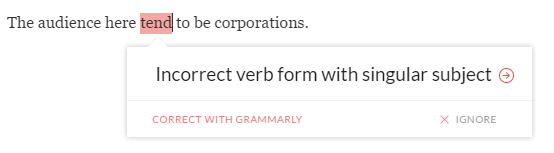
I’ve also discovered a problem with the verb form in the following sentence:

  • The audience here tends to be corporations.

I’m advised this isn’t correct:

tends

So I duly drop the final letter to make the verb agree with the plural subject corporations. Then I’m told:

tend

Now the verb form is incorrect because it doesn’t agree with the singular audience. And so we go around in a loop. There is a facility to add custom spellings or to ignore a suggestion, but no way to let the software learn your writing style or to flag up false positives.

Ultimately, the writer has to determine whether the words that are written, or the way in which they’re written, are suitable for the intended purpose. Grammarly is a tool that uses algorithms to apply the conventional rules of English; it’s not a textbook that must be followed precisely.