How I Don’t Remember It

I’ve recently joined a new poetry group. It’s so new that we don’t even have a name yet, but I’m enjoying the work of the other members.

One of them wrote about his time at Stirling University and included a photo of the place in the springtime. For the following month’s meeting, I visited Paisley, where I studied at what’s now the University of the West of Scotland. I’d paid a brief visit to the town centre in 2016, but it had been some years since I’d explored its other areas.

I’d expected some change, and I saw it particularly in the accommodation. There were new blocks of flats in a couple of spots, while one place I used to rent from the University had clearly been sold to a slum landlord – and the other might well have been going the same way.

I then walked up Neilston Road, which is one of the backbones of the town. From the moment I turned onto it, I began to wonder where I was. There were new tearooms with seats outside – even though it rained all day – but even taking them out of the equation, I didn’t even remember other landmarks.

Deutsch: Logo University of the West of Scotland
Logo of the University of the West of Scotland (Photo credit: Wikipedia)

There were bends in the road I didn’t recall, buildings that must have been there a century I didn’t register, and a field with cows as you head out of town that I must have seen at some point.

At least now I had a focus for my poem. One of the prompts had been ‘A letter to…’ so my piece became A Letter to Paisley, with the first lines reading:

I saw you the other day,
I’m sorry I didn’t recognise you.

But I found the opening words to be the easy part. Sometimes I can have something I really want to say, or I theme I particularly want to explore, and I find it difficult to work out how to present it.

In the rest of the piece, I muse upon the changes that have taken place and the parts I didn’t recognise, and I ponder whether it was the excitement of moving there at age 18 that caused me not to take in the details I saw on that day. I presented the piece to the group on Thursday of last week, and they helped me to make a few changes that will probably find their way into the next draft.

Strangely enough, I gained a BSc Music Technology while I was there. I didn’t do much with the qualification as it was, but I was able to use it to gain a place on the Masters degree I completed last year.

Note to self: don’t call this entry ‘The Write Stuff’

Last week, I was reminded that when you have a passion for an activity, you’ll find a way to carry it out no matter what the conditions.

I’ve subscribed to Artificial Womb, a feminist zine run by my friend Ana Hine. The format really is an old-school zine, with A4 pages of typed text and freehand drawings stapled together into a booklet. But this edition was different. The first variation to catch my eye was the return address on the envelope; it was a hospital in Kent. In this issue, Ana is candid about why she’s confined to the place at the moment.

Regardless, she somehow managed to find collaborators, write and illustrate the zine entirely by hand, photocopy the pages, and post the finished product to subscribers. On top of that, there’s a mini booklet about her former partner and a small piece of art on a separate sheet. I think that’s marvellous work under the circumstances.

You can subscribe to the zine right here.

A public-domain photo of an open notebook.

Most of my fiction, poetry and even blog entries start life as pencil on paper. But last week, I also wrote a letter of my own by hand.

I have a friend in the US who goes by many aliases, but for the purposes of this entry, I’ll call her C. In March, I sent her special-edition David Bowie stamps and she replied recently with a thank-you card, two postcards, and a handwritten letter. I felt compelled to return the favour.

On one hand, I found the process of writing to be liberating in the sense that there was no urgency. Unlike an electronic message, there is no expectation of a near-instant response, so I was able to draft and redraft the letter, and also to write one of the postcards in the area depicted in its photograph.

But the process also highlighted a difference in style between her letter and mine. C would go off at tangents and ask questions, some of them rhetorical, whereas I was more inclined to create a narrative structure and answer questions rather than ask them.

So I rethought my style, and the final letter deviates radically even from its last draft, answering some of her questions and posing my own. Even with the aforementioned postcard, that ends on a cliffhanger, with the comment that a stranger had sat next to me on the bench as I was writing and that I wished he would find his own spot.

I also alerted C when I’d posted my letter, as she’d told me that mine was arriving. After our brief discussion on the matter, I don’t think I’ll flag it up next time, and simply let it be a surprise. I might also surprise you and end this entry abru

A Long Aside

Once you’ve written a piece, it’s a good idea to lay it aside for a few days, perhaps a few weeks. But what happens when the days and weeks turn into months and years?

In 2013, I was given a homework task from a writing class. I had to pen a story containing the words sleeping, falling, and alchemy. I struggled to write something, so I used a fallback technique of creating a diary form. The draft of the story was about an 18-year-old woman who had just started university and was assigned a nasty flatmate. I titled it F in Hell, the F being short for the antagonist’s name.

I redrafted the story a couple of times over the next two years, tightening the language and enhancing the plot points. But I didn’t do anything else with it, other than giving readings at a couple of events.

In 2016, I was desperate to write a creative piece for my MLitt Writing Practice & Study dissertation. The problem was that there was no unifying theme to my pieces because I’d wanted to expand my horizons, so they were difficult to bring together into a cohesive collection. I’d printed off some of my best short stories and poems to show my supervisors. One of them picked up on F in Hell and suggested expanding it.

Phone Booth (film)
Phone Booth (film) (Photo credit: Wikipedia)

The tactic worked. The diary structure was ideal for demonstrating my prose skills yet flexible enough to allow interpolation of my poetry. Furthermore, as the story is told in an impromptu first-person narrative, I didn’t necessarily have to iron out every inconsistency before the relatively tight deadline. The title was changed to Jennifer Goldman’s Electric Scream.

Almost overnight, a short story that had lain forgotten in my archive became the piece that helped me to clinch my Masters degree.

And the tale doesn’t stop there. In August of last year, I was in the audience for a BBC radio recording when I realised the piece would work well on stage. I spoke again to one of my tutors, a playwright himself, and learnt the basics of script formatting and practical considerations for the props and scenery.

From then until last week, I’d been converting Jennifer Goldman’s Electric Scream into a script, and making the plot much darker, before entering it into a competition. Even if I don’t win, I know I have a finished product ready to be sent elsewhere.

There are many professional writers who have left work aside for one reason or another and reaped the benefits.

In the 1960s, Larry Cohen pitched an idea to Alfred Hitchcock for a film set entirely in a phone booth, but neither could find a compelling reason to keep the character there. When Cohen revisited the concept decades later, the world had changed: nearly everyone carried a mobile and had fears of terrorism on their minds. In 2002, with the idea well over 30 years old, Phone Booth finally opened in cinemas.

Sometimes the delay is beyond the control of the author. Jilly Cooper left a novel manuscript on a bus in around 1970. Disheartened, it took 14 years to begin again. In the intervening time, the plot and characters had time to mature, and her novel Riders was finally released in 1985. She considers it among her best work.

Moving away from writing, My Modern Met ran an article in April about the Draw This Again project, inviting artists to revisit and redraw their old pictures. Sometimes there’s a year between the two, sometimes there’s a decade. Be sure to click through to the Deviant Art page for many more examples, and see how each one has improved by being left aside for so long.

A Launch at Long Last

Anyone who routinely submits work for consideration can tell you how long it often takes to receive a response, let alone see your words in print. Right now, for instance, it’s too late to plan for summer; publications will shortly be looking for Christmas-themed material.

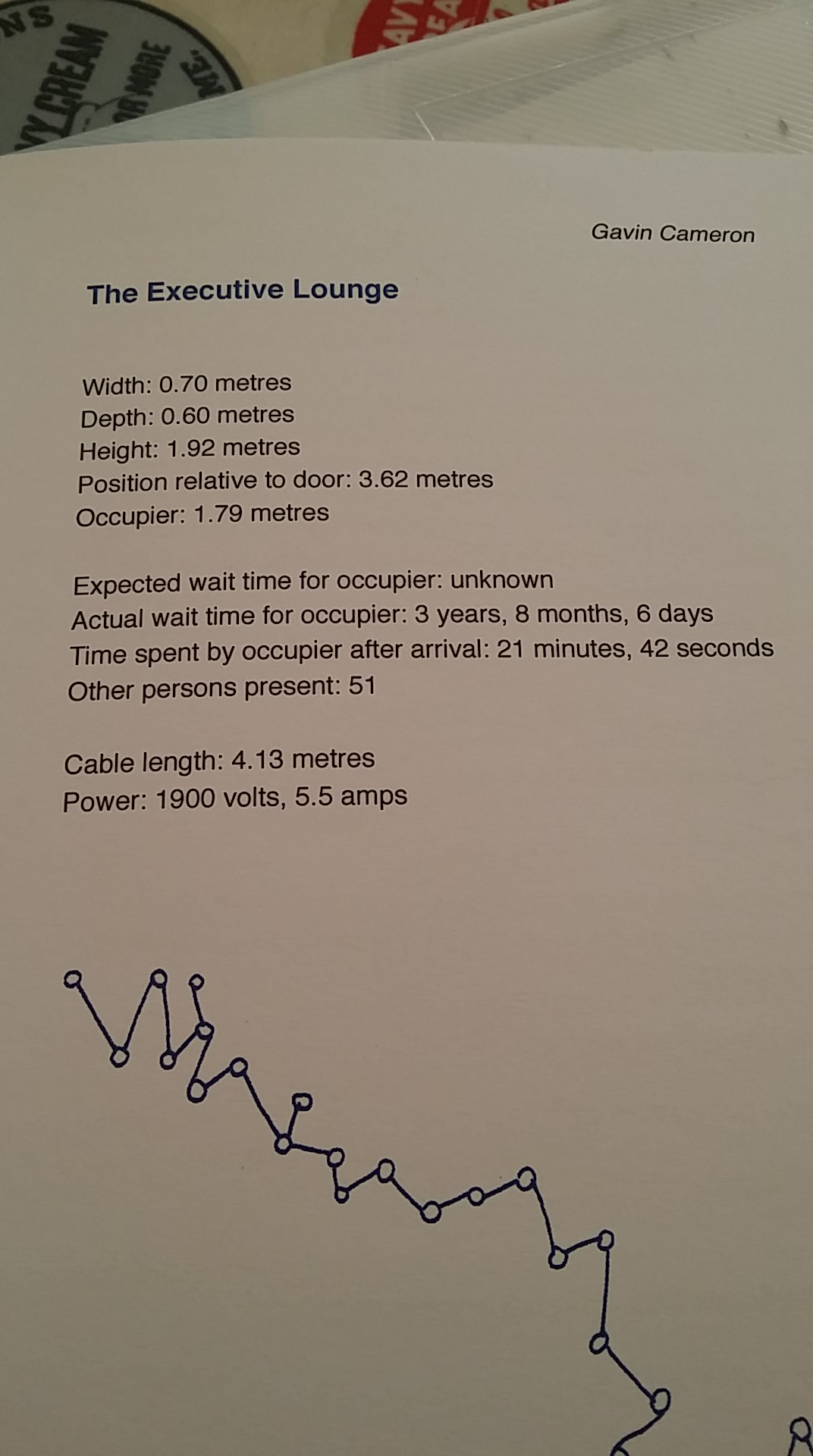
In October last year, I heard that my poem The Executive Lounge had been accepted for the local publication Dundee Writes. However, the launch only took place on Thursday of last week. Nonetheless, it was worth the wait because my piece is alongside some excellent work from students and alumni. There is also a focus on one of the creative writing tutors who died around a year ago.

The style of the pamphlet tends towards the less mainstream and more experimental and wistful. My poem describes an object without naming it. Instead, the reader is presented with a list of statistics about the item, with the most telling stats placed near the end.

It’s a favourite of my own work, and it seemed to go down well with the audience, but it is primarily a page poem. On this occasion, audience members could follow the text in the book; but when I read a loud it a couple of years ago, it received no reaction at the end, not even applause.

Here’s the piece:


A Walk in the Gardens

A couple of Saturdays ago, I visited the Botanic Gardens in Dundee, owned by the city’s university. Within its 21 acres, there are plants and trees from around the world and educational areas where you can learn more about them.

That day, the Gardens had been opened up specifically for writers, artists and photographers to respond in their chosen media for an upcoming anthology by the organisation who maintains them. A botanist even led us to many of the noteworthy spots, from tropical plants that change gender overnight to hardy shrubs that live on a limited water supply.

I’ve long believed that going for a walk helps to sort out any thoughts a writer has. In this case, there was a lot of input from the botanist’s talk, from discussions with other participants and indeed from my own observations.

English: Bean germination
English: Bean germination (Photo credit: Wikipedia)

Yet there was so much input to process that it took several days to form any meaningful output. During these days, I was taken by the idea that some trees can survive forest fires while other trees actually rely on fire for their seeds to germinate. I made drafts in free verse with internal rhymes, but the narrative was ultimately going nowhere.

Some friends, also poets, were on the same tour. One of them writes poems around the length of a haiku, although he doesn’t use the haiku form itself. Looking at my own work, I realised I liked the opening line and the conclusion, and I felt that to include other details would simply be filler and distract from the message I wanted to impart. So, borrowing his style, I kept only those parts: two sentences enjambed over four lines.

After leaving it aside for another few days, I came back to my verse yesterday morning and decided to enter it for the anthology. For that reason, I’m unable to publish the finished product online, but you’ll be the first to know if it’s included.

Which brings me to an event happening this coming Thursday. I’m having a poem published in Dundee Writes, a pamphlet distributed by the University of Dundee. I’ll report back on the launch event next week.

A review of Fat Kid Running by Katherine McMahon

Every so often, I’ll hear about a show and instantly feel compelled to go along. Much of the time, is because I’ve heard great word-of-mouth; sometimes it’s because I like an actor or musician involved in the project.

On the odd occasion, I go because I find the concept utterly arresting, and that’s why I bought a ticket for Fat Kid Running at the Scottish Storytelling Centre on Friday. The poster warned that Katherine McMahon’s debut show is not an inspiring before-and-after picture, but an honest insight into her body image issues. As I’ve been overweight all my life, I wanted to hear from someone in a similar position.

In the interests of full disclosure, I’ve met and spoken to McMahon before, but we’re not otherwise acquainted.

The show opens with a mock bleep-test, a theme revisited at the climax of the piece. We’re taken on an autobiographical trip through bullies in the school changing rooms, via health checks at the GP surgery, and how she built up to running several kilometres without stopping. Sometimes the narrative is poignant but always peppered with a sense of humour that lifts the audience at just the right moment.

A pair of ASICS stability running shoes, model...
A pair of ASICS stability running shoes, model GEL-Kinsei (Photo credit: Wikipedia)

Although the poetic prose was compelling in itself, what shone through for me was how genuinely she appeared to accept and love her body with no excuses and no delusions. There are two costume changes, both done in view of the audience, and she makes direct reference to her unshaven armpits and ‘boyish’ figure.

Even after seeing Fat Kid Running, McMahon and I still differ in one respect: I’m still committed to losing weight while she’s determined not to lose any. Yet it’s allowed me to understand the other point of view for the first time, and sends a message that a healthy body is not necessarily a slim body.

This performance, presented by Flint & Pitch, was the only one to date. But I’d love to see it go on tour, along with the support acts.

Calum Rodger was the first act to take the stage with a narrative called Rock, Star, North centred around the landscape of the Grand Theft Auto series. He takes a fresh look at what millions of players see but never study, and creates a rapid-fire homage.

Secondly, a musical group. Belle Jones, Audrey Tait and Lauren Gilmour presented Closed Doors, a story told mostly in rap verse about an unfolding major incident that forces racist neighbours out of their flats to mix with each other. The current ending was left too open for my liking, but I’m assured that it’s a work in progress.

Altogether, a Friday night well-spent.

Performance Review

I’ve always been honest about how I’m not a lifelong fiction writer or poet. Peppered throughout this blog is the story of how I began writing fiction in 2010. What I haven’t covered so far is how I became involved with performance poetry.

In early 2013, I heard someone speaking about Ill Manors, directed by the rapper Plan B. One day, I decided to listen to the soundtrack with a view to seeing the film at another time. During one of the tracks, a new voice said, “Pity the fate of young fellows, too long abed with no sleep.” I immediately liked it and wondered who this voice might belong to.

John Cooper Clarke, Cardiff, 1979
John Cooper Clarke, Cardiff, 1979 (Photo credit: Wikipedia)

John Cooper Clarke was the answer. He first came to prominence in the late 1970s as a punk poet in the vein of Gil Scott-Heron and as the antidote to John Betjeman. He would often open shows for groups like Joy Division, and they eventually opened for him.

By 2013, Clarke was undergoing a resurgence. Having shaken off the ‘punk’ label, he was touring again, he was working with contemporary musicians, and his work even became required reading for the GCSE syllabus. Plan B began working with him after hearing his poem Evidently Chickentown used in an episode of The Sopranos.

When I went to see Clarke on stage, he brought along Mike McGarry and Luke Wright. Until then, I’d been accustomed to the light and humorous verse of Pam Ayers, and I hadn’t considered that performed poetry didn’t have to be cheesy. Indeed, I remember listening to Clarke’s piece Beasley Street while waiting for a bus on a street that could easily have been the one described.

After that gig, I listened to as much performance poetry as I could find, particularly through the former Edinburgh-based duo Rally & Broad. I was introduced to performers as diverse as the politically-minded Alan Bissett and mellow guitarist Lake Montgomery. Alas, I missed the chance to meet Kate Tempest because I’d been invited to read at the Scottish Poetry Library in Edinburgh while she was in Glasgow signing her novel.

But what of my own performances? The acts I saw and heard all influenced what I was writing at the time. Probably the first poem I wrote for performance was Anatomy of a Party, available on The Purple Spotlights EP. It was the first piece where pace mattered, with a long and fast first section, then a calmness near the end. I also took every opportunity to perform my work and learn through experimentation what flies with an audience and what goes down like a lead balloon.

As I’ve written more material, it’s become gradually more personal, and that was influenced in part by a weekend masterclass with Francesca Beard in 2016, who encouraged the group to write something we were scared to write about.

Only a few months later, I was informed that I would have my most personal poem to date published in Aiblins: New Scottish Political Poetry, the first to deal directly with my own bisexuality. It wasn’t that I was scared to tell people – indeed some of the audience already knew – but I was worried that people would miss the satire and think it was insulting.

Another poem on my current setlist is heavily influenced by Andrea Gibson, with an honourable mention to the Tempest poem The Woman the Boy Became that I happened to find at the aforementioned masterclass. My piece Sir Madam features either an intersex or transgender character – it’s never specified which – who has a horrendous back story. I was scared to read it in case my portrayal was considered offensive. In fact, it has been well received, even from those who identify as other than male or female.

And I still have more performers to hear. Two people independently recommended Neil Hilborn recently, and who knows where his influence might take me next.

The Business of Personality; The Personality of Business

I feel I often bore you senseless with NaNoWriMo references, though it is a large part of my writing life. This time, I pinky-promise to use it only as a launchpad for my main point.

Over the past month, I’ve come to know two NaNo members particularly well: one through spending time together at meetings before the rest arrive, and one by corresponding mainly online. I’ve known both parties for some time, but by conversing so frequently, I feel I understand them better as individuals and as writers.

Notice the order of those words: ‘individuals’, then ‘writers’. I believe we can create better professional connections by first knowing a little more about the other person.

We’ve all probably passed sales reps on the street who ask, “Who’s your electricity supplier?” without so much as a preliminary, “How are you?” Three thoughts occur to me when I hear the electricity question:

  1. It’s annoying.
  2. It’s too personal and abrupt when you haven’t built up even a little trust.
  3. It signals that the seller is interested in you only as a customer, not as a person.

    A segment of a social network
    A segment of a social network (Photo credit: Wikipedia)

I’ve seen the people-first principle succeed before. I have a ‘day job’ in the civil service, and my department began experimenting in around 2010 with an internal social network modelled on Twitter. The rules told us that the site was primarily for business talk, but that some social and recreational chat was permitted. In practice, the social talk was predominant, and it led to a lot of in-jokes and banter. Yet when someone wanted to talk business, the others were more inclined to help because we were already acquainted with one another.

I still speak to some of these people today, though the network has long since closed. Of the replacement websites introduced, none has created the same sense of community. I believe that’s because the social club aspect has been relegated in favour of a business-first approach that doesn’t prompt the same connection.

So where can a writer meet with other writers without feeling as though they’re being sold something? Where I’m from, we’re lucky enough to have a regular monthly meet-up where any writer can drop by and interact with other writers on an informal basis. We meet in a bar aptly called The George Orwell, and there are no readings or speeches. If somebody does have work to promote, it never feels pushy because we all know each other socially.

If you ask your nearest library, they’ll probably be able to direct you to such a nearby group. And if there isn’t one, consider starting your own; it’s not easy, but it can be hugely rewarding.

Outside The Box

Regular readers will be aware that this blog covers all types of writing from short stories and poetry to screenplays and rap music. I believe there’s a lot we can learn from all these forms. Even watching Made in Chelsea is a great lesson in improv.

However, on moving into a new place last month, I took the decision not to own a TV. This was something I’d considered for a long time as I would either rarely watch it, or it would become a distraction when I could be doing something productive. Either way, it would more than counteract the benefits of having one.

The other factor swaying my decision is the matter of the TV licence. In the UK, you need to pay an annual fee if you have equipment that receives television broadcasts, if you watch live TV online, or if you use BBC iPlayer for any purpose. The money goes towards funding the BBC and there are heavy fines if you aren’t correctly licensed.

While it’s a difficult field to police, that’s enough of a disincentive for me not to have a telly. If there’s something I really want to see, I have other options. You can watch DVDs or most catch-up services without a licence, and you can also own a radio without charge. Even better, I’m fortunate enough to be within easy reach of two cinemas: one mainstream, the other independent.

With not having a TV, it’s an obvious question to ask what I have in its place. The answer:


Vic Vic Hooray

Last night, I went to see a live screening of Rosencrantz and Guildenstern Are Dead by the National Theatre from the Old Vic in London.

It’s one of those plays that’s often referenced – particularly by Radio 4 types – but rarely seen performed, and it’s the one that placed Tom Stoppard squarely on the map when it was first performed at the Edinburgh Fringe in 1966. And that’s the bulk of what I knew about this icon until yesterday.

This performance was fronted by Daniel Radcliffe and Joshua McGuire as the eponymous men, while David Haig took the role of The Player. I found each of these to be perfectly cast: the former two respectively forming a straight-man-and-comic act, and the latter inhabiting the part without being tempted to overact.

Rosencrantz and Guildenstern
Rosencrantz and Guildenstern (Photo credit: Wikipedia)

Throughout the play, there are key scenes interpolated from Hamlet. While it isn’t necessary to have seen that play to enjoy this one, anyone who does would be at an advantage, as the speech in these interpolated scenes retains Shakespeare’s original words. Yet when we hear Rosencrantz and Guildenstern speak with each other, the dialogue is in 20th-century English, switching to a more Shakespearean cadence when they converse with outsiders. This technique shouldn’t work, but we’re so swept up in the action that the code switching barely matters.

I can’t pretend to have caught every word, owing to the dense wordplay with philosophical overtones, often delivered at a breakneck pace. I feel that a second viewing might fill the holes in my recollection.

There also appeared to be a different dynamic between Rosencrantz, Guildenstern and Hamlet. Whereas in the original play, Hamlet seems excited to meet his old friends despite his grief, this doesn’t come across in Stoppard’s version. What we see here is Hamlet largely uninterested in anyone else because of his grief.

Any playwright who borrows wholesale from Shakespeare has to understand what they’re doing, and it’s clear that Stoppard did. He doesn’t parody Hamlet, he expands upon it, creating what we might today call fanfiction. And it’s expanded past the point of a pen portrait or a short story to become a feature-length production that enhances our understanding of Rosencrantz and Guildenstern as characters, as men and as friends.

I’ve now been to see several National Theatre broadcasts at the cinema. The experience has always been a positive one, but I can detect something of a reluctance. It’s as if a live transmission is something the National Theatre feels obliged to do to gain an audience, not a move they actively want to take.

There is also the uncanny disconnection between the cinema audience and the actors. Conventionally, a theatre audience will applaud at the end to show their appreciation. A cinema audience, on the other hand, will hardly ever applaud even when the showing isn’t pre-recorded – although I experienced one exception after I, Daniel Blake.

This should not be read as a criticism of the National Theatre, but as encouragement to keep up these broadcasts. I live many hundreds of miles from London; other than travelling there one weekend, this is the closest experience I’ll have to being at a West End production. It’s a jolly good show all round.

Rosencrantz and Guildenstern Are Dead runs at the Old Vic until 6 May 2017