I've been writing fiction and poetry since 2010, and run two writers' groups.
This is a blog to talk about that writing, and to speak to fellow authors.
One piece of advice commonly given to new writers is to read widely: to read within and beyond their genre, read classics and airport paperbacks, read Western authors and works in translation.
A sheet of bingo cards. There will be no whistling at ‘Legs eleven’, thank you. (Photo credit: Wikipedia)
It’s great advice. The more books an author is exposed to, the richer their writing will probably become. Exciting things can happen when two styles meet; I’d read two Chris Brookmyre titles before I found out they’re supposed to be crime novels, not comedies. But lately, I feel as though I’m doing anything but reading.
I’ve been to see a couple of documentaries about Hedy Lamarr and Michael Caine respectively, I went to the StAnza poetry festival, I’ve seen I, Tonya and Lady Bird, I’ve played bingo, I’ve been to a lecture about the Higgs boson particle, I’ve seen a production of Spring Awakening. In short, I’ve been having a ball – and that ball was on Saturday two weeks ago.
I don’t think there’s such a thing as a wasted experience. In fact, there are some authors whose real-life experiences are inseparable from their written work.
Andy McNab first came to prominence with Bravo Two Zero, an account of an SAS mission in the early 1990s. He’s since gone on to write fiction that draws upon his knowledge and skills. PD James worked in the criminal justice system and the NHS for a long time and infused her expertise into her books.
It probably doesn’t hurt if you don’t read as much as you’d like. There are experiences everywhere, just waiting to be written about.
A friend of mine has a phrase: ‘Better felt than telt’. The last word is the Scots way of saying ‘told’, and the phrase means you can gain more insight from being somewhere then reading about it.
This blog is updated every Monday at 6pm. To the reader of any regular publication, it should seem as though the content trickles out on a predictable basis. But that rarely happens in practice.
English: Question Mark (Photo credit: Wikipedia)
In my case, I’m sometimes able to plan two or three entries ahead, or I have difficulty deciding what to leave out. Other times, I’m still deciding on a subject or writing an entry a few hours before it’s due to be published.
This week has fallen firmly into the second category, bringing little writing news, other than a rejection e-mail that simply said: ‘Gavin. Clever, but not quite what we are looking for.’
So rather than swerve off-topic for the sake of making an entry, I was going to leave this one here and think about next week’s content.
That was until I learnt that my friends at The Beans Podcast had a worse week than I did. They’ve lost an entire episode.
On Saturday, I made my annual trip to StAnza, the poetry festival in St Andrews. And what better way to start than Breakfast at the Poetry Café with a pastry and a panel of four poets, namely Sara Hirsch, Jan Baeke, Esther Mijers and Luke Pell. They talked about the inclusion or exclusion of the self in their work, with an extensive discussion on pronouns.
English: St Andrews Town Hall (of 1858-1862), between Queen’s Gardens and South Street, St Andrews, Fife, Scotland, where some of the StAnza events took place. (Photo credit: Wikipedia)
I then moved on to the 12 Showcase, featuring some of the women who collaborate and respond to each others’ poetry via a shared Google document. Dispensing with introductions or explanations, they formed an almost hypnotic chain of verse full of back references and tangents, infused with their individual styles.
Past & Present saw Oli Hazzard speaking about John Ashbery, then W.N. Herbert speaking about W.S. Graham. It’s often difficult to know what to leave out when speaking about a prolific figure, but in their respective 25 minutes, each poet gave a broad sense of their subjects to the packed audience.
StAnza’s theme this year was Going Dutch, ‘shining a spotlight on the poetry of Flanders and the Netherlands in Dutch and Frisian.’ There were Dutch poets peppered throughout the event, but Five O’Clock Verses was the first time I’d heard anyone speak Frisian, the language most closely related to English.
When Tsead Bruinja performed in the language, I was reminded of a childhood memory. In Scotland, there used to be five minutes of Gaelic news shown every evening, and I’d be able to pick out borrowed words such as helicopter. In Bruinja’s case, the most outstanding term was double-D, referring to the bra size. Although he set a high standard, Tara Bergin was able to match it with her absurdist poetry, all delivered in English.
Poetry Centre Stage is held in the main auditorium of the Byre Theatre and is always a must-see. I’ve heard a lot about William Letford, but I don’t recall seeing him before. Half of his 40-minute set was devoted to a story cycle about a family who go to live in the forest. It sounded a lot like prose, but it was written in a wonderfully poetic manner. I left before Liz Lochhead’s appearance because I wanted to prepare for my personal highlight.
The StAnza Slam gives two and a half minutes to 12 participants, all eager to impress a panel of judges. Four of them would then progress to a second knockout round, with three minutes allowed.
I’m pleased to report that I managed to enter the second round with a piece called Sir Madam that’s proved popular at previous events. However, Jo Gilbert deservedly walked away with the prize after a poem about cake.
Although slam competitions are by nature competitive, they tend not to be ego-driven – at least in my experience – and I think that’s great.
For the last decade or so, StAnza has complemented the Dundee Literary Festival, which has traditionally been held in October. While StAnza appears to be stable, there might not be a Dundee event this year as we’ve normally been given news by now. If it doesn’t happen, Dundee writers might just have to pull together and hold an unofficial one of our own.
In the middle of last week, the UK was hit by an exceptionally strong gust of snow. My area was given a rare Red Warning, and that led to some cancellations and closures.
Charles Darwin by Julia Margaret Cameron [Public domain], via Wikimedia CommonsOn Thursday, for instance, my office was closed and I was excused from doing the ‘day job’. I instead used the time to send work to a publisher. On Friday, I was supposed to be exhibiting my Fun a Day pieces created during January, but that’s been postponed. In fact, the one event that went ahead as normal was partly outdoors.
So on Saturday, I visited the Botanic Gardens in Dundee, whose volunteers are compiling an anthology of written and visual work inspired by the grounds. To this end, they’ve organised Focus Days where writers, photographers and artists are given a tour of the trees and plants to generate ideas. In this instance, the tour was restricted to the heated glass houses, although the participants seemed willing to go out in the snow.
The tour was followed by a lively discussion about the work that should appear in the anthology and how it should be created. Some of us shared our existing work; I read a piece I’d already submitted for consideration and three of the other members inferred religious symbolism where there wasn’t intended to be any.
Frustratingly, no consensus was reached about the anthology as a whole, but we reconvene in three weeks and we’re looking to take it forward from there.
If any new work was generated by Saturday’s visit, it’ll probably be infused by the ambient conditions. Some writers use it almost as a character in its own right and, done well, it can enhance a scene without distracting the reader. In To Kill a Mockingbird, Harper Lee invokes sticky summer heat; Kirsty Logan steeps The Gracekeepers with a cold sea chill.
Even when you’re trying to create a fictional universe, of course, nobody can escape the weather. Shooting began on the first Star Wars film 42 years ago this month in Tunisia, a location chosen for its desert landscape. On the second day, the country was hit by a rare winter rain that hadn’t been seen for 50 years, destroying sets and damaging equipment.
The vast majority of mainstream literature is written from one of two main points of view.
A first-person narrative is where the narrator talks from their own perspective; for example, ‘I saw the fight,’ or, ‘He hit me first.’
A third-person narrative describes what other characters are doing; for example, ‘Greg saw the fight,’ or, ‘Joey hit Greg first.’
Within these points of view, there are variations, and some writers even use a combination of the two within the same work.
But what is a second-person narrative? Quite simply, it’s where an author uses you rather than I,he, she, or they. Depending on the context, the second person can be used with different intents. The author could be:
addressing the reader directly. This is common in choose-your-own-adventure stories, where the reader is asked to select from different potential outcomes.
treating the reader as a character by describing how they look or what action they’re taking. A few novels are written in this way.
writing an open letter or similar to a third party, but the reader is privy to that letter. This is common in poetry and song.
It’s a personal opinion, but I find the second of those three intents to be the most jarring.
An author might write, for example, ‘You’re a tourist. You’re wearing a summer dress and sipping coffee in a bistro on an autumn evening.’ I find it difficult to suspend my disbelief to such an extent that I can inhabit that character.
On the other hand, if the author had described a third party so richly, I would find it easy to inhabit that character’s world. I don’t think twice about the other intents when I encounter them.
This week, I’ve had a conglomeration of events, most of which weren’t related to writing. Unfortunately, these have left me no time to construct a full entry, but nor do I want to throw together a substandard post.
Instead, I’m going to encourage you to make use of the time you would have spent reading this entry. Perhaps edit a poem, perhaps plan your diary for the week, perhaps send that e-mail you’ve been drafting.
Whatever you do, make it productive, and I’ll catch you back here next week.
On Thursday, I took part in the Echo event at Dundee Contemporary Arts. This is an open call for artists and writers to respond creatively to the current exhibition; this season it’s Kate V Robertson and Andrew Lacon.
Dundee Contemporary Arts, Dundee, UK (Photo credit: Wikipedia)
I’ve been taking part for roughly three years and each one is different in character, in mood and in style. Still, the last time was particularly unusual as there were no visual artists, only poetry and storytelling. The DCA collated some of the pieces into a leaflet to be given to the audience. The pieces are performed in the gallery itself, often in front of the artwork that inspired it.
Echo is not a paid gig. The participants volunteer their own time and the DCA benefits from increased visitors. On the face of it, this sounds like a one-sided deal in favour of the gallery, but I like doing it because I believe having a deadline keeps my skills sharp.
I’ve also come to realise that when I write a piece, I like to know my words will be seen by someone.
When I was completing my MLitt Writing Practice and Study degree, one of the tutors wanted us to complete a daily routine called five-finger exercises, where you take an existing paragraph and rewrite it in five different prescribed ways. While I understand this might be useful for beginners or creatively blocked writers, I found I was generating all that material for no useful purpose.
With Echo, I find I still have that freedom of experimentation, yet the fact it’ll be heard helps me to raise my standard as high as I can. I do occasionally write just for myself, but that’s only by exception.
I was advised that the next DCA exhibition will be ‘bonkers’, so I look forward to seeing what arises from that.
A couple of friends have recently asked me to look over pieces they’ve written. At one time, it would have been difficult for me to do this as I didn’t like to give negative feedback. Having received honest critiques of my own work, I now feel comfortable about identifying areas of improvement in others’ work and making suggestions for improvement.
Firstly, I received an 11-line poem. Among other suggestions: I could see that each line began with a capital letter even in run-on sentences, which is unconventional in modern poetry; I swapped around a couple of clauses to create a stronger image; and I broke up the poem into three stanzas instead of one. These suggestions are partly personal preferences, but they’re informed by reading a lot of poetry and considering what works well and not so well.
Editing film at the Lubin film studio in Philadelphia, 1914. A reel difficult job.
The other piece I looked over was an application for a university course, and I had help from a friend who has experience in this field. In this instance, I didn’t know all the specialist terminology or concepts, but there were aspects common to most writing styles that I could point out: using shorter paragraphs to create more negative space, which is easier on the eye; thoroughly checking spelling and grammar, for which I suggested reading the piece out loud while alone; and moving a certain project nearer the top of the application as it stood out among the others.
Ultimately, the writer has the final call on how to present their own piece. As such, I made it clear that the corrections were merely suggestions.
There is always a risk that the other party will react badly or become disheartened, particularly if you don’t know each other very well. It’s impossible to police another person’s feelings, but there are ways to make an unfavourable outcome feel less harsh. A classic is the Bad News Sandwich: a positive greeting, the negative result, a positive next step. Here’s a rejection e-mail I received last year:
Thank you for entering the August 50 Word Fiction Competition.
Unfortunately, your story was not selected as the winner this month. It was another very busy month and very difficult decision for our judges.
If you’d like to enter again, we’d love to see your words.
So when I close that message, I don’t think What an arrogant bunch, I think, I’ll up my game for September.
I also like to participate as often as I can, and I’m always happy to give advice to those who want to do the same. I’ve updated my guide from 2016, and I stress that it is only a subjective guide, not a textbook.
Talk with the organisers about what’s required
Ask the organisers to talk you through their plan for the event. This will typically include, but is not limited to: how long you’ll be asked to speak for, what type of content is required, whether you’ll be given an introduction, where you should wait before you’re called up, and whether any fee is payable.
If it’s an unfamiliar venue, be sure to obtain the exact address and check how to access the building. Don’t forget to arrive in plenty of time.
Think about your own structure and running order
The organisers will take care of the overall structure and running order, but it’s wise to plan your own time so you don’t miss a step. A typical note-to-self might read:
Give name and say you’re reading from short story collection The Pie Seller
Briefly mention editor at Law Hill Books
Tell obesity clinic anecdote
Read out And an Onion One Too
Thank Tracey Jones for organising
You’re happy to sign copies
Read out The Crust of the Matter.
Note that the thanks isn’t placed at the very end. This structure means the audience are more likely to go away with the ending of your work in their head.
Briefly explain if you need to, but don’t apologise
Some pieces do require an explanation; perhaps a work is unfinished, is an extract from a longer work, or was written under certain circumstances. But keep it brief and don’t explain anything that the audience will take from the piece.
If you feel you can’t read a particular piece without apologising, either take it out of your set or work on it until no apology is necessary.
Read out loud and time your words
The best way to identify weak parts in your set is to read it aloud – and that’s the last thing you want to happen in public. So find a space on your own and read it out when nobody can hear you. Are there any long sentences that need to be broken up? Are there words that are difficult to say clearly?
When reading from a book or from sheets of paper, it’s a good idea to turn up the corner slightly or stick a post-it note to the back. When using an e-reader or tablet computer, practice tapping the correct area of the screen to turn the page; there might also be a delay on some devices.
Don’t forget to use a stopwatch so your words fit within the agreed timeslot.
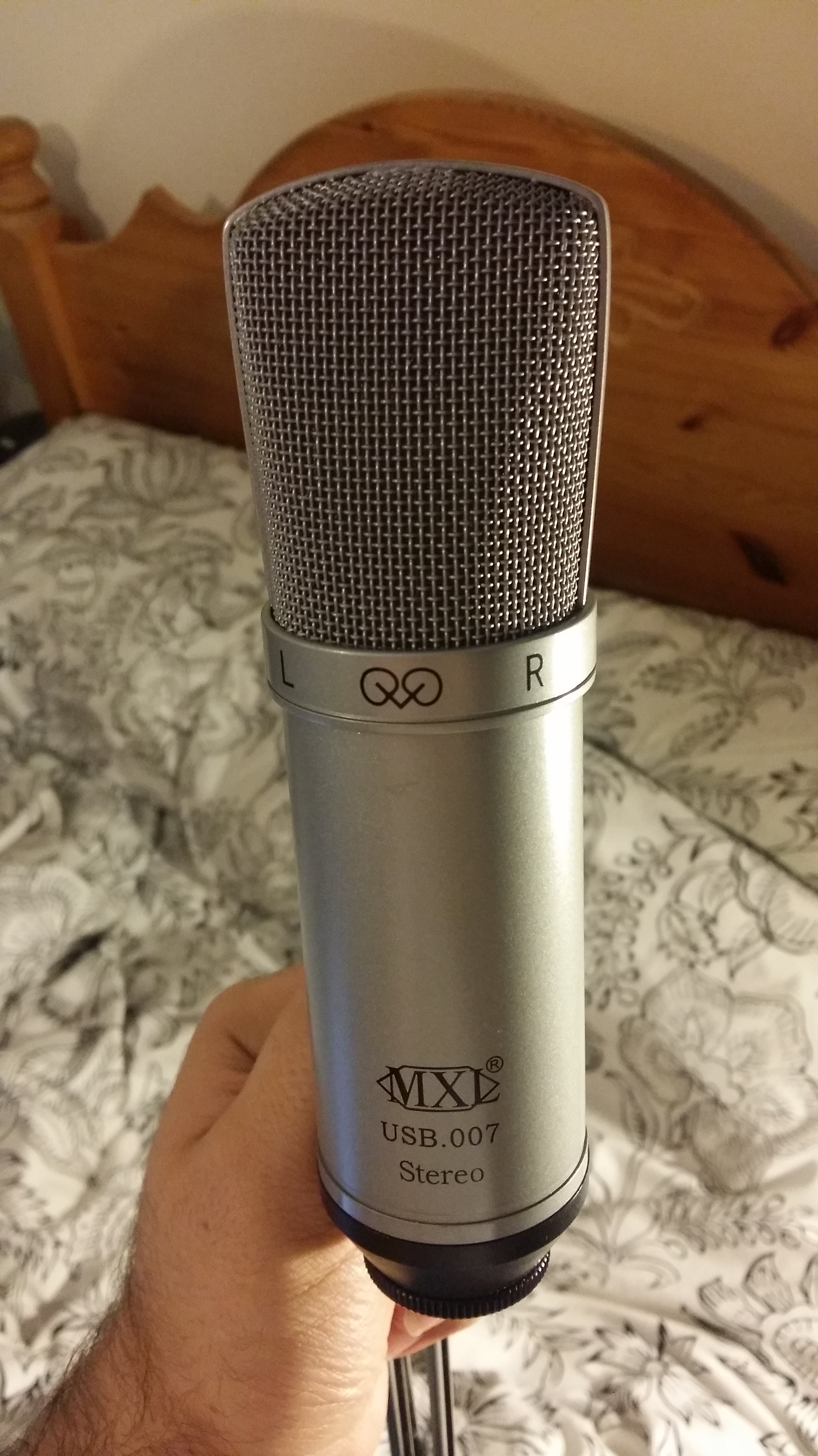
My USB condenser microphone.
Make sure everyone can hear you.
In my experience, smaller readings tend not to use a microphone, so you need to project. Avoid tilting your head down to read the piece; instead, hold your manuscript higher and off to one side so it doesn’t muffle your words, or look down only with your eyes. Always speak slowly than you would in normal conversation.
If you do have a microphone, ask the sound engineer if you can test it out beforehand, especially if you’re unfamiliar with using one. Whether the microphone is handheld or on a stand, keep it at the same distance from your mouth. One of the biggest distractions for an audience is a sound level that increases and decreases at random.
Avoid too much alcohol or a heavy meal before the gig
I fully understand why folks need Dutch courage before going on stage. But a drunk speaker rarely makes a good impression, especially during a paid gig.
My rule is not to take alcohol before speaking, only coffee or a soft drink. It’s also a good idea not to eat too much in the hours before the performance, as a heavy meal can also slow down your thought process.
Decide where in the room to look.
I know a few poets who deliberately look at individual audience members. However, it can be unnerving to make eye contact. Fortunately, there are some techniques to make this easier.
One of my favourite methods is look between two people, so the person on the right assumes I’m looking at the one on the left, and vice versa. Another way, which is particularly good for a theatre setting, is to look beyond the back row. This has the advantage of keeping your posture correct.
Keep going through the cock-ups
Perhaps the microphone fails, perhaps you forget the words, perhaps somebody keeps chatting during the show. A performer has no control over these factors.
The audience will normally forget the problem if you ignore it and keep going. Conversely, they’ll remember the person who dries up and leaves the stage or screams at noisy attendees. However, if you find different audiences keep reacting in the wrong way to the same part, consider revising it or editing it out in future performances.
Signalthat you’ve finished.
At the end of a piece, the audience doesn’t necessarily know whether you’re finished or simply pausing for dramatic effect. But an audience can pick up on your gestures. You can lower your manuscript, step backwards slightly or say Thank you, whereupon they’ll take the hint and applaud.
Do it again.
It’s an eye-rolling cliche, but the more you stand up and speak in public, the easier it becomes. Over time, you’ll learn little nuggets like which techniques work or don’t work for you, which pieces always or never provoke a reaction, and so on.
Ultimately, a good performance can increase your fan base and help sell more work.
Regular readers will know that I’m an avid blogger; I produce an entry every week come rain, shine or public holiday.
Always open to an alternative point of view, however, I clicked on a sponsored post a couple of weeks ago about the topic of how blogging doesn’t lead to book sales. Sponsored posts are usually an indicator of quality, often containing persuasive text and statistics to support the blogger’s point of view.
In this case, an author was selling a book via Kindle about how to increase Kindle sales, but using what amounted to a 3,700-word rant. I then headed to the author’s Amazon page to read what others had to say about this guy; the consensus was that the information was useful, but they objected to some unnecessary and offensive material within the text. In short, the writer had adopted the wrong tone.
Judging the tone of a piece can be a tricky business. Something meant in a satirical or sarcastic manner can be interpreted as serious or libellous, and that’s partly why I believe it’s important to take a break from a piece and to look at it later with fresh eyes.
But this sponsored post wasn’t a one-off piece written on a bad day. Everywhere this author had been published, there appeared the same attitude and the same comments. The reason I’m not linking to his site isn’t to do with the tone of that page; he’s also a pickup artist, so I’d rather not drive any more traffic there.
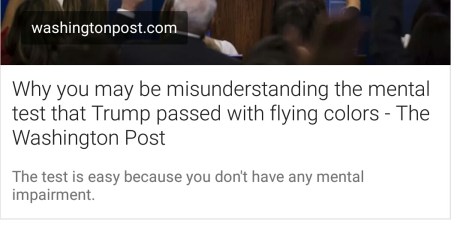
Fortunately, there are countless other examples available. I’d like to single out the Washington Post as having a particular problem. Consider these two headlines, published around six months apart:
In both cases, we have an accusation. Firstly, the reader is told they know nothing about US Independence Day. Secondly, it’s the sub-headline that causes a problem; it assumes that the reader has no mental impairment. This is a deliberate move from the publication to anger the reader and therefore generate a click.
And it works. An excellent article from Wired lays out the psychology behind emotional responses, and it’s noted that other emotions also attract readers. Some websites follow a two-sentence structure designed to entice curiosity without revealing too many details; a journalist from Poynter explains how Upworthy headlines operate.
What I haven’t been able to find is why we as a culture haven’t collectively learnt to ignore these sensationalist tactics, just as many users have become selectively blind to banner and sidebar advertising.
In my years of running this blog, I probably haven’t judged my tone correctly in every single entry. However, I always aim to bring people on board by moderating my words in such a way that people are engaged, not outraged.
Looking back over the last three months, each week has attracted between two and eight presses of the Like button, plus the occasional new follower. I’d much rather have two engaged readers than have a hundred people visit, be offended, and leave permanently.


![Julia Margaret Cameron [Public domain], via Wikimedia Commons](https://upload.wikimedia.org/wikipedia/commons/thumb/a/ae/Charles_Darwin_by_Julia_Margaret_Cameron_3.jpg/446px-Charles_Darwin_by_Julia_Margaret_Cameron_3.jpg)



 Gavin Cameron