Gttng Strtd Wth SMS

Last week’s entry was all about postcards. In writing about these, however, it was necessary to touch upon its replacement technology: SMS. I realised I had more to write on the matter. so today’s entry effectively serves as a part 2.

When the first SMS-capable handsets became available, they wouldn’t contain a full keyboard. Instead, each letter was mapped to the number pad in the following semi-standardised formation:

I say ‘semi-standardised’. The 0 key usually acted as spacebar, while 1 often produced symbols, but some layouts deviated from this. Ditto the toggling of capital letters, which we’ll disregard for the following demonstration.

To type the word BOOK, the following steps were necessary:

  • B required two presses of 2.
  • O – three presses of 6.
  • Pause for a second or press the right arrow, depending on phone, to allow the letter to register. O would otherwise loop back around to M.
  • O – three further presses of 6.
  • K – two presses of 5.

Overall, quite the frustrating process. It quickly became accepted practice to omit letters from words or use soundalikes. This might morph the word thanks into thx, or tomorrow into 2moro, which are still reasonably legible.

There were further innovations to come. One was the T9 system, which guessed each letter in context based on its neighbouring presses. To type the aforementioned BOOK, you would press the buttons 2-6-6-5 once each. The display might suggest BOOK first, but COOL or CONK could be selected from the menu, cutting down on overall presses.

Many phones would remember which words were used most commonly, but my Nokia 3330 never did. If I wanted to mention my pal Amy, I always had to scroll through BOX and COW.

Despite T9, the abbreviated style still persisted in popular culture for some time, with Fall Out Boy releasing a single as late as 2007 titled Thnks fr th Mmrs. It only died out when touchscreen input became more common.

Cards on the table, I was never sorry to see SMS speak disappear. Although it took longer, I liked to write my sentences out properly, and it could be challenging to decode some abbreviations. I much prefer what we have these days. No doubt the style will make a resurgence at some point, but I won’t be participating in that.
A Quick Word About Postcards

Although postcards are now virtually obsolete in daily life, I can remember a time when they were used to enter competitions, to cast votes in polls, and to let friends and family know you’d reached your holiday destination safely.

But when I’m going away for a day or two, I like to maintain the last of those traditions. In most cases, I know I’ll arrive back home before the mail does, even when it’s within Great Britain, but it doesn’t diminish the surprise for the recipient.

A typical card measures around four inches by six, although there are wide variations, with the front featuring a picture or design. The back is split into two equal sections, so your text has to fit into that left section because the address and the stamp will take up the right-hand side. You can also buy books of plain postcards where the address and stamp go on the front, allowing use of the entire rear side.

Still, the fixed format forces you to pick your words wisely or to minimise the size of your handwriting. The inventors of the SMS initially chose 160 characters as the limit based upon those restrictions.

In the earliest days of mobile messaging, each one typically cost between 5p and 10p to send; those figures are not adjusted for inflation. Some handsets supported longer messages, but each block or partial block of 160 characters was charged separately.

Despite this, an SMS easily undercut the price of a stamp in the second half of the 1990s – shown by this table from The Great Britain Philatelic Society – especially as you didn’t need to buy a physical postcard either.

The cost of SMS and similar messages today is negligable. Most phone subscriptions have some element of inclusive or unlimited allowance, putting the higher cost into perspective. On a day trip to Birmingham yesterday, I sent just two cards, but they cost me 87p apiece in second-class stamps.

Knowing I might not have a chance later in the day, my intention was to write them both on the flight and post them at the other end. I forgot to take them out of my bag until we were almost ready to land, but they’re both now safely in the post awaiting delivery.

Memorable Names for Fictional Characters

Most of the time, I find it easy to think of what the characters in my stories should be called. Their names often appear at the same time as the storyline.

I wrote one such piece in 2014 titled Adrian Eats the World, which appeared at the same time as the title. Until I found the file while writing this, I thought that was still its name. In 2015, it seems I had a change of mind and amended his name to Mikey. I can’t remember what made me change this, so it’s now been restored.

More recently, I’ve included a Rosalind McQueen because the cadence simply worked well. During the story, she changes this to Scott McQueen, which has a different cadence but is equally as pleasing.

The most difficult character to name was a sci-fi story set during the 1960s in a world where a group of intelligence agents were worried about an impending visit from aliens. This character was supposed to be the young man who had been drafted into the unit as a favour by his father.

I looked to take the James Bond approach, with an ordinary first name and a distinctive last name. It took weeks to settle upon Malcolm St Clement. Even then, I wasn’t certain because the only other person I could find with that last name was the actress Pam St Clement from EastEnders, and even that’s a modification of her real name: Pamela Clements. However, it sounded good, and I kept using it.

On other occasions, a name is the least of my concerns.

In one of my series, the first-person narrator remained unnamed until the 24th part. I didn’t even realise I was omitting the name at first; it simply wasn’t central to the storyline. Besides, the 2004 film Layer Cake pulled off this trick nicely.

Even once I became aware of the omissions, there were workarounds I could employ to avoid saying it. It helped that the series was an ensemble effort comprising seven other named main characters. Eventually, I decided to reveal the narrator’s name as a minor twist in what was intended to be the finale. I’ve since added a surprise 25th story.

The other layer to this discussion is the use of nicknames. I find these hard to pull off convincingly. Unexplained nicknames can be jarring, yet when they are explained, the backstory can feel contrived or a little too perfect.

In this instance, it might be wise to take a cue from real life. For instance, there’s a website for pilots and fans of the F-16 fighter jet that has a whole section devoted to the imaginative callsigns in the forces. A few are clever, but most are a little ramshackle and that makes them sound a little more convincing.

What We Talk About at Writing Group

For the last ten years, I’ve run a weekly writing group. This has almost always been on a Tuesday and with a co-organiser.

I inititally joined in 2010, when the group was still a branch of National Novel Writing Month (NaNoWriMo). I took over in 2015 once the original organisers graduated and moved away. After withdrawing our affiliation from NaNoWriMo two years ago, two of us now jointly run it as an independent group.

It must be stated that we have a manageable number of members, so other than a few word-of-mouth referrals, the group is not actively recruiting at present.

In its current form, members can drop in at any time during the two-hour session, either in-person or via Discord. They’re welcome to stay for a short while or the whole session, and there isn’t even an expectation to write. We frequently end up chatting, joking, making plans and/or solving problems.

But although that format is consistent these days, it took some trial and error to figure it out.

As the main NaNoWriMo challenge only took place during November, the weekly meetings coincided with that. After some enthusiasm by members, we cautiously extended the-e weekly meetings on a trial basis through December, then January, then February, and so on. People were still coming along, so we confidently started meeting up all year round. We now have a recurring table reservation and the staff know us well.

On a couple of occasions before the pandemic, I even brought the members around to my house on 31 October so we could begin to draft our novels at the stroke of 1 November.

While the meetings themselves have always been a hit, the members have rarely been interested in any formal activites such as writing sprints, feedback sessions or homework challenges. Variations of these have been attempted with different leaderships in different years, but none have caught on.

In Dundee, at least, the thirst is simply for ringfenced time to write every week and that’s what we provide.

Sitting – I Won’t Stand for It

Five years ago this month, I finally started working from home on account of the pandemic. This was a major change after 14 years being in an office, although the transition was delayed from March because my employer at the time had only had desktop PCs and needed to buy us laptops.

Before this, I’d already been interested in a standing desk. Regular use can help improve your overall health. To this end, I’d experimented with differnt layouts for my own computer, settling on a tabletop stand that could hold a laptop and nothing more.

With the prospect of working from home, however, it was necessary to find room for an external monitor because we used several software applications and it was easier to keep them all on screen at the same time. I quickly found a gas-lift standing desk adaptor and the employer made a contribution towards buying it.

In this time, I’ve changed jobs twice and moved house once, and I still work from home for the majority of the time. I realised recently that while the setup worked perfectly well, the equipment took up more than twice the space of what I actually required, so it was time to scale down.

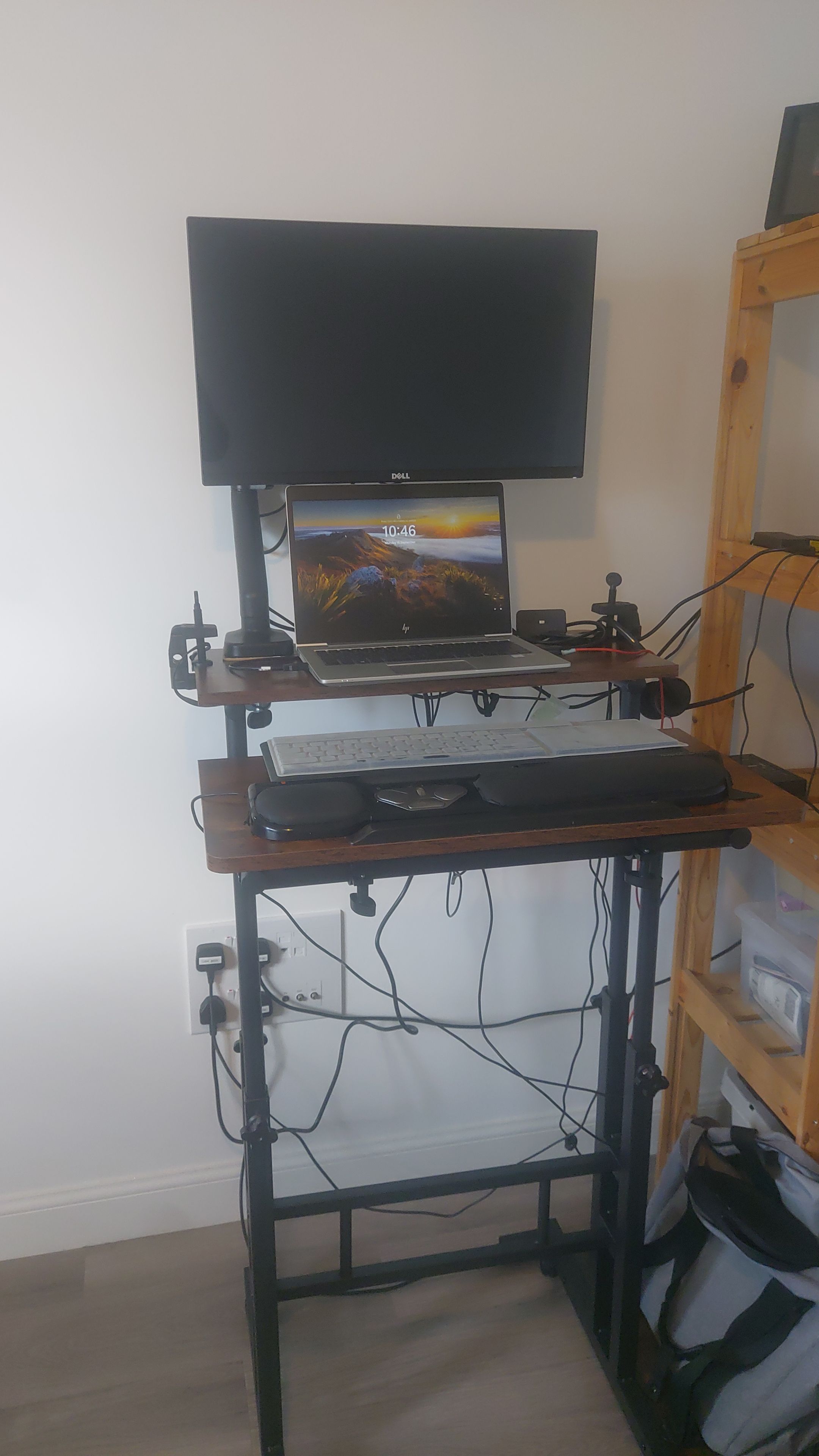
My new desk is just 600mm square, split horizontally, as seen below.

The desk set up in a standing position, with a monitor, laptop and keyboard on the tabletop parts. Towards the bottom is a bank of electric sockets; to the right of the picture, wooden shelves can be seen.

The far half of the tabletop can hold the monitor arm and laptop, while the keyboard can be at a different height and/or angle on the near half. It even has a built-in extension cable and LED lights, eliminating the need to use my own cable.

I’ve had to compromise slightly, with the wooden shelves providing a handy place for a few of the electrical adaptors. However, all the essential parts are present and the new setup fits much more snugly into the room.

Here’s to this lasting at least the next five years, if not much longer.

Hotchpotch Moves to Groucho’s

Regular readers will know that I used to run a monthly open-mic event called Hotchpotch, which I handed over to my pal Eilidh in October 2024.

At the time, the event had been running at a café in Dundee until an upcoming permanent closure was suddenly announced in July 2025. The August event was able to go ahead, but she had to find somewhere to hold it in September.

Fortunately, it didn’t take long to find a suitable replacement: a live music venue called Groucho’s that was once a second-hard record shop. For context, Hotchpotch has probably moved ten times in 15 years for one reason or another.

Unlike a typical music gig, however, Hotchpotch has a particular set of requirements for accessibility. There are people constantly entering and leaving the stage area, plus the environment needs to be quiet enough for the audience to hear clearly. Often, you just need to try out the place to find out what fits and what needs improvement.

Aside from a fixable incompatibility with our microphone and the house PA system, the maiden event yesternight went marvellously and attracted some positive feedback. I took the opportunity to read a piece that was specifically written for the occasion.

Being back on the pub circuit feels like a homecoming in a way because that’s where the format evolved. A couple of members even returned after a few years away. The event also made me realise I’ve missed one aspect in particular.

Two venues ago, we were in the basement of a pub called the Hunter S Thompson. At the end of each event, I would pack up and go home soon afterwards because I was always working the following morning. It took me some time to realise members weren’t simply chatting and dispersing; they were instead heading upstairs and drinking together for an hour or two.

From then on, I encouraged folks to do that, as the more cash we could put through the tills, the more likely we were to secure our bookings for the future. I even joined them on occasion, but not every month.

When we moved to a café in 2023, we were given a 9pm curfew to allow the staff to finish at a reasonable time. But with Groucho’s open until at least 1am, I look forward to seeing the return of this particular element.

The In-Between Times

As we enter September, it strikes me that we’re a somewhat in-between period.

The summer months have just ended, and publishers know that mid-year is a quiet period for book sales. This seems almost paradoxical, as a lot of people like to take a book for the beach. The one big event we’ve seen – I use the term big loosely – is book one of The Thursday Murder Club being released as a motion picture.

On the other hand, we’re also a little too early for Christmas. That’s the perfect moment to release autobiographies and memoirs so people can buy them for stocking-fillers. Two of the most anticipated titles are from Dolly Parton and Margaret Atwood.

And on a local level, the Edinburgh Fringe packed up more than a week ago, while the fledgling Dundee Fringe doesn’t start for another ten days.

Yet there’s plenty to keep me busy at the moment. I can’t recall a time I’ve had so many short story ideas; not just idle concepts, but fully-formed outlines that can reasonably be written at some point. At last count, these comprised three standalones and a series that will likely have six parts.

The only real barrier is finding the time to actually pen them, and I suppose this in-between time is the ideal opportunity.

Dashing Through Dashes

A few weeks ago, a pal sent me a satirical article about the use of the em-dash. It was written in a response to a more serious article from Inside Higher Ed. In short, this punctuation mark has come to prominence of late because Large Language Models often use them when asked to write creative passages.

Before we dive into that, however, what is an em-dash?

At its simplest, it’s a wide horizontal line that was historically the same width as the letter ‘M’ on a typewriter. In the age of the desktop computer, the size doesn’t necessarily scale directly. It always runs up against the neighbouring words:

It seemed the problem—at least, we considered it a problem—was that everyone was using the em-dash again.

It lends a disjointed pace to the writing, either introducing related thoughts or changing the subject.

This should not be confused with its sister mark, the en-dash. As its name implies, this was once the width of the letter ‘N’. This is a more flexible mark:

The Duckworth–Lewis Method – and its later variant with Stern – has been adopted by the International Cricket Council.

Here, the first dash is used to join the words Duckworth and Lewis without spaces either side. The others two do have spaces and are used like brackets to add extra information. This punctuation mark is not typically used to imply the same pace or a disjointedness as its sister.

Merriam-Webster has a more detailed guide to such punctuation, although I notice the name of the dictionary itself uses a hyphen, not an en-dash.

While reading up on why Large Language Models favour the em-dash, I found no clear answer. My theory is that many of them have been trained on older works, when this mark was more prevalent, and the software is picking up on this. The satirical article from earlier specifically names Mary Shelley and Emily Dickinson as heavy users.

I’m such a heavy user of the en-dash that I have a Windows keyboard shortcut especially for it. As I write, however, I think back to the one and only time I’ve used the em-dash extensively in a written work: my university dissertation.

Throughout the course, I was determined not to have my work pigeonholed into one category or another. This worked well until I needed to put together a cohesive dissertation based on what I’d written. The solution was to borrow a somewhat scatterbrained character from one of my stories as a connecting thread. I would make her use the em-dash to talk through the pieces she had supposedly written in character.

I graduated with an MLitt Writing Practice & Study in 2016, long after automated plagairism software was introduced, but a few years before Large Language Models were available. Had I handed in that essay today, I’m convinced I would have been questioned about it even if the plagiarism test had come back clear. But this old-school punctuation mark really was the best choice for the story at that time.

A Look at the EasyJet In-Flight Magazine

On Wednesday of last week, I discovered that EasyJet still prints an in-flight magazine. In an age where most airlines and other transport operators have opted to go digital, let’s have a closer look at the August 2025 issue.

The magazine can be opened from either cover, with the two sets of pages rotated 180 degrees from each other. The larger set opens to a predominately editoral section of 100 pages. The other opens to a shorter section detailing the food and luxury items that can be bought on board. I could find a digital version of the shopping section, but not the editorial part.

Both sections are interspersed with aspirational third-party advertising. However, there appears to be no overarching theme. The products featured include Bennett Winch bags, Qwetch flavoured water and branded cups, the musical version of The Devil Wears Prada at the Dominion Theatre in London, and personalised car number plates by Registration Transfers.

IMM International handles the advertising for the magazine, describing their audience as ‘Smart, elegant and refined, with a cheerful outlook’, but breaking down the demographic no further. My subjective conclusion is that the target market is those who would rather save money on the actual travel and instead spend it at the destination and/or on a quality durable product they can bring with them.

One notable absence is advertising for third-party travel agents and transport providers. The airline quite reasonably wants you to book only with them, so any talk of curated travel experiences are kept largely to the editorial part.

In addition to the suggested itineraries in Morocco, Venice and Croatia, there are two main interviews. The first is with fitness instructor Joe Wicks, and there’s a sharp a focus on his many trips to France and Italy. The other interview is with DJ Carl Cox, discussing his upcoming Ibiza residency. It’s no coincidence that EasyJet can fly you to all these places.

Buried deep inside, I also spotted pages written in other languages, namely Portuguese, Italian, German and French. This feature is not explained by the contents page nor the articles themselves. However, as a primarily English-language publication, I presume this is an opportunity for Brits to practice their holiday phrases.

But what of the paper format?

Thinking this over, it seems to make sense because you can’t use a mobile phone in the air, except in flight mode. As such, passengers would need to remember to download the information before takeoff. This is less of a problem on a train or a boat.

Instead, the magazine is right there in the pocket beside the safety card. They’re re relying on people picking it up, flicking through it and maybe spending some money on an aspirational item.

Six Vital Writing Items

Since becoming a writer, I’ve found I’ve come to rely on a several useful items and resources. Let’s look at six of the more important ones, divided equally into two lists.

Related to technology

  1. Privacy screen
    If you regularly use a laptop in a public place, such as cafés or trains, grab a privacy screen yesterday. These narrow the field of view so anyone looking from the next seat is unlikely to see your screen. I used to own one that was stuck to the screen with near-invisible tabs, although dirt found its way behind that, so I think I’ll buy a removable one next.
  2. Text shortcuts
    When I’m writing, there are certain words, phrases and symbols that I often use, so I’ve set the AutoCorrect in Microsoft Word to generate these; for example, the letters ‘wr’ type out ‘whether’ into the document. In tandem, I have an AutoHotkey script, allowing me to generate a en-dash with a simple key combination, among other useful symbols. Finally, if you press Win+V on a Windows machine, you can access the multiple copy-and-paste feature to save time when transferring a lot of different items.
  3. Mobile hotspot or tethering
    After a decade of running a writing group, the one constant is a hit-or-miss Wi-Fi connection, sometimes from week-to-week in the same venue. I recommend finding a mobile phone plan that allows you to use your own Internet connection where the house Wi-Fi fails, perhaps even a cheap one seperate from your normal phone. Indeed, some tablet devices support a SIM card, which does the same job.

Unrelated to technology

  1. Diary with note pages
    For many years, I’ve kept an A5-sized paper diary with a week spread over a page or two pages. When you’re on the phone to organisers, it’s much easier to check your availability. I also make sure there’s plenty of note space, as many of my pieces begin life as pencil on paper. Speaking of which…
  2. Sharpener with shavings container
    These days, I never buy a pencil sharpener without a little bin attached to it. It keeps all the shavings contained so I don’t need to move away from my desk to deal with a blunt pencil.
  3. Subscription to Writing Magazine or similar
    I feel obliged to point out that other magazines are available; this is simply my go-to publication. I haven’t grouped this under technology as printed magazines still appear to be thriving, even if the content is also available digitally, including Writing Magazine. I like their sheer breadth of featured publishers and competitions, although only a handful will be suitable for my work.