A Regular Writing Routine

I’m part of the Wyvern Poets group in Dundee, having been a founder member in or around 2015.

Unlike my other groups, this one does not actively recruit members but it does publish its work. Most notably, Dundee University has invited us to put together a pamphlet for the Being Human festival every November, and to perform our work on campus.

For the rest of the year, the members each write a poem ahead of our monthly meetings. There is always an optional prompt; normally a single word like ‘environment’, ‘pace’ or ‘journey’. The poems are then discussed on a peer-review basis and suggestions are made between members.

I find if I undertake no other writing in a given month, I always submit something for the group, even if it’s at the last minute or if I’m not entirely happy with it. As there’s only around a week until the next meeting, I’m going to crack on with this month’s prompt – villanelle – right after I finish this.
Writing to Form

Broadly speaking, there are two ways to format a poem.

The first is to use a form. This can include structures like a short unrhymed haiku, a complex luc bat of indefinite length, or rhyming every second or fourth line.

In my own work, I would normally default to free verse, but in a recent piece, I started writing a triolet before realising that a villanelle has a similar repetitive structure, but allowed more than twice as many lines. The intent was to present as a heated argument between two people, so the repetition worked quite well.

In free verse, by contrast, the form is dictated by the poet in terms of line length, syllable count, where any rhyme is placed, &c. In my experience, this is often misunderstood by non-poets – and even some poets – as it can look like the words are simply chopped-up prose or placed at random, rather than placed there with intent.

It’s difficult to sum up in a few paragraphs how to write free verse poetry, but the best advice I can give is to chop out what you don’t absolutely need. Even when writing to form, I sometimes find it necessary to remove the unnecessary and replace the missing syllables with another thought or a stronger image.

This advice particularly comes into its own with rhyming couplets. If it works for the piece, then that’s great, but consider whether removing the couplets element might make it stronger. I have a lot of experience of hearing second lines that seem to be placed there only to rhyme with the previous line.

When The Muse Strikes

As I sit down to write, it feels like a continuation of the last entry, where I talked about inspiration appearing at 5am. This time, however, the inspiration happened near the end of the day.

I’ve been asked to provide a poem for a 12 Days of Gratitude project. As late as Saturday of last week, I’d absolutely run dry of ideas. There were plenty of people to thank, but nothing that fitted into a structure.

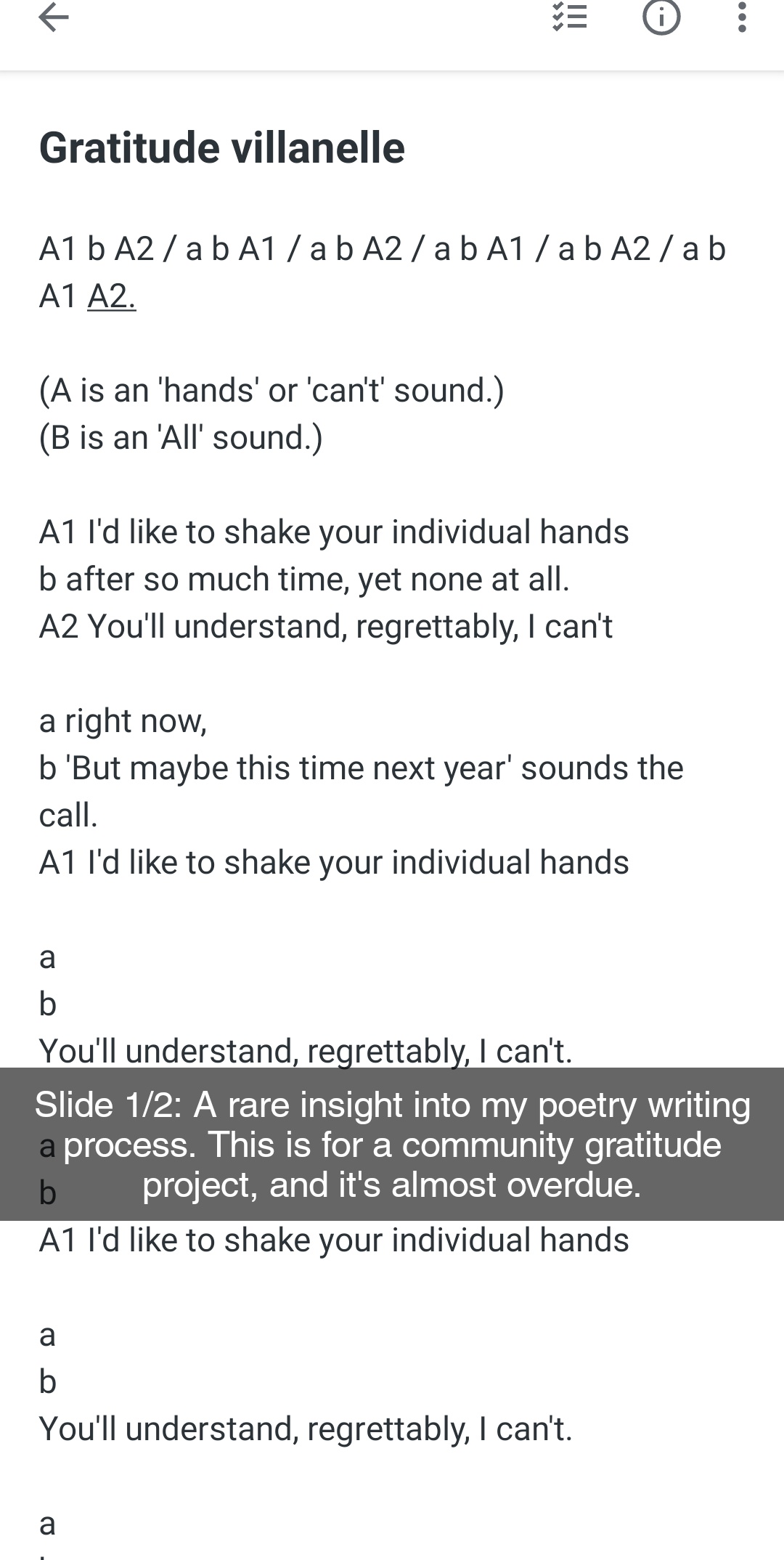
While I do find walking helps with the process, I wasn’t having much luck – and over an hour later, I thought of my first line and the structure. I even took a couple of pictures to document this. It’s rare that I would show such an incomplete draft so early, but it happened by surprise.

Half-completed villanelle about gratitude

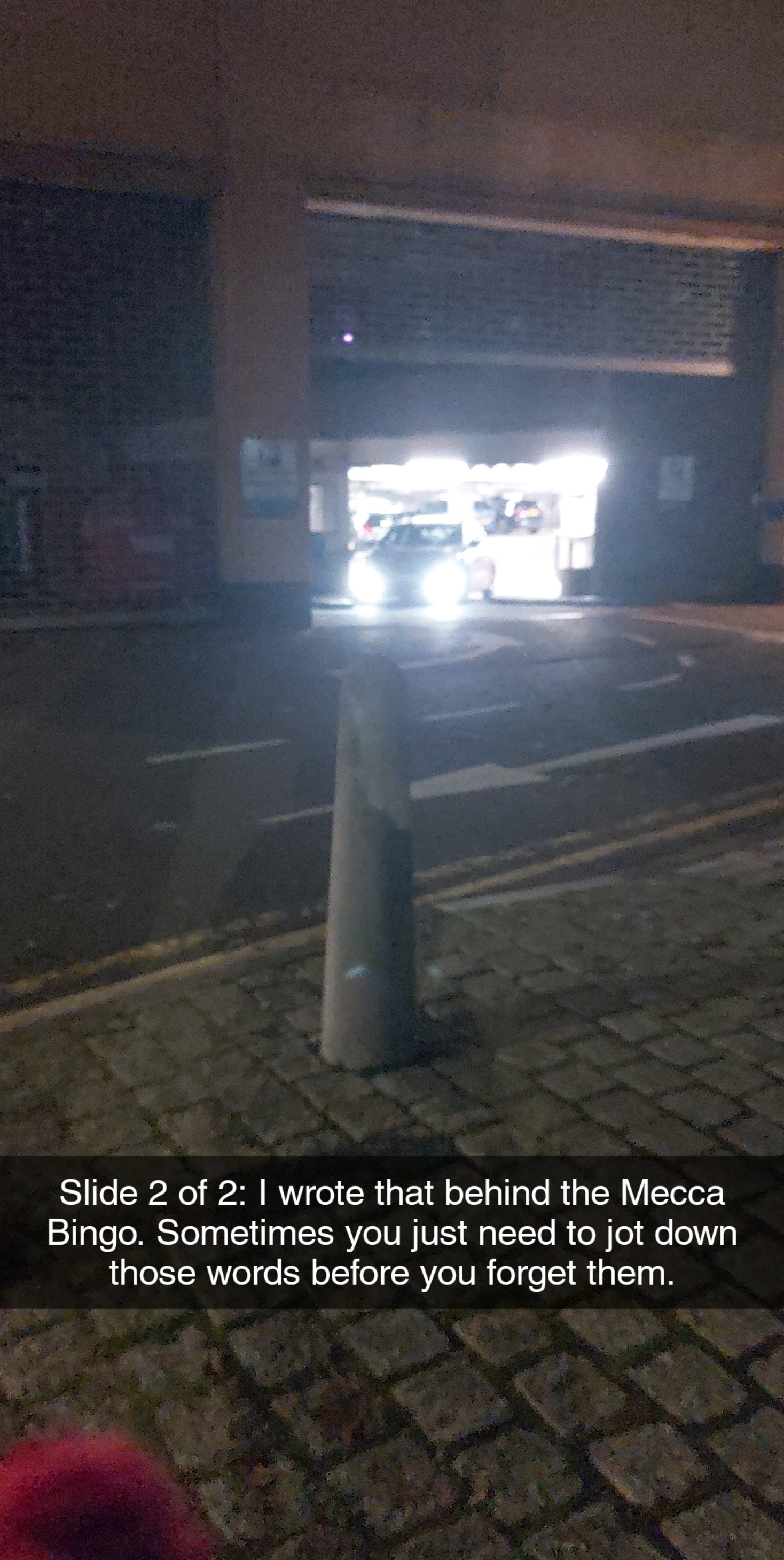
My walk had taken in river views and grassy areas, but when I wrote those lines, I was probably the least inspiring place I’d been that evening: behind the Mecca Bingo.

Picture of Mecca Bingo where villanelle was written

What I need to do now is finish the piece and make a recording of it, but arguably the hardest part is over, so the rest should be plain sailing.