Gttng Strtd Wth SMS

Last week’s entry was all about postcards. In writing about these, however, it was necessary to touch upon its replacement technology: SMS. I realised I had more to write on the matter. so today’s entry effectively serves as a part 2.

When the first SMS-capable handsets became available, they wouldn’t contain a full keyboard. Instead, each letter was mapped to the number pad in the following semi-standardised formation:

I say ‘semi-standardised’. The 0 key usually acted as spacebar, while 1 often produced symbols, but some layouts deviated from this. Ditto the toggling of capital letters, which we’ll disregard for the following demonstration.

To type the word BOOK, the following steps were necessary:

  • B required two presses of 2.
  • O – three presses of 6.
  • Pause for a second or press the right arrow, depending on phone, to allow the letter to register. O would otherwise loop back around to M.
  • O – three further presses of 6.
  • K – two presses of 5.

Overall, quite the frustrating process. It quickly became accepted practice to omit letters from words or use soundalikes. This might morph the word thanks into thx, or tomorrow into 2moro, which are still reasonably legible.

There were further innovations to come. One was the T9 system, which guessed each letter in context based on its neighbouring presses. To type the aforementioned BOOK, you would press the buttons 2-6-6-5 once each. The display might suggest BOOK first, but COOL or CONK could be selected from the menu, cutting down on overall presses.

Many phones would remember which words were used most commonly, but my Nokia 3330 never did. If I wanted to mention my pal Amy, I always had to scroll through BOX and COW.

Despite T9, the abbreviated style still persisted in popular culture for some time, with Fall Out Boy releasing a single as late as 2007 titled Thnks fr th Mmrs. It only died out when touchscreen input became more common.

Cards on the table, I was never sorry to see SMS speak disappear. Although it took longer, I liked to write my sentences out properly, and it could be challenging to decode some abbreviations. I much prefer what we have these days. No doubt the style will make a resurgence at some point, but I won’t be participating in that.
Using Fractals as Illustrations

Regular readers will probably have spotted that each of these blog entries has a pattern as its featured image. Specifically, these are fractals, each generated by a mathematical formula.

It’s long been known that visual content appeals more to users than plain text. However, licencing pictures can be expensive and appropriate public domain images are hard to find. My content is all about writing, which – by its nature – is often plain text.

Instead, I use a program called Xaos for generating these patterns. As I’m not mathematically-minded, I simply use the random image generator, cycling through them until an interesting one appears.

What’s more, it rarely takes more than a couple of minutes. This helps me a lot, as I commonly write or edit my entries up to the last minute.

The main cover picture is my own work, though. A few years ago, I would attend writing classes in the grounds of Barry Mill, a former watermill in Angus, and I captured this wonderful shot of a light over the doorway. I’m unlikely to replace that with a fractal any time soon.

All the Fun of the Day

For the second year, I’ll be taking part in Fun a Day. This is a project where participants do something creative during January, either one project per day or something larger over the entire month.

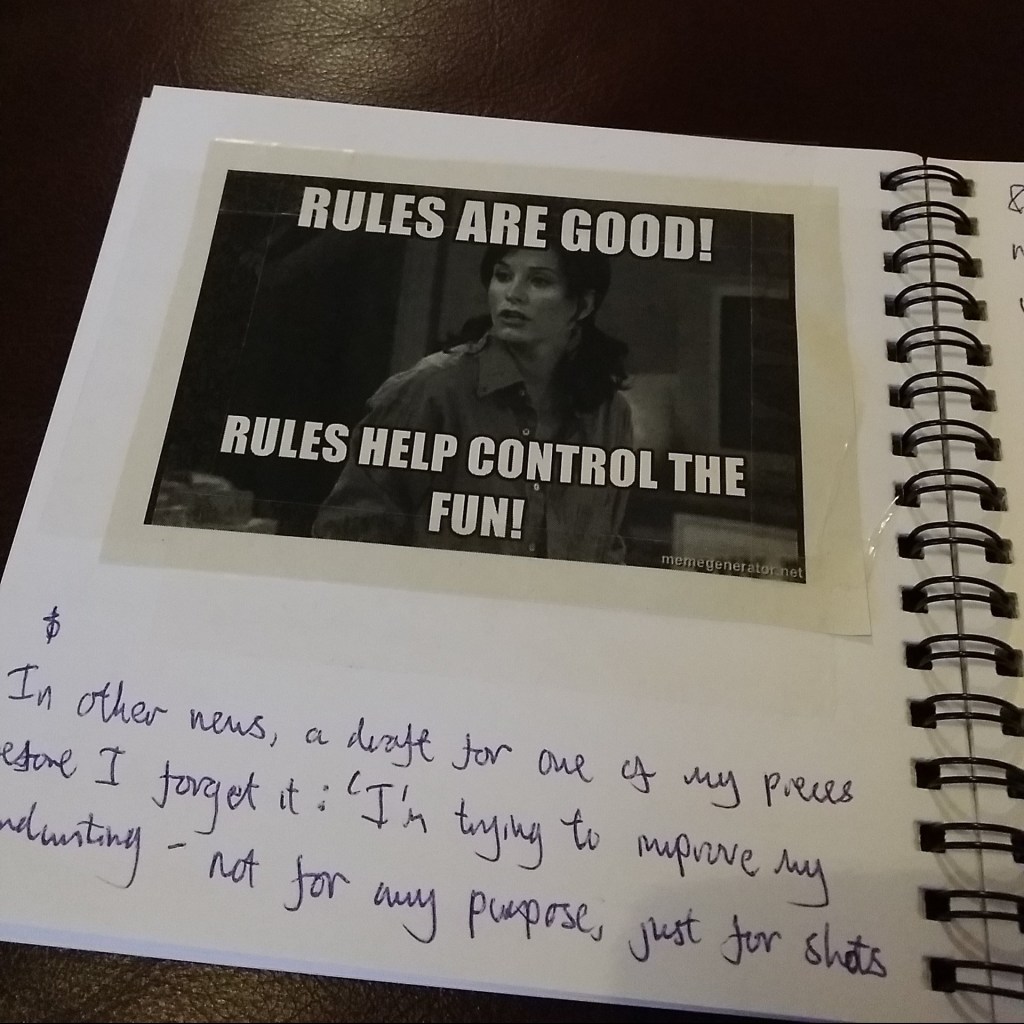
I’ve already started to document my progress in a commonplace book. With the official hashtag now announced, I posted my first two pictures online. The first contained the three rules of my project. The second contained this quote from Monica Geller in Friends.

Rules are good! Rules help control the fun!

My main project will be text-based. I’ll be writing a fragment of 40 words on Day 1, 39 words on Day 2, and so on until I’m writing 10 words on Day 31. The text will form a complete circle so the fragment on the last day will join up with the fragment on the first.

That said, being around visual artists has had an effect on me. Last year’s project consisted largely of pen on lined paper, which looked somewhat out of place compared to the other participants’ installations. Poets think about how their work looks on the page; artists think about how it looks on the wall.

In fact, the proposed title is Line for a Walk, derived from a quote by the artist Paul Klee. Depending upon which source you read, he said, ‘A line is simply a dot going for a walk,’ or ‘A drawing is simply a line going for a walk.’ I actually used this analogy to explain to the organiser what it’s like to write a novel in a month, and the phrase stuck with me.

There are side projects planned alongside the main one, but these aren’t quite so rigorously defined yet. Even if they don’t happen, January will not be a dull month.