Friday Poetry in St Andrews

It’s the time of year for StAnza, the annual poetry festival in St Andrews. I’ve made a point of going for some years now, as it’s only half an hour away by bus.

I would normally go on a Saturday and/or a Sunday, but I could only attend the launch party on Friday instead, and this also meant missing a visit to a pal who lives nearby. Before the pandemic, I would set aside the weekend, typically staying in the town. I’ve fallen out of that habit, but next year would be a good time to resurrect it.

During the same period, the festival length has been reduced from six days to three. I’ve heard grumbles from poetry pals about this cut-down programme, this would work in my favour. By omitting weekdays other than Friday night, there’s less chance of events clashing with work, and I’d be able to attend late-night readings with a finishing time dangerously close to the last bus home.

The next email I’m expecting from StAnza is a feedback form. They’ve nothing to worry about on that front, as I enjoyed the launch. Half of it was improv, calling poets at random to read poetry themed around colours, with the other half a structured reading from Ruth Padel.

The more important aspect is that such festivals often rely on sponsors for their continued operation. The more customer reaction the organisers receive, the easier it is to convince funders to back it the following year, so always fill these in.

The other two places I would like to visit for the first time, ideally this year, are the Wigtown Book Festival and the Orkney Storytelling Festival. These start in September and October respectively, but it’s a good idea to start planning now.

A Short Trip Across the Water

Every March, I make a point of going to the St Andrews poetry festival, or StAnza. While I’m there, I take the opportunity to visit a pal who lives at the back end of town.

A couple of years ago, he lent me a poetry book – Occasional Poems by Callum Rodger – which I thoroughly enjoyed. I recently found it again while clearing out some old papers, and I asked whether he wanted it back, which he did. I happened to have some free time that coming Saturday, so I arranged to pop over.

He was unwell on the day of the visit, but I didn’t plan to stay long anyway, as I had other places to be before and afterwards. I was glad of the visit because I came away with several suggestions for novels to read, to the point where I’m considering reactivating my Audible account.

St Andrews is also home to my nearest branch of Topping & Co, somewhere else I usually make a point of visiting, but time wasn’t on my side. There will always be a next time, though.

I’ve Started So I’ll Finish

On Saturday, I made my annual visit to StAnza in St Andrews, billed as Scotland’s International Poetry Festival.

I’ve been going for around a decade, but my commitment has varied from year to year. Sometimes I’ve been to as many events as possible during a day trip, and sometimes I’ve booked accommodation so I could stay for the late-night slam.

This year, I made a conscious decision to buy just one ticket for the Breakfast Poetry show. As part of the entry fee, the audience is offered light refreshments and a coffee. In the afternoon, I planned to take the opportunity to catch up with my pal Robert who lives in St Andrews.

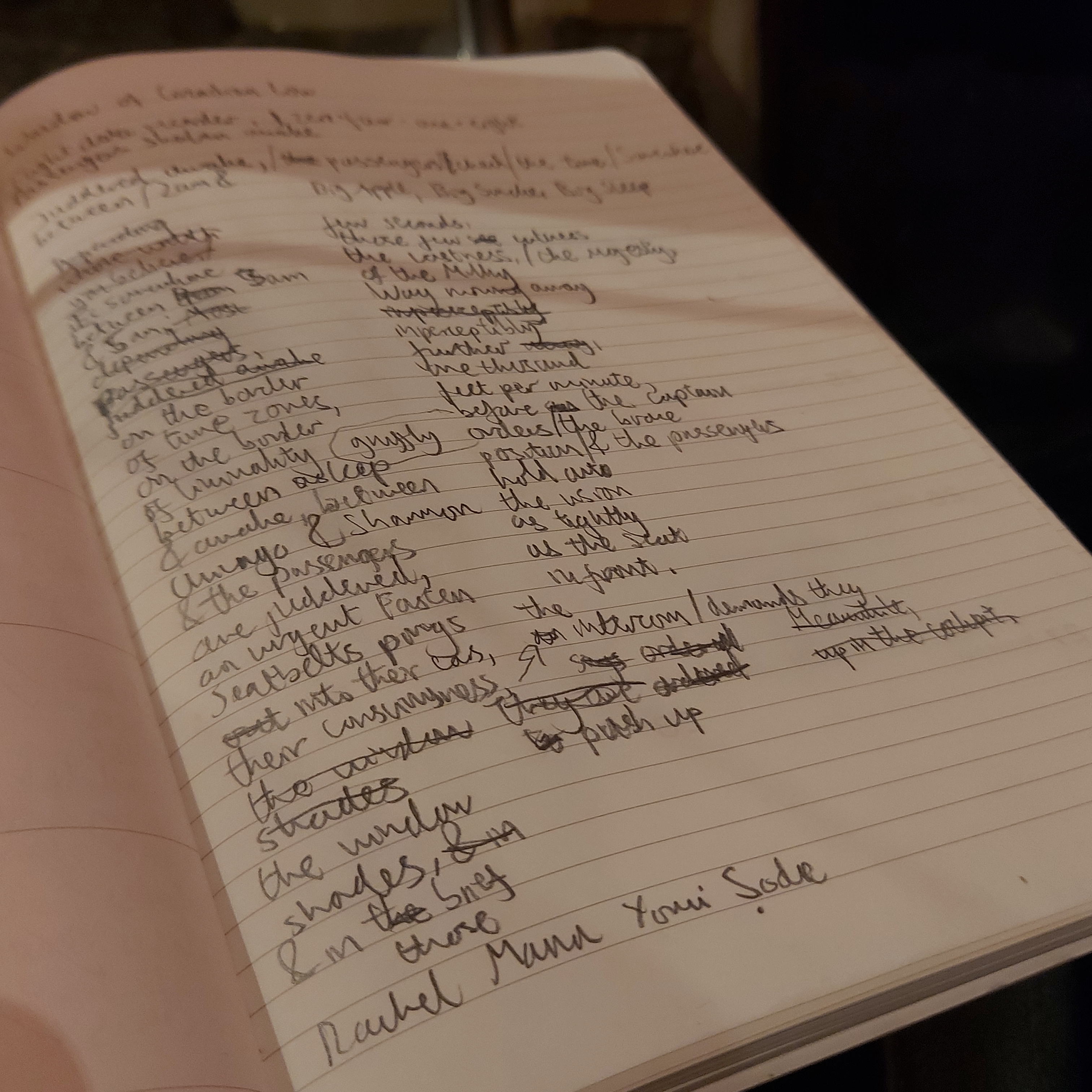
My advice for going to StAnza – and poetry events in general – is always to carry a notepad and pencil. I always find little nuggets of information that would otherwise be forgotten afterwards.

I’m glad I did because I was trying to compose a poem for my monthly Wyverns group using the prompt ‘Stars and planets’. I’d been turning over two ideas but they’d been coming out as short stories.

But as I listened to our guests Rachel Mann and Yomi Ṣode, it started to come together. It’s hard to quantify, but just being around other poets can help the process along. I was able to complete the piece that morning.

The following day, I typed up the piece and sent it to the group. The meeting had already taken place a week before it normally does because of a scheduling conflict, but I did received generally positive feedback by email.

I don’t yet know what my next festival will be, but I’m looking forward to finding out what’s on.

A Little Poetry

Every year, I take time to visit StAnza, the poetry event in St Andrews. The festival is typically spread over the course of around a week, so I normally book a few events on the same day. This year took a significantly different form but it was no less literary.

I booked just two events: the breakfast poetry in the morning plus the slam competition on Saturday evening. I’d planned to use the middle of the day to visit a pal I haven’t seen for around three years.

He introduced me to a game called Bananagrams. It’s easier to demonstrate than explain, but fans of Scrabble will likely enjoy it. We played four games and discussed a few of the books on his shelf.

By the end of the afternoon, I’d decided to skip the slam. It goes on late into the evening and I was too tired to stay up. Instead, I used the time to compose an overdue card to a pal in Dublin, complete with a handwritten letter that ended up being four A5 pages long.

If I were one of these people who posted these vapid inspirational quotes, I’d end with something like ‘The serves as a reminder that even when plans change, there are always opportunities to connect and create meaningful moments.’ And yet that very much expresses how I feel. Just this once, let’s lean into this sentiment.

Marching into March

Around a week ago, tickets for the StAnza poetry festival went on sale. For around a week, there are poetry events all over St Andrews, particularly in the Byre Theatre and Parliament Hall, but also taking advantage of smaller rooms and venues across town.

I’d normally be at the front of the queue for events, but I’ve held off booking them this year. I have other commitments that potentially clash, plus I was waiting to receive this month’s wages.

It’s likely I’ll go to the breakfast event on Saturday, with a pie or a pastry served before it. I’m then going to visit a pal I haven’t seen for two years who lives in the area. At night, I need to decide whether to enter the slam competition, as the late finish means staying overnight or catching one of the last buses home. I’m then playing Dungeons & Dragons the next day.

So as soon as I publish this, I’ll be looking through the festival programme and working out a plan. I can already see some of the staple events, like poetry in translation, round table discussions and music recitals; I just need to work out how to fit them into my schedule.

I have

Being There

In early March, the StAnza poetry festival takes place in St Andrews. I’ve been going for at least five years now. It’s an easy half-hour bus trip, although I’ve previously stayed over so I can go to late shows without worrying about missing the last ride home.

While it would be inaccurate to say there is a ‘house style’ of poetry, it does tend towards the contemplative and wistful, more Carol-Ann Duffy than Brian Bilston. In this relatively quiet town, save for the transient student population, it’s a mood that fits well.

In 2020, the in-person festival narrowly escaped cancellation, so the events were held in venues across town as normal, predominantly the Byre Theatre or the town hall. The challenge this year is to convey its essence through a screen for the first time.

The ones I’ve been to so far this year certainly fit what I expect to see from StAnza: these include the two-hour launch event, a meditation session, and a poets’ feedback group.

But what I enjoy most are the breakfast panel discussions where the audience is served with a pie and a cup of tea. On Sunday, I tried to recreate this at home, and it was somewhat successful:

A Twitter update showing a pie and other food on a plate, and an online event on a projector.

It’s not too late to grab many of the tickets. The festival is on all this week, and there are plenty available free of charge.

Who Took the Slam Title?

Back in March 2020, I was fortunate to be able to take part in the poetry slam at the StAnza festival in St Andrews before live events were halted later in the month.

In a typical year, there are several such slams throughout Scotland. The winner of each is allowed to compete in the Scottish Slam Championships in Glasgow the following January, and that winner competes for the world crown.

As there were insufficient live events this year, the Scottish Slam instead took place online over the space of a week, with the top three highest-scoring poets competing against each other in the final on Saturday just gone. Jenny Foulds became the victor.

The dozen or so poets are called to the stage in a random order and allowed up to three minutes to read a piece. In the second round, the poets are called up in reverse order, under what the organisers call Glasgow Rules. This not only allows the poet to impress the judges twice, but is said to avoid the phenomenon of ‘score creep’. This happens where the judges’ frame of reference changes during the contest and the points they award either increase or decrease.

In this instance, the two judges could award a score out of 30 per poem, so our final marks were out of 120. I scored 77, or roughly 19 points per judge per poem. It’s not a terrible mark, but I can hold my hands up and say my heart wasn’t entirely in it.

Part of it was the lack of a stage and the unspoken feedback that is felt from an audience. I tried to compensate for this by using a headset with a long cable and standing back as I performed, almost as if there were a crowd there. But I was otherwise occupied in the days leading up to it, and I picked my poems less than 24 hours in advance. I didn’t have the time to read them out again and again, adding or omitting words as I went.

There’s no guarantee that a good edit or a decent rehearsal would have increased my score. Maybe my work simply wasn’t to the taste of the judges; maybe one or both of them didn’t like that I ran well short of the three available minutes.

However, I would have felt happier if I’d known I’d put in my best performance – and there’s still plenty of time to practice until next year.

Line Breaks

Last week, I was at the StAnza poetry festival in St Andrews, where I’ve been going for around five years. Most of the events are centred around the Byre Theatre, where you can immerse yourself in verse for five days.

This year, I saw shows featuring: Tim Turnbull, my pal Angie Strachan, foreign-language verse, and even meditation. I also entered an open-mike and the Slam contest where the winner will go on to compete with other poets from around Scotland, and spent time reading and listening to the ambient displays around the Byre.

But it’s difficult to listen to a lot of poetry in quick succession. Having gone to StAnza for so long, I’ve learnt to leave some slack in my schedule.

On the Thursday and the Friday, I took a walk by the harbour and the beach to grab some fresh air and to reflect upon what had been said. I also took the opportunity to decide what I would read at the slam. And of course I visited the Topping & Company bookshop, where I was even served with tea, unasked.

I’ve currently no other literary festivals lined up for 2020, but I’ll definitely be going back to next year’s StAnza and taking a similar approach to structuring the days I visit.

Slam Weekend

On Saturday, I made my annual trip to StAnza, the poetry festival in St Andrews. And what better way to start than Breakfast at the Poetry Café with a pastry and a panel of four poets, namely Sara Hirsch, Jan Baeke, Esther Mijers and Luke Pell. They talked about the inclusion or exclusion of the self in their work, with an extensive discussion on pronouns.

English: St Andrews Town Hall (of 1858-1862), ...
English: St Andrews Town Hall (of 1858-1862), between Queen’s Gardens and South Street, St Andrews, Fife, Scotland, where some of the StAnza events took place. (Photo credit: Wikipedia)

I then moved on to the 12 Showcase, featuring some of the women who collaborate and respond to each others’ poetry via a shared Google document. Dispensing with introductions or explanations, they formed an almost hypnotic chain of verse full of back references and tangents, infused with their individual styles.

Past & Present saw Oli Hazzard speaking about John Ashbery, then W.N. Herbert speaking about W.S. Graham. It’s often difficult to know what to leave out when speaking about a prolific figure, but in their respective 25 minutes, each poet gave a broad sense of their subjects to the packed audience.

StAnza’s theme this year was Going Dutch, ‘shining a spotlight on the poetry of Flanders and the Netherlands in Dutch and Frisian.’ There were Dutch poets peppered throughout the event, but Five O’Clock Verses was the first time I’d heard anyone speak Frisian, the language most closely related to English.

When Tsead Bruinja performed in the language, I was reminded of a childhood memory. In Scotland, there used to be five minutes of Gaelic news shown every evening, and I’d be able to pick out borrowed words such as helicopter. In Bruinja’s case, the most outstanding term was double-D, referring to the bra size. Although he set a high standard, Tara Bergin was able to match it with her absurdist poetry, all delivered in English.

Poetry Centre Stage is held in the main auditorium of the Byre Theatre and is always a must-see. I’ve heard a lot about William Letford, but I don’t recall seeing him before. Half of his 40-minute set was devoted to a story cycle about a family who go to live in the forest. It sounded a lot like prose, but it was written in a wonderfully poetic manner. I left before Liz Lochhead’s appearance because I wanted to prepare for my personal highlight.

The StAnza Slam gives two and a half minutes to 12 participants, all eager to impress a panel of judges. Four of them would then progress to a second knockout round, with three minutes allowed.

I’m pleased to report that I managed to enter the second round with a piece called Sir Madam that’s proved popular at previous events. However, Jo Gilbert deservedly walked away with the prize after a poem about cake.

Although slam competitions are by nature competitive, they tend not to be ego-driven – at least in my experience – and I think that’s great.

For the last decade or so, StAnza has complemented the Dundee Literary Festival, which has traditionally been held in October. While StAnza appears to be stable, there might not be a Dundee event this year as we’ve normally been given news by now. If it doesn’t happen, Dundee writers might just have to pull together and hold an unofficial one of our own.

Note to self – do not call this entry ‘Slampionships’

Before I begin properly, I wrote a blog entry some time ago about what to do after writing a novel. Last week, it was posted on the official NaNoWriMo website.

And now, on with the main event.


On Saturday, I attended the Scottish Slam Championships for the first time. At this event, poetry slam champions from around Scotland compete to be crowned the first among their peers. Before we move into the details of the evening, what is slam poetry?

Ross McFarlane, who performed at the event, outlined the idea in an article from 2015:

Based on different criteria depending on the slam itself, poets are expected to, in one way or another, perform their poetry to be judged by the audience as a whole or a panel of onlookers (sometimes experts and sometimes not). While it might be the case that a lot of slams have more in common than just this description, it would be pretty safe to say that any event with this format could be considered a slam.

Source: Glasgow Guardian

This particular Championship is run under Glasgow Rules:

  1. The running order of the performers is determined by names drawn from a hat.
  2. In round one, the performers each have 3 minutes to perform a poem in front of a panel of judges. The running order is then reversed and each performs a second poem.
  3. In the second and final round, the three highest-scoring poets each duke it out with a third poem until a winner is declared.

Rosenau Poetry Slam

The photo isn’t from this night, but it is royalty-free. Here are the photos from the night. [Photo by Charlyfoxtrott4 (Own work) [CC BY-SA 4.0 (https://creativecommons.org/licenses/by-sa/4.0)%5D, via Wikimedia Commons)]

So what type of material can the audience expect to hear? While there’s no fixed theme, don’t expect to hear nature or Shakespearean poetry, except in a satirical context. You’re more likely to learn about the political landscape, LGBT issues, religion, and of course the self. It’s not uncommon to hear swearing either. I attended to support Angela Strachan who performed a hilarious satire on the appeal of Aldi, and A.R. Crow who reflected upon the death of George Michael.

I also happened to meet a university friend attending her first-ever slam, and what an introduction it was. It’s sometimes possible to guess who the finalists might be, but the performances were so strong that the field was wide open, even at the end of the first round. The host Robin Cairns kept the night running smoothly, trading the occasional strong insult with some of the poets.

If you want to find out who won the evening, head to the Scottish Slams Twitter page.

All of which is a nice warmup for StAnza, the poetry festival in St Andrews. I took part in their slam last year and I’ve signed up to compete again.