Running a Readathon

For the last six years or so, I’ve been involved in a small readathon that takes place on Discord. Over time, it’s been scheduled on various dates and has been run by different people.

In its current incarnation, I help my pal Jenny to run it once a year, approximately around Yuletide. This year, it was set to start at 8pm on Saturday, finishing at 8pm on Sunday. This left us both enough time for a screening of It’s a Wonderful Life first.

For the avoidance of doubt, the intention of the readathon is not to stay up and read for 24 hours straight. Instead, it encourages participants to ringfence some time over these 24 hours to settle down with a book.

We provide regular prompts throughout the event. These might include:

  • Sharing how you discovered the book you’re reading.
  • Telling the group three facts about the author.
  • Writing a haiku about an event or character in the story.

There are also reminders to stand up, stretch, eat and drink. We established early on that some participants were in different time zones, so we could say, Depending on your side of the Atlantic, it’s likely to be approaching either breakfast-time or lunchtime, so be sure to stop and fill up.’

Because Jenny is a night owl and I’m more of an early riser, it was relatively easy to coordinate the full 24 hours., particularly as I had a half-baked plan to watch the winter solstice sunrise from the Law Hill in Dundee. This meant it would pair nicely with the summer solstice six months earlier, even if the cloud cover meant there wasn’t particularly much sun.
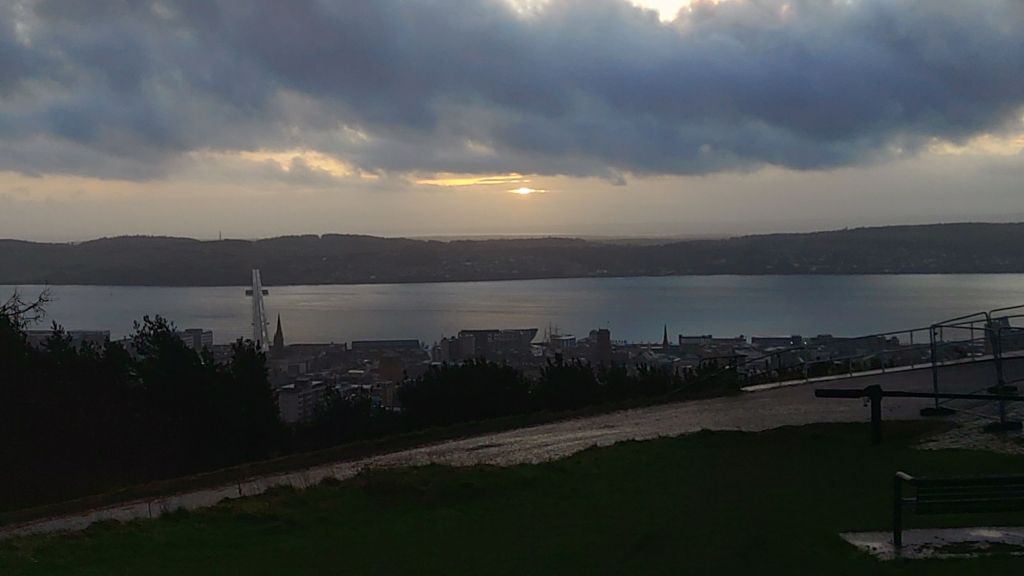
Winter solstice sunrise as seen from the Law Hill in Dundee. There is thick cloud cover partially obscuring the sun. The sky glows softly behind dramatic clouds, casting muted light across the water and buildings. A bridge spans the river, and a bench in the foreground sits beside a damp path and grassy verge.

So what of the actual stories?

I’ve become a lot more interested in audio storytelling over the last 12 months, so rather than reading paper books during the readathon, I listened to a drama on BBC Sounds based on the Fukushima nuclear accident in 2011, a radio drama called Cat and Mouse Game by R D Wingfield on YouTube, and an audiobook of The Time Machine by H G Wells.

The participants’ reading lists incorporated a variety of authors such as Ayn Rand, Becky Chambers, Iain M Banks and George Orwell.

I was a somewhat tired by the end of Sunday, but the event was very satisfying to run. It goes at an easy pace with just enough interaction to keep the server ticking over. I look forward to holding it again next year.

Start a Story Late, Finish it Early

Every so often, a pal and I run a readathon where we invite members to set aside some time one weekend to catch up on reading. It last took place a couple of weekends ago, and I intended to make some progress with War & Peace.

However much I wanted to read, though, I kept putting it aside because I wanted to write. I can’t think of the last time I had such an urge to pick up a pen. I was continuing a fantasy series under a pseudonym on a well-known website. It’s a passion project and I can’t foresee a time where I wish to claim ownership, so references to the plot will be vague.

The classic wisdom for writing a story, and especially a play, is to start late and leave early. The aim is to hook the reader by going straight into the drama rather than explaning the backstory, which can be done once said drama is established.

Stories will sometimes will arrive fully-formed, and these are a joy to write. In the most recent parts, I’ve had a strong idea of where the charcters should be, yet I’ve struggled with how to place them there while maintaning the pace of the story.

Despite its genre, this series still has one foot in the recognisable world. In the most recent part, I needed four characters to end up in a riverside cottage and I tried to build up a sense of drama before they even arrived.

The first draft saw their trains delayed because of industral action and bad weather, so there was a sense of relief upon arrival. Another draft saw them arrive early, only to be told by the grumpy cottage owner they couldn’t enter for another two hours.

Because fiction is so subjective and personal, it’s difficult to teach someone how to spot where the action should begin. When you’ve been doing it for a while, though, you develop a sense of where it fits best.

As I continued, I realised the real drama would happen at the cottage, so I didn’t need to create any more on the journey and I began the story at the time of their arrival. By contrast, if I’d needed to convey any backstory to the reader, having the characters stuck on a train chatting about previous events might have been the ideal way to do it.

A Short Spell of Reading

I have a group of pals who hold a readathon approximately every three months, typically coinciding with the equinoxes and solstices. It used to be an intensive twelve hours but has settled down into a more relaxed two-day format.

Ahead of the most recent one on Friday and Saturday, I went to the library and found two short story collections, namely:

  • Her Body & Other Parties by Carmen Maria Machado.
  • The Rental Heart and Other Fairytales by Kirsty Logan.

I started with the Kirsty Logan one. I’d enjoyed her novel The Gracekeepers, and I even met her at a launch on its release. But the esteem in which I hold the novel didn’t translate to that collection.

Back in July, I wrote an entry about short stories and how readers need to feel satisfied before the end of the narrative. I also prophetically ended the entry by saying I would park the thought for the moment with the intention of returning at some point. This is that point.

In the case of the Logan collection, I’d like to turn to a different metaphor. Each story is a jigsaw puzzle rather than a picture. There’s nothing inherently wrong with that, and a few of the stories worked. However, it’s necessary to make sure all the pieces are there so the reader can mentally assemble them and this didn’t work in a lot of cases. A story about a coin-operated boy simply baffled me towards the end.

I’m only part-way through the other collection, but all the pieces are present, so I’m enjoying the stories much more.

Taking the time to read has also encouraged me to continue with other projects. For instance, I submitted a 50-word-story to a competition run by the Scottish Book Trust. I’ve then continued some overdue work on my stage monologue. Who knows what else I’ll manage to tackle when I next dislike a book?

A Weekend of Reading

I’m in a few different literary groups that meet on a monthly or weekly basis. There is also one that’s active only a few times a year, set up by a pal who is a particularly enthusiastic reader. The group has come to be known as the Seasonal Readathon.

From its inception until earlier this year, its format had been largely the same: we would reserve a Saturday or a Sunday and spend time reading between the hours of 8am and 8pm. The leader would also give out optional prompts every hour, ranging from ‘Predict what happens next in your book’ to ‘Don’t forget to eat dinner’.

The most recent event took place on Saturday 24 June, with a radical difference. We would still spend 12 hours reading, but these would be spread over two days without necessarily having prompts every hour. As it was summer and unusually warm, we also arranged a meet-up in a nearby park.

Initial feedback suggests that while members didn’t manage a full 12 hours of reading, it still spurred them on to read more than they otherwise would have. Also, the slower pace seems to have been a hit with those who were working or had other difficulties being present for the usual 8am to 8pm period. For my own part, Saturday was booked solid, so it helped to have the Sunday reserved as well.

Our next readathon will be in autumn. As this is Scotland, an open-air meet-up is unlikely at that point, but there remains the possibility to congregate indoors and carry on our reading.