Extrovert Through The Gift Shop.

There’s no escaping the truth that writing is a solitary occupation. Authors can spend hours of their life alone in attics, sheds, and cafés, immersed in the land, world or universe they’re trying to create. It’s therefore tempting to imagine that this breed of people are shy introverts. Actually, of the majority I’ve seen, I’ve found the reverse to be true.

These days, it’s important for a writer to be able to self-promote, as many publishers’ marketing budgets are not massive. A prime example is Man Booker Prize winner Eleanor Catton, whom I had the privilege to see at a live event last week. She was interviewed about her book The Luminaries and gave some excellent, confident answers. Doug Johnstone also illustrates my point, as he’s forever looking for an opportunity to crack out his guitar. Chris Brookmyre dispenses entirely with an interviewer in favour of his own speech, while Iain (M) Banks usually invited questions from the word go.

This space reserved for Banksy's next piece
This space reserved for Banksy’s next piece

Have you considered trying it yourself?

Public reading and question-fielding is not reserved exclusively for established authors. Anyone can do it, and I believe they should. Like many authors, I read my work out loud when there’s nobody around, as it’s a valuable tool for ironing out clumsy phrases and misplaced punctuation.

I also consider myself an extrovert. I might spend time alone in front of a PC churning out short stories, but I’m perfectly at home in front of a microphone or camera. I volunteered at hospital radio for a long time, and used to keep a video blog. I’m also lucky enough to have a writers’ open-mike night nearby, where I can try out new material. The audience is made up of fellow authors and poets.

That’s not to say I don’t find it terrifying standing in front of them. I’ve never made a complete hash of it, but I have stumbled, and that’s something I need to work on. But even if you’re an introvert, find a willing audience and push through that barrier. It’s valuable for seeing how well the piece goes down with the public, particularly if they’re laughing when they should be shocked, or vice-versa.If you do, your work will almost certainly improve, and if you become published, you’ll already have the experience of making public readings.

While I was writing this, I thought of one introvert who always causes a fuss whenever he exhibits a new piece. I refer you to Banksy in his iconic film Exit Through The Gift Shop. He seems uncomfortable with the camera being near him, but his self-promotion skills are second-to-none. I know he’s an artist, but if he were a writer, I wonder what type of work he would produce?
The Update to The Update.

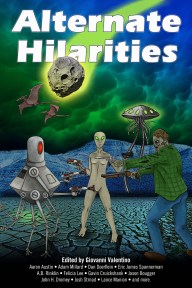
Alternate Hilarities

Over the last few entries, I’ve posted that Strange Musings Press would be printing my story Amending Diabolical Acronym Misuse, subject to raising enough money through their Kickstarter page.

I’m pleased to report that the $1,100 target has been reached, and the anthology will absolutely and definitely be going ahead.

The Kickstarter campaign is still open, and there are extra bonuses for reaching $2,200 and above.

An Update on @Strange_Musings, and Some Transatlantic Translations.

Alternate Hilarities

Around three weeks ago, I was pleased to report that I’ve had a third short story accepted for publication. Strange Musings Press of New York will be printing Amending Diabolical Acronym Misuse, subject to raising enough funds through their Kickstarter page.

There’s still around a week left to raise the $1,100 required for it to go ahead. You can donate at several different levels from $1 to $150, each of which buys you into the project with increasing levels of reward, including electronic and/or paper copies, autographs, and your name in the Contributors’ section.

My story is called Amending Diabolical Acronym Misuse, and it’s about a man who wants to rid the world of badly-constructed acronyms. Although I’m Scottish, my dialect is British English so that’s how most of my stories are written, including this one.

If I’m sending to an American publisher, I often change the grammar and spelling to suit; at least, I have a decent stab at it. In one case, I even wrote the whole story in US English because the character was so strong in my head: a cross between Jason Gideon from Criminal Minds, and Adrian Monk. In Amending…, I took the decision to keep it in my natural dialect as there are a number of references to British places and companies, and I felt it would look odd if I, “translated” it.

A couple of weeks ago, I began reading The Traveller by John Twelve Hawks. The narrative is written with a curious mix of dialects. For instance, the title is spelt with two Ls and there’s a reference to a pub, but the colour gray and an SUV appear in other parts. The SUV would be known as a 4-by-4 in Britain. The story is set in several countries so I expect it’s difficult to settle on one standard spelling, yet it’s not a distraction here, and I’m thoroughly enjoying the story.

Conversely, my mentor Zöe Venditozzi released her debut novel Anywhere’s Better Than Here in 2012. When a US edition hit the shelves, she told me there were no spelling changes made. When you buy a copy, watch out for the character whose initials match mine.

So is it important to adapt your dialect depending on which side of the Atlantic you’ll be published? I expect most Internet users will be accustomed to reading both, but at the same time, people will still write in whichever they feel comes most naturally.

Perhaps one day in the future, the two will merge and we’ll have one way of spelling each word, one form of grammar for all. It would be more practical, but probably rather dull.

Can you help @Strange_Musings fund an anthology?

Alternate Hilarities

I’m pleased to report that I’ve had a third short story accepted for publication. New York publisher Strange Musings Press will be printing Amending Diabolical Acronym Misuse. However, it will only go ahead if enough people contribute.

To this end, a Kickstarter campaign has been set up to raise $1,100 by Tuesday 25 March. You can donate at several levels from $1 to $150, each of which buys you increasing levels of acknowledgement, privilege, and general bragging rights.

I wouldn’t ask you to do something that I’m not prepared to do myself, so I’ve donated $22 under my legal name Gavin Cruickshank. That amount includes $10 overseas postage for a copy of the book, due out on Thursday 1 May. You can see my contribution on the backers’ page.

I would be most grateful if you could give whatever you can, and the editor Giovanni Valentino will be delighted. Don’t forget to share this blog post on WordPress and/or your preferred social networks.

If this comes off, I’ll have been published in the UK, Australia, and the US. Canada, I have my eye on you.

More E-Rejection™ Slips.

A couple of months ago, I discussed the content of rejection slips, or their modern electronic equivalent, which I’ve dubbed E-Rejection™ slips. In that entry, I discussed the feedback to one of my stories, The Strange Case of Mr Brown. I felt the editors had missed the point of the story by their response.

Last weekend, I received another E-Rejection™ from a local publication, and the sender told me that one of the two pieces had been discussed until a late stage in the decision making process, but both had ultimately been refused. That piece was The Strange Case of Mr Brown.

The latest slip didn’t provide any other information about either piece, but I had faith in Mr Brown. It’s written from the point of view of a lawyer in the late 1800s, so it has a certain period style that needs to be believable but understandable to a 21st century audience.

Yet there is such a fine line between self-belief and self-delusion, and not just in writing. It’s terrifically difficult to judge yourself honestly. Just look at the singers on talent shows who are so convinced they’re the next big thing while missing every note.

I’ve considered the question of how to decide whether your self-belief is justified or not. There is probably no single good way, but it’s worth examining any recurring themes in your feedback. If editors or reviewers have different negative comments to make, you probably haven’t made a complete hash of it. But if they all focus in on one or two negative aspects, then there’s a chance you need to put it more work.

One recurring theme I find is that editors like my writing style, but feel that the plot never took off. That often spurs me on to add twists that I otherwise wouldn’t have felt the need to include.

But if you have a better way of using feedback to your advantage, I’d like to hear it.

Dissecting Two E-rejection™ Slips.

If you’re a writer, feedback is a great thing, although less so if you’re a sound engineer. But the quality can vary considerably. Let’s consider two of my recent rejection slips, or the e-mail equivalent thereof. I think I’ll trademark the term e-rejection™.

We’ll endure the bad one first.

An anthology publisher sent me an e-rejection™ to my short story The Strange Case of Mr Brown, with the opinions of three readers.

Two of them commented that the story was bland, but neither of them offered up any specifics about why they thought so. With that information, I could have refined the weak parts. The third one pointed out that the eponymous Mr Brown had an eidetic memory, and that this case wasn’t strange, but I believe the reviewer missed the point that the, “case,” also referred to an unusual court hearing.

And now for something a lot better.

Some time ago, I sent a synopsis of my novel Fifty Million Nicker to an publisher. Less than two weeks later, they asked for the whole shebang.

In the e-rejection™, they told me that they felt the story didn’t take off and lacked a sense of drama or excitement. But they planted a useful nugget halfway through that summed up the areas for improvement: “You needed to surprise us with unexpected twists, and real obstacles, and genuine peril for the protagonist to overcome.”

Essentially, they were telling me to up my game, and I agreed with 90% of the criticism. I’d spent so long honing and polishing it that I’d never stepped back and considered if I could improve the actual story. And I’m now halfway through rewriting the some of the sections.

The common thread.

Both publishers commented that they liked my writing style, the latter even stated they would be happy to consider future work. When I write, I work to the principle that a sentence is only successful when you understand it after one reading. So it annoys me when I read a headache like this: “He knew that she wanted him to think that she had failed to call his bluff.” That’s not from a real book, thank goodness.

If you’re a publisher and want to slate consider the aforementioned works, I’m happy to send them on.

Taking The Lid Off The Pen

When you speak to a lot of authors, it’s common to hear that they were always writing stories as children or experimenting with poetry as teens. However, I’ve only been writing for three years, since 29 October 2010, in fact. That was the day I signed up to National Novel Writing Month (NaNoWriMo) on a whim, since everyone else was doing it.

From high school until that point, I’d written hardly any fiction. Since then, I’ve entered NaNoWriMo every year and written dozens of short stories, many of them under the tutorship of Zöe Venditozzi, whom I’m sure would like you to buy her book. I’m also pleased to report that I’ve had a flash fiction piece published in The Fiction Desk, while FourW will publish one of my short stories next month. More on the latter when it happens.

Although I didn’t write fiction until three years ago, I have kept a blog for a long time, and it’s still a powerful way of spreading your message, even in these days of Twitter and Facebook. I don’t plan to give up my with ageing LiveJournal for my day-to-day activities, but I did want to start afresh with WordPress for discussing my writing.

I’m viewing this as an experiment, and it might not last. After all, the more you write about writing, the less time you have to write. But I hope I can whip myself enough to keep this place updated, and more importantly, to make sure you want to read it.

One final thought: I’ve used the tag-line Carry on for a long time, before that Keep Calm poster ever came out. I’m debating whether to have a tag-line at all, and if so, what should it be?