Every April, there’s a contest called Camp NaNoWriMo, an offshoot of November’s National Novel Writing Month. In November, the aim is to write a 50,000-word novel in 30 days. Camp, by contrast, allows participants to choose a word goal starting at 10,000 and to work on any type of writing.
I intended to do more work on one of my unpublished novels, which is mostly written but needed extra scenes. I did write a few thousand words of it, but I didn’t feel the same enthusiasm as I did when I edited it a couple of months ago. Rather than bore myself stupid with it, I changed focus.
A piece of advice often given to new writers is Finish what you start. It’s rare that I don’t finish work, but I did have a few short stories that had gone nowhere. I therefore used the opportunity to finish two of them.
One had started off as a little self-indulgence but rereading it after this time allowed me to work out and deliver the message I was trying to convey. The other one should have been written in one session, but I was interrupted and never went back to it. I now have a satisfactory ending for both pieces and they’re ready for a second redraft – and a ruthless reduction in their word counts. As for the novel, I will redraft it when my enthusiasm returns.
Camp NaNo is traditionally done without a group leader and without meet ups in person. In Dundee, however, we’ve been fortunate enough to have active members who have met up every Tuesday in April to work on their respective pieces. I set my own target at 10,000 words as I also had a university paper to hand in around the same time, but thanks to these meetings, I managed to reach the goal.
If you’re also in Dundee, by the way, there’s a new monthly Literary Lock-in at the George Orwell up the Perth Road. There are no speeches or readings, just an opportunity for writers to mingle and speak with each other. The next one is on 25 May.
For those of you who enjoyed the main event in November, we’re now nearly a week into Camp NaNoWriMo. This is an offshoot project where you have a free choice of what you want to work on, and you can set your own word target from 10,000 upwards. However, this is not what I want to discuss today.
One of our group members keeps a WordPress blog about her experience of moving to Scotland, from eating ice cream on a cold day to voting in last September’s independence referendum. Indeed, we boast a number of members from other countries.
There’s a joke often repeated that there is no such thing as American English, there is English and then there are mistakes. Joke or not, I find it difficult to agree with this statement, as there are so many variations of English even as you travel within the same country. For proof of this conjecture, just ask people on your favourite social media site what they call the end slice of a loaf of bread and watch the arguments come to a head.
The Stranger (collection) (Photo credit: Wikipedia)
Regular readers will know that I’ve so far been published in three countries: England, Australia, and the USA. Sometimes when I send to US publications, I change the spelling and grammar appropriately, with guidance from Microsoft Word and my own knowledge of Hollywood movie dialogue. This isn’t, I admit, a perfect system. And yet the one story published there is written in British English, and that’s because the protagonist is obsessed with acronyms, and changing the location would mean rewriting those acronyms, so the Britishisms stayed accordingly.
I know virtually nothing about Australian English, so I stick with my usual spelling and syntax. Here’s where to buy FourW Twenty-Four containing my story, although they’ve omitted my name from the website. I made reference to a motorway, whereas a quick Internet search suggests that highway or freeway might be more appropriate. The type of road is not a major plot point in this piece, nor does the action take place in a specific locality, but I know a few expats who can advise me for next time.
While looking up these links, I discovered that another Gavin Cameron wrote a non-fiction book in 1999 about the threat of nuclear terrorism. So if that’s a subject that interests you, it’s the other guy you want to speak to.
Sometimes an idea for a piece strikes after hearing about a topical event. Last week, for instance, I posted a poem I wrote on the day of the solar eclipse. Back in November, I was also inspired to write a short story prompted by the BBC’s coverage of the Ferguson riots. Since last week’s entry was posted, the world has been talking about the Germanwings plane that crashed in the French Alps. That also inspired a poem in the same form as the eclipse one.
Neither the Ferguson nor the Germanwings pieces have been posted online as I might send them to a publisher in the future. I’m afraid you’ll have to take my word for their contents, which I discuss later on.
When writing a response to current affairs soon after they happen, the details are fresh in everyone’s minds as they’re analysed in the papers and on TV. However, the danger is that specific incidents from the wider event are sometimes forgotten as soon as a week after they occur; in some cases, the entire event might not survive in people’s memories. It’s hard to tell which events might stick around and which won’t. The piece you’ve written in response might therefore contain details that need to be explained in future readings.
Regarding the three pieces in the first paragraph, my solution to this problem was not to focus on the incident itself, but the thoughts and feelings generated by it. To find the universal truth, if you will. It’s not necessary to know that the eclipse took place in March 2015, nor that anything happened in Ferguson, nor that a certain plane crashed in a certain place.
The alternative is to make the piece self-contained, giving the reader enough of an insight about the event for them to understand why you’ve responded to it in a particular way.
A good example comes from the Billy Joel hit We Didn’t Start the Fire. In the lyrics, he makes reference to around 100 world events that happened between his year of birth (1949) and the song’s release (1989).
Many of the earlier events, such as Bob Dylan’s career and John F. Kennedy’s assassination, had already stayed in the public consciousness. However, a modern listener might wonder the meanings behind Hypodermics on the shore and Rock-and-roller cola wars in the late 1980s, as these haven’t been widely retained in our collective memories. There’s no way Joel could have known this, of course, nor that the Berlin wall – after having its construction noted in the song – would be knocked down just two months after its release.
Last week, an editor wanted to make unsolicited contact with me, but was unsure of the best way to approach it. She settled for asking me via Twitter to e-mail her. This started me thinking.
There are several ways to reach me publicly: leave a comment below, send a Twitter message to @LadyGavGav, or post to me on Google+. Yet I hadn’t previously thought about how people could contact me privately. In the case of the editor, it meant putting her e-mail address in the public domain, which I’m keen to avoid thanks to the risk of spam.
So I’m interested in how you manage to maintain contact with others? A ‘disposable’ address that forwards to your real one? A website form? Or some other method I haven’t thought about?
Recently, I’ve rediscovered the art of playwrighting. National Novel Writing Month used to have an offshoot called Script Frenzy. In 2012, its last year, I wrote my first and only full-length script: a stage play for two actors. Since then, I’ve become more comfortable with dialogue in prose, and how it can be used to imply action, or indeed how an action can omit several lines of speech. I haven’t yet edited my Script Frenzy work, but I imagine I could tighten up the dialogue and cut out many of the directions.
One thing that strikes me about penning a play is that you must have a clear idea of where it’ll be performed, not just which venue, but where in the world. A radio drama, for instance, will be radically different from a screenplay, and done on a vastly different budget. Even taking a stage play from London’s West End to Broadway will require the script to be laid out in a different format. But once you know where it’ll be set, the rest falls into place.
Scrivener, for instance, offers several different templates, including all the ones mentioned in the last paragraph, and any that aren’t shown by default can probably be downloaded. You tell the program your next action by pressing Enter or Tab at the end of each line. I’ve found this software a joy to work with for novelling, and just as good for scripts.
It’s most important, however, to remember that playwrighting is not for control freaks. The moment you give it to a director, he or she will have different ideas about how your words should be presented to an audience. You might imagine your characters sitting opposite sides of a table dressed formally, but the director might see them in jeans cuddled up next to each other. The writer has limited input in this process. The only way to guarantee it goes the way you want is to become a director yourself.
Sometimes after posting an entry, I decide or realise I should have added some more information. To that end, I have addenda for two recent posts.
After putting together last week’s top tips for public speaking, I think I should slot an extra one after Think about your introduction.
Avoid too much alcohol and/or a heavy meal before speaking. Both of these slow down the thought process. I recognise the meal often comes before the entertainment so try to leave sufficient time for it to digest. Being drunk at an organised event rarely makes a good impression on the audience, and is inexcusable if you’re paid to perform. I often have one coffee before I speak, which speeds up the thought process.
A few entries ago, I also discussed how to set or avoid setting a story in a particular era. Yesterday, I finished the Anthony Burgess classic A Clockwork Orange, written in 1962 and set in a near-future society relative to that year.
To avoid the problem of including dated slang, Burgess opts instead to invent his own jargon partly based on Russian. It’s easy to see why he chose that language, as the Cold War was at its height then. Many of the words have to be inferred through their context, as most editions deliberately omit a glossary.
He does, however, also use English words in an uncommon manner. A couple of these words have made their way into modern slang and these passages read as though they’ve been written recently. A case in point is like, with which the main character Alex peppers his speech not only as a comparison but when he’s struggling to remember the words he means.
There is another example, but I’m not sure whether it’s intentional, when he describes a stereo, “playing a very sick electronic guitar veshch,” the last word meaning thing or stuff. There is only one instance of it in this context, and it sounds as though it has the modern slang meaning that’s used alongside wicked and cool. For the rest of the book, Alex only uses the word sick when he’s feeling physically ill, and the Wikipedia appendix doesn’t list it.
Finally, yesterday marked the birthdays of three very famous writers. Robert Burns is the most obvious – I read To a Mouse to an audience in honour – but Virginia Woolf also burned candles on 25 January, and one of my major influences John Cooper Clarke turned 66.
Thanks to electronic publishing and print-on-demand, there are more ways than ever to read fiction. It is, however, as important as it’s ever been for a writer to be able to stand in front of a crowd and read out his or her pieces.
A good live performance means engagement with your existing audience, a chance to have your name known by more people, and – if you’re published – to shift more copies of your work. I was performing on Thursday just gone, and I’m scheduled to take part in three more over the next fortnight.
To that end, I’ve put together some advice for speaking to an audience. These should be treated not as unbreakable rules, but as guiding principles to bring out a better performance.
Think about your introduction. At a minimum, people want to know your name and the title of the work you’ll be reading, but you’ll sometimes need to include other information. To make this part sound natural, I like to make brief notes which I’ll expand as I go along. The list below is totally fictional, but it might read:
Give name
Thank Tracey Jones
Piece is called On the River Tay
Taken from collection The Pie Seller
Brought copies, happy to sign
When it’s read out, it might go, “Good evening, my name’s Gavin Cameron. I’d like to thank Tracey Jones for inviting me to read tonight, and the piece I’ve chosen is called On the River Tay. It’s taken from my collection The PieSeller. I’ve brought some copies and I’ll be happy to sign them afterwards.”
Explain if you need to, but don’t apologise. A good example is when you’re reading an unfinished piece of work. In December, I read out an unedited piece I’d written during National Novel Writing Month. I felt I needed to explain that what they were about to hear wasn’t as highly polished as they were accustomed to, but I was still willing to share with them as an example of what can be done in a month. Should you feel the need to apologise, it’s worth reconsidering whether you want to read out that particular piece.
Before reading to someone, read to no-one. Find a space where you’re on your own and hear how it sounds. Check the inflections you use in the piece, and whether there are any long sentences where you need to take an extra breath in the middle. If you’re reading a new piece, this is also a prime opportunity to make edits.
Practice your page turns. Unlike a rock star, the great thing about being a writer is that you’re often allowed to take your notes on stage. When reading from a book or from sheets of paper, turn up the corner slightly or stick a post-it note on each page to help turn them more easily. When using an e-reader or tablet computer, make sure you practice tapping the correct area of the screen to turn the page, as there is a delay on some devices.
Keep your mouth where everyone can hear it. Avoid tilting your head down to read the piece; instead, hold your manuscript higher and off to one side so it doesn’t muffle your words. Always speak loudly and more slowly than you would in normal conversation. If a microphone is available, keep it at the same distance from your mouth; I’ve seen too many readers wander around the stage and it sounds like a Norman Collier routine. Where possible, work with the sound engineer to set the level before the gig begins.
Sometimesthe audience reacts in the wrong places. I’ve had experiences where an audience didn’t laugh in a place I’d expected; don’t point out it’s a joke or tell it again, just move on to the next part without comment. There might be occasions where they react, positively or negatively, in an unexpected place; in this case, pause until it dies down and move on without comment.
Signalthat you’ve finished. Just lower your manuscript by your side and/or say, “Thank you.” The audience will take the hint and applaud.
Do it again. This guide doesn’t cover how to deal with nerves. There are many tricks you can use to overcome them: the classic advice to imagine everyone naked, or more unusual methods such as looking at people’s eyebrows to avoid eye contact. However, the only effective way of becoming a confident public speaker is by doing it again and again. It’s worth remembering that the audience sometimes is nervous on behalf of the speaker and most will be forgiving even if you make a mistake.
Speaking of which, even the best of us experience the occasional cock-up. In October, I was invited to a poetry reading at Dundee University and I attempted to read one of them from memory. I managed the second time, but here was the first attempt:
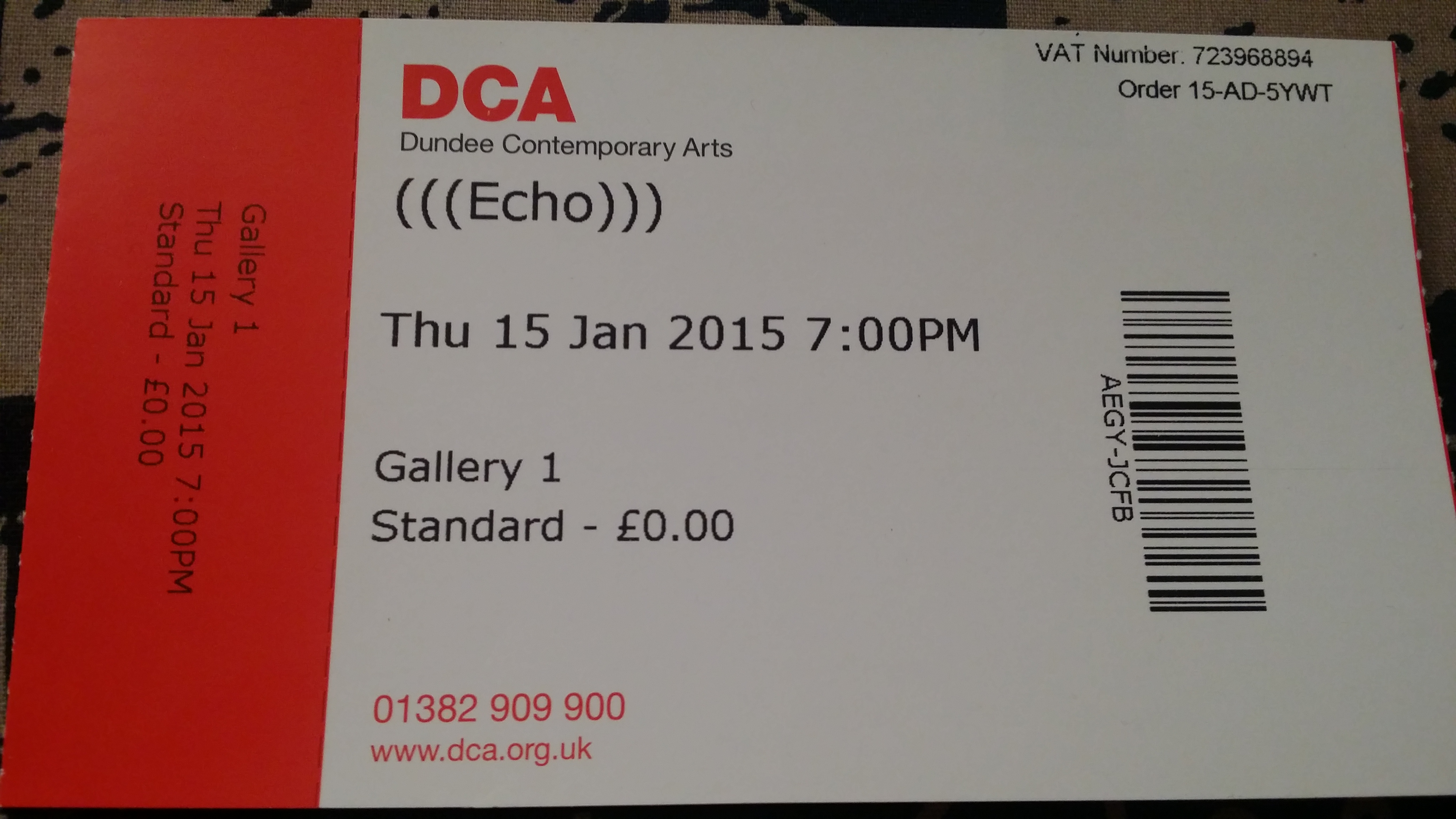
I’m pleased to report that I’ve been asked to respond to the Jim Campbell exhibition currently showing at Dundee Contemporary Arts. Until now, only other artists had been invited to do this, but there will also be poets and prose writers this time. The event takes place on Thursday the 15th, 7pm, Gallery 1; tickets are free of charge.
Something that fascinates me about the creative arts is the ability for writers and artists to respond to each other through their work, often very quickly. A recent example is how cartoonists around the world reacted to the Charlie Hebdo shootings. I’ve previously taken inspiration from the Michael Brown riots in November. In the BBC News report, there was a snippet of a police officer shouting, “Stop trying to turn over the vehicle immediately,” through a megaphone. I responded with a 340-word piece, but only to that fragment of speech, not to the rest of the events in Ferguson.
But it doesn’t always take tragedy to provoke a response. In 2000, Tony Blair lifted his arm at the end of a speech and inadvertently revealed a sweaty armpit. A day or two later, a deodorant company used the image in a press advert.
This isn’t the first time I’ve responded to an art exhibition, although I wasn’t asked to do so last time – I was simply inspired. A friend’s solo show opened on a Friday in summer 2013. By the time I caught the bus home, I was beginning to develop the idea. I spent the weekend typing it up and changing the names to ensure it was definitely fictionalised, and I sent it to her on the Monday.
On Thursday, it’ll be a different type of response. I’ve spent weeks working on it and had time to explore different options such as using props. All I need to do now is keep rehearsing so the response is as fluent as I can make it. Next week, I’ll be offering click save draft my best tips about public speaking.
I’ve been keeping a log of all the books I finished in 2014. Note that these were finished in the last year, and that the top one or two might have been started in 2013. Here’s that list in full:
Number
Author
Title
1
Ella Cheever Thayer
Wired Love
2
Nethergate Writers
If Stones Could Speak
3
John Twelve Hawks
TheTraveller
4
Nethergate Writers
Whodunwhat?
5
Rachel McCrum
The Glassblower Dances
6
Jenny Lindsay
The Eejit Pit
7
Luke Wright
Mondeo Man
8
Various authors
Alternate Hilarities
9
Adam Gopnik
Paris to The Moon
10
Virginia Woolf
Mrs Dalloway
11
Carson McCullers
Ballad of The Sad Café
12
Jayne Anne Philips
Quiet Dell
13
Raymond Carver
Elephant and Other Stories
14
Kohta Hirano
Hellsing
Not all of these were traditional novels. Numbers 5, 6 and 7 were poetry chapbooks, 9 was a collection of essays, while 14 is my first foray into reading graphic novels.
My favourite of these had to be number 1. It was published in 1880 and was ahead of its time both in terms of the technology used in the story and that the main characters are all women, with the men in supporting roles. My least favourite was number 10. This choice will rub up two of my lecturers the wrong way, but while the quality of her writing is high, her books never form much of a story. I had to wait until page 168 for anything major to happen.
Since I became a writer, I’ve tried to finish any book I’ve started even if I find it hard going. I’m currently trying to plough through the abstract concepts in Mein Kampf by Adolf Hitler, and I tackled Crawling Round South Oakwood by Stephen Slaughter a couple of years ago although it read like an unedited first draft. Before then, I would give up after a short time; I didn’t make it past the first few pages of Road to Mars by Eric Idle, nor A Brief History of Time by Stephen Hawking.
Mathematician Jordan Ellenberg has developed a formula based on the latter of these books called the Hawking Index to estimate how far people are reading before giving up. It uses the five passages in each book most highlighted by Kindle users. However, in the time since the publication of the formula, the title of least-read book is no longer Hawking’s masterpiece, but Capital in the Twenty-First Century by Thomas Piketty. You can read the full list here.
A few weeks ago, I was listening to Sleeper’s 1996 track Sale of the Century, and the following lyrics jumped out at me:
Let’s take a photograph
We’ll burn all the negatives
These days, very few photographs are taken on film, but that’s how it would have been done at the time of the CD’s release nearly 19 years ago. As we fast approach New Year, it started me thinking about how the language we use can inadvertently place a piece of writing in a particular era.
For instance, I own a computing book published in the late 1970s or early 1980s in which the author writes, “When I was a young hacker…” But he’s not talking about accessing any systems illegally; the term hacker originally meant someone who was merely proficient at using computers.
I’ve just finished reading Quiet Dell by Jayne Anne Phillips. The story is part fiction, but based on a series of murders that happened in the 1930s. She uses newspaper sources from the period. One of these talks about the matrimonial bureau the killer used, and another mentions a colored porter working at a hotel. Although the actual date is mentioned at the beginning of each chapter, this sets the action in a social context. These days, of course, there are no matrimonial bureaux left while the latter term has become widely unacceptable.
It’s very difficult to know how language will change and it’s therefore difficult to adapt accordingly. You might write a story today about a character who watches a Netflix film on her tablet device, but within a decade, she might have it streamed directly into her head by BrainMoviez. Indeed, the word film itself is an anachronism, as it was part of the same technology mentioned in the Sleeper track.
One way around this potential obsolescence is to mention that a character is, for example, listening to music or driving a car without mentioning the source of the sound or the type of car. Yet that can deprive the reader of a sense of location. Even when a writer tries to create a sense of timelessness, there are often hallmarks that signal when the piece was written. Most readers will realise this and take it into account.
I’m now going to back up this entry to a floppy disc, dial into the Web, and post it.