For the last ten years, I’ve run a weekly writing group. This has almost always been on a Tuesday and with a co-organiser.
I inititally joined in 2010, when the group was still a branch of National Novel Writing Month (NaNoWriMo). I took over in 2015 once the original organisers graduated and moved away. After withdrawing our affiliation from NaNoWriMo two years ago, two of us now jointly run it as an independent group.
It must be stated that we have a manageable number of members, so other than a few word-of-mouth referrals, the group is not actively recruiting at present.
In its current form, members can drop in at any time during the two-hour session, either in-person or via Discord. They’re welcome to stay for a short while or the whole session, and there isn’t even an expectation to write. We frequently end up chatting, joking, making plans and/or solving problems.
But although that format is consistent these days, it took some trial and error to figure it out.
As the main NaNoWriMo challenge only took place during November, the weekly meetings coincided with that. After some enthusiasm by members, we cautiously extended the-e weekly meetings on a trial basis through December, then January, then February, and so on. People were still coming along, so we confidently started meeting up all year round. We now have a recurring table reservation and the staff know us well.
On a couple of occasions before the pandemic, I even brought the members around to my house on 31 October so we could begin to draft our novels at the stroke of 1 November.
While the meetings themselves have always been a hit, the members have rarely been interested in any formal activites such as writing sprints, feedback sessions or homework challenges. Variations of these have been attempted with different leaderships in different years, but none have caught on.
In Dundee, at least, the thirst is simply for ringfenced time to write every week and that’s what we provide.
Regular readers will know that I used to run a monthly open-mic event called Hotchpotch, which I handed over to my pal Eilidh in October 2024.
At the time, the event had been running at a café in Dundee until an upcoming permanent closure was suddenly announced in July 2025. The August event was able to go ahead, but she had to find somewhere to hold it in September.
Fortunately, it didn’t take long to find a suitable replacement: a live music venue called Groucho’s that was once a second-hard record shop. For context, Hotchpotch has probably moved ten times in 15 years for one reason or another.
Unlike a typical music gig, however, Hotchpotch has a particular set of requirements for accessibility. There are people constantly entering and leaving the stage area, plus the environment needs to be quiet enough for the audience to hear clearly. Often, you just need to try out the place to find out what fits and what needs improvement.
Aside from a fixable incompatibility with our microphone and the house PA system, the maiden event yesternight went marvellously and attracted some positive feedback. I took the opportunity to read a piece that was specifically written for the occasion.
Being back on the pub circuit feels like a homecoming in a way because that’s where the format evolved. A couple of members even returned after a few years away. The event also made me realise I’ve missed one aspect in particular.
Two venues ago, we were in the basement of a pub called the Hunter S Thompson. At the end of each event, I would pack up and go home soon afterwards because I was always working the following morning. It took me some time to realise members weren’t simply chatting and dispersing; they were instead heading upstairs and drinking together for an hour or two.
From then on, I encouraged folks to do that, as the more cash we could put through the tills, the more likely we were to secure our bookings for the future. I even joined them on occasion, but not every month.
When we moved to a café in 2023, we were given a 9pm curfew to allow the staff to finish at a reasonable time. But with Groucho’s open until at least 1am, I look forward to seeing the return of this particular element.
Since becoming a writer, I’ve found I’ve come to rely on a several useful items and resources. Let’s look at six of the more important ones, divided equally into two lists.
Related to technology
Privacy screen If you regularly use a laptop in a public place, such as cafés or trains, grab a privacy screen yesterday. These narrow the field of view so anyone looking from the next seat is unlikely to see your screen. I used to own one that was stuck to the screen with near-invisible tabs, although dirt found its way behind that, so I think I’ll buy a removable one next.
Text shortcuts When I’m writing, there are certain words, phrases and symbols that I often use, so I’ve set the AutoCorrect in Microsoft Word to generate these; for example, the letters ‘wr’ type out ‘whether’ into the document. In tandem, I have an AutoHotkey script, allowing me to generate a en-dash with a simple key combination, among other useful symbols. Finally, if you press Win+V on a Windows machine, you can access the multiple copy-and-paste feature to save time when transferring a lot of different items.
Mobile hotspot or tethering After a decade of running a writing group, the one constant is a hit-or-miss Wi-Fi connection, sometimes from week-to-week in the same venue. I recommend finding a mobile phone plan that allows you to use your own Internet connection where the house Wi-Fi fails, perhaps even a cheap one seperate from your normal phone. Indeed, some tablet devices support a SIM card, which does the same job.
Unrelated to technology
Diary with note pages For many years, I’ve kept an A5-sized paper diary with a week spread over a page or two pages. When you’re on the phone to organisers, it’s much easier to check your availability. I also make sure there’s plenty of note space, as many of my pieces begin life as pencil on paper. Speaking of which…
Sharpener with shavings container These days, I never buy a pencil sharpener without a little bin attached to it. It keeps all the shavings contained so I don’t need to move away from my desk to deal with a blunt pencil.
Subscription to Writing Magazine or similar I feel obliged to point out that other magazines are available; this is simply my go-to publication. I haven’t grouped this under technology as printed magazines still appear to be thriving, even if the content is also available digitally, including Writing Magazine. I like their sheer breadth of featured publishers and competitions, although only a handful will be suitable for my work.
About 2½ weeks ago, my laptop developed a fault. It had been tucked inside a protective sleeve, which was itself inside a rucksack, when I was caught in an exceptional downpour on the way to a pal’s place.
Although the machine wasn’t especially damp, I suspect the rain was the culprit. It initially switched on and worked as normal, then a blue-screen error was displayed. Fortunately, after being left to dry out for an hour, it gradually returned to normal.
And it kept working as normal until Tuesday night of last week, when the problems suddenly reappeared. This time, there was no blue-screen warning and no resolution even after drying it out for hours. It simply would not load Windows from the local hard disc.
Knowing I would need a PC for the weekend’s activities, I immediately looked for a replacement, settling on a second-hand Acer from CEX.
That said, I wasn’t worried about my actual files going missing. They were synchronised with OneDrive, and I have an external hard drive where I diligently back them up at the start of each month.
Well, all except one file.
On my desktop, I had a shortcut to Microsoft Word document where I’m writing a current story. I’d most recently updated it between the first and second failures of the former laptop. I thought this pointed to a location in OneDrive. To my surprise, it was on the local disc, the same one that became unreadable, and it didn’t appear to be backed up anywhere on the external drive.
I thought about the problem for a few days. While I don’t have a great deal of knowledge about the inner workings of a computer, I do know many systems are modular, so individual components can be swapped if you’re prepared to dive inside the cover.
I also discovered it was possible to buy an inexpensive piece of kit to turn a bare hard disc drive into a makeshift USB thumb drive. This allowed me to verify the disc itself was still working – and that document was intact. While the case was open, I also took the opportunity to swipe one of the RAM units from the old computer and double the memory of the new one.
At the time of writing, the new computer is almost entirely set up. By coincidence, this week’s entry was supposed to cover five or so items I rely upon as a writer. In light of current events, that’ll be pushed to next week or a future entry.
Meanwhile, here’s a timely reminder to back up your work.
At the beginning of May, I spoke about having my computer kitted out with 12GB of RAM, giving its processing power a significant boost from the previous 4GB. This meant Windows no longer had to leech space off the hard disc for basic tasks.
Even without that leeching, the disc was still almost at its limit – and that wasn’t including my videos, which had to stay on OneDrive only. A few weeks ago, I decided to have a look at these videos again and see whether any could be discarded.
After watching a few, I decided not to delete them. I instead followed the recommendations from several forum posts to convert them from the current data-intensive format into a more space-efficient one.
Many of the videos are poetry and story readings from live events spanning 2014 to 2022, with a heavy skew towards 2015 and 2016. They were intended primarily as references so I could improve my performances rather than finished products, so some of the camera work is shoddy, but the audio is crisp. I’ve fallen out of the habit of filming as I’ve gathered more experience.
Instead, the videos have become a memento of a new era. In the earlier ones, I’d just taken over my open-mic night Hotchpotch. We were in a different venue and the format was more like a story circle than a staged event.
Then there were other readings I’d forgotten, held in places such as Dundee Contemporary Arts and the Scottish Poetry Library. I recognised early drafts of works that have either become substantially different final products or have languished unseen since their composition.
While there are a handful of videos made after 2020, just two of these are readings. These were specific projects and were intended for a wider audience, so more care was taken over these.
Now the collection is under control, I’ll be more selective about what’s added. Any run-of-the-mill readings probably won’t make the cut, even if they might be interesting in years to come. Maybe I’ll make an exception if I’m ever on telly.
About 15 years ago, I read the epic Herman Melville book Moby-Dick; or, The Whale. There’s one part I remember clearly, and it’s a quote from chapter 124:
The magnetic energy, as developed in the mariner’s needle, is, as all know, essentially one with the electricity beheld in heaven [...]
As the volume was published in 1851, it seems strange we’re seeing using the word electricity because it sounds too modern.
A few chapters earlier, however, the author explained how the ship was equipped with a lightning rod which was connected to a chain touching the sea bed. Again, that sounds too up-to-date, but it was a century after Benjamin Franklin’s kite experiment, so the movement of lightning was well understood by that time.
The author Nicola Cornick is attributed with naming this phenomenon The Tiffany Problem. The use of the name Tiffany as a first name dates back to medieval times, yet it feels like a 20th-century derivation. However, the term can be applied to any similar anachronism, not just names.
Conversely, the name of this observation isn’t actually that old, only dating back to 2018.
Another book where I spotted this was Dracula, where Bram Stoker mentions that Jonathan Harker has a Kodak camera. The Eastman Kodak Company was set up five years before the novel was published in 1897, but a 21st-century author might be cautious of including such a detail.
Staying in this universe, it’s possible to extrapolate in other ways. For example, some of the action is set in Whitby and this had long been connected to Leeds by rail, where Marks & Spencer was founded in 1884. As such, it’s canonically possible that Dracula could have enjoyed a cup of M&S tea.
Of course, as the problem originally highlighted becomes more widely known, that becomes the key to solving it. Now when readers encounter a girl called Tiffany living in the 1400s, they’ll recognise it’s historically consistent, and I think we’ll see authors starting to feel more relaxed about using it.
I’ve realised there’s a contradiction in my writing process, and I’ve been struggling to reconcile the two sides of the coin.
On the one hand, I occasionally pepper into my entries that many of my writing ideas happen while walking. There’s something about the constant motion that brings these to the surface.
On the other hand, I realised a few years ago that I consider writing to be a strictly indoor activity, not an outdoor one. I examined this in a short entry titled Inside the Box from 2022, and I still agree with the points made.
The recent streak of sunny weather has brought this duality to mind. It’s provided a good incentive to go for these walks and think about recent projects.
I will, of course, always write down an idea when it occurs. Yet even on the warmest day, I hadn’t once considered intentionally taking my computer or notepad outdoors.
I entertained the thought that it might be down to practical issues like screen glare, spitting rain or unexpected gusts. Annoying as these are, it doesn’t fully describe my aversion to outdoor writing. I can be anywhere with walls and a ceiling; I’ll happily write on public transport, and I even jotted down the beginnings of a poem in a club this weekend.
In short, it simply feels wrong to write anywhere but indoors, and there’s no concrete reason for it, especially when I like to be outdoors to form ideas.
If you’ve any clues or insights about why this might be, I’d like to hear from you.
I have two wireless printers used for different purposes. The larger one takes A4 paper and is for ordinary documents like manuscripts, while the smaller one prints onto a roll of thermal paper and can be used to create typed stickers. As they’re both made by Brother, they’re distinguished by the network names Big Brother and Little Brother.
A few weeks ago, I started to experience problems with the first of these, particularly when trying to print off documents from Outlook. Last week, the connection completely broke down, and it was the very worst time for this because I needed to print off a proposal I’d written for a writing class.
As such, I spent a chunk of Good Friday fixing the problem. The problem somehow fixed itself after I removed the printer from Windows and added it again. It happened just in the nick of time to commit that proposal to paper, and I hope to bring further news
At around the same time, Little Brother was up to the capers. This always had a quirk where the software sometimes says it’s offline, yet it spits out the print a few seconds later. More recently, the printing has become more hit and miss before failing completely.
It’s only by good fortune that I didn’t urgently need prints from that machine, since it took a lot of time on Saturday to fix it. It proved necessary to remove the existing installation, then use a temporary wired connection and disable the VPN while setting it up again.
I don’t fully understand the problem, but it’s probably not unrelated to a recent Windows update that won’t install for me, and it seems many other users are in the same situation.
What I now have, however, is a USB cable on standby in case this happens again.
Inspired by this, he now produces content aimed at exposing phone scammers and educating viewers about how to spot their tactics. At the very least, he wants to waste hours of their time that might otherwise be spent scamming others.
The style of the channel took some time to grow on me, as it’s rather chaotic. He typically uses a voice-changer to make scammers think they’re talking to an elderly person, before making up nonsensical stories to tell them, often on the spot. Between calls, he explains to the viewers what he’s doing and why.
On Sunday, Kitboga posted a video where he spoke to a scammer who claimed to represent the publisher Penguin Random House. Unusually, the other party agreed to a meeting via Zoom. I won’t give away the outcome, but I promise it’s worth watching the entire 36-minute video as he explains the scam and considers his next move.
This isn’t the first time a publishing scam has been featured on the channel.
Most of us want to see our writing out there in the world, but we also need to be careful. One of the best ways is to be very dubious about anyone who reaches out with an offer regarding your work.
If you’re ever uncertain whether a contact is genuine, be sure to check with the company. You can often find details on their official website, in the indispensable Writers’ Handbook, and/or in the Companies House database. When in doubt, hit the Block button and move on.
It was quietly announced last week that the organisation behind National Novel Writing Month was to close. Universally known as NaNoWriMo, or even NaNo, this was a challenge to draft a 50,000-word novel during November each year, later expanding to include smaller challenges in other months.
The announcement, made on Sunday 31 March, was so quiet that only those on the mailing list received it. There also exists a corresponding video from the Interim Executive Director, which has not gone down well with the commenters.
And yet, at the time of writing, the official website remains unchanged. So when I heard the news second-hand on April Fool’s Day, I had to double-check it, missing the chance to include the news as last week’s entry. Still, the week-long gap has allowed some time for reflection.
I joined NaNo in 2010. It had been around for 11 years at that point, and was arguably at the height of its popularity, as illustrated by Google search trends over the years. There were dozens of affiliate groups around the world, including one in Dundee city centre. At my very first meeting, my laptop ran out of battery, so I rushed out to buy a notepad and a mechanical pencil. The graphite rods kept breaking, rendering it next to useless.
Fast-forward five years, and I’d graduated from member to organiser in the natural flow of people leaving and joining. I stayed in that role for nine years alongside several different co-leads until we withdrew our affiliation in 2024 over the nonsense that had been happening.
By this time, I’d fallen out of love with the central November challenge, as I found myself with an increasing series of started but incomplete novels. I didn’t fall out of love with bringing writers together, so I’m pleased still to be co-leading the independent group we created to replace it.
So the big question: what caused the closure? It’s a complex story that can best be told by the NaNo Scandal website, which has documented the problems with the organisation from December 2022.
However, the simplest analogy is that of a Fortune 500 company, which will typically act to keep its stakeholders satisfied. In the case of NaNo, the stakeholders were the organisers on the ground who encouraged members to keep writing and to keep donating. After alienating these folks, the cash dried up.
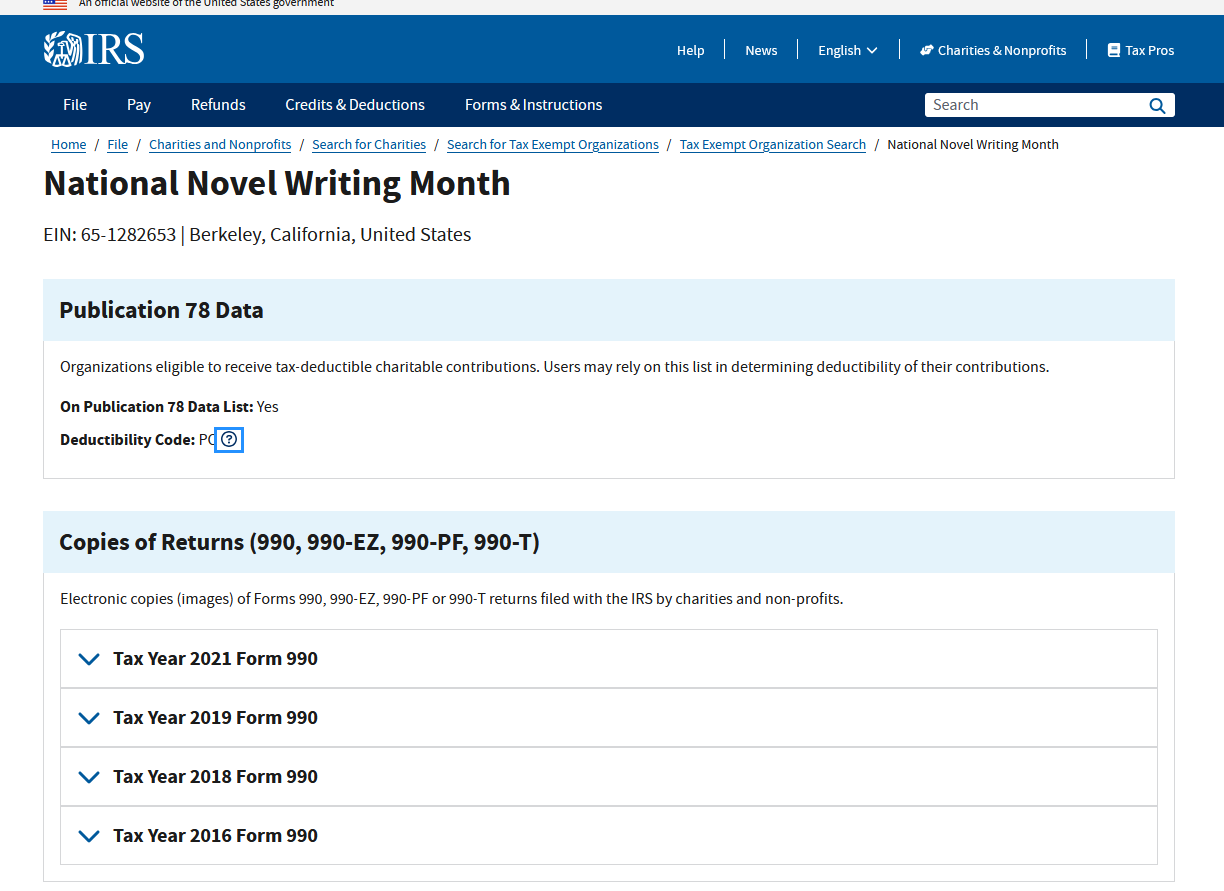
Speaking of cash, search information from the US Internal Revenue Service (IRS) website makes for interesting reading. From what I can gather, the nonprofit National Novel Writing Month should be filing Form 900 annually, which then becomes a matter of public record. However, the last document at the time of writing dates from 2021.
I’m absolutely no expert, so perhaps there’s a genuine reason why the last four years are missing from this list. But if you’re an accountant or you’re connected with the IRS, you can access the search function and enter the Employer Identification Number 65-1282653 to find out the details.
I really don’t want to leave this entry on a sour note. I was involved with the organisation in some capacity for 14 years, so more than half of its 26-year history. I had some wonderful experiences, and I still speak to so many former participants. So here are three memories that stand out:
I held a couple of midnight launch parties at my home, with the plan to start writing in the first hour of 1st November. I had only a two-seater couch at the time, so every chair and cushion was taken up with people, who were also dodging electrical extension cables. As the clock hit 12am, the entire room fell silent for an hour, aside from the tapping of keys.
I’d met someone in real life and was chatting to her via Facebook Messenger. I wanted to take a gamble and ask her out, so I enlisted the members of that week’s NaNo meeting for advice, all of whom were in long-term relationships themselves. They helped me to steer the conversation and figure out what to say next. She still turned me down.
A local organiser used to be known as a Municipal Liaison or an ML. As the pandemic was easing, the government was permitting people to meet up again, while NaNo was still warning MLs to hold only online meetings. To circumvent this, I told the group I would be in our usual venue at a certain time, and there were spare seats if anyone happened to be passing, but that this was not a meet-up. I even wore a sticker reading NOT ML, which became an in-joke for a long time afterwards.

 Gavin Cameron