Who Reads This Stuff Anyway?

The first entry to this blog was posted on 10 October 2013, making it 12 years old last month.

The intent was to create a deadline each week so I would keep writing regularly. That’s going well so far because when this entry is published, it’ll be number 641, or an average of at least one entry a week. But how many people are likely to read it?

Well, that depends what measure you use.

If you look at each entry, you can usually find at least one or two Likes, although some have in the region of eight or nine. The same names tend to pop up week after week. Altertatively, we can look at stats provided by WordPress from December 2024 onwards. The number of monthly visitors ranges from 113 throughout May to 548 in October – with one outlier.

For some reason, August attracted a total of 1,163 unique visitors, most of whom came back two or more times:
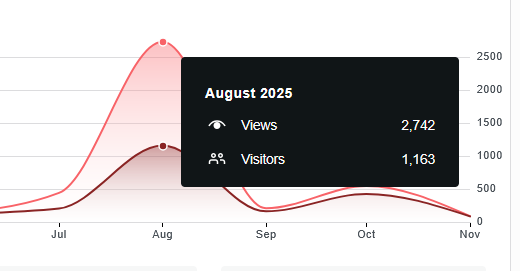
Data visualization of site traffic from July to November, showing a sharp rise in both views and visitors during August 2025. Tooltip reveals 2,742 views and 1,163 visitors for that month.

The timescales match up with two entries from that period. The first talked about an Edinburgh Fringe show by Ross McCleary and Stefan Mohamed, while the second addressed the thorny topic of Creative Scotland curbing its funding. I can only expect one or both topics were on the minds of my audience.

All of which is interesting to me, but I haven’t even touched upon the reason I started writing this entry.

Every time I hit Publish, an email is sent to anyone who opts into receiving notifications. I was advised yesterday by a long-term aquaintance that her email provider had suddenly started placing my WordPress notifications into a folder, starting with an entry from June about audio dramas. Before then, the last email in the folder was from a reply I’d made on LiveJournal in December 2016.

Unless something unpredictable happens, I know this blog is never going to reach a wide audience. It helps me to stick to a regular deadline. If it finds an audience, then marvellous, and if not, nothing is lost.

Gaining Traction

When the independent film Donnie Darko was released in 2001, it recouped less than an eighth of its $4.5 million budget at the box office.

Looking back, it’s not hard to see why. The film centres around a jet engine falling off an aircraft, and the picture was released a month-and-a-half after the September 11 terrorist attacks.

Yet, when it was released on DVD, it began to develop a cult following despite flopping at the cinema and despite the format still being in the early-adopter stage. To date, the film has recouped all its costs, plus about half as much again.

It should have been the case that Donnie Darko was forgotten about. Just like those comedies that never make it past series 2, or the countless Top-10 singles heard everywhere for six weeks then never played again.

But there are other examples of where entertainment has taken a while to gain traction.

A recent example is the BBC drama series Line of Duty, with the first episodes broadcast in 2012 to a reasonable 3.8 million people, but seven years later, that figure has more than tripled. The audience of Love Island also turned an audience of barely 600,000 into nearly ten times that figure between 2015 and 2019.

Of course there isn’t a formula for this, or the examples quoted above wouldn’t be such rarities, but there is good advice. A phrase often attributed to PT Barnum is, ‘Always leave the crowd wanting more.’ It’s advice that often works.

Indeed, in a case of art imitating life, The Greatest Showman – based upon his life story – never rose higher than fourth place in the chart, but had a cinema run spanning several months.

Just don’t leave the crowd wanting too much without delivering it. Fans of the sci-fi TV show Firefly were left hanging when original run was abruptly cancelled after its debut in 2002. It took until 2005 to complete the narrative.