A rather short entry this week. In fact it’s a mere musing on the event that turned everyone and their dog into expert astronomers. I’ve used the form of the tanka, which starts as a haiku but has two extra lines of seven syllables apiece.
The moon ate the sun
on Friday morning in March.
We viewed it through the
office window, expected
to work through all the carnage.
About four years ago, I started attending a creative writing group I’m still in today. The tutor gives a prompt and the job of the class members is to write a passage inspired by it. In one of the early sessions, we had a member who often wouldn’t write anything, but would instead describe what she would’ve written. I had a similar experience at the StAnza poetry festival in St Andrews on Saturday.
I’d been meaning to attend this for some time, and this year I finally bought a ticket for Clive Russell (Coronation Street, Game of Thrones). My plan was to arrive around midday and buy tickets for other shows on an ad hoc basis. I queued at the Byre Theatre box office for a show about Alexander Pushkin and Russians in Paris, to be told that the tickets were now available only at the venue door. When I reached the, they had just sold out.
I decided instead to have lunch quickly, then see a 12pm show by a artist and a poet who had written a Ladybird-style book about St Andrews. An enjoyable 40 minutes as they described the challenges of being in two different cities but having to collaborate, but only the audience members attended.
After tea and a scone with one of my classmates who was working at the event, I headed to Musings@MUSA, which encouraged visitors to use the objects on display as inspiration for their own poetry. The first exhibit I saw was marked Seal of Approval and that phrase stayed with me. The 17-line poem I wrote was definitely inspired by elements in the exhibition, but ended up not being about the place.
Finally, time for Clive Russell. I queued up at the auditorium to be told it was, “At the top of the building.” I wasn’t sure how she knew this from looking at my ticket, as there were no obvious markings, but I moved upstairs to the top entrance and took my seat. We were treated to a duet poem written by Rock McKenzie, then the experimental Veridian String Quartet performing Different Trains by Steve Reich.
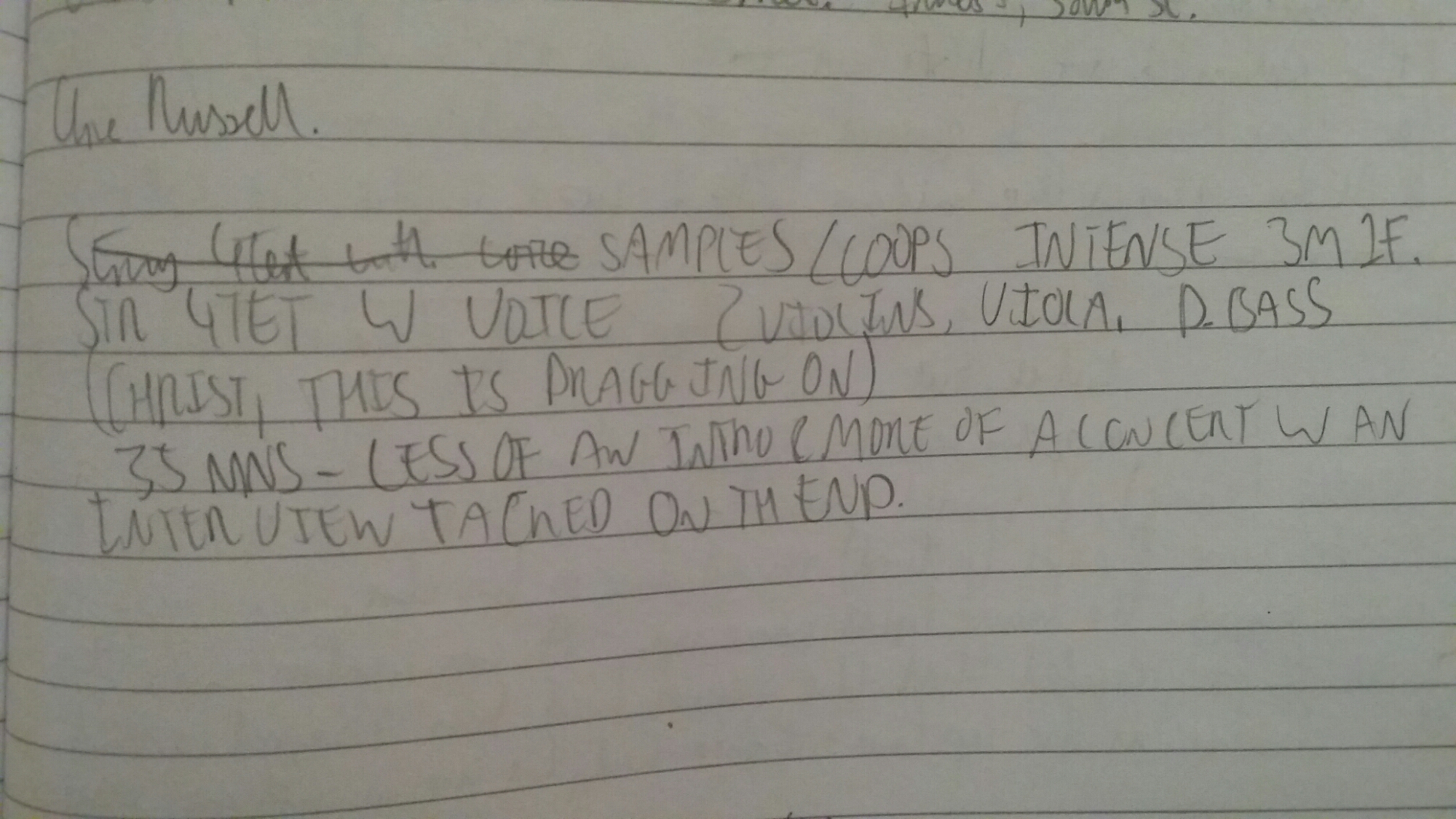
I made some notes in advance of the main event. The photograph below shows some of these.
When the house lights came up and there was no Clive Russell, I was puzzled. The man beside me said that venues for these two events had been swapped around. I slowly worked out that the first ticket checker had meant a completely different venue, while the second one should have paid attention to the show name on my ticket and not let me in. However, I was indeed in the venue printed on the ticket.
To compound the matter, I’d offered to review the events for Dundee University Review of the Arts, or DURA. If I were writing for The Guardian or suchlike, or I’d’ve been sacked on the spot. Fortunately, DURA’s contributors are volunteers, so I explained the situation to the editor in question and it was no big deal. She even gave my classmate and me a lift home in the evening.
I still enjoyed the day, and I’m tempted to go back next year. I’ve learnt nothing is a waste of time if you can take from it a good anecdote or a free pen.
Last week, an editor wanted to make unsolicited contact with me, but was unsure of the best way to approach it. She settled for asking me via Twitter to e-mail her. This started me thinking.
There are several ways to reach me publicly: leave a comment below, send a Twitter message to @LadyGavGav, or post to me on Google+. Yet I hadn’t previously thought about how people could contact me privately. In the case of the editor, it meant putting her e-mail address in the public domain, which I’m keen to avoid thanks to the risk of spam.
So I’m interested in how you manage to maintain contact with others? A ‘disposable’ address that forwards to your real one? A website form? Or some other method I haven’t thought about?
Sometimes after posting an entry, I decide or realise I should have added some more information. To that end, I have addenda for two recent posts.
After putting together last week’s top tips for public speaking, I think I should slot an extra one after Think about your introduction.
Avoid too much alcohol and/or a heavy meal before speaking. Both of these slow down the thought process. I recognise the meal often comes before the entertainment so try to leave sufficient time for it to digest. Being drunk at an organised event rarely makes a good impression on the audience, and is inexcusable if you’re paid to perform. I often have one coffee before I speak, which speeds up the thought process.
A few entries ago, I also discussed how to set or avoid setting a story in a particular era. Yesterday, I finished the Anthony Burgess classic A Clockwork Orange, written in 1962 and set in a near-future society relative to that year.
To avoid the problem of including dated slang, Burgess opts instead to invent his own jargon partly based on Russian. It’s easy to see why he chose that language, as the Cold War was at its height then. Many of the words have to be inferred through their context, as most editions deliberately omit a glossary.
He does, however, also use English words in an uncommon manner. A couple of these words have made their way into modern slang and these passages read as though they’ve been written recently. A case in point is like, with which the main character Alex peppers his speech not only as a comparison but when he’s struggling to remember the words he means.
There is another example, but I’m not sure whether it’s intentional, when he describes a stereo, “playing a very sick electronic guitar veshch,” the last word meaning thing or stuff. There is only one instance of it in this context, and it sounds as though it has the modern slang meaning that’s used alongside wicked and cool. For the rest of the book, Alex only uses the word sick when he’s feeling physically ill, and the Wikipedia appendix doesn’t list it.
Finally, yesterday marked the birthdays of three very famous writers. Robert Burns is the most obvious – I read To a Mouse to an audience in honour – but Virginia Woolf also burned candles on 25 January, and one of my major influences John Cooper Clarke turned 66.
Thanks to electronic publishing and print-on-demand, there are more ways than ever to read fiction. It is, however, as important as it’s ever been for a writer to be able to stand in front of a crowd and read out his or her pieces.
A good live performance means engagement with your existing audience, a chance to have your name known by more people, and – if you’re published – to shift more copies of your work. I was performing on Thursday just gone, and I’m scheduled to take part in three more over the next fortnight.
To that end, I’ve put together some advice for speaking to an audience. These should be treated not as unbreakable rules, but as guiding principles to bring out a better performance.
Think about your introduction. At a minimum, people want to know your name and the title of the work you’ll be reading, but you’ll sometimes need to include other information. To make this part sound natural, I like to make brief notes which I’ll expand as I go along. The list below is totally fictional, but it might read:
Give name
Thank Tracey Jones
Piece is called On the River Tay
Taken from collection The Pie Seller
Brought copies, happy to sign
When it’s read out, it might go, “Good evening, my name’s Gavin Cameron. I’d like to thank Tracey Jones for inviting me to read tonight, and the piece I’ve chosen is called On the River Tay. It’s taken from my collection The PieSeller. I’ve brought some copies and I’ll be happy to sign them afterwards.”
Explain if you need to, but don’t apologise. A good example is when you’re reading an unfinished piece of work. In December, I read out an unedited piece I’d written during National Novel Writing Month. I felt I needed to explain that what they were about to hear wasn’t as highly polished as they were accustomed to, but I was still willing to share with them as an example of what can be done in a month. Should you feel the need to apologise, it’s worth reconsidering whether you want to read out that particular piece.
Before reading to someone, read to no-one. Find a space where you’re on your own and hear how it sounds. Check the inflections you use in the piece, and whether there are any long sentences where you need to take an extra breath in the middle. If you’re reading a new piece, this is also a prime opportunity to make edits.
Practice your page turns. Unlike a rock star, the great thing about being a writer is that you’re often allowed to take your notes on stage. When reading from a book or from sheets of paper, turn up the corner slightly or stick a post-it note on each page to help turn them more easily. When using an e-reader or tablet computer, make sure you practice tapping the correct area of the screen to turn the page, as there is a delay on some devices.
Keep your mouth where everyone can hear it. Avoid tilting your head down to read the piece; instead, hold your manuscript higher and off to one side so it doesn’t muffle your words. Always speak loudly and more slowly than you would in normal conversation. If a microphone is available, keep it at the same distance from your mouth; I’ve seen too many readers wander around the stage and it sounds like a Norman Collier routine. Where possible, work with the sound engineer to set the level before the gig begins.
Sometimesthe audience reacts in the wrong places. I’ve had experiences where an audience didn’t laugh in a place I’d expected; don’t point out it’s a joke or tell it again, just move on to the next part without comment. There might be occasions where they react, positively or negatively, in an unexpected place; in this case, pause until it dies down and move on without comment.
Signalthat you’ve finished. Just lower your manuscript by your side and/or say, “Thank you.” The audience will take the hint and applaud.
Do it again. This guide doesn’t cover how to deal with nerves. There are many tricks you can use to overcome them: the classic advice to imagine everyone naked, or more unusual methods such as looking at people’s eyebrows to avoid eye contact. However, the only effective way of becoming a confident public speaker is by doing it again and again. It’s worth remembering that the audience sometimes is nervous on behalf of the speaker and most will be forgiving even if you make a mistake.
Speaking of which, even the best of us experience the occasional cock-up. In October, I was invited to a poetry reading at Dundee University and I attempted to read one of them from memory. I managed the second time, but here was the first attempt:
You were expecting an entry on Monday, weren’t you? Douglas Adams commented, “I love deadlines. I like the whooshing sound they make as they fly by.”
While I normally frown upon such a laissez faire attitude, I completed National Novel Writing Month on Sunday 30 November at 1:13pm with 50,123 words. As Municipal Liaison, I wanted to set a good example, but I was keen to stress to the members that there’s no shame in not reaching the target.
From there, it was straight into the folio for my MLitt module, comprising two short stories, two poems and a poetic monologue, representing a variety of styles. I’d done most of the work, so it was a matter of pulling together the threads into one document. I submitted that at lunchtime yesterday, the day it was due.
Which left today to craft an entry, and I’ve had plenty of time to do so, as I’ve been awake since 1:50am after approximately four hours’ sleep.
This will be my blow-out weekend before I dive straight back into other projects and catch up on my reading. On my coffee table lies Quiet Dell by Jayne Anne Phillips and Raymond Carver’s collection Elephant and Other Stories, both of which need to be returned to the library in under a fortnight. The former is a weighty volume, but I shall tackle it before that deadline.
For this, I’d like to introduce Binge Reading™. It’s similar to the more familiar binge drinking or binge watching, but better for you than both of these activities. Use Binge Reading™ as you please, but remember to mention you read it here first.
WordPress informs me that I’ve been writing on this site for exactly a year now. Thank you very much for joining me over the last twelve months. I’d like to start today with a little more recent history.
Two weeks ago, I watched a TED lecture about the techniques anyone can use to improve their powers of recall. It seems that humans are kitted out with excellent spacial and visual memory, and it’s much easier to remember something when it’s associated with a journey or the layout of a building. TED lectures themselves are traditionally delivered without notes.
I’ve read it several times but that is the first and only occasion I’ve heard the recording so far. Yet a fortnight on, I can recall the journey.
Allen Ginsberg (Photo credit: Wikipedia)
I remember where I was when I heard the best minds of his generation destroyed by madness.
I remember where I was when the saintly motorcyclists appeared.
I remember where I was when Moloch! appeared over and over.
I remember where I was when I was with him in Rockland.
One piece of advice often given to writers is to keep a notepad by the bed for good ideas. I’ve done this for years and I can still count on one hand how many flashes of inspiration I’ve had at 2am. What works for me is being active, particularly going for a walk.
I think the spatial memory concept is part of the reason why walking works wonders for ideas. As you amble, the brain is observing everything around you, which makes associations and triggers off memories. Please do ask for a second opinion about that theory from someone who’s qualified in these matters.
One of the great elements of being a poet – or indeed a prose writer – is that you aren’t normally expected to memorise your work. A rock musician doesn’t look at the chords as he’s performing to Wembley Stadium, a dancer on the West End stage doesn’t refer to the steps in her hand, but a poet is permitted to read from the page.
I have seen poetry recalled successfully from memory many times, but the occasion that stands out most was Alan Bissett. He not only performed two or three pages of a play without prompting, but acted out both parts by just the tone of his voice. Last place goes to Labour Party leader Ed Milliband MP, who forgot to mention immigration or the deficit in a recent speech.
I know only one of my poems by heart, but it’s the manageable length of eight lines with eight syllables each. My longest poem is a 120-line free verse piece called Anatomy of a Party.
In the first draft of this post, the last sentence of that last paragraph was, I could, and probably should, learn it using the Memory Palace technique as described in the TED talk, but there seems little point as I’d usually have it in front of me. But then I took a second thought. There’s an event on Friday where I plan to read Anatomy of a Party and two much shorter pieces, time permitting. I wonder whether I could memorise one of the shorter pieces for that day.
I offer no guarantees, but I think I’ll make an attempt. I’ll report back next Monday.
From Thursday to Saturday this week, Nassim Soleimanpour’s experimental play White Rabbit Red Rabbit will be performed at the Traverse Theatre in Edinburgh. Siobhan Redmond, Phill Jupitus and Ewen Bremner will have had no direction, no rehearsals, and no idea of what their lines will be. Instead, the script is placed in an envelope that will be opened in front of the audience just before the performance begins.
The play’s structure was influenced by the sanctions against the writer. He is a conscientious objector against military service in his native Iran, and is not allowed to leave that country. A symbolic empty seat is left in the front row of each performance.
I’m in the habit of listening to The New Yorker fiction podcast, where authors perform other authors’ short stories and are interviewed about why they like what they’ve just read. A couple of months ago, I encountered Donald Bartheleme for the first time through his story Concerning the Bodyguard. This piece is experimental in a different way, narrated through a series of questions, repeating nouns where a pronoun would normally suffice. Salman Rushdie read it, lending an extra edge through his measured baritone voice.
It took until the post-reading interview before I really understood what the story was saying, although the penny might have dropped had I listened to it one more time. It’s very much snagged my interest in Bartheleme, and if I encounter his books in my travels, I will definitely place them on my reading list.
It’s a safe bet that many of us have one or two pieces that don’t conform to the accepted norms, and it can be difficult to find a suitable home for these.
One of mine is a work called The Executive Lounge which takes the form of a list of statistics describing a place, but that place only becomes clear in the last two lines. I don’t know whether to classify it as prose or poetry, as a list usually contains line breaks like a poem, but this has the metre of a prose piece.
Whichever way you consider it, it’s most definitely for the page, not performance. My only public reading of it so far was in front of an audience who are accustomed to my work, and it’s the only one of my pieces they didn’t understand until I explained it. To date it’s been rejected by several publishers. Regardless, I consider it to be a completed work in which I still have faith.
However difficult it is to find a home in a mass-market world, never be afraid to experiment. With an ever-increasing number of small publishers springing up, at least one of them is bound to be on your wavelength. The next time I identify an editor who might appreciate The Executive Lounge, I’ll send it straight to them. If nobody took a risk from time to time, we’d all be reading bland and unchallenging literature.
Incidentally, the place I read out that piece was Hotchpotch, an open-mike night for writers rather than musicians. If you live in or near Dundee, the next event is on Monday 20 October at The Burgh Coffeehouse on Commercial Street from 7pm to 9pm. Bring along your best work, experimental or not.
A couple of weeks ago, I went to see a special screening of Local Hero. It’s an excellent film, and if you have the opportunity, you should see it.
The director Bill Forsyth was brought in at the end to hold a question-and-answer session with the audience. He mentioned at the beginning that he hadn’t seen the film in years, and an audience member asked why this was. He answered that he wasn’t ashamed of his work, simply that he wasn’t interested in looking back, and questioned whether – for example – a writer would be interested in rereading their old stories.
Contrary to the director’s opinion, my answer is a definite yes. I openly admit that being a writer wasn’t a childhood dream, and I therefore don’t have notepad upon notepad of embarrassing teenage musings. Rather, I wrote my first fiction in late 2010, just before I turned 27, and looking back enables me to keep a weather eye on how I’ve improved.
Even if I come across an old piece that I find jarring, I know I only need to rewrite it, or in extreme cases, deconstruct it, to bring it up to my current standards.
A prime example of such a jarring piece is one of the first poems I wrote, called The Cooler, a short verse about a character’s self-imprisonment. Looking at it now, it needs to be longer to fully convey the situation, as it’s currently unclear, and the clumsy language needs to be trimmed, eg, “It stays cold all night like a fridge.” Now I’ve looked back at it, I can think about these issues and improve the work.
In my next entry, I intend to cover the issue of rewriting in a more in-depth fashion.
I mentioned I’ve been writing fiction for less than four years, but I was a blogger long before that, discussing the issues on my mind at that moment, much as I do here. That writing is a little embarrassing, but it’s only by looking back that I can see how much I’ve moved on. Here’s a typical entry from almost exactly ten years ago.
There are many writers who started later in life, and I found out recently that John Grisham is one of them. He didn’t write his first novel until he was in his 30s, and didn’t give up his work as a lawyer until his second was published.
On Monday of last week, I debuted a new poem at Hotchpotch. This is a local open-mike night for writers. While I’m far more of a prose writer than a poet, I thought this particular piece would go down well.
I’ve been to enough live events to know the standard housekeeping message that’s given before the performance. This poem was a version of the announcement that made it sound as though the speaker was having a mental breakdown. It did indeed attract a positive response, while a second poem and a short story were also well-received.
At last month’s Hotchpotch, I had a picture taken of me. I didn’t particularly like it because my neck was too far forward reading the piece. This time I was sure to stand up straighter and look up at the audience from time to time. I’m not saying my pieces came across better because of it, but I certainly felt better by paying attention to these factors.
I’m an advocate of people reading out their work in public, and of course in private while proofreading. If you know of a nearby group, go along and support it. There are actually two such groups around here, but I didn’t take to the other one since the focus there is mainly on folk tales, whereas Hotchpotch has a more literary flavour. Some groups even allow you simply to listen without contributing for the first meeting.
But what if there isn’t a group, or it’s not the right style for you? Have you ever thought about starting your own? There’s no reason why you should wait for someone else to do it, as it probably won’t happen.
The meeting place doesn’t have to be anywhere with a stage. We meet on the upper floor of a café, and we create an informal Poets’ Corner near the top of the stairs. Some pubs and coffee shops are happy to donate their space provided the participants are putting money in the till, so we hold at least one break during each evening. Just bear in mind that the venue could back out or change their terms at any time. A pub we used to use free of charge suddenly wanted £50 a session, even though we probably spent double that in drinks alone.
The other element you need to decide is the ethos. Should the audience offer constructive criticism to the readers, or is it solely for writers to try out new material? At Hotchpotch, the latter approach is taken, although there’s nothing to stop people giving feedback to each other privately afterwards.
But above all, it’s for writers to meet and talk to each other. Every time we meet up, I usually hear about an upcoming event or two that I wouldn’t otherwise have known about. The actual writing process is generally a solitary pursuit, but we all still need that connection.