Over the next couple of months, I’ve been asked to read poetry at a few events. Each one is free to attend. Here’s a handy cut-out-and-keep guide to them:
Livewire; Wednesday 19 October; Bonar Hall, Dundee. I’ve just finished an MLitt Writing Practice and Study course at the University of Dundee. This is one final showcase for our class, where I’ll be reading a piece called Sir Madam from my dissertation.
Launch of Aiblins; Monday 21 November; Underdog, Castlegate, Aberdeen. This launch is for the same book discussed above, but in a different city. The event is still being finalised, and I’ll give you more information when I have it.
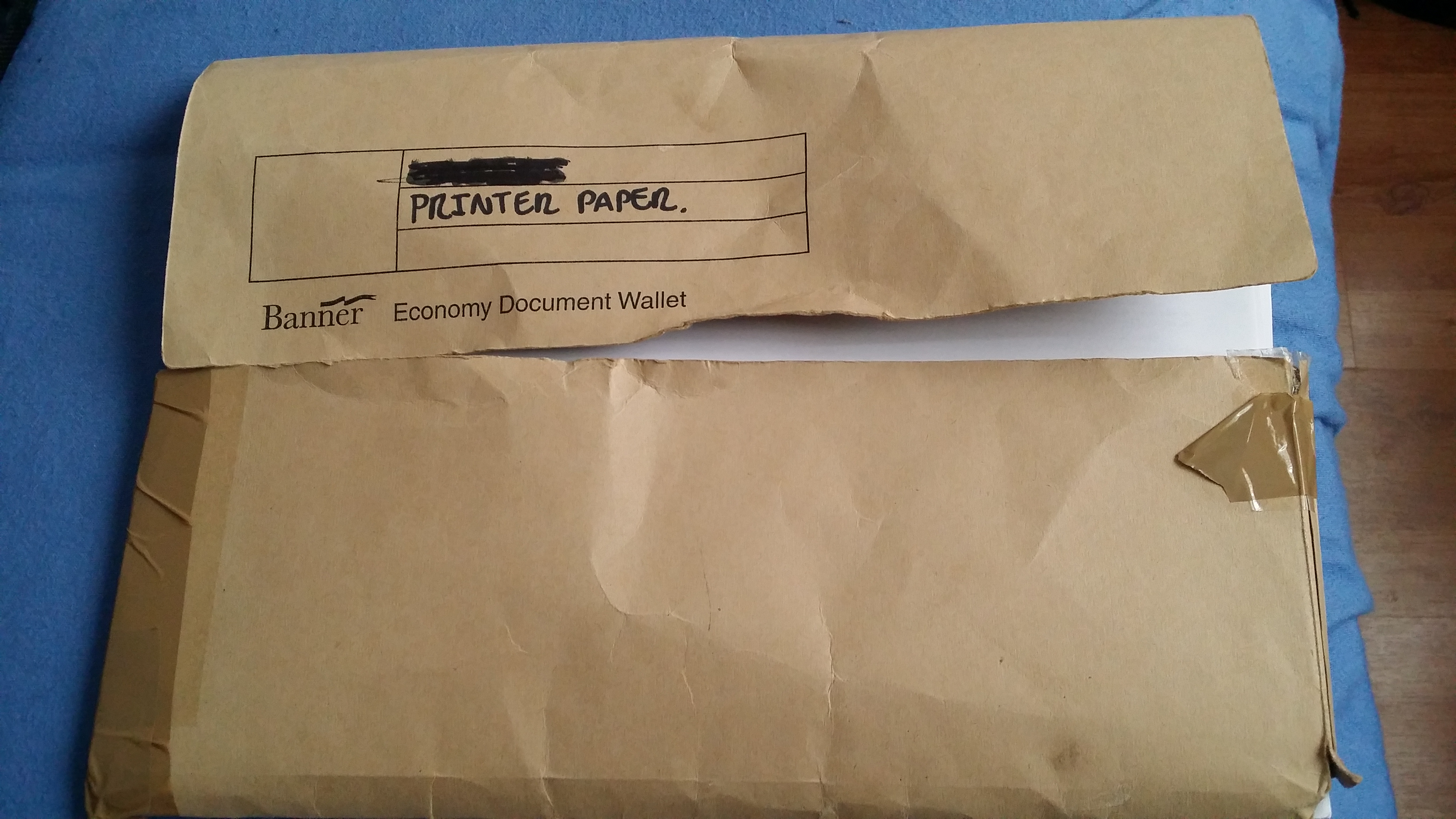
Last week, a friend was complaining about a major writing competition that still only allows postal entries. I’d also submitted work because it’s a prestigious publication, but I agree with her point of view. Considering the hundreds of manuscripts that must be received – versus the tiny portion that makes the final cut – this seems a colossal waste of paper, not to mention the needless postage time and cost.
Many competitions offer the postal route as an alternative to an online submission, and there’s nothing wrong with that. Nor is there any issue with posting work that must be physically held to be appreciated. But there are still a bunch who want normal prose and poetry to be sent on paper.
English: A stack of copy paper. (Photo credit: Wikipedia)
Until the 1990s, this was how submissions were made. Internet access and e-mail accounts were generally the domain of academics and computer enthusiasts. Come the next decade, however, and newer technology began to creep into people’s homes. Nearly 17 years after the millennium, online access is nearly universal in the Western world, and postal submissions now look incredibly outdated.
That’s not to say I don’t like a paper book. In fact, some recent research has concluded that sales of e-books are falling. But a book is the final product; the process of gaining the interest of an editor or a competition judge ought to be as quick and cheap as possible.
Yet I would like to understand the other side of the argument. Do you run a publication that only wants submissions on paper? How does it benefit you? What would make you consider accepting online entries?
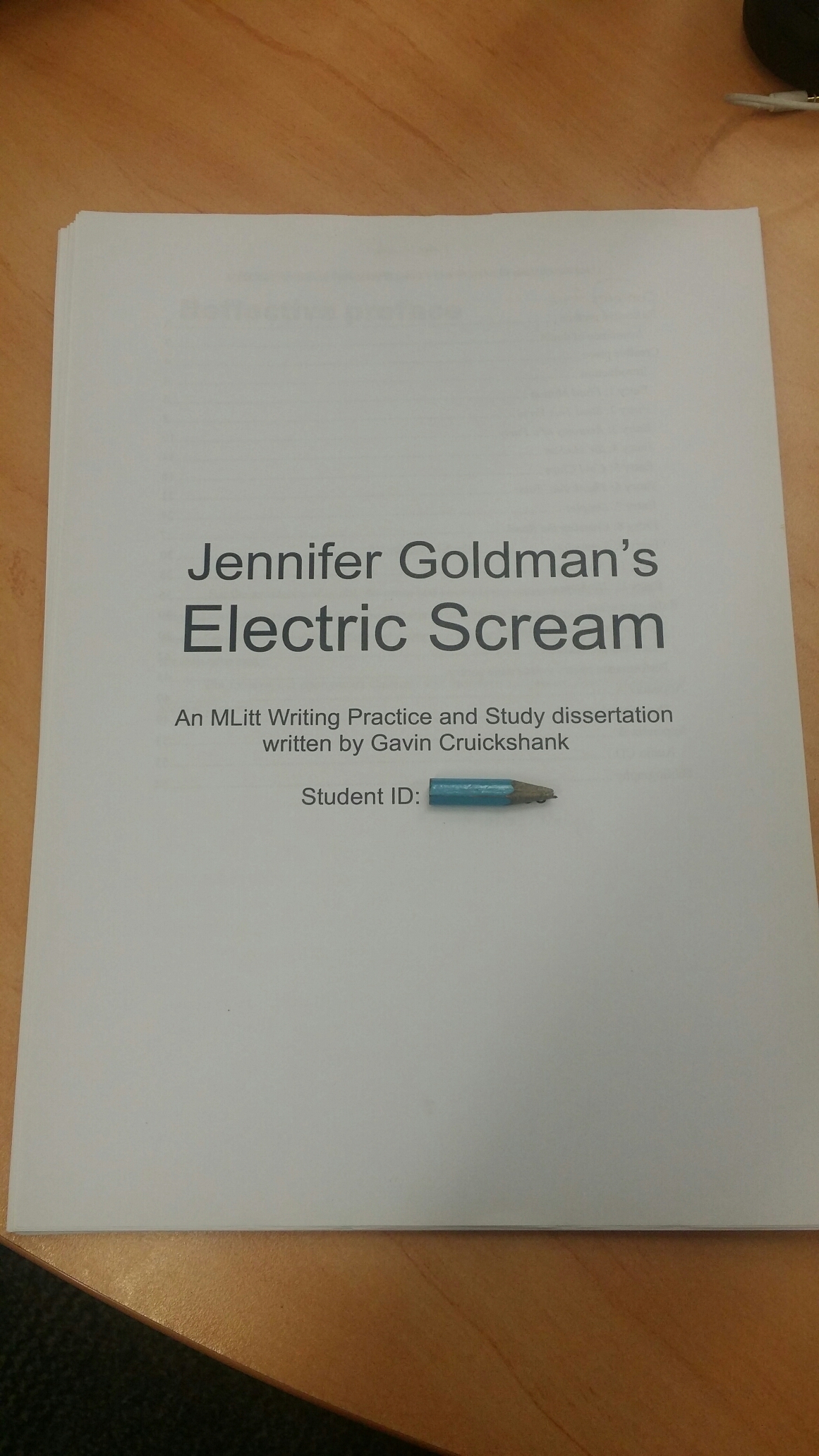
This is the last Monday of working on my MLitt Dissertation, freeing me to give you more in-depth entries from next week onwards. But I’ve one more filler photo for you, and it’s the cover of said dissertation.
There is a creative part of up to 15,000 words, which can include prose and/or poetry, and 3,000-word part to discuss it further. Jennifer Goldman’s Electric Scream is set in 2027 and is written from the perspective of a 29-year-old poet who finds and transcribes a video diary she kept as a student in 2016.
You might notice the dissertation is ‘written by Gavin Cruickshank’, and that’s because I have to use my legal name. I would otherwise use my middle name Cameron.
Last week, I was speaking to a poet and I accidentally used this individual’s last name, which can also work as a first name. The poet accepted my apologies but described such mistakes as a ‘pet hate’.
I was furious with myself not only for doing it to someone whose work I admire, but because I feel the same way when someone spells Cruickshank incorrectly, especially when I’ve spelt it out or the other party has made an assumption. J K Rowling didn’t help by giving Hermione Granger a cat called Crookshanks.
I therefore use my middle name to avoid the spelling issue. Of course, this sometimes causes as much confusion as it saves. At a reading a couple of weeks ago, the organiser thought Gavin Cameron and Gavin Cruickshank were two different people and wasn’t sure which of us had agreed to participate.
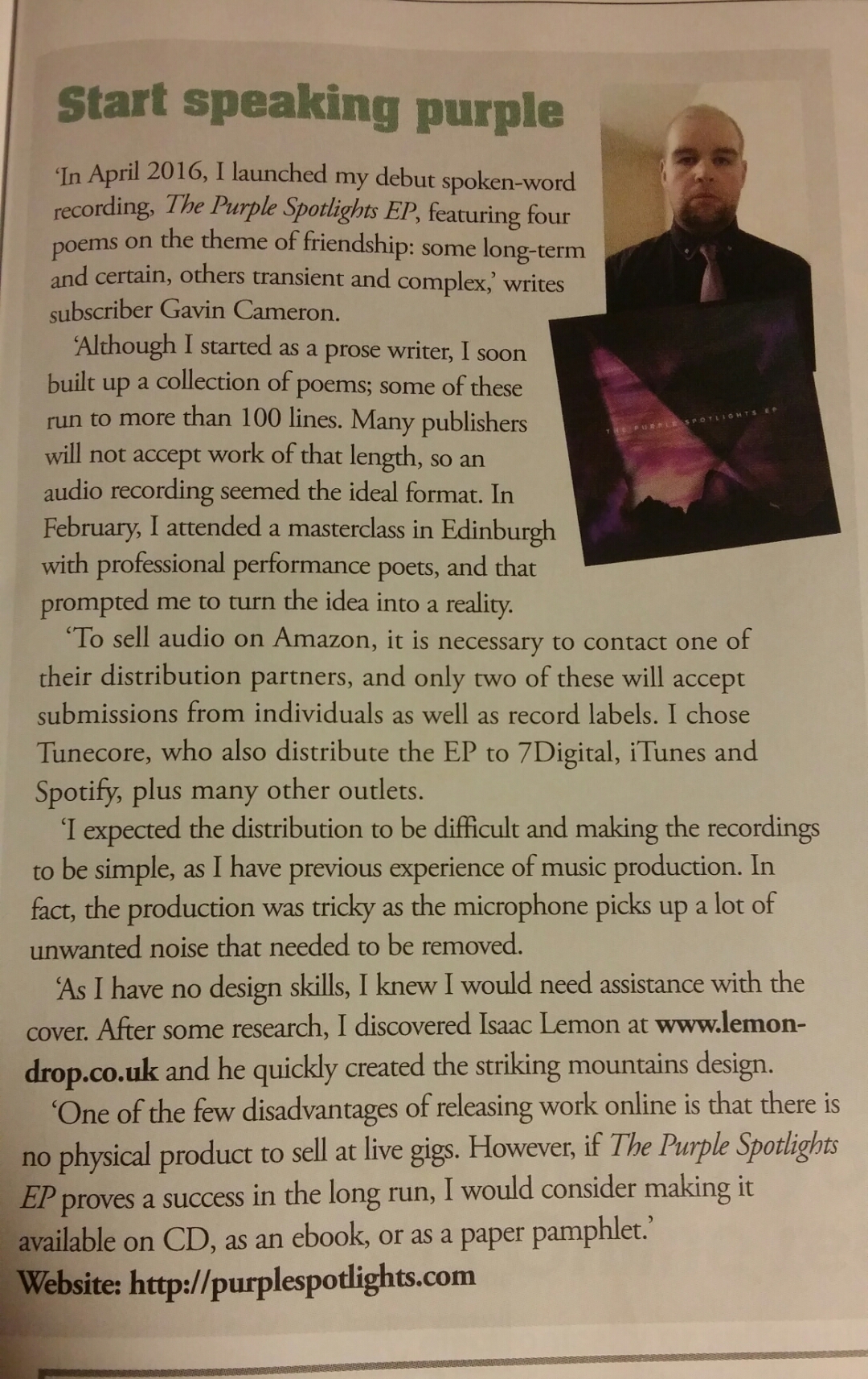
I’m so far behind with my reading that a friend actually pointed this out to me before I saw it. The Purple Spotlights EP, self-released in April, has been featured in Writing Magazine. It’s available from Amazon, iTunes, Spotify, plus many other outlets.
It’s great having a polished story or poem ready to be sent to a publisher or entered into a competition, but then comes the difficult part: waiting for a response. Often it takes months, sometimes it takes weeks, and a select bunch answer in a few days. This is unavoidable.
But here’s what separates a beginner from a seasoned pro: the former often sits and waits for a response, while the latter almost always uses the time to work on another piece. It’s desirable to build up a portfolio because many publishers, and almost all competitions, say you can’t send the same piece to two or more different places simultaneously.
Novel submissions are different in this respect. Most agents recognise that a book is an all-consuming work, and that it could be sent to a number of other places. It’s good practice to inform the other agents if one takes it on.
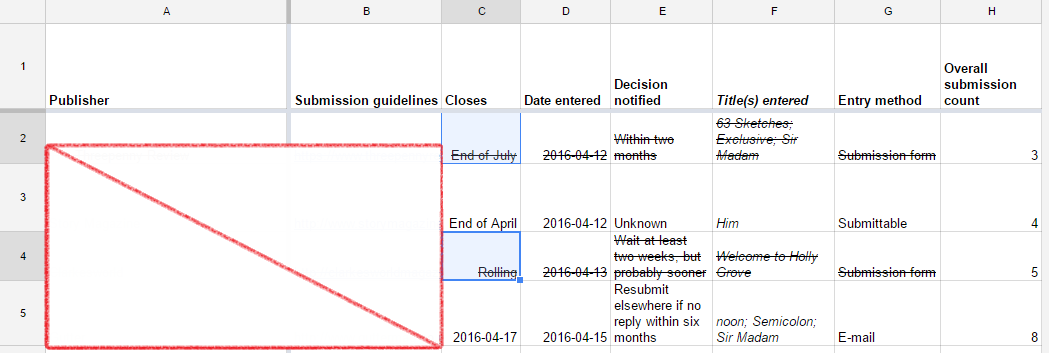
Whichever situation you’re in, it’s important to keep track of what you’ve submitted to where. It might be a simple as keeping a list if you’ve only a few pieces, but I have dozens in different places, so I use a spreadsheet to record the details:
I’ve edited out the names of the publishers and the links to their submission guidelines as I might want to resubmit in the future. The last column keeps track of how many pieces I’ve sent out during the year. My target is at least one piece per week on average; I have a poet friend whose target is an average of at least one piece per day. Otherwise, the tracker is self-explanatory.
It’s also important to keep track of what you’ve had published. These appear on another spreadsheet, and I keep the manuscripts in their own directory.
In many cases, the rights revert back to the author after a period of around six months to a year, so the same piece could potentially be sent to another publisher further down the line. If you’re unsure, ask the editor.
Last week, a friend asked me to give him feedback on a piece he’d written and performed to camera. As he’s not yet ready to go public with it, let’s call him Jack.
I would have given him honest feedback if it had been no good; I don’t think it helps to give praise unduly. I listened to it a few times to determine whether it stood up to repeated listenings, and to listen carefully to the words and their meanings. I concluded it was almost ready for a live audience, and I gave him tips about how it might be improved.
It’s hard to define performance poetry. Some pieces work equally as well on the page as on the stage. Spoken word also falls somewhere between rap and stand-up comedy. Rap generally relies on wordplay and repetition, while stand-up is often infused with the comic’s personal experience, and both elements can be present in performance poetry.
While I don’t have a catch-all answer, there were three elements in Jack’s piece that – in my opinion – made it suitable for performance.
Firstly, he started with a strong image and good use of internal alliteration. The first line alone revolved around ‘L’ and ‘T’ sounds. As we moved on, we began to hear more alliteration, plus complex and slant rhymes.
English: Eminem performing at the DJ hero party with D12 on June 1, 2009 (Photo credit: Wikipedia)
A great example comes from the Eminem track Stan. This video starts at lines where the rapper has stacked up the ‘ee’ sounds of ‘dream’, ‘sleep’ and ‘scream’, but the piece as a whole is largely lines of a regular length with an often-slant AABB rhyme scheme. You can see this when the lyrics are written on the page.
Secondly, Jack took his opening lines and repeated them near the end, although not verbatim. This type of repetition can be vital tool in performance, as it helps to cement ideas in the mind of the audience.
More regular repetition can be used to create an onomatopoeic effect, but be sure to do it consciously, as random repetition can sometimes feel as though the poet is trying to pad out the words. I can think of two great examples. The first piece is safe for work: Francesca Beard with The Fluffy Song, with a reputation helps bring out the voice of the eponymous dog. The second piece is decidedly NSFW: John Cooper Clarke performing Evidently Chickentown, where the swearing lends the effect of a hen clucking.
Thirdly, Jack’s voice in the video infused the piece with a different slant benefit had been read on the page. It wasn’t in his normal register, but reminded me of Murray Lachlan Young: rich and defined with an intentionally snobbish undercurrent.
Of course, anyone who reads a performance piece will bring something to it. Andrea Gibson is quite the opposite of Young, packing a lot into a poem and rattling through it with barely any time for breath. There’s no wrong way of performing, as long as you aren’t forcing yourself to do something unnatural.
When Jack is ready to go public with his work, I’ll post it here and I’m sure you’ll see what I mean.
Between my MLitt essay and the EP, my submissions to publishers had been put on hold. Now I have the time to submit material, I’m sharply reminded of how slow the process can often be, and it’s the exceptions that prove the rule.
I submitted to two places that said they would give a response within approximately two days, and they both kept their respective promises. But because they’ve been so quick, it makes the other two seem painfully slow as I won’t hear from them for between two and six months.
It’s common to find publishers that use Submittable, a website that provides a semi-standard way of submitting work and tracking your correspondence. I rather like doing it this way.
Where paper reincarnation happens
For instance, I’ve had to send in a query to an editor as two of my pieces have been outstanding for six months with nothing more than an acknowledgement. However, if I don’t receive a response in a reasonable timescale, Submittable allows you to withdraw your work.
I also like the ability to attach Word or PDF documents, or whichever format the publisher wants. It’s a personal view, but I dislike having to paste my work into the body of an e-mail. Many writers use Word or Scrivener, or a number of other programs. Whenever you copy from a program, the formatting often goes pear-shaped after pasting. When pasting into Gmail, I sometimes find the line spacing changes to 1.5 and can’t be altered, or the font changes and can’t be harmonised. Ctrl+Shift+V will paste the text without formatting, but you then have to reinsert any bold or italics, or unusual spacing.
Another pet hate is a requirement to submit by post. The cost of postage is an irritation, although my main concern is how much paper must be wasted in the process, as editors select only a fraction of the material submitted. It seems an archaic practice in the age of electronic communication. If I ever have to print a document and notice a mistake, I keep it in a folder so I can print on the blank side in the future. Any paper that can’t be reused goes into the house recycling bin.
While I’m waiting for responses, I would like to know why publishers ask for copy-and-paste or postal submissions. Is there a compelling reason why these practices still happen?
I’m today launching my debut spoken word recording, The Purple Spotlights EP, featuring four poems on the theme of friendship: some long-term and certain, others transient and complex. It’s available from on 7 Digital, Amazon, iTunes and Spotify, and many other outlets. Head to PurpleSpotlights.com for samples.
Although I started as a prose writer, I soon built up a collection of poems. Some of these run to more than 100 lines and many publishers will not accept work of this length, so an audio recording seemed the ideal format. In February, I attended a masterclass in Edinburgh with professional performance poets, and that prompted me to turn the idea into a reality.
I expected the distribution to be difficult and making the recordings to be simple. I’ve talked before about my previous interest in radio and music production, so I drew on some of that experience. However, the production was tricky as the microphone picks up a lot of unwanted noise that needed to be removed.
I’ve also previously discussed my lack of design skills, so I knew I would need assistance with the cover. After some research, I discovered Isaac Lemon here on WordPress, and he’s since moved to Lemon Drop. He quickly created the striking mountains design, which looks fantastic next to other recordings.
One of the few disadvantages of releasing work online is that there’s no physical product to sell at live gigs. However, if The Purple Spotlights EP proves a success in the long run, I would consider making it available on CD, as an e-book, or as a paper pamphlet.
But until that happens, go and tell all your friends. Heck, even tell your enemies. I’ll be performing tracks from the EP at a few gigs this month:
Thursday 14 April, 6:30pm; Masterclass Showcase, Scottish Poetry Library, Edinburgh.
Monday 18 April, 7pm; Hotchpotch, The Tinsmith, Dundee.
When you’re in the middle of writing a novel or compiling a poetry collection or some other big project, it can be easy to forget the end goal. One way to maintain your momentum is to remind yourself what will or might happen when it’s completed.
Try creating something that represents your aim, like a mock cover for the finished volume. Or find a trophy, even if it’s made of cheap plastic, and label it something like [Your name] – Forward Prize – 2017. Or even write the speech you plan to give at your first launch.
Now leave the artefact in a place you’ll see it every day, and that’ll remind you what you’re working toward. It’s not simply words on a page, but something people will buy and possibly admire.