When you’re in the middle of writing a novel or compiling a poetry collection or some other big project, it can be easy to forget the end goal. One way to maintain your momentum is to remind yourself what will or might happen when it’s completed.
Try creating something that represents your aim, like a mock cover for the finished volume. Or find a trophy, even if it’s made of cheap plastic, and label it something like [Your name] – Forward Prize – 2017. Or even write the speech you plan to give at your first launch.
Now leave the artefact in a place you’ll see it every day, and that’ll remind you what you’re working toward. It’s not simply words on a page, but something people will buy and possibly admire.
Normally, blog entries come to me easily. It might be prompted by a comment during the week, or be inspired by a particular problem I’m having.
This week, however, I’ve been struggling to complete an entry. I started on the topic of swearing, then about gaps in your writing CV, then about third-person biographies, but none of these topics were going anywhere. I might return to them in the future, but today’s entry is about finishing what you start.
I normally good at finishing stories and poems, but I have a few that have been untouched since the first draft. Most recently, I was asked to respond to an exhibition at Dundee Contemporary Arts. I abandoned my original idea after four verses because it was much too wordy and I wanted to take the narrative in a different direction. Here are those four verses:
We saw the archipelago of masts
while sailing over Dogger Bank in gale
force six conditions. They displayed full sails
like pirate vessels of the ancient past.
They numbered in the twenties. We informed
our captain. She immediately warned
them of our presence with a blast,
instructed us to try the radio.
All frequencies, all wattages, yet no
response was heard. When 30 minutes passed,
she ordered that her ship should deviate
of-course toward the masts, though gale force eight
was forecast. Once we had a closer view,
we noticed something out of place. The decks
were underwater. So it seemed. We checked
again. Correct. All decks submerged, no crew,
no skeletons, no personal effects,
just masts with sails and ragged flags. Perplexed,
we asked the captain where to go. Perplexed,
she stopped us by the archipelago.
Again we tried to use the radio
as gale force eight turned into 10. The next
the next we knew, the bow was pointing in the air.
It knocked us to the deck.
This needs a lot of work done. There are a number of options to breathe new life into it: cut out unnecessary words and phrases, continue to add verses, rewrite it as prose, recycle elements of it into other works, and/or cut it into individual phrases and shuffle them about.
To make what became the response, I used some elements of this story, cut out a lot of detail and rendered it as prose. The final result mimicked the shipping forecast on Radio 4.
I’ve done something similar for older pieces. Around 2011, I wasn’t writing much poetry and I thought what I had was quite a good piece. Four years later, I revisited it while answering a writing prompt and it wasn’t as good as I remembered. I took the same idea but structured the verse differently and I’m now happy with it.
Some writers seem scared to finish pieces, as if they’ll think of a better word or structure as soon as it’s been submitted to a publisher. But if its publication you’re looking for, there comes a time when you need to let go of it. Remember there will be every opportunity to amend it if it’s rejected, and some publishers will allow – or insist upon – amendments if it’s accepted.
I’ve been asked before how I know when I’ve finished a piece. That’s not an easy one to answer, but the best measure I have is when I stop thinking about it day-to-day. That’s when I leave it alone for a while, then revisit it with fresh eyes later on.
It’s a good idea to finish what you start, at least to the best of your ability. If you see the perfect outlet for your piece, it’s much easier to tweak it than to have to add or remove significant portions. You might then be able to submit it comfortably before the deadline.
Last week, we lost one of the most flamboyant and enigmatic musicians of our generation. Yet you never hear David Bowie described as a 70s star or as retro; he managed to remain relevant throughout his 50-year career.
One way he achieved this was the use of surprise, from the Ziggy Stardust look, to Jareth In Labyrinth, to setting up an ISP in 1998. And that’s something other writers and poets can learn from.
Prior to 1992, PD James was known for writing detective novels. She was 72 when she published her only science fiction work, The Children of Men, earning positive reviews from many corners. Similarly, you would expect something funny from Clive James, but his poetry collection Sentenced to Life is thoughtful and poignant.
So how does a writer deliver something unexpected? It might be as simple as writing a short story when you usually pen poetry, or as radical as having a section of your novel made into an animated video.
Either way, the idea must still come naturally. If you’re writing poetry on a subject when you’d really rather be adapting it for the stage, it’ll be obvious your heart isn’t in it. It’s a good idea to revisit an idea that hasn’t worked its current form and see where it can be adapted to another, or experiment with different ways of creating ideas.
When I have the beginnings of an idea, for example, I like to go for a long walk and turn over the idea in my head before putting anything down on paper. Yet when I was asked to respond to an exhibition at Dundee Contemporary Arts in October, I had no ideas, not even the beginning of one. Instead, I sat on the yoga mats provided as part of the exhibition with a notepad and told myself I was staying until I put something down.
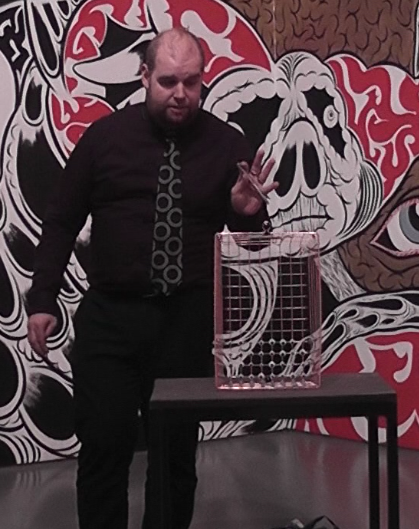
The result (pictured) was a visual response with a wire basket and 100 googly eyes. It was unusual and untested for me, as I’ve had no art training – and to my friends who know this, it was most definitely aContinue reading “The element of”→
On Thursday, I was asked to take part in an event at short notice as one of the poets was unwell. Flow! is a project by Gemma Connell where a poet is teamed up with a dancer. The dancer knows nothing about what the poet will read and has to react spontaneously. The best way to explain it is by watching part of Thursday’s event:
The first poet in this video was the fabulous Amy Gilbrook. She performs most of her work from memory and makes excellent use of internal rhyme. I’d met her before, but I wasn’t acquainted with the dancers.
There are challenges to complete throughout the night, including a section where audience members are invited to writes phrases on pieces of paper. The poets then must assemble these into a new poem, then read it out there and then.
Each dancer and each poet is allowed to take part in no more than three Flow! events, so there’s a potential to take part in two more, and I would happily oblige.
However, it occurs to me that I’m neglecting someone. Prose. When I started out, she was the one I followed, the one I allowed to infiltrate my body of work. But along the way, Poetry surfaced, showed me her possibilities within her boundaries for which Prose has no equivalent.
Now it’s time to go back and find a balance between her and Poetry. Yet there will be no grovelling; there will be the knowledge that Poetry bestowed upon me: how to stretch myself, how to structure, how to affect an audience. And I’ll approach Prose with a renewed enthusiasm, a new sense of purpose, and challenge her to help me produce something to make Poetry jealous.
To that end, I’m going to worship Prose tonight at Hotchpotch, an open-mike night for writers. Anyone can come along and read out their work – or even that of a published author – with no judgement or criticism. If you happen to be in Dundee tonight, it’s at the Burgh Coffeehouse on Commercial Street, and the readings begin at 7pm.
Last week, I discussed what to do when you don’t like someone else’s work, be it a novel or a live event, and a big thank-you for all the responses I received. However, I had an experience last week where I didn’t like part of my own work.
I was invited to write a piece inspired by the D’Arcy Thompson Museum at the University of Dundee, which would then be performed in the museum a few weeks later. Sir D’Arcy was a naturalist who disagreed with some aspects of Charles Darwin’s work, and the museum houses his surviving specimens.
I’m quite used to turning round work very quickly: I write it, leave it alone for a few days or a few weeks – depending on the deadline – then give it an edit. If I’ve time, I might be able to repeat this process, refining further each time.
With the Sir D’Arcy piece, I struggled to come up with the idea in the first place even after two long visits to the collection. Finally, I wrote a short poetic monologue inspired by a seven-foot narwhal tusk on the wall. The piece imagines what might have happened when the tusk was delivered to Sir D’Arcy and his students, and uses this to demonstrate that some of his ideas and views are now accepted by today’s scientists.
I was happy with the first section of the piece, but was less happy with the second, which I felt broke the Show, don’t tell rule. I felt it was too factual as the story was not shown through the actions of a character, as in the first section. The actual reading went well, but if I had more time, I could have improved it; in the process of writing this entry, I’ve thought of a possible way.
However, unless I’m invited back for a second performance – and that is a hint to the organisers – I have to accept that I put out what I consider to be substandard work.
If you’re a fan of The Big Bang Theory, you’ll know that Sheldon Cooper is particular about which seat he chooses, particularly in his own apartment. Writers can be similarly picky about where they pen their works.
Among my writer friends alone, there is one who writes better with absolute silence and another who penned most of her novel in a noisy student pub. There is no right or wrong way. For my own part, I’m typing this entry in one of my favourite places: at the bottom end of my bed, standing with my back to the window. But when I’m stuck on a project, I sit on the mezzanine floor of a particular cafe in town and it usually unblocks my flow.
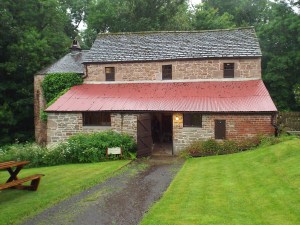
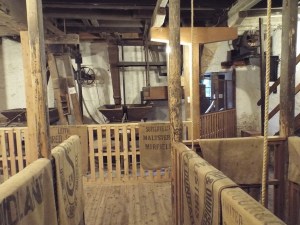
On Saturday, I was given the opportunity to attend a one-off writing group at the secluded Barry Mill near Carnoustie to raise funds for its restoration. After a tour and a demonstration of its working waterwheel and machinery, the nine or so attendees followed the stream back to the weir through acres of wild flora.
The tranquillity, location and history of the place was supposed to serve as inspiration for a poem or prose piece – and it worked. It took me some time to put something together, but I managed to write three verses, using the mill as a starting point, and nearly everyone had written something for reading out. It didn’t help, however, that it was raining onto our notepads for much of the visit, or that two of the chairs collapsed – mine included – before the session even began.
So if you feel your writing is becoming a little stale, try going somewhere else. Not everyone is able to escape to the countryside, of course, but it might work even to move location within the same general area or even the same building. Before I discovered my current spots, I experimented with a number of places before finding one that felt just right.
I’ll leave you with an electronic postcard of Barry Mill.
Last week, I had the opportunity to show my published and soon-to-be published pieces to my work colleagues. Some of them were aware of my writing through reading this page, while it was news to others.
I don’t talk about my fiction writing much when I’m doing my day job. Although it certainly isn’t a secret, I believe there is a time and a place for promotion, and I was given that time and place on Thursday lunchtime, so I took advantage of it.
On Twitter and Facebook, it’s particularly important to keep a balance between ordinary updates and promotional copy. How often have you seen an account post exactly the same message four or five times a day? It makes people switch off, like that one individual you avoid at the party as you know they’ll talk about their pet subject ceaselessly. Besides, if you say everything upfront, what is there left to have a conversation about?
Two great places for advice about promotion – and there are dozens of others – include the writer Rayne Hall, and the marketer Wilco Wings whose advice can be adapted for writers.
And now I have your attention through our implied conversation, it’s time to launch into the self-promotion.
To date, three of my short stories have appeared in the following anthologies: Because of What Happened by The Fiction Desk, FourW Twenty-Four by Booranga Writers’ Centre (I’m not credited on the website, only in the book), and Alternate Hilarities by Strange Musings Press. While looking out materials for my work event, it seems I’ve misplaced my copy of Because of What Happened, so I’ll have to hunt it down like JR Hartley and his book aboutfly fishing.
I’m also due to have two poems published in an upcoming anthology called Seagate III when the last tranche of funding comes through, and one in a promotional leaflet for the MLitt Writing Practice and Study programme at the University of Dundee.
By coincidence, I received an e-mail last week from Giovanni Valentino, editor of Alternate Hilarities. In each of his anthologies, he likes to run a reprint from the magazine of the same name from the 1990s, but it’s becoming harder and harder to find the authors.
To this end, he’s asking the Internet for help. On the off-chance that you’re one of the following people, or that you know their whereabouts, please e-mail him forthwith at giovanni.valentino@strangemusingspress.com.
Issue 2
Alex MacKenzie, The Elvis Wars
Dana Cunningham, The Man Who Could Communicate with Animals
Hot on the heels of my copyright post the other week, a case of poetic plagiarism was brought to my attention. Remaining copies of Laventille have been pulped after Sheree Mack admitted to including others’ work in her own inadvertently, although fellow poets have accused her of stealing work deliberately.
In this instance, it’s not only the original poets who have been hurt by her actions, but the pulping will wipe out the profit margin that Smokestack Books would otherwise have made.
The one positive aspect we can salvage from this mess is that this type of plagiarism is relatively rare. If it happened every day, this story wouldn’t have been reported and nobody would have kicked up such a stink.
Postgraduates
I’m a firm believer that every writer ought to learn the skill of public performance. More on that story later. But last Wednesday marked the first time I would be performing to an audience of academics, rather than the general public or other writers.
The University of Dundee has run a Postgraduate Conference for the last four years where students set the agenda by presenting papers. Students were also free to respond creatively to this year’s theme, Lost in Translation. When I saw the final running order, I appeared to be the only person giving a creative response, and I seriously considered withdrawing as I didn’t feel it would fit in with the other presentations.
The upshot is that I did go ahead with it, although I was moved to a different slot with theatre students and a novelist. I felt it flowed more smoothly, and I received an excellent response, both verbally and on the anonymous feedback slips. My tutor was also sure to stop by and ask a couple of tough questions.
Performance
Shortly after the Postgraduate Conference, I went along to a workshop… on performance; unfortunately, it had to be in that order. Jenny Lindsay, one half of poetry duo Rally & Broad, was hosting, and they’re one of my favourite contemporary acts. She asked each of us why we were there. I told her I was quite comfortable with public speaking, but I felt there was always more to learn.
Blockbusters (UK game show) (Photo credit: Wikipedia)
She took us through the process of preparing for an event, including how we might introduce ourselves, putting together a set list, and we even took turns at walking out in front of an audience. The organiser is hoping to put on another event in the near future but using an actual stage.
If you have the chance to hone this skill where you live, I recommend signing up. What many writers don’t realise is that if you’re snapped up by a publisher, you’ll be expected to read excerpts to a live audience. I’m not going to pretend it’s easy to stand up and entertain people, but the only way to make it easier is to keep practising, and prepare your materials thoroughly in advance. Remember, most audiences aren’t sitting waiting for you to slip up – they’re willing you on.
Promotion
Although National Novel Writing Month and its offshoot Camp NaNoWriMo are over, an enthusiastic band of us have continued to meet each week. The most recent meeting was yesterday, but we left after an hour to visit Waterstones where Kirsty Logan was promoting her novel The Gracekeepers.
I’d seen the posters across town, but I hadn’t heard much else about it until that evening. By the time I’d listened to the excerpt, learnt about the background of the world in which it’s set, and was told were some characters written as gender-neutral, I decided I wanted it. The issue of gender is something I become interested in since my feminist friends talk about from time to time.
And our group each spoke to Kirsty Logan for a couple of minutes each as she signed our books. I wish I’d thought to take a photo, as her dress contained pictures drawn in the same style as the book jacket. If I ever have a novel published, that’s a touch I’ll think about adopting, although I might settle for a shirt rather than a dress.
Last night, while stuck for something to watch on TV, I came across an old Rich Hall DVD. I’ve been a fan of his for some years, whether as himself or in the guise of country musician Otis Lee Crenshaw. This DVD featured both personas. In the Crenshaw part, he performs a couple of template songs using the details of audience members to fill in the blanks.
Rich Hall performing live on November 1, 2007 at Knabrostræde in Copenhagen, Denmark. (Photo credit: Wikipedia)
Regular readers will know that I encourage every writer to stand up and read their work in front of other people, and one area I like to explore is customising the material to that particular situation. Writers can easily use those same principles of comedy at a reading.
Not too long ago, I saw a poet walk on stage with a rucksack. He started his act, and midway through, he took off the rucksack and walked through the audience, giving out small bars of chocolate to everyone who had performed before him and to anyone involved with organising the event, adding briefly why he considered each individual to be, “awesome.”
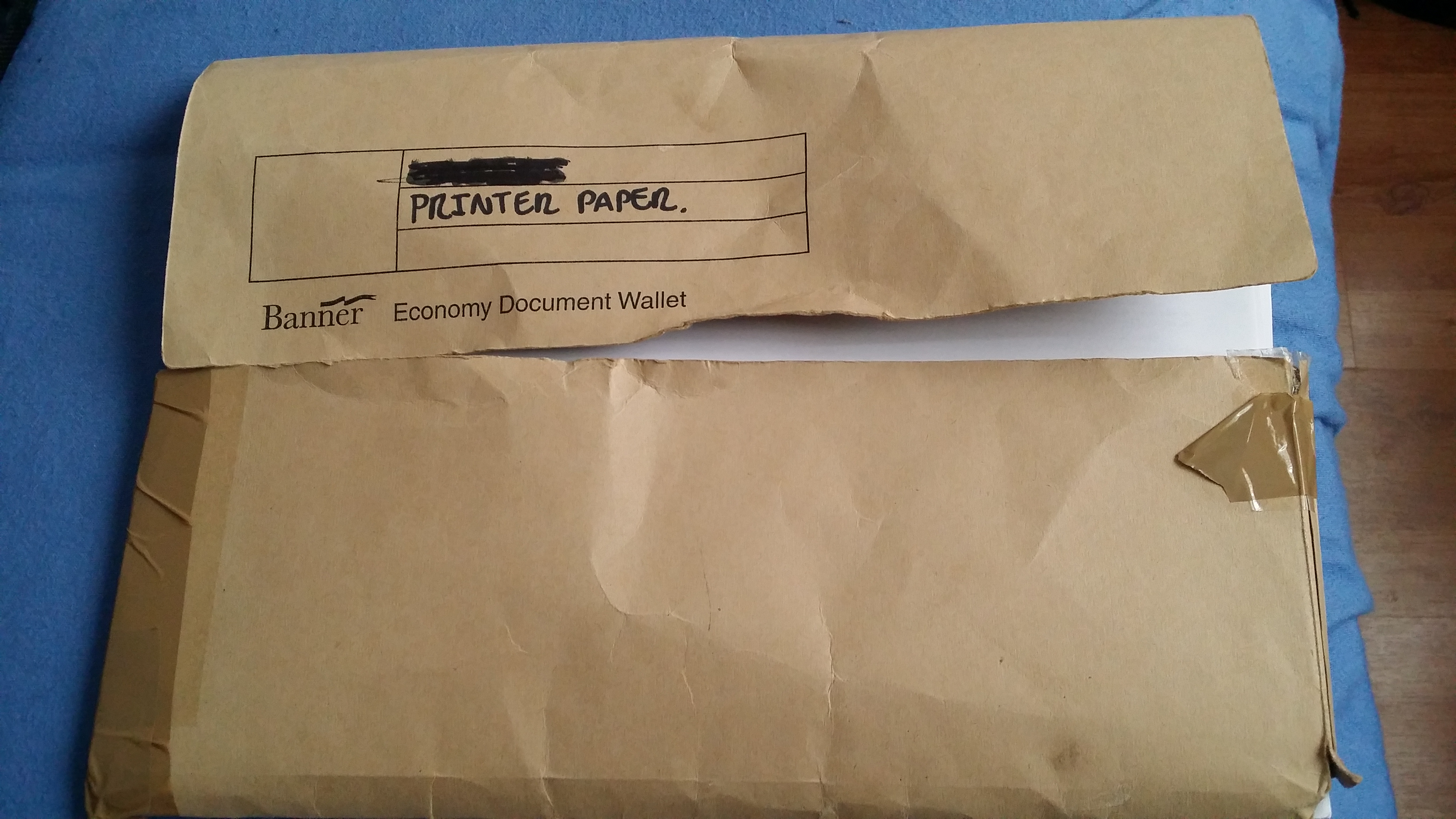
The last time I tried a tailored act, I read out a story consisting of six passages from six viewpoints. I placed each passage in an envelope, marked each one with a letter from A to F, and passed a beanbag around the audience. Whenever it was caught by a new person, I asked them to shout out a letter and that would determine the order of the story.
Some acts thrive on audience embarrassment, but that’s not to my taste unless anyone is heckling or generally being difficult. When I threw the beanbag, I made it clear that whoever caught it would not be hauled up on stage or embarrassed in any way. And with regard to the rucksacked poet, who doesn’t like free sugary treats? These two approaches kept the audience on-side, while allowing the performer to customise the reading to that particular location on that particular night.
In fact, even this entry is situation-specific, as the subject would have been totally different if I hadn’t seen that DVD last night. Rich Hall is also responsible for one of the most bizarre situation-specific incidents I’ve seen on stage. At the Edinburgh Fringe a few years ago, he unexpectedly brought Radio 4 stalwart Barry Cryer on stage as a guest vocalist.