For a few years now, I’ve been going to the StAnza poetry festival in St Andrews. On Saturday, I was invited to compete in the Slam, hosted by Paula Varjack. Although I’d applied some time ago, I was only told that week I’d been granted a place.
There are a few simple rules:
The running order is drawn from a hat.
In round one, everyone is allowed to read a poem for up to two minutes. You’ll be stopped if you run over.
In round two, after the interval, the top four scorers from round one are given 2½ minutes each to read another poem.
The 2017 Slam Champion is crowned.
English: Textbox at the Casa Encendida (2008) – Textbox is a performance space for spoken word poetry and literature. (Photo credit: Wikipedia)
The first poem was always going to be Crossing the Road, published last year; it’s punchy and takes less than a minute to perform. The strength of this Slam is that there’s no ‘house style’, so the contenders spoke on subjects as diverse as ageing, love, insomnia and contemporary politics. Just about everyone put in a sterling performance, including the other first-timers, and I thought I made a good job of mine.
The exact number of points given by the judges were not revealed, but five people progressed to round 2 because two contenders had scored exactly the same, none of which where me. The ultimate victor was Kevin Mclean, who goes on to compete in the Scottish Slam.
I’m not disheartened by my placing. I’m accustomed to performing in front of large audiences, but not with a competitive element. So what I want to do now is sharpen my skills even more by studying what other poets do and how they appeal to the audience.
Elsewhere at the festival, I witnessed excellent performances from Jackie Kay and Sarah Howe, and I chatted to the latter for a while. I also bought Paula Varjack’s book, and filmed performances from poets inspired by looking around St Andrews.
Tonight I’m hosting a spoken-word evening called Hotchpotch. This is an informal monthly event where writers and poets can read out their own work without judgement or criticism. In recent months, we’ve seen many new faces, a trend we would like to maintain.
To keep our events at the forefront of people’s minds, I’ve made it a priority to communicate with members regularly, also to cross-promote other literary events and the venues we use. I send a bulletin every couple of weeks on Facebook and Twitter, and by e-mail.
The last time, though, there were some problems with the reminders, and it was up to me to fix them.
Facebook
A lot of our regulars subscribe to the Hotchpotch Facebook page. This is the easiest update to make: it can be done on a PC or a phone, subscribers are notified immediately when a new post appears, and there’s a facility to tag the pages of related literary groups. The posts can also be edited, and people can ask questions in the comments.
On Facebook pages, administrators have the option to post under their own name or to post under the name of the page. The last time, I forgot to change the option and posted as myself. People could still see the message if they happened to look at the page, but they wouldn’t be individually notified.
The post had been up for a few hours before I noticed. Fortunately, all I had to do was copy it, make sure the related events were correctly tagged, and repost it in the correct mode.
Teh interwebz. (Photo credit: Wikipedia)
Twitter
After posting on Facebook, I send out the link on Twitter using HootSuite software. This can calculate the times of day that people are most likely to see your updates; in our case, it typically posts at 9am the following day.
Shortly after I’d corrected the Facebook error discussed above, I saw our Twitter post had a spacing error which meant the venue wasn’t properly credited. To add to the problem, the message had already been retweeted by two followers and later a third. One of these is the Scottish Poetry Library, which has an extensive audience and is great exposure for us.
The question was how to correct this error in the least disruptive manner. I didn’t want to leave the post as it was because it looked unprofessional, yet I didn’t want to take it down because users had already engaged with us. I’ve learnt a few things from managing literary groups, and one of them is to admit when you’ve made a mistake.
I posted a corrected version with the venue properly credited. I then sent private messages to the three users explaining what had happened and asking whether they would do me a favour and retweet the correct version. And they did. This move ended up working in our favour, as more Library followers engaged with our new message than the original.
E-mail
A significant proportion of our members don’t use Facebook or Twitter, so we also maintain a mailing list.
The bulletin I’m most worried about is this one; once an e-mail has been sent, it’s not usually possible to recall or amend it. So when I send Hotchpotch updates, I’ve set up a 30-second delay so it can be cancelled if necessary before it leaves my outbox. Gmail users can find this feature in the Settings.
But despite the problems with the Facebook and Twitter pages, the e-mail was sent without any mistakes.
I spoke a little about my upcoming gigs in the last entry. This week, I want to pass on some of the advice I’ve picked up in the years I’ve been performing.
A live performance is a great way to introduce yourself to a new audience, and to add extra enjoyment for your existing fans. So it’s crucial to make a solid effort. The advice below should be treated not as strictly unbreakable rules, but as guidelines to make your event flows as smoothly as possible. Some of the points were made in a 2015 entry, but have been updated as I’ve gained more experience.
Think about your introduction.
Check with the organisers what content you need. Sometimes you need to give an introduction; other times, you’ll be asked only to read the piece. If you do need to introduce your work, it’s worth making brief notes, such as:
Give your name
Thank Tracey Jones for organising
Story is called On the River Tay
Taken from collection The Pie Seller
Published by Law Hill Books
Brought copies, happy to sign
Then on the night, you might say, “Good evening, my name’s Mary Walker. I’d like to thank Tracey Jones for inviting me to read tonight, and the piece I’ve chosen is called On the River Tay. It’s taken from my collection The PieSeller, and that’s published by Law Hill Books. I’ve brought some copies and I’ll be happy to sign them afterwards.”
Explain if you need to, but don’t apologise.
Some pieces do require an explanation. Perhaps the work is unfinished; perhaps it’s an extract from a longer work and needs context. But whatever you have to explain, keep it as brief as you can and certainly don’t apologise. If you feel an apology is necessary, ask yourself whether the piece is ready to be heard in public.
Before reading to someone, read to no-one.
The best way to identify any weak parts in a piece is to read it aloud – and that’s the last thing you want to happen in public. So find a space on your own and read it out when nobody can hear you. Are there any long sentences that need to be broken up? Are there words that are difficult to say clearly when grouped together? Can you add or take away any alliteration or rhyme?
If you don’t have the luxury of solitude, the next best method is to use text-to-speech software and listen to your words through headphones. There is plenty of suitable software available online, and some programs allow you to adjust the speed and the type of voice.
Make sure you also time yourself and keep it within the constraints laid down by the organiser. This might mean writing a longer introduction to expand a short piece, or reading out only a section to reduce it.
Practice your page turns.
Unlike a rock star, the great thing about being a writer is that you’re often allowed to take your notes on stage. When reading from a book or from sheets of paper, it’s a good idea to turn up the corner slightly or stick a post-it note to the back to help turn it more easily. When using an e-reader or tablet computer, practice tapping the correct area of the screen to turn the page. Make sure to account for any delay, as not all devices instantly show the next page.
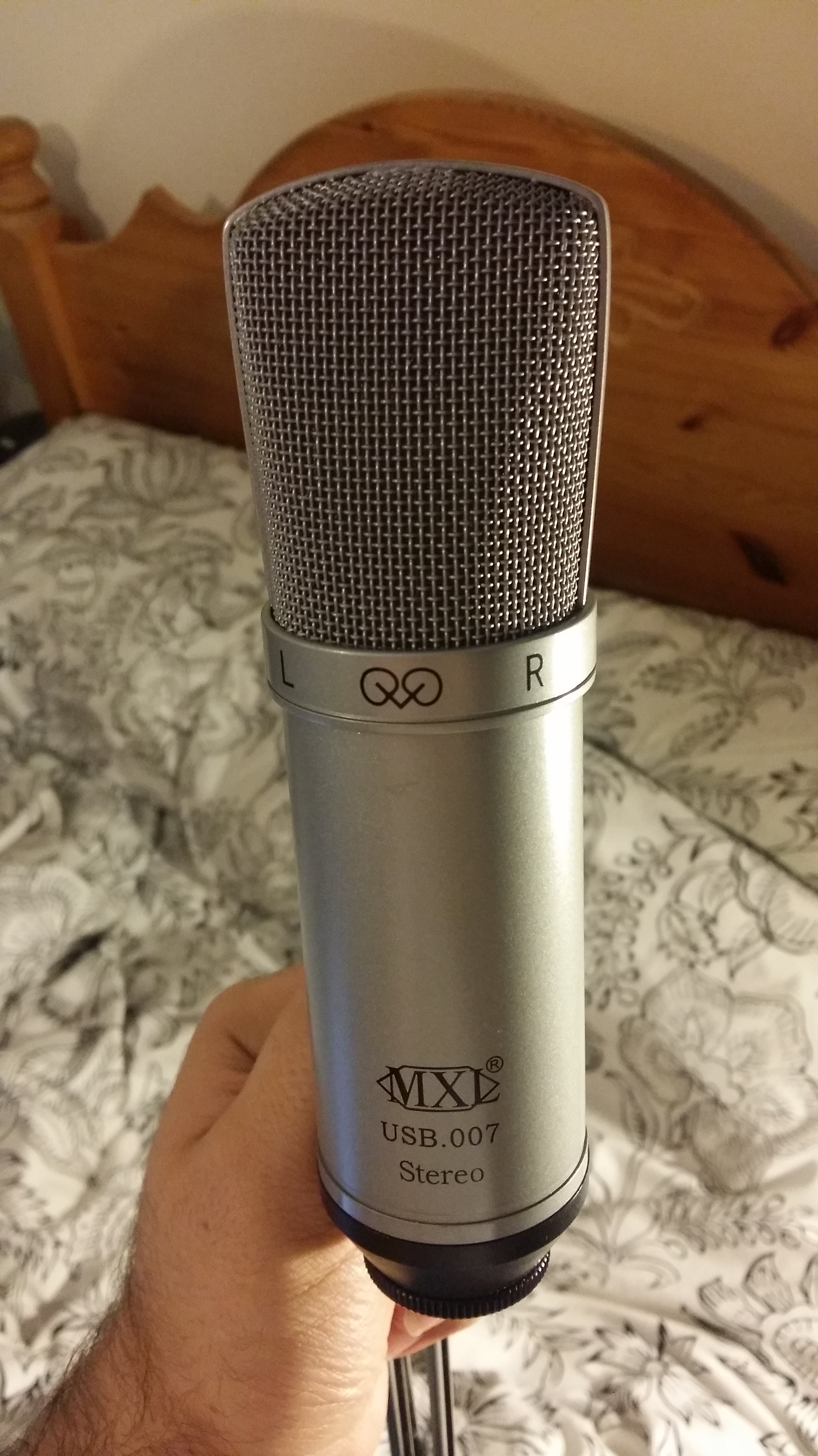
To use my microphone, you have to speak into the side. It connects to a PC with a USB cable, and works with no additional software.
Make sure everyone can hear you.
In my experience, smaller readings tend not to use a microphone, so you need to project. Avoid tilting your head down to read the piece; instead, hold your manuscript higher and off to one side so it doesn’t muffle your words, or look down only with your eyes. Always speak slowly than you would in normal conversation.
If you do have a microphone, ask the sound engineer if you can test it out beforehand, especially if you’re unfamiliar with using one.
Most microphones collect sound from the top, but some designs mean you need to speak into the side, like mine (pictured). Either way, make sure you know which one has been given to you. One of the biggest distractions for an audience is a sound level that vastly increases and decreases, especially at random. Whether the microphone is handheld or on a stand, keep it at the same distance from your mouth.
Avoid too much alcohol or a heavy meal before the gig.
I fully understand why many people need Dutch courage before going on stage. But a drunk speaker rarely makes a good impression, especially during a paid gig, so strictly control your alcohol intake. It takes some concentration to perform, and too much booze impairs that concentration.
My rule is not to take alcohol before speaking, only coffee. Afterwards, however, I sometimes enjoy a red wine. It’s also a good idea not to eat too much in the hours before the performance, as a heavy meal can also slow down your thought process.
Decide where in the room to look.
I know one poet who deliberately looks at individual audience members and delivers a few lines before moving on to the next person. However, this is not what most people do because it can be unnerving to make eye contact. Fortunately, there are some techniques to make this easier. One of my favourite methods is look between two people, so the person on the right assumes I’m looking at the one on the left, and vice versa. Another way, which is particularly good for a theatre setting, is to look beyond the back row. This has the advantage of keeping your posture correct.
Sometimesthe audience reacts wrongly.
I’ve had experiences where an audience didn’t laugh when I’d expected, or chuckled at a serious point. You have no control over this. Should it happen to you, don’t point out the anomaly or repeat it. Wait for the laughter to die down if there is any, then move on without comment. But if you find different audiences keep reacting in the wrong way to the same part, you might consider revising it or editing it out in future performances.
If there’s a cock-up, keep going.
In a live event, something is likely to go wrong. Perhaps the microphone fails, perhaps you forget the words, perhaps somebody walks out. The best course of action is to keep going. The audience will easily forget a slipup if they’re engaged with your narrative. Conversely, they’ll remember the person who stopped the show early, and they’ll remember for the wrong reasons. It’s true that there is no easy way to recover from forgetting your words, other than picking up from the last section you remember, but keep saying something.
Two years ago, I was invited to read at Dundee University Students Association. I was debuting a poem called Housekeeping. I now know this piece back to front, but if you’ll excuse the terrible picture quality, here was my first attempt at memorising the words:
Signalthat you’ve finished.
At the end of a piece, the audience doesn’t necessarily know whether you’re finished or simply pausing for dramatic effect. But an audience can pick up on your gestures. You can lower your manuscript, step backwards slightly, or say, “Thank you,” whereupon they’ll take the hint and applaud.
Do it again.
It’s an eye-rolling cliche, but the more you stand up and speak in public, the easier it becomes. Over time, you’ll learn little nuggets like which techniques work or don’t work for you, which pieces always or never provoke a reaction, &c. Ultimately, a good performance can sell more books.
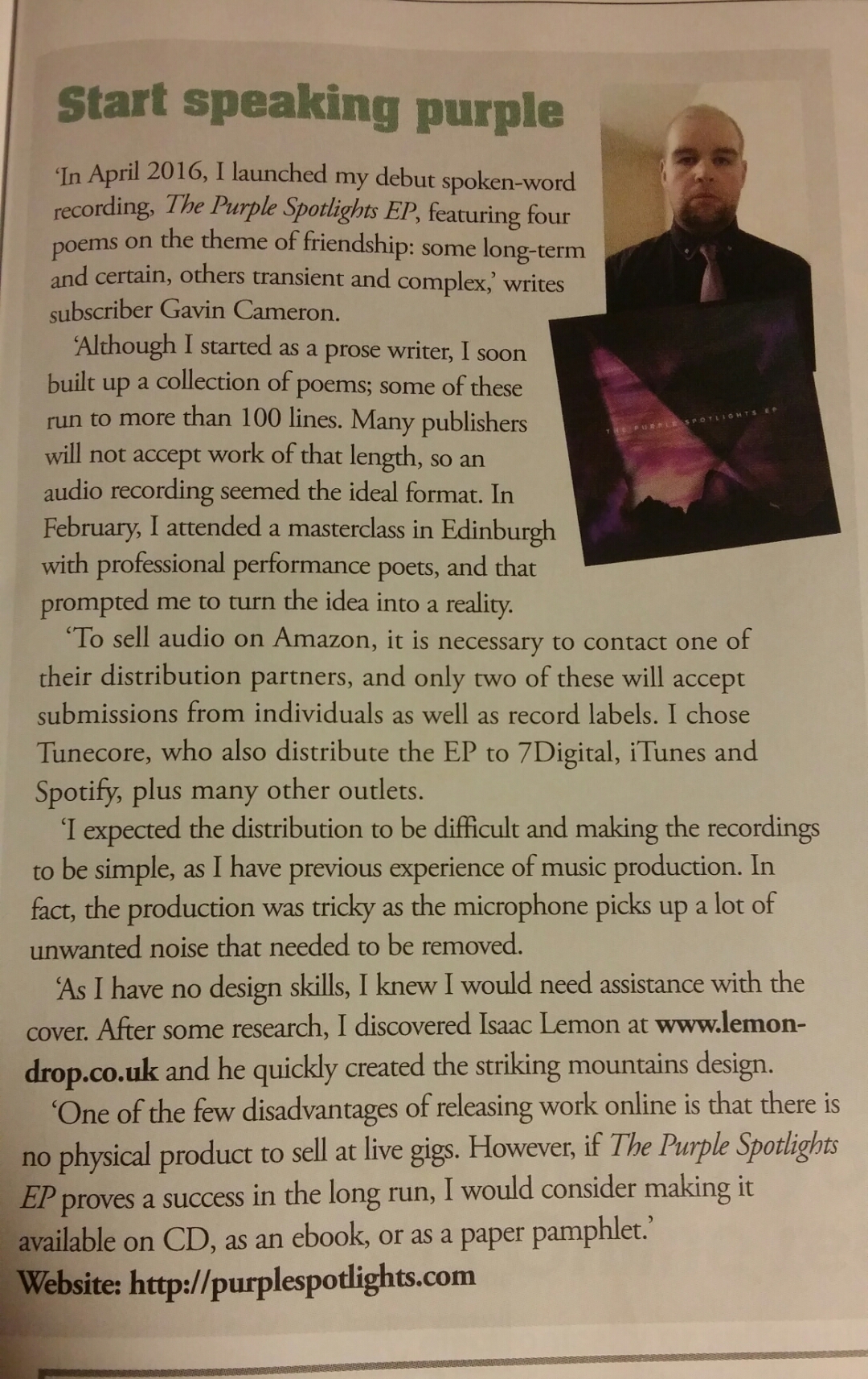
I’m so far behind with my reading that a friend actually pointed this out to me before I saw it. The Purple Spotlights EP, self-released in April, has been featured in Writing Magazine. It’s available from Amazon, iTunes, Spotify, plus many other outlets.
Last week, a friend asked me to give him feedback on a piece he’d written and performed to camera. As he’s not yet ready to go public with it, let’s call him Jack.
I would have given him honest feedback if it had been no good; I don’t think it helps to give praise unduly. I listened to it a few times to determine whether it stood up to repeated listenings, and to listen carefully to the words and their meanings. I concluded it was almost ready for a live audience, and I gave him tips about how it might be improved.
It’s hard to define performance poetry. Some pieces work equally as well on the page as on the stage. Spoken word also falls somewhere between rap and stand-up comedy. Rap generally relies on wordplay and repetition, while stand-up is often infused with the comic’s personal experience, and both elements can be present in performance poetry.
While I don’t have a catch-all answer, there were three elements in Jack’s piece that – in my opinion – made it suitable for performance.
Firstly, he started with a strong image and good use of internal alliteration. The first line alone revolved around ‘L’ and ‘T’ sounds. As we moved on, we began to hear more alliteration, plus complex and slant rhymes.
English: Eminem performing at the DJ hero party with D12 on June 1, 2009 (Photo credit: Wikipedia)
A great example comes from the Eminem track Stan. This video starts at lines where the rapper has stacked up the ‘ee’ sounds of ‘dream’, ‘sleep’ and ‘scream’, but the piece as a whole is largely lines of a regular length with an often-slant AABB rhyme scheme. You can see this when the lyrics are written on the page.
Secondly, Jack took his opening lines and repeated them near the end, although not verbatim. This type of repetition can be vital tool in performance, as it helps to cement ideas in the mind of the audience.
More regular repetition can be used to create an onomatopoeic effect, but be sure to do it consciously, as random repetition can sometimes feel as though the poet is trying to pad out the words. I can think of two great examples. The first piece is safe for work: Francesca Beard with The Fluffy Song, with a reputation helps bring out the voice of the eponymous dog. The second piece is decidedly NSFW: John Cooper Clarke performing Evidently Chickentown, where the swearing lends the effect of a hen clucking.
Thirdly, Jack’s voice in the video infused the piece with a different slant benefit had been read on the page. It wasn’t in his normal register, but reminded me of Murray Lachlan Young: rich and defined with an intentionally snobbish undercurrent.
Of course, anyone who reads a performance piece will bring something to it. Andrea Gibson is quite the opposite of Young, packing a lot into a poem and rattling through it with barely any time for breath. There’s no wrong way of performing, as long as you aren’t forcing yourself to do something unnatural.
When Jack is ready to go public with his work, I’ll post it here and I’m sure you’ll see what I mean.
I’m today launching my debut spoken word recording, The Purple Spotlights EP, featuring four poems on the theme of friendship: some long-term and certain, others transient and complex. It’s available from on 7 Digital, Amazon, iTunes and Spotify, and many other outlets. Head to PurpleSpotlights.com for samples.
Although I started as a prose writer, I soon built up a collection of poems. Some of these run to more than 100 lines and many publishers will not accept work of this length, so an audio recording seemed the ideal format. In February, I attended a masterclass in Edinburgh with professional performance poets, and that prompted me to turn the idea into a reality.
I expected the distribution to be difficult and making the recordings to be simple. I’ve talked before about my previous interest in radio and music production, so I drew on some of that experience. However, the production was tricky as the microphone picks up a lot of unwanted noise that needed to be removed.
I’ve also previously discussed my lack of design skills, so I knew I would need assistance with the cover. After some research, I discovered Isaac Lemon here on WordPress, and he’s since moved to Lemon Drop. He quickly created the striking mountains design, which looks fantastic next to other recordings.
One of the few disadvantages of releasing work online is that there’s no physical product to sell at live gigs. However, if The Purple Spotlights EP proves a success in the long run, I would consider making it available on CD, as an e-book, or as a paper pamphlet.
But until that happens, go and tell all your friends. Heck, even tell your enemies. I’ll be performing tracks from the EP at a few gigs this month:
Thursday 14 April, 6:30pm; Masterclass Showcase, Scottish Poetry Library, Edinburgh.
Monday 18 April, 7pm; Hotchpotch, The Tinsmith, Dundee.
On Thursday, I was asked to take part in an event at short notice as one of the poets was unwell. Flow! is a project by Gemma Connell where a poet is teamed up with a dancer. The dancer knows nothing about what the poet will read and has to react spontaneously. The best way to explain it is by watching part of Thursday’s event:
The first poet in this video was the fabulous Amy Gilbrook. She performs most of her work from memory and makes excellent use of internal rhyme. I’d met her before, but I wasn’t acquainted with the dancers.
There are challenges to complete throughout the night, including a section where audience members are invited to writes phrases on pieces of paper. The poets then must assemble these into a new poem, then read it out there and then.
Each dancer and each poet is allowed to take part in no more than three Flow! events, so there’s a potential to take part in two more, and I would happily oblige.
However, it occurs to me that I’m neglecting someone. Prose. When I started out, she was the one I followed, the one I allowed to infiltrate my body of work. But along the way, Poetry surfaced, showed me her possibilities within her boundaries for which Prose has no equivalent.
Now it’s time to go back and find a balance between her and Poetry. Yet there will be no grovelling; there will be the knowledge that Poetry bestowed upon me: how to stretch myself, how to structure, how to affect an audience. And I’ll approach Prose with a renewed enthusiasm, a new sense of purpose, and challenge her to help me produce something to make Poetry jealous.
To that end, I’m going to worship Prose tonight at Hotchpotch, an open-mike night for writers. Anyone can come along and read out their work – or even that of a published author – with no judgement or criticism. If you happen to be in Dundee tonight, it’s at the Burgh Coffeehouse on Commercial Street, and the readings begin at 7pm.
Last week, I discussed what to do when you don’t like someone else’s work, be it a novel or a live event, and a big thank-you for all the responses I received. However, I had an experience last week where I didn’t like part of my own work.
I was invited to write a piece inspired by the D’Arcy Thompson Museum at the University of Dundee, which would then be performed in the museum a few weeks later. Sir D’Arcy was a naturalist who disagreed with some aspects of Charles Darwin’s work, and the museum houses his surviving specimens.
I’m quite used to turning round work very quickly: I write it, leave it alone for a few days or a few weeks – depending on the deadline – then give it an edit. If I’ve time, I might be able to repeat this process, refining further each time.
With the Sir D’Arcy piece, I struggled to come up with the idea in the first place even after two long visits to the collection. Finally, I wrote a short poetic monologue inspired by a seven-foot narwhal tusk on the wall. The piece imagines what might have happened when the tusk was delivered to Sir D’Arcy and his students, and uses this to demonstrate that some of his ideas and views are now accepted by today’s scientists.
I was happy with the first section of the piece, but was less happy with the second, which I felt broke the Show, don’t tell rule. I felt it was too factual as the story was not shown through the actions of a character, as in the first section. The actual reading went well, but if I had more time, I could have improved it; in the process of writing this entry, I’ve thought of a possible way.
However, unless I’m invited back for a second performance – and that is a hint to the organisers – I have to accept that I put out what I consider to be substandard work.
Before I begin the entry proper, I need to ask a question of the WordPress community.
Whenever I post an update, a link is sent to three social media sites. The Twitter and Google+ connections have worked from day one, but the Facebook one needs to be refreshed at least once every couple of weeks or the link isn’t posted. Every so often, I also remove the WordPress app from Facebook and reauthorise it, but that has no long-term effect either.
How do you fix this permanently? I’m fed up of having to make a manual post to Facebook.
Last week, I mentioned I was attempting stand-up comedy for the first time through Bright Club. It was, for a while, looking like it might be a disaster. When I was rehearsing at home. I kept forgetting to say important lines. At the rehearsal on the day, I forgot which section came next and had to ad-lib until I remembered.
During that final rehearsal, a lot of my material hadn’t received much of a reaction, probably because I was speaking to the other comics and they’d heard much of it already. But at the end of that rehearsal, the organiser wanted to check the microphone level, so I recited a limerick that wasn’t part of the act. It went down so well with the others that I was persuaded to slot it in.
This is not the venue I was in. It’s merely a generic representation of it. (Photo credit: Wikipedia)
There were six acts performing; I would be fifth on the bill. I chatted to the MC before the show and in the interval and we agreed it was going well. All I would need to do was remember all my lines, plus the limerick, plus the other tweaks that were suggested, plus a prop I needed, plus to speak slowly enough so everyone could catch my words.
When I walked on, I began with a joke that referenced the previous act, then launched into my own material. Most of it got the reaction I wanted, and the limerick even earned a round of applause. Indeed, everyone was a hit with the audience.
Would I do it again? Of course I would. Bright Club is slightly limiting in that you have to talk about your research; I could have crowbarred twice as many gags in there if I’d been free to discuss anything.
The performance was captured on camcorder, but it’s not yet available as it needs to be edited. I’ll make sure you’re the first to see it, Facebook connection permitting.
This Friday coming, I’m going to try my hand at stand-up comedy. I’m quite comfortable with reading prose and poetry out loud, and I tell jokes on Twitter. However, this’ll be the first time I’ve combined these two skills, and it’ll be in front of an audience comprising students and academics. If you’re in Dundee, Bright Club starts at 8:30pm at The Braes on the Perth Road. At the time of writing, there were still tickets available.
Stand-up is a stream of consciousness art form and needs to be delivered from memory. I don’t have a great track record with memorised pieces. If you’ve been a long-term subscriber, you might recall the time I crashed and burned when trying to recite my opening piece:
But Bright Club looks after its comics. I attended a four-hour training session with Susan Morrison from The Stand and came away with a book titled Be a Great Stand-Up. There is also a rehearsal session tonight.
At first, I had some difficulty writing enough material for the eight-minute slot, but by using the techniques imparted in the training, I’ve added parts and cut others, and more or less made it the correct length. And I’m not having as much difficulty recalling it as I thought I might.
I sometimes forget not everyone is comfortable speaking in front of an audience; this was brought home to me during a discussion with classmates on the MLitt course I’m taking. I’d like to share with you, therefore, three great pieces of advice about posture, emotion, and focus. I’ve learnt two of these from experts, while the other is from me.
Posture, Giles Brandreth. In his Edinburgh fringe show Word Power!, former MP Brandreth imparts a wealth of advice. My favourite tip was a rather rude one to help you assume correct posture on stage: nipples leading. In other words, make sure they’re pointing straight forward and your posture will look after itself.
Emotion, Jenny Lindsay. During the summer, I attended a session run by one half of Rally & Broad. She related a story about a writer who was becoming upset every time she reached a certain part in a monologue. She asked the rest of the cast to write positive messages on the paper to help her through it. This is an extreme case but it is a useful way to remember everyone else wants you to succeed.
Focus, Gavin Cameron. This is general advice, so I’m hijacking it and sticking my own name upon it. For most of the time, I avoid looking at individual members of the audience. Instead, I pick a point of focus beyond the back row of the audience and address it. For a change in focus, I look between two audience members; the person on the left assumes you’re looking at the person on the right, and vice-versa. This allows you to concentrate on the words without being distracted by the listeners.
The only real way to improve is to keep doing it. I often ask to have my pieces videoed – as Bright Club will be – and watch it back. I’ve long reached the stage when I’m able to watch and listen back to myself without wanting to turn away. From doing this, I’ve learnt I say ‘um’ a lot without me even realising it, and that’ll be the next fault I work on.
I’d like to leave you with a video of me reading my poem Textbook. It’s one I had difficulty writing, but has proved so popular that it was used to promote the MLitt course along with the work of my contemporaries. I was most pleased I managed it in one take, and I hope Friday’s gig goes just as smoothly.





 Gavin Cameron