A Nickname That Sticks

At my school, some of the boys acquired nicknames that stuck with them until they left.

Some were rather obvious: ‘Wilf’ was derived from the first name William, while ‘Gubby’ was shortened from the surname Gilbertson.

But some were a little stranger. One boy was dubbed ‘Beefy’, not for being fat, but after an incident that isn’t necessary to repeat. And I never did find out how Adam started to be called ‘Cuba’

A nickname in a story can be a powerful way of telling the reader about the personality of the character or the type of friends that surround them. The best nicknames work with mutual consent, but not necessarily consent with the nicknamed party.

In the William Golding novel Lord of the Flies, Piggy says early on that he doesn’t want to be called Piggy. Yet nobody had thought of calling him this until he mentioned it, then everyone started doing it.

When just one person has another name for a character, it tells us as much about the person who uses that name as the person it applies to.

Perhaps it’s a close bond between the two. In the crime series NCIS, Ducky nearly always calls Gibbs by his first name ‘Jethro’ because they’re old friends.

Conversely, I’ve witnessed the opposite relationship. In a previous job, one colleague accidentally referred to another as ‘Declan’ instead of Brendan. For the next three years, he continued to use ‘Declan’, seemingly oblivious that none of the rest of us found it funny, least of all Brendan.
Knowing How to Start

Although you see a new blog entry here every week, it isn’t always an easy business knowing how to start writing them. Sometimes, I have only a vague idea of what I want to say; other times, there might be two topics of equal importance that don’t link into each other or sit well together.

There’s no good answer to either of these problems, but one technique is to start writing anything, whether it’s a fragment, a plan, someone else’s words, or even a load of nonsense. After a few minutes of non-stop writing, I find this has the effect of turning on the tap so a structure begins to flow.

Another good method is to head out for a walk or a run, depending upon your preferred speed. A few years ago, I was struggling to write a short story about a man with an excellent memory but limited social skills. I went for a walk in the rain, writing down fragments in my notepad in bus shelters. The moment I had the line, ‘Anger can do in five seconds what a shrink can’t do in five years’, I was ready to write the rest of it.

At times, of course, there will be nothing pressing to say. It’s more difficult to start from a blank slate, but the above techniques can be used in the same way.

A Short Guide to Short Stories

Although I usually write poems these days, I started off exclusively producing short stories. It took a year of writing verse before I’d call myself a poet. However, I found myself going back to stories after a long time away.

There is no universally-accepted definition of a short story: some focus on the word count, while others consider whether the story could be read in a single sitting.

In any case, there are some features that distinguish this form from longer prose:

The timeframe

Even a slow or meandering short will make its point more quickly than a longer story. A 2000-word story might spend 500 words introducing the concept, the next 1200 might explore how the status quo is upset, while the remaining words resolve the story and often spring a twist upon the reader.

In a novel, the first chapter alone could be 2000 words.

Every word plays a part

While there is scope for description in a short story, there probably won’t be room to include detail that isn’t directly relevant to the plot. For example, the reader probably doesn’t need to know the main character wears a yellow scarf and a green clip unless those items are later found at a murder scene.

Characters and locations are limited

In a short, it’s rare to find more than five characters or a number of different locations, otherwise the story can feel as though it’s jumping around too much. I novel, on the other hand, can change location every chapter if the plot demands it.


If you’re writing and you find you can’t keep within these constraints, you might have a novella on your hands or even a novel. Let it develop any way it comes out.

Generally, the more words you write, the more description, plot and characters can be included without overworking the narrative.

Incidentally, it’s easier for a filmmaker to adapt a short to the screen than a novel because less action needs to be left out. It’s a Wonderful Life, Total Recall and Brokeback Mountain are all based on short stories.


Restoration

I’ve had some computer problems over the weekend. Windows was running slowly and wouldn’t update, and I eventually had to perform a system restore.

Although this has caused lots of short-term chaos, it seems to be a good long-term solution; it already feels like a new machine. Unfortunately, this episode has taken up so much of my attention that I don’t have a full blog entry for you.

However, I did manage to catch up with some reading earlier in the week. I was on a train to Birmingham and back, a total of around 11 hours, so I’m halfway through the short story collection Arcanum Unbounded by fantasy author Brandon Sanderson.

Most authors write short stories of mayble a few thousand words long and that stand alone from each other. By contrast, this author’s short stories are more like novel extracts, while some would qualify as novellas. What’s more, almost all of them link into the same universe, known as the Cosmere.

I bought the book when I met Sanderson last year because there were no more copies of his latest novel left. I’m glad I started with this collection as it’s given me an excellent sample of his style, and now I look forward to tackling his novels when I have the chance.

Surprise, Surprise

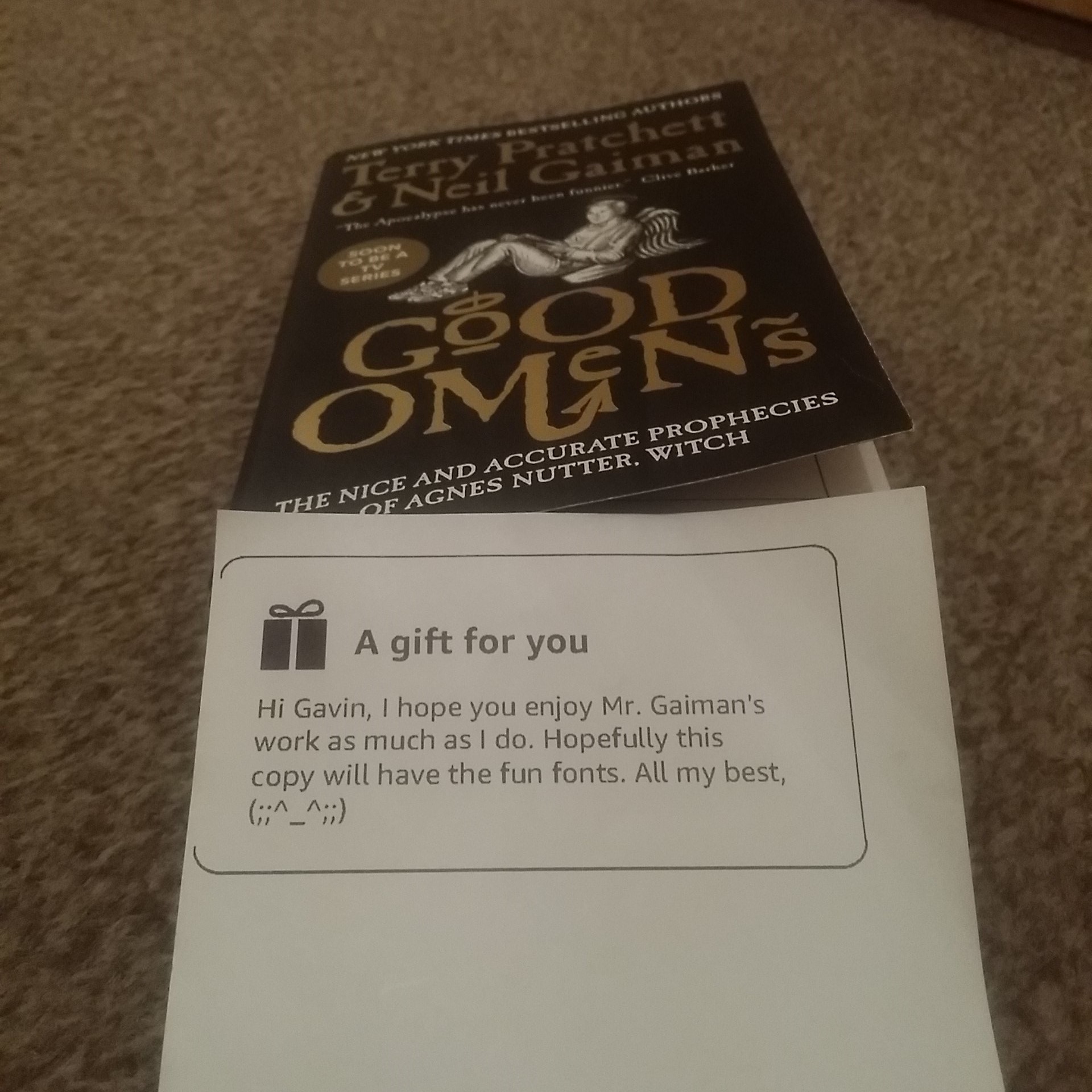
On Tuesday of last week, I came home to a parcel. I was only stopping for a brief time before heading out again. I didn’t pay much attention to it, as I was expecting a USB cable.

Just before leaving, I opened the parcel to check I’d received the correct equipment. So imagine my surprise when I found it actually contained the following:

Picture of Good Omens with a personalised gift note

Good Omens by Terry Pratchett and Neil Gaiman. There was no sender’s name, only a cat’s face made up with punctuation marks. However, it didn’t take long to trace it to an American friend. Around a week before, she’d heard the BBC radio adaptation from 2014. I’d casually mentioned I’d heard this, but hadn’t read the full novel, so she’d jumped at the chance to send it.

It was an incredibly thoughtful gift, and I’m making good progress with reading it. I’m working on what to send back as I have National Book Tokens that need to be spent before the balance expires.

When to Stop; When to Start

In April, I began to redraft a novel that I originally wrote in 2011. In the intervening years, I’ve learnt a lot more about the principles of structure and how to raise the stakes in a narrative, so I was pleased with the way the redraft was turning out.

By Tom Murphy VII [ GFDL (http://www.gnu.org/copyleft/fdl.html), CC-BY-SA-3.0 (http://creativecommons.org/licenses/by-sa/3.0/) or CC BY-SA 2.0 (https://creativecommons.org/licenses/by-sa/2.0)], from Wikimedia Commons
By Tom Murphy VII [GFDL (http://www.gnu.org/copyleft/fdl.html), CC-BY-SA-3.0 (http://creativecommons.org/licenses/by-sa/3.0/) or CC BY-SA 2.0 (https://creativecommons.org/licenses/by-sa/2.0/) ] from Wikimedia Commons
However, there came a point where I’d pushed the main character through as many hoops as I could conceive until he’d achieved his goal. At that point, there wasn’t much to keep him from doing anything he wanted without resistance, so the narrative began to stall. At around the same time, I began to pull together a spoken-word show. I therefore made the decision to leave aside the novel, so for the last month, I’ve been concentrating on the show.

When I stop thinking about a work in progress, I find that’s the time to leave it. The novel is currently handwritten, so I’ll start typing that up once I’m finished with the show, then see where we can take the main character from there.

Other highlights this week include performing at Inky Fingers in Edinburgh on Tuesday and listening to some cracking poets, including the featured Rachel Plummer.

And on Thursday, I heard Caroline Bird performing from In These Days of Prohibition. This is the second time I’ve heard her on stage, and it was again a wonderfully absurdist experience.

And Yet the Pencil Moves

Four weeks ago, I mentioned that I’d been rewriting a novel I started in 2011. I’m pleased to report that I’ve had enough momentum to keep going until now.

I’m following a chapter-by-chapter breakdown with the key points and word counts. In my experience, planning is never a waste of time, even if the plan is eventually amended or abandoned. Indeed, I don’t know of any major novelist who doesn’t plan to some degree.

English: Signature of Charles Scrivener
English: Signature of Charles Scrivener (Photo credit: Wikipedia)

In this case, the plot has been amended substantially, but I believe it’s for the better. In the first few drafts, the main character achieved his goals too easily, whereas now there are a number of obstacles in his way. My favourite tight corner so far is where he catches a taxi to pick up millions of pounds, but doesn’t have enough immediate cash to pay the fare.

Like many of my drafts, this one is written in pencil into a notebook; even my plan is written on the back of scrap paper. I find this method more satisfying than typing it. When it is finally entered into Scrivener, I’ll edit it, so that becomes the next draft.

Writing a novel is a time-consuming process, and even more so are the rewrites to produce a tighter story, but it can be a rewarding endeavour.

A Structured Story

I’ve written several novels, all of which remain unfinished and unpublished. In 2011, I drafted my second one, about a man who takes part in a challenge to win millions of pounds. Since then, I’ve periodically revisited the manuscript, but it never quite shaped it into a form I like.

The most recent attempt was over the bank holiday weekend. I sat down and fitted the key events into a structure that resembles a Hollywood screenplay. There are five major turning points that occur at set intervals during the narrative.

Hollywood Sign
Hollywood Sign (Photo credit: Wikipedia)

On the face of it, this sounds rather restricting, but for the first time in a long while, I’m actually excited about the project.

One stumbling block was a scene where the main character is taken to another country and left to find his way back to the UK. Having the structure to follow helped transform this rather long and dull trek into a series of shorter journeys, each part ending in a cliffhanger and raising the stakes a little higher.

Every so often, you’ll hear a novel or a film described as ‘formulaic’. This is usually caused by the writer making the structure too obvious. The turning points ought to be invisible to the casual reader or viewer, but they will be there, shaping the story into a form that audiences subconsciously expect.

Further To…

As National Novel Writing Month draws to a close, I thought I might have run out of steam by now.

English: NWP teachers at work.
English: NWP teachers at work. This photo has little relation to the entry; I just like the guy’s hat. (Photo credit: Wikipedia)

On the contrary, I hit a turning point in my novel on Saturday, a remarkable 25 days into the contest. I now have a new structure that I’m pleased with, and I’m more excited than ever to commit it to paper. The downside is that the new structure incorporates little of the material I’ve already written, so what I have now is effectively a 40,000-word collection of character sketches.

It therefore looks like I’ll be continuing this project during December as I don’t want to let the momentum trail off.

What I actually planned to do in December was to turn a certain public-domain novel into a screenplay; as far as I can tell, nobody has done it before with this book. It’s waited more than one-and-a-third centuries, though, so a few more months of delay won’t make much difference.

Finally, you might remember I made an entry regarding my experience of understanding the Scots and Dundee dialects; it was called Fluent in 1½ Languages. Since then, some brainbox at the University of Abertay has shown that understanding the Dundee dialect is as good as knowing a second language.

Carré on Spying

On Thursday evening, I enjoyed the privilege of watching a live cinema broadcast with spy author John le Carré. He made a speech from the Southbank Centre in London and was later interviewed by Jon Snow of Channel 4 News.

Even at the age of nearly 86, he’s still an imposing presence, with a slow and measured delivery that commands attention. He related a number of anecdotes about his time in the Security Services, many of them delightfully unflattering about the other party. I suspect, though, that there are a hundred more, all quite unrepeatable in polite company. Indeed, the sole swear word appeared in a direct quote regarding the rivalry between MI5 and MI6, reminding us that he wasn’t always a grand old figure of Establishment, but one of the lads.

John le Carre

It was in the late 1950s when le Carré began his career in espionage, and his most popular character – George Smiley – was created during this period. Yet the author isn’t stuck in the past and I admire that in anyone. For instance, he remains as politically astute as ever: acknowledging the starkly different threats posed by the Soviet Union and Isis, while lamenting the reemergence of fascism after fallow decades. Like the idealist Smiley might have believed, he would much rather have seen an era of peace when the Cold War ended.

The overarching purpose of the evening was to promote his latest novel A Legacy of Spies. Though le Carré has warned in the past that he’d given his final interview, it seems he can’t help but be lured back into the spotlight from time to time. For as long as he’s prepared to do this, he can rest assured there’s an audience waiting to hear his words.