‘Those expressions are omitted…’

The major literary news story of the week was an announcement that Puffin Books would revise selected passages in new editions of books by Roald Dahl. The Telegraph provides a decent background of the reaction this has provoked.

One word that keeps cropping up is bowdlerising, a reference to Thomas Bowdler. Beginning in 1807, he produced a series of books titled The Family Shakspeare [sic] that removed what he considered to be improper language. The title page claimed: ‘Nothing is added to the original text; but those words and expressions are omitted which cannot with propriety be read aloud in a family.’

It is also known that his sister Henrietta started the project and contributed to the subsequent volumes, although it’s not clear how evenly the work was split.

While the public largely agreed with the changes during its first hundred years, attitudes had changed by the early 20th century. This is when the verb to bowdlerise gained its modern meaning of making overzealous edits.

In the case of Dahl, I think the situation could have been approached differently. Perhaps a newly-written foreword to explain the historical context would have been more appropriate to help young readers understand the language choices.

However, it’s clear that Puffin is banking on solid sales, as hundreds of hours and thousands of pounds must have been spent on the changes. It remains to be seen in the long run whether the readers of the future agree that the text has been bowdlerised.

At the time

Preparing for November

For the last eight years, I’ve had the privilege of running the Dundee & Angus region of National Novel Writing Month. The name is usually shortened to NaNoWriMo.

My official title is Municipal Liaison (ML) and I’m just one of an army of volunteers around the world who run local regions of differing sizes. Dublin, for instance, is one region. By contrast, the entirety of Italy is also its own region for NaNoWriMo purposes, although that’s not uncommon outside the Anglosphere.

The poster child of NaNo is the challenge to draft a 50,000-word novel over the 30 days of November. Regions are not required to meet year-round, but ours does every Tuesday. November sees an increase in membership, so we’ve learnt to plan accordingly.

In addition to our Tuesday meetings, we have an additional one each Saturday in November. Traditionally, this is at a different location. I always like to have a co-ML as a backup, and she organised that alternative venue.

But why meet year-round in the first place?

It’s less well-known that the organisation also runs standalone challenges during April and July where you choose your own goal.

The idea came about after the 2015 November challenge, when there was an enthusiasm to keep meeting up into December. A previous co-ML and I decided to extend it on a trial basis each month, and we eventually met up every week until April 2016.

At that point, it was clear the weekly meetings were a winner. These allowed our members to come along during the off-season to work on other projects or prepare for the next challenge.

When the pubs were closed during the pandemic, we already used Discord as a meeting place, and this was stepped up. Our meetings now take a hybrid form, where members have the alternative to engage in our private server.

The in-person element, however, will always remain central for as long as I’m in charge of the Dundee & Angus NaNoWriMo region.

Acting as Gallery Assistant and Finding the Time to Read

I’m a regular visitor to the Dundee Contemporary Arts building, which holds around three major exhibitions per year. No matter what’s on display, I’m forever fascinated by the job of the gallery assistants. Aside from opening nights and special events, the pace is normally relaxed enough that some of them read novels while on shift.

Last week, I had the chance to experience this for myself on a smaller scale. First, a little background.

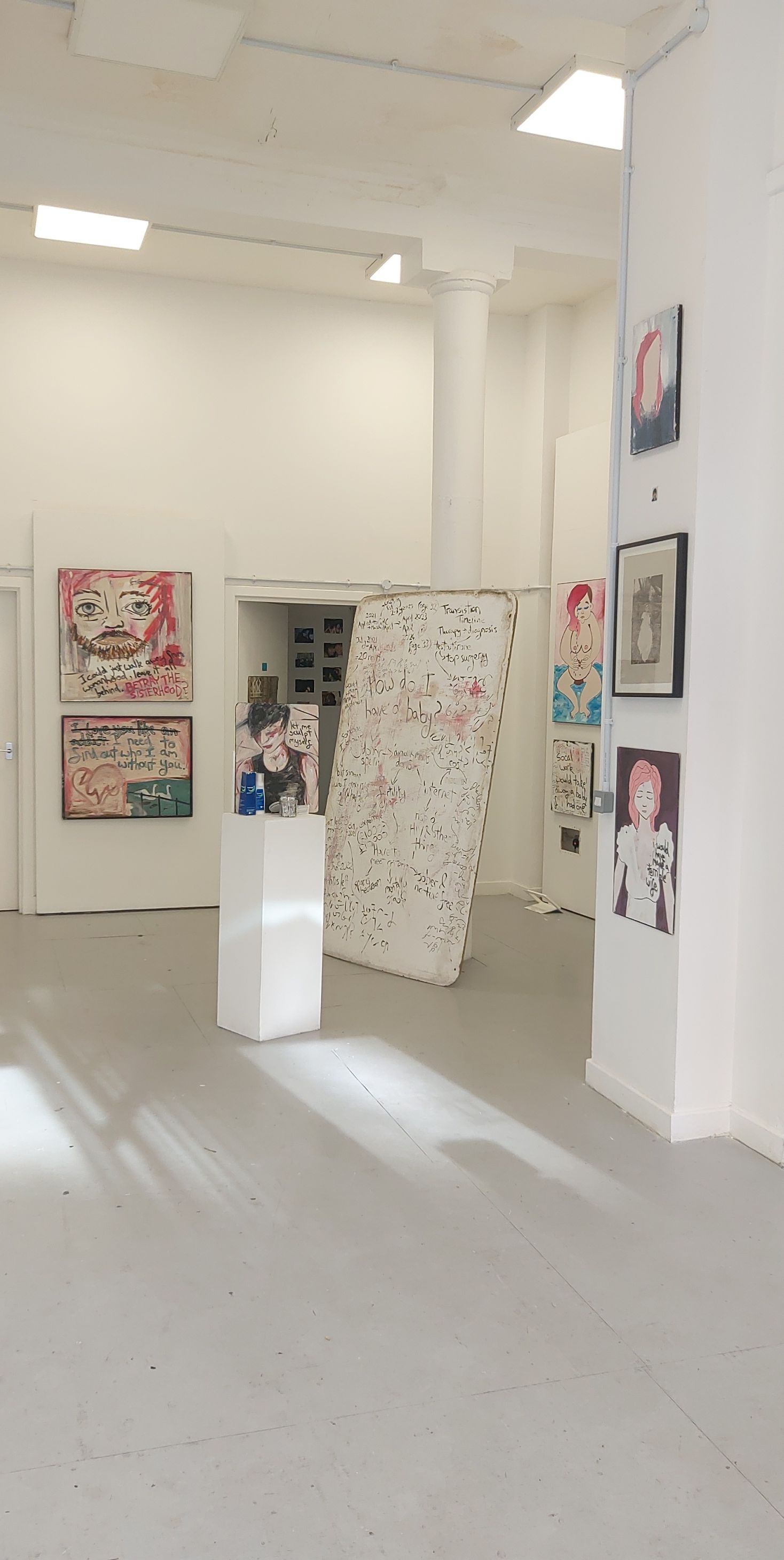
On Thursday, I visited an art exhibition called Funeral For My Deadname at Saltspace in Glasgow. This was run by an artist pal, and the highlight of the opening night was him completing and signing a document to legally change his name to Luke ‘Luca’ Cockayne in front of a crowd of visitors.

Luca also displayed a selection of his artworks in the gallery, some dating back more than a decade. These were available for viewing until Sunday, and some are featured below.

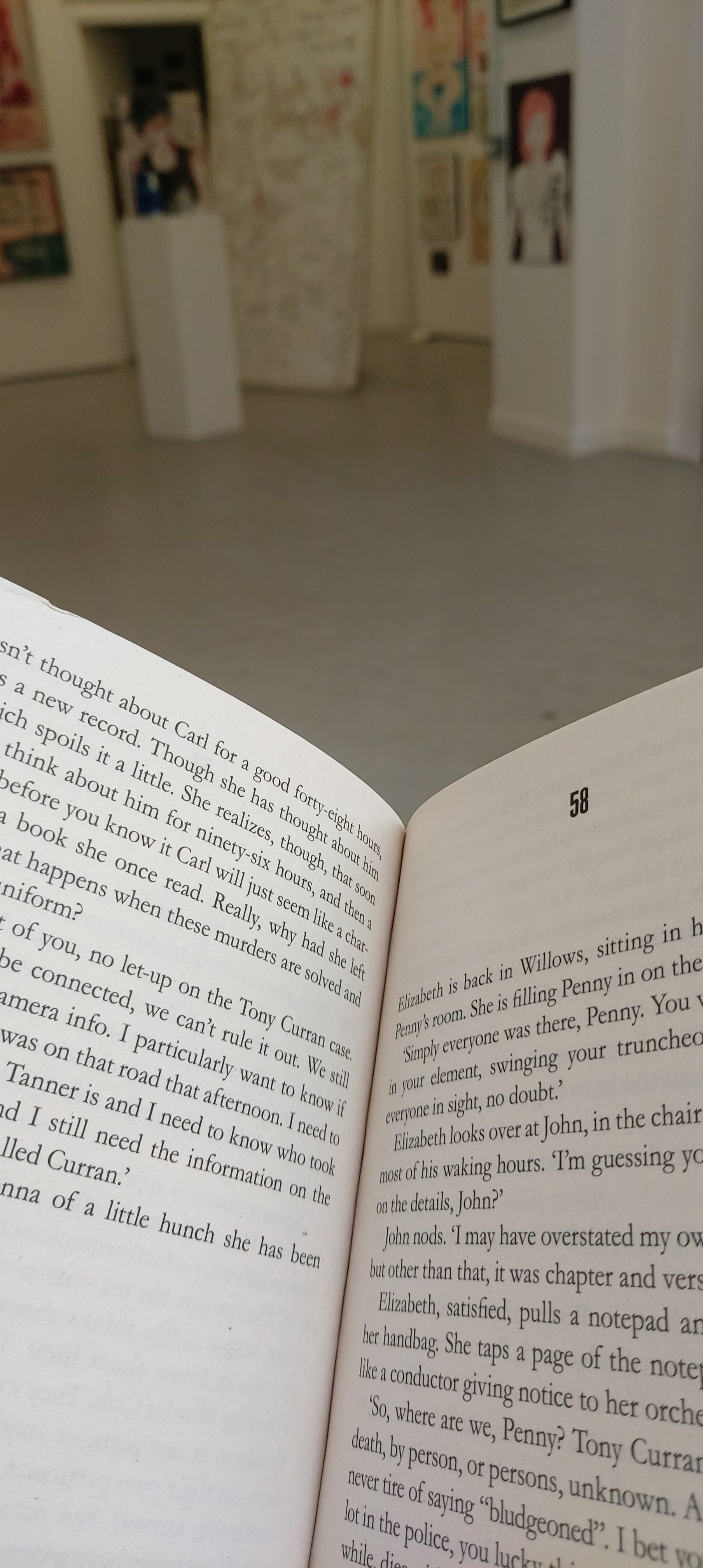
As I hadn’t originally planned to be there on the opening night, I’d already booked my travel for Saturday. I didn’t intend to waste it, so I visited again and spent the day at Saltspace. In contrast with the busy opening night, there was a mere trickle of visitors during the day.

I’d brought with me the Richard Osman bestseller The Thursday Murder Club. It had been sitting in my bag for a long time, and by last week, I’d reached the halfway stage. With a combination of a long bus journey and quiet conditions at Saltspace, I was down to the last few pages by Saturday evening, then I finished it on Sunday.

I also promised my pal I’d dash off a quick clerihew in honour of the event:

Funeral for My Deadname.
I hereby proclaim,
announce and swear
that a change is in the air.

Remembering Where You Read It

More than ten years ago, I read the Herman Melville novel Moby-Dick, which is a hefty 500 pages. At the time, I volunteered every week at a hospital radio station and I used the bus journey to tackle much of my reading. Over time, I began to associate the route with the narrative of the story, even though the two were very different.

I recalled this recently as I read the Richard Osman novel The Thursday Murder Club on a bus, and I realised I have a few of these associations.

Breakfast at Tiffany’s is a book I’ll always associate with a bar where I currently hold a writing group, while A Room With a View reminds me of another bar not far away. Catch-22 is a particularly memorable case, as the association covers both the physical place, namely the school library, and the backdrop of the emerging War on Terror.

This phenomenon isn’t restricted to novels either. On a poetry front, I reviewed a Michael Pederson book in a park, and finished a Lorraine Mariner collection by candlelight one Christmas Eve.

In some cases, it must be stated that the reading locations were more memorable than the books, but I won’t single out any of them – at least not today.

The Importance of Structure and Conflict

This entry gives away the storyline of the novel The Bricks That Built the Houses by Kae Tempest. If you don’t want to know, it’s a good idea to skip this entry.


Every six months or so, one of my writing group members runs a 12-hour read-a-thon, where members can encourage each other to engage with a book they want to start or finish. We had the last one on Sunday just past, and I finished reading the aforementioned novel.

As a long-time fan of Kae Tempest’s other work, including poetry readings and music-backed albums, I really wanted to enjoy this, but what a letdown.

We’re led into the slightly seedy, slightly grimy world of the characters. But when the characters’ backgrounds are spelt out one after the other, it quickly becomes directionless.

Around two-thirds of the way in, there’s a scene where some chancer is beaten up after trying to charge a drug dealer double the previous price. This would have made a fantastic opener, from which we could have seen the tensions rise. Instead, any conflict is almost immediately resolved in the following chapters.

The book also suffers from some hallmarks of the first-time novelist. Firstly, Harry is a thinly-veiled version of Tempest. Secondly, the other characters all talk in a similar manner to each other, and not much conflict is built up between them for most of the time.

All the elements of a great story are there, but the final product feels like a collection of notes than a cohesive whole. The only element that made me push on through is the poetic prose throughout.

Having reached the abrupt ending, I recalled hearing about the first edit of Star Wars. It didn’t impress test audiences very much.

There is a standard story structure underpinning almost every major film, so an editor carefully went through the footage and shuffled it into an order closely resembling that structure. Here is the video of how it was done:

Had someone done the same with this novel, I might have been giving it a far better review.

A Trickle of Income

In 2003, The Killers released their first single Mr Brightside, but it didn’t take off commercially until 2004. Despite the gap of nearly two decades since then, the single has spent 307 non-consecutive weeks in the UK Top 100, accurate to Friday 25 March 2022. This type of sleeper hit has a literary equivalent called the midlist.

A midlist book in a publisher’s catalogue won’t shift a lot of units at any one time, instead consistently selling enough copies to justify keeping it in circulation. But is this a good or a bad place to be? It depends on who you ask.

Publishers typically like the midlist because it gives them a wide pool to choose from, not to mention bringing in reasonable passive income for minimum marketing. On the other hand, writers can find it difficult to promote their work because those marketing budgets are geared towards new releases.

Realistically, most published novels will end up on that list, with only a few breaking out as household names. But the aforementioned passive income can also benefit authors. I’ve had a few short stories and poems published between five and ten years ago, and they bring in secondary royalties from when books are lent or copied.

If you’ve had anything published with an ISBN, I urge you to register with the Authors’ Licensing and Collecting Society. There’s a one-off membership fee taken from your first payment, but subsequent ones are made every six months with no further deductions.

The Energy of the Beginner

Having run events for so many years now, it’s always interesting to watch the folks who are new to writing.

Some have an idea, but don’t know how to start off. Others need constant reassurance that they’re doing a good job. There are even some who fill every spare moment with writing classes and courses.

It’s not only inevitable that everyone will go through this process, but it’s necessary. All the experimentation allows you to figure out your preferences and dislikes. From my own perspective, I figured out early on that I like sending my work to publishers but entering it into competitions. I then worked out that I like to pen monologues or plays rather than novels.

If you do have that kind of energy, my advice is to use it while you have it. Bluntly, once your motivation goes, it might never return.

Repetitive Reading, Repetitive Reading, and Repetitive Reading.

On Christmas Eve, a pal and I went to see It’s a Wonderful Life at the cinema. After the showing, we discussed the number of times we’d seen it. In her case, it was around the 15th time; for me, probably around eight or nine.

Unlike my pal, it’s a rarity that I’ll watch a film more than once. Ones that fall into the three-times-over club include The Matrix, Home Alone, and Star Wars: Episode IV. I simply don’t gain the same enjoyment from watching something again, especially if it’s soon after the last time.

With books, it’s even less likely I’ll read one for a second time. It’s not just that I can’t find the same enjoyment, but there’s a greater time commitment. Assuming a minute per page, a novel takes far longer to read than the two hours or so needed to watch a film.

The only attempt I’ve ever made was with the Christopher Brookmyre story All Fun and Games Until Somebody Loses An Eye. In that case, I didn’t even reach the halfway point.

I do, nonetheless, tend to keep books afterwards if I like them. I might never again read A Clockwork Orange, Breakfast at Tiffany’s nor Fight Club, but I do like to know they’re there.

Learning From Fiction

Growing up, I read a substantial chunk of Roald Dahl’s output. I liked them not just for the stories, but how he would explain concepts to his young readers. It was through his novels that I learnt why payments of royalties are made, how some fighter jets fired missiles through the propellor, and that finds of certain metals need to be reported to the authorities.

But learning from fiction is in no way restricted to children’s books. Anyone can glean or dispute historical stories from Dan Brown, or learn a little about the law from John Grisham.

A personal favourite is The Day of the Triffids, where a character talks about risk management by using an example from his family farm. It was explained that once in a while, the cows would bunch together and burst through the perimeter fence, yet it was so rare and unpredictable that it was quicker and cheaper to fix breaks as they occurred than to reinforce the whole fence.

And then I read Lee Child giving praise to Frederick Forstyth as The Day of the Jackal turns half-a-century old. The entire novel is almost a textbook for an assassination, such is the level of detail. The hitman isn’t a spiv with limitless resources. We see how he funds his operation and where his weapon and fake documents are obtained.

Yet the reader is never overloaded with lists of data. The key technique is to convey much of the detail via dialogue. At the very beginning, for example, a suspect begins to tell the police about the assassination plot, and the reader learns the details at the same time as the officers.

I feel compelled to leave a caveat here that anything learnt in fiction should always be cross-checked with a non-fiction source. That’s doubly true if you plan to include something educational in your own work.

November, But Not as We NaNo It

We are fast approaching the start of November, which means that National Novel Writing Month (NaNoWriMo or NaNo) is nearly upon us. This is a worldwide challenge to draft a novel of 50,000 words in 30 days, and I run the Dundee & Angus region for Scotland.

NaNo headquarters in California took the decision not to endorse nor support any meet-ups in person until they say otherwise. This has had a profound effect on our group, who have been accustomed to meeting all year round for five years. Even the pub we use is currently closed until restrictions on selling alcohol indoors are eased.

What we have in our favour is a number of student-age members who are accustomed to interacting online. We already use Discord software, and we’ve been working this week on improving its features.

Traditionally, physical goodies are part of the experience; these usually include stickers, pens and erasers. This also introduces another hurdle of either asking folks to trust us with their postal address or meet up in accordance with local regulations. As such, we’ve replaced the pens and erasers with bookmarks so they fit more snugly into an envelope.

In short, this does not and will not feel like any other NaNo. In other years, I’d even associate the colder nights with the coming of the contest, but that simply hasn’t happened.

There are a couple of factors, however, that won’t change and that we’ll keep reminding our membership:

  • Everyone is welcome in our group regardless of nationality, LGBT identity, &c, provided they follow the published codes of conduct.
  • There is no shame in not hitting the 50,000-word target.