For nearly 50 years, the organisation has been collecting royalties on behalf of authors. Unlike primary royalties, such as book sales, these are from secondary uses of creators’ works, including: photocopies, cable retransmission, digital reproduction and educational recording. Members receive a bank payment in March and/or September every year, depending on the types of work registered and how often the works have been requested.
If your work appears in at least one publication with an ISBN, you’re almost certainly eligible to join. You’ll need that ISBN, plus a few other details about the work.
Be aware of the one-off membership fee of £36, which is deducted from your first payment rather than paid upfront. There is also a commission of 10% taken from each annual payment, which allows the ALCS to continue to fund its work.
This year, writers received a total of £47.5 million. This is not shared equally, but is based upon the number and type of works registered. It almost certainly won’t be enough to live on as a passive income, except perhaps if you’re a prolific author.
Rather, it’s an acknowledgement of the principle that authors should be paid when a transformative or derivative work is made using someone else’s source material.
About 15 years ago, I read the epic Herman Melville book Moby-Dick; or, The Whale. There’s one part I remember clearly, and it’s a quote from chapter 124:
The magnetic energy, as developed in the mariner’s needle, is, as all know, essentially one with the electricity beheld in heaven [...]
As the volume was published in 1851, it seems strange we’re seeing using the word electricity because it sounds too modern.
A few chapters earlier, however, the author explained how the ship was equipped with a lightning rod which was connected to a chain touching the sea bed. Again, that sounds too up-to-date, but it was a century after Benjamin Franklin’s kite experiment, so the movement of lightning was well understood by that time.
The author Nicola Cornick is attributed with naming this phenomenon The Tiffany Problem. The use of the name Tiffany as a first name dates back to medieval times, yet it feels like a 20th-century derivation. However, the term can be applied to any similar anachronism, not just names.
Conversely, the name of this observation isn’t actually that old, only dating back to 2018.
Another book where I spotted this was Dracula, where Bram Stoker mentions that Jonathan Harker has a Kodak camera. The Eastman Kodak Company was set up five years before the novel was published in 1897, but a 21st-century author might be cautious of including such a detail.
Staying in this universe, it’s possible to extrapolate in other ways. For example, some of the action is set in Whitby and this had long been connected to Leeds by rail, where Marks & Spencer was founded in 1884. As such, it’s canonically possible that Dracula could have enjoyed a cup of M&S tea.
Of course, as the problem originally highlighted becomes more widely known, that becomes the key to solving it. Now when readers encounter a girl called Tiffany living in the 1400s, they’ll recognise it’s historically consistent, and I think we’ll see authors starting to feel more relaxed about using it.
It was quietly announced last week that the organisation behind National Novel Writing Month was to close. Universally known as NaNoWriMo, or even NaNo, this was a challenge to draft a 50,000-word novel during November each year, later expanding to include smaller challenges in other months.
The announcement, made on Sunday 31 March, was so quiet that only those on the mailing list received it. There also exists a corresponding video from the Interim Executive Director, which has not gone down well with the commenters.
And yet, at the time of writing, the official website remains unchanged. So when I heard the news second-hand on April Fool’s Day, I had to double-check it, missing the chance to include the news as last week’s entry. Still, the week-long gap has allowed some time for reflection.
I joined NaNo in 2010. It had been around for 11 years at that point, and was arguably at the height of its popularity, as illustrated by Google search trends over the years. There were dozens of affiliate groups around the world, including one in Dundee city centre. At my very first meeting, my laptop ran out of battery, so I rushed out to buy a notepad and a mechanical pencil. The graphite rods kept breaking, rendering it next to useless.
Fast-forward five years, and I’d graduated from member to organiser in the natural flow of people leaving and joining. I stayed in that role for nine years alongside several different co-leads until we withdrew our affiliation in 2024 over the nonsense that had been happening.
By this time, I’d fallen out of love with the central November challenge, as I found myself with an increasing series of started but incomplete novels. I didn’t fall out of love with bringing writers together, so I’m pleased still to be co-leading the independent group we created to replace it.
So the big question: what caused the closure? It’s a complex story that can best be told by the NaNo Scandal website, which has documented the problems with the organisation from December 2022.
However, the simplest analogy is that of a Fortune 500 company, which will typically act to keep its stakeholders satisfied. In the case of NaNo, the stakeholders were the organisers on the ground who encouraged members to keep writing and to keep donating. After alienating these folks, the cash dried up.
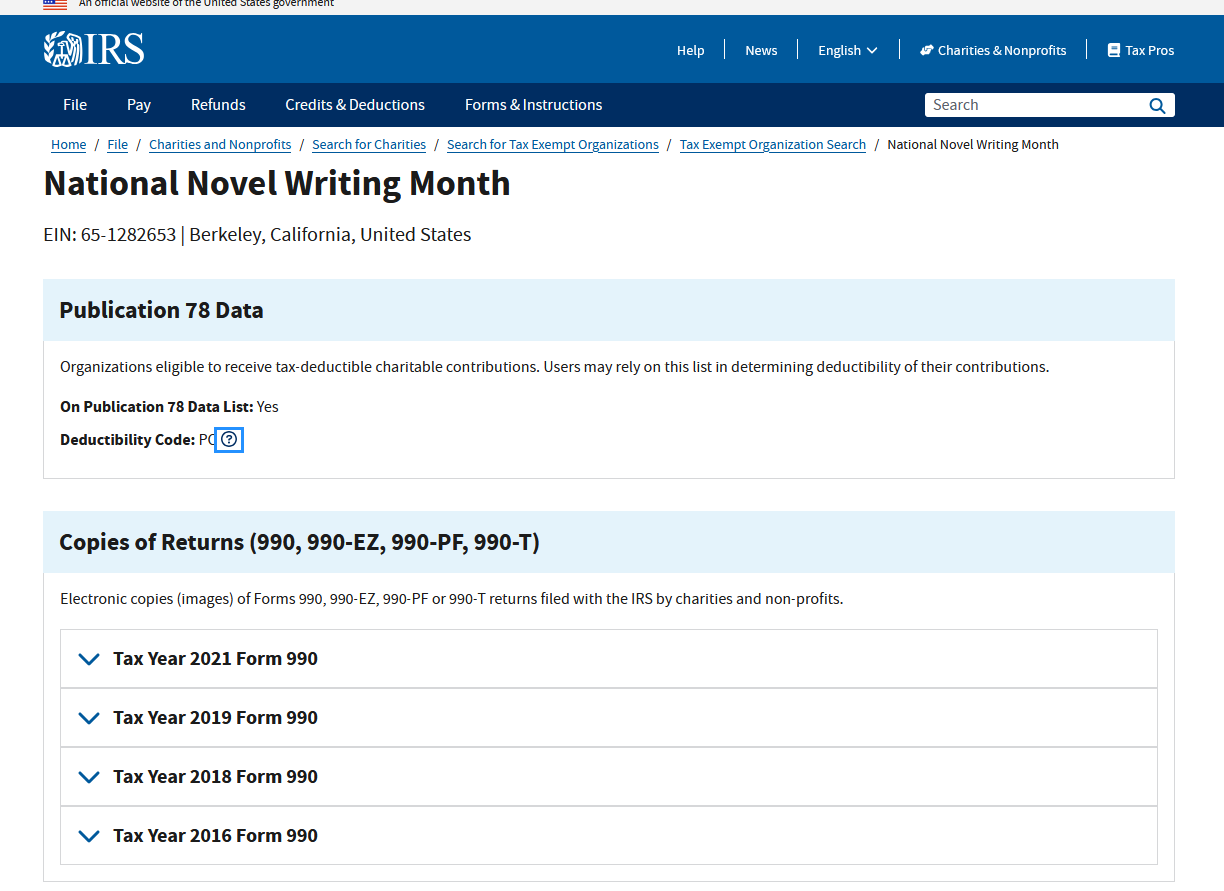
Speaking of cash, search information from the US Internal Revenue Service (IRS) website makes for interesting reading. From what I can gather, the nonprofit National Novel Writing Month should be filing Form 900 annually, which then becomes a matter of public record. However, the last document at the time of writing dates from 2021.
I’m absolutely no expert, so perhaps there’s a genuine reason why the last four years are missing from this list. But if you’re an accountant or you’re connected with the IRS, you can access the search function and enter the Employer Identification Number 65-1282653 to find out the details.
I really don’t want to leave this entry on a sour note. I was involved with the organisation in some capacity for 14 years, so more than half of its 26-year history. I had some wonderful experiences, and I still speak to so many former participants. So here are three memories that stand out:
I held a couple of midnight launch parties at my home, with the plan to start writing in the first hour of 1st November. I had only a two-seater couch at the time, so every chair and cushion was taken up with people, who were also dodging electrical extension cables. As the clock hit 12am, the entire room fell silent for an hour, aside from the tapping of keys.
I’d met someone in real life and was chatting to her via Facebook Messenger. I wanted to take a gamble and ask her out, so I enlisted the members of that week’s NaNo meeting for advice, all of whom were in long-term relationships themselves. They helped me to steer the conversation and figure out what to say next. She still turned me down.
A local organiser used to be known as a Municipal Liaison or an ML. As the pandemic was easing, the government was permitting people to meet up again, while NaNo was still warning MLs to hold only online meetings. To circumvent this, I told the group I would be in our usual venue at a certain time, and there were spare seats if anyone happened to be passing, but that this was not a meet-up. I even wore a sticker reading NOT ML, which became an in-joke for a long time afterwards.
As the backlash dies down, it’s being quickly replaced by puzzlement. If this book had been written by a previously-unknown author and released by a small press, it’s easier to see how this might have happened.
But this is one of the country’s best-known celebrity chefs contracted to one of the five largest publishers in the world, namely Penguin Random House. The manuscript will have been seen by countless pairs of eyes before the first copy was even printed. Each would have looked at a specific element such as grammar or typesetting, and that would typically include some consultation with the community it portrays. The story is also widely believed to have been ghostwritten, adding another possible layer to the checking process. We’re unlikely to find out who this is. It’s almost always a contractual requirement that the identity of a ghostwriter is not revealed.
Still, this book somehow slipped through the net, and the reason might never be known. I’m only conjecturing here, but it’s possible that everyone involved assumed someone else was dealing with the matter, or maybe any concerns didn’t reach more senior ears.
It must be stated that there’s nothing wrong per se with authors writing outside their own experience, but it’s vital to have an insider’s perspective. When Frederick Forsyth wrote The Day of the Jackal, a fictionalised background to a real assassination attempt on Charles de Gaulle, he used his background in investigative journalism to construct his plot. It shows in the precision of the language and imagery, even if I personally think he could have deployed a few more commas.
Regardless of whether it’s done for well-justified reasons, banning or withdrawing a work is often the best promotion it can receive. I wasn’t aware of Billy and the Epic Escape before this news broke, nor about Oliver’s most recent cookbook, which is also on sale and has attracted no controversy.
I had to make a journey on Sunday involving a change between two buses. In case of delays, I’d left myself plenty of time, so I made a last-minute decision to grab a book for the journey – but not just any old book.
For several years, I’ve owned a paper copy of War and Peace by Leo Tolstoy. Before falling out of the habit, I’d already reached the halfway point and it had remained virtually untouched ever since.
Despite its reputation for being dense, the structure is surprisingly reader-friendly. The book is actually an omnibus of four volumes, each divided into several parts and subdivided into a lot of short chapters. So in the 45 minutes between buses, plus the journey itself, I made some decent inroads.
Even the text itself is rich in humour, not something I expected from a tome about the Napoleonic Wars. That said, I took a decision early on not to worry too much about following the plot and simply enjoy the current page.
After making such a positive start on Sunday, I wanted to continue the good work. As such, I’ve given myself a target to finish the last page by the end of December, and I’ve even set up a spreadsheet to monitor my progress. And when it’s finished, I’ll be sure to pass it on to someone else who wants to see what all the fuss is about.
Around 2015, I bought a copy of the Leo Tolstoy novel War & Peace. I say ‘novel’, but it actually comprises four volumes, telling the story of the French invasion of Russia through the eyes of four fictional families.
The book is noted for its length, but all the chapters are short enough that you can read one or two before bed; there are just a lot of chapters. That also doesn’t mean the story has been stretched out longer than it needs to be. Tolstoy has enough plot points to justify the word count.
I recently found the book again, with the bookmark still around the halfway point where I left it. I’d fallen out of the habit of reading it, and I’d really like to restart it.
My edition has character biographies at the start, but I made a decision early on that I wouldn’t try too hard to keep up with the individual characters and instead just enjoy the story.
I think my best tactic for diving back in is to devote a full day or weekend to making progress. Meanwhile, the book is now at least in a prominent place so it won’t slip my mind.2024-05-21 Fractal
Long-time readers of this blog will know I’ve been involved with National Novel Writing Month (NaNoWriMo) since 2010. This is a not-for-profit initiative that encourages members to draft a 50,000-word novel every November.
In 2015, I began to organise our local Dundee & Angus region. A local leader is known as a Municipal Liasion (ML). Each ML needs to sign an agreement every year promising to enforce the code of conduct, hold regular meetings, and so forth. In fact, we already go over and above the agreement by holding meetings every week, not just during November.
I always like having a second ML in charge to help me make difficult decisions. This turns out to have been a prudent move.
Late last year, a member of NaNoWriMo staff in California stood down after making a racist comment about a colleague. Separately, the organisation was slow to remove a forum moderator who was sending inappropriate material to minors.
As a reaction to this, a new Interim Executive Director was appointed without warning, who then released a draft ML agreement with several adverse clauses. These included requiring us to verify our identity with a US company that doesn’t comply with GDPR and preventing us from speaking to MLs in other regions. There has also been a general air of disrespect in replies from this Director, which I haven’t experienced in a decade and a half of involvement.
There are a lot of aspects to this story, but that’s a summary of the main points.
As the situation with NaNoWriMo worsened, the other ML and I started serious discussions about withdrawing our affiliation and becoming an independent group. Our format had slowly evolved over the years, adapting to what members wanted, and we felt we could retain this aspect without external oversight.
Around this time last week, we sent a long bulletin announcing our independence and offered the opportunity for members to ask questions.
The news seemed to go down well. By this time, the MLs from most of the other regions in Scotland had also decided to step down. If anything, the decimation of NaNoWriMo has brought us closer together.
The next discussions in our local area will be about what to do with this newfound freedom. We’ve already amended our terminology to distinguish ourselves from our former identity, registered a URL for future use and discussed holding a summer writing event instead of a November one.
Whatever happens, we remain convinced that withdrawing our NaNoWriMo affiliation is the right action to take and we look forward to the year ahead.
This entry builds upon what was said in the last entry about the Michael Palin TV series Around the World in 80 Days. If you don’t want to know the major plot points, skip this one.
I’d previously managed around half an hour of the first episode before describing it as a posh boys’ club and switching it off. I’m pleased to be proved wrong – albeit only partially.
The third episode is devoted to a seven-day trip on a small boat from Dubai to Mumbai. Everyone on board is expected to muck in with the rigorous daily routines and Palin shows himself to be remarkably adaptable.
But two episodes later, after reaching Hong Kong, a chauffeur is waiting for him with a bottle of champagne. He’s then taken to luxury accommodation and meets several entrepreneurs. It’s clear this is where he feels most at home.
There are also occasions where he would be wise to keep his mouth shut. I found he often felt a need to provide a commentary on what was happening rather than being silently present in the moment. He also asks some questions to female train passengers that seem inappropriate to modern ears.
I’m willing to cut a little slack on that front. The series is around 35 years old now, when Mumbai was still Bombay, plus Hong Kong was yet to be handed back to the Chinese.
On balance, I’m glad I revisited this. By his later series Pole to Pole, he has become better at presenting the places rather than himself, and at handling unexpected situations.
But we can’t talk about Palin’s very real journey without referencing the fictional journey of Phileas Fogg from the source novel Around the World in Eighty Days by Jules Verne.
I’m very much of a mind to read this sooner rather than later, especially as it’s in the public domain and widely available. In fact, Project Gutenberg has an audio version available free of charge, just like its text-based content.
As the organisation operates globally, it relies on hundreds of volunteer co-ordinators around the world to welcome members, arrange meet-ups and raise donations. After joining the Dundee & Angus region as a punter in 2010, I’ve been running it since 2015.
During my time in charge, we’ve started additional weekly meetings during the rest of the year. As such, I like to have a co-organiser to help with tasks such as sending out bulletins, reorganising our Discord server, and covering for each other if we’re busy on a given week.
Even with this, November still remains our busiest month ahead of the novel-writing. By tradition, we organise a launch party in October, a Thank Goodness It’s Over party in December, and an additional weekly meeting on each Saturdays in November.
From our members’ point of view, NaNoWriMo will start on Wednesday 1 November. For us, those conversations need to start right now, and that’s what we’ll be doing over the next four weeks.
Jack Kerouac wrote his novel On the Road in the era of the typewriter. The trouble was that had a story to tell and didn’t want to be interrupted every five minutes to replace the sheet of paper.
His solution was to buy a roll of teletype paper, giving 120 feet of paper in a continuous scroll. That’s the equivalent length of approximately 123 sheets of A4. The novel was reportedly written in three weeks while his wife supplied him with coffee and Benzedrine.
The entire scroll was displayed at the British Museum in 2012. Had it been written today, he likely would have used a computer, robbing popular culture of this artefact.
I’m reminded of this stream-of-consciousness approach as I look at a Simplenote entry I’ve had for the past two weeks or so. Coming home from a poetry gig, I thought of a few lines of verse, adding a few more lines shortly afterwards. Then yesternight, I added a lot more lines, with only minimal editing.
In terms of plot structure, it’s very disjointed and I don’t intend to resolve this. I’m also satisfied with the opening lines and the closing lines, yet I feel it needs something more in the middle to bulk it up from the 23 lines it currently contains and I can’t tell yet what its final form is likely to be.
While it’s unlikely this short note will end up like On the Road, I do have one precedent for a project that grew out of all recognition. I started off writing a one-line gag about how we fictionally used to order YouTube videos by post. By the time I’d finished editing, it had ended up as a short story with more than 1,700 words.

 Gavin Cameron