Lost and Perhaps Found

When I started writing around 2010, I made a point of keeping an archive of my work.

Every story and poem has its own directory, and dated revisions are kept within each one. Plain text doesn’t take up much storage space, so there’s plenty of scope to keep doing this into the future.

About two or three years ago, I was looking for a particular poem I’d written; I knew its title, many of the words, and roughly when it was written. So when the archive showed no results after several attempts, I realised my system had broken down somewhere and wrote it off as a loss. I could have reconstructed it with a little effort, but I never did.

There’s a common misconception about Snapchat that it deletes every picture you send. In fact, you can set it to keep a copy of every picture you add to the My Story feature.

Fortunately, I’d not only set this up, but I’d taken a clear picture of the original handwritten verse four years earlier – and I’m not in the habit of doing that. In February 2022, while looking for something else, I found that picture. The original verse had almost certainly been shredded along with other papers. I swiftly copied the words into a Word document and placed it in the archive.

Luckily this was only a 16-line poem. Other writers have suffered far greater losses. Jilly Cooper, for instance, lost the original manuscript of Riders on a London bus and it took her years to rewrite.

Not all losses are accidental. A significant quantity of drama has been wiped from BBC and ITV archives, including episodes of popular shows like Doctor Who and Dad’s Army. Before the advent of home video, there was little incentive to keep old programmes except to resell them overseas.

In some cases, collectors and members of the public have discovered recordings; some in great condition, others needing significant restoration. The BFI used to hold an annual screening called Missing Believed Wiped, featuring a selection of recovered footage, but I’m unable to find any recent events.

It remains a mystery whether I typed out the poem in 2018 then lost it, or whether it was never typed up in the first place. I’ve nonetheless started backing up my archive locally and online so no further mishaps should happen.
How the Story Ends

Although this entry discusses the endings of screenplays and short stories, no spoilers are revealed. We’ll be looking at the craft of bringing a story to an end rather than the specifics.

There’s been some disquiet over the ending of the TV version of Game of Thrones, with the consensus that it had been unsatisfying compared to the action that had gripped viewers earlier in the run. It echoes the rumbles that followed the endings of Lost a decade ago and The Prisoner in the 1960s.

Conflict is at the heart of storytelling across all media and all eras, and it’s by convention that the conflict should rise and rise as the story progresses, then end with a final resolution that ties up every plot point. Unless a writer is exceptionally skilled, it’s difficult to break away from this convention and still hold the audience.

An unsatisfying ending is usually because the writer failed to resolve the conflict, or sometimes because said conflict wasn’t strong enough in the first instance.

Let’s look at The Prisoner. The series begins when a former British intelligence agent known as Number Six is abducted and imprisoned in a coastal village, where absurd rules apply and staff attempt to nudge him into explaining why he abruptly resigned from his job.

Despite this strong initial premise, the series begins to fall into a rut. By the halfway point of the run, each episode sees Number Six attempting either to escape or to win over his captors, but failing each time in a near-predictable manner.

The final episode is consistent with the absurd rules that had been well established, but fails to answer the question posed about why Number Six had left the security services. That revelation could have been one of the greatest moments in TV history. But thanks to the erratic production, the episode instead divided its viewership.

It is entirely possible to end a piece in such an open-ended manner, as is common in some short stories, but this must be carefully done. A few years ago, I had a story published in an anthology whose stories didn’t seem to have proper endings, leaving me with the feeling that each writer was concealing a vital plot point.

However, an open ending is common in The New Yorker and similar publications. In other media, the film Teeth (2007) is a particularly good example of showing how the previous sequence of events might be about to repeat without spelling it out too much.

The bottom line is that a good ending must either indicate that the previous conflict will be resolved in some way, or an audience must have enough information to work out how it might be resolved once the narrative ends.

Some Salvaged Scribbles.

A few days after my handwritten entry last week, I was looking for something in my bottom drawer, when I discovered an old notepad. It’s nothing special; it’s a Tesco Value spiral-bound A4 pad with a slightly ripped cover.

I’ve used a quarter of its 80 pages, and most of it is taken up with attempts to expand on a fragment of poetry that I tried to expand into a song, although there is also a brief novel idea, pages of free writing, and a poem on the topic of my own handwriting.

Of these, I only consider the poem be a decent piece of work. As for the rest, I know what I was trying to express, but I didn’t have the techniques at my disposal to do it properly. But looking at the content, I’ve calculated that I last wrote in this notebook in September 2009, more than a year before I began writing. I’m therefore not surprised about the quality.

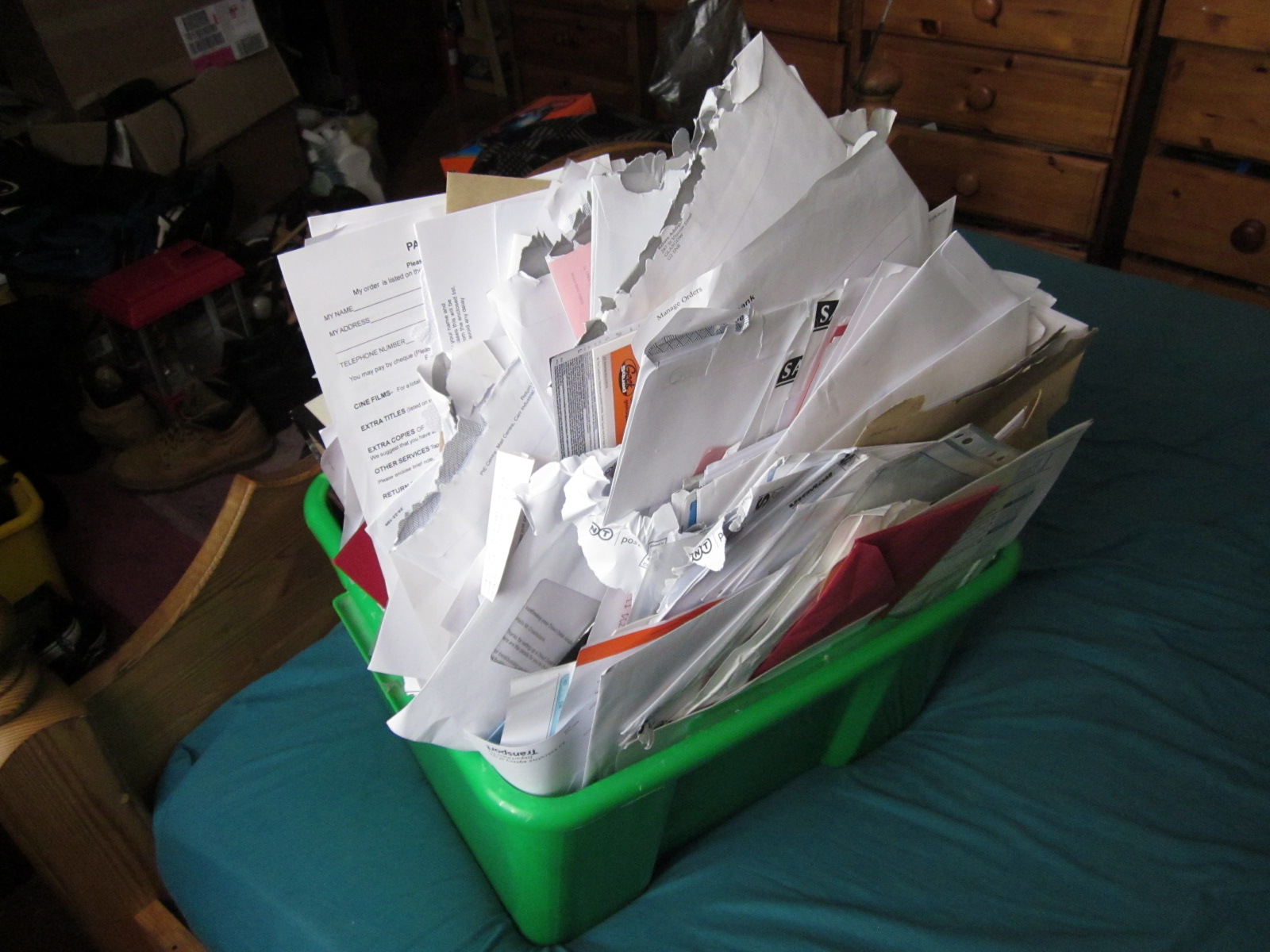
My filing system
My filing system

Yesterday, I discovered other half-completed notebooks, but none as full or detailed as this one. I’ve noticed I rarely reached the last page, although I’m more than likely to complete my current ones. Also, there are hardly any drawings or even doodles, just text.

But the one notebook I would like to look at again is missing, believed lost. At my very first National Novel Writing Month meeting, my laptop battery died. I had to rush out and buy a notepad and mechanical pencil so I could continue my story. I had it about a year before its disappearance, and it contains drafts of my first novel, and some of my earliest stories. I don’t think I’ve lost anything, but I might have.

I know I’m not the only writer with notepads dotted about, and I’d like to hear about yours. Do you have any hidden in a drawer somewhere? What did you discover when you pulled them out again? Have you misplaced an important story you wish you could recover?