Too Long a Title

In 2002, the rock group Cornershop released two singles from their album Handcream for a Generation. In March, we saw Lessons Learned from Rocky I to Rocky III, while August bought Staging the Plaguing of the Raised Platform.

Before writing this entry, I listened to both tracks. They’re both solid guitar-driven and riff-heavy pieces that should have been hits, yet neither song gained traction. Only the first of these even reached the Top 40.

I think two factors were in play here. Firstly, and most obviously, they found it difficult to escape their massive track Brimful of Asha five years earlier. Secondly, in my experience, the public finds it difficult to overlook a long or unwieldy title.

I was reminded of these songs when I heard about the upcoming science-fiction series The War Between the Land and the Sea. It’s produced by Russell T Davies and is part of the Doctor Who universe, so the BBC is unlikely to encounter much resistance to the nine-syllable title. If they had attempted this title for a new show, by contrast, that hurdle might have been much higher.

There are other instances of media where a long title has been used. Right now, I can think of:

  • The novel Fried Green Tomatoes At The Whistle Stop Cafe by Fannie Flagg (1987).
  • The film The Englishman Who Went Up a Hill but Came Down a Mountain (1995).
  • The Channel 4 comedy The Increasingly Poor Decisions of Todd Margaret (2009).

Like them or not, titles of this length tend to slow the reader or viewer a little. When the first on the list was adapted into a screenplay, it was given the truncated title Fried Green Tomatoes. This reminds me of a point made in the George Orwell novel 1984:

COMINTERN is a word that can be uttered almost without taking thought, whereas COMMUNIST INTERNATIONAL is a phrase over which one is obliged to linger at least momentarily.

Sometimes the gamble does pay off, and the audience successfully beyend behind the title:

  • The film Lock, Stock and Two Smoking Barrels (1998) is known by its fans as simply Lock, Stock.
  • The police procedural show CSI: Crime Scene Investigation (2000) goes so far as to nudge its viewers into abbreviating it.
  • Mark Haddon didn’t lose any readers by calling his novel The Curious Incident of the Dog in the Night-Time (2003).

The final two examples, both from the world of music, are each making a definite statement.

For her second studio album in 1999, Fiona Apple chose the following title, with the capitalisation as it appears on the Genius website:

When the pawn hits the conflicts he thinks like a king
What he knows throws the blows when he goes to the fight
And he’ll win the whole thing ‘fore he enters the ring
There’s no body to batter when your mind is your might
So when you go solo, you hold your own hand
And remember that depth is the greatest of heights
And if you know where you stand, then you know where to land
And if you fall it won’t matter, cuz you’ll know that you’re right

It’s a rather twee sentiment, but it’s nonetheless out to make a statement. The cover art makes the first three words legible from a distance, while the rest require a closer look, giving the listener an easy abbreviation.

Apple held the Guinness World Record for the longest album title until Chumbawamba beat it nine years later with the following. The capitalisation has been converted to sentence case:

The boy bands have won, and all the copyists and the tribute bands and the TV talent show producers have won, if we allow our culture to be shaped by mimicry, whether from lack of ideas or from exaggerated respect. You should never try to freeze culture. What you can do is recycle that culture. Take your older brother’s hand-me-down jacket and re-style it, re-fashion it to the point where it becomes your own. But don’t just regurgitate creative history, or hold art and music and literature as fixed, untouchable and kept under glass. The people who try to ‘guard’ any particular form of music are, like the copyists and manufactured bands, doing it the worst disservice, because the only thing that you can do to music that will damage it is not change it, not make it your own. Because then it dies, then it’s over, then it’s done, and the boy bands have won.

In this instance, the last five words are emphasised on the album cover, which echo the first five words and again make an unignorable statement.

In short, a long title certainly makes a statement, but consider carefully whether your audience will look beyond it or not.

Knowing My Own Limits

I’m often uncertain what to write on this blog until I actually sit down to type it out. But I’ve recently been plauged with a different problem, where I know exactly which topic I want to cover, but I can’t find an angle for it.

Some months ago, I was reminded about African American Vernacular English (AAVE). The University of Hawai’i has an excellent introduction, breaking down the usage into vocabulary, sounds and grammar. My trouble is that I’ve nothing to add beyond that as don’t know any native speakers personally, so my experience is limited to what I’ve heard in films and on TV.

If I were to pursue this topic in the future, it’s possible I could draw parallels with the Scots language.

One example from the university link above is using the word bad to mean good. It can, of course, still mean bad, but the meaning may depend on its context. Meanwhile, I grew up listening to Scots speakers talk about the morn’s morn. The first morn means tomorrow, while the second means morning. But again, it’s a matter of context, as the phrase can also be used to refer to the indefinite future, much like the Spanish mañana.

Aside from that short analysis, I feel that’s as far as I can go with discussion of AAVE, certainly for the time being.

Fluent in 1½ Languages

On Friday, I attended the premiere of a play written by John Quinn, whom I’ve known for several years.

In O Halflins an Hecklers an Weavers an Weemin, he tells the story of the jute industry in Dundee. The play was staged in the round within Verdant Works, which used to be a functioning jute mill and is now a museum dedicated to the manufacture of the material. I thoroughly enjoyed the evening, particularly the satirical in-jokes that only locals understand.

A large portion of the dialogue is in local dialect; in fact, even the title seems like gibberish to those who aren’t familiar with the vernacular. Helpfully, however, the programme contains a glossary of the terms used in the production. The title translates as ‘The Mother Tongue’:

Glossary from the play

In everyday life, I speak and understand standard English. I also understood almost every word of the play without looking at the definitions, and I’d be able to decipher the dialect’s parent language: Scots. But to say anything in dialect or Scots, I would have to make a conscious effort to work out my sentences.

That’s why I say I’m fluent in 1½ languages.

There’s a long tradition of English as a written language, with dictionaries and grammar guides going back centuries. Scots, on the other hand, is more of an oral language and there’s no commonly-accepted way to render it on paper. As such, I find it easier to catch what’s being said than if it’s written down.

The problem is most apparent with the sound at the end of the word ‘loch’, which is pronounced like ‘huh’, but said from the back of the throat; a similar sound appears in German. This guttural noise is usually written as ‘ch’, but in English, those letters are pronounced as in the word ‘church’. There are also less obvious issues. The word ‘yes’ can be translated as ‘aye’ or ‘ay’, but depending on the context, the word ‘ae’ might mean ‘always’.

In modern times, there’s been a revival of the Scots language. Perhaps it’s down to the formation of the current Scottish Parliament in 1999; perhaps it’s because Scots speakers can now easily find one another online.

In my experience, there’s a minority of people who use the language merely to show off or to exclude non-speakers. But spoken for the right reasons, it’s full of rich expressions that often have no direct translation.

‘Tartle’ is the act of hesitating while introducing someone because you’ve forgotten their name, and is under consideration by the Collins dictionary. ‘Driech’ can be used to describe any weather except warm and sunny, and can only be used in relation to weather. There are even informal neologisms such as the word Facebook being split into its component words and translated to ‘Pusjotter’; there’s no one definitive reference for this, so here are my search results.

I’ve no plans to start writing in Scots myself. But I am pleased to be fluent in half a language and I appreciate the insight it gives me.

An Update on @Strange_Musings, and Some Transatlantic Translations.

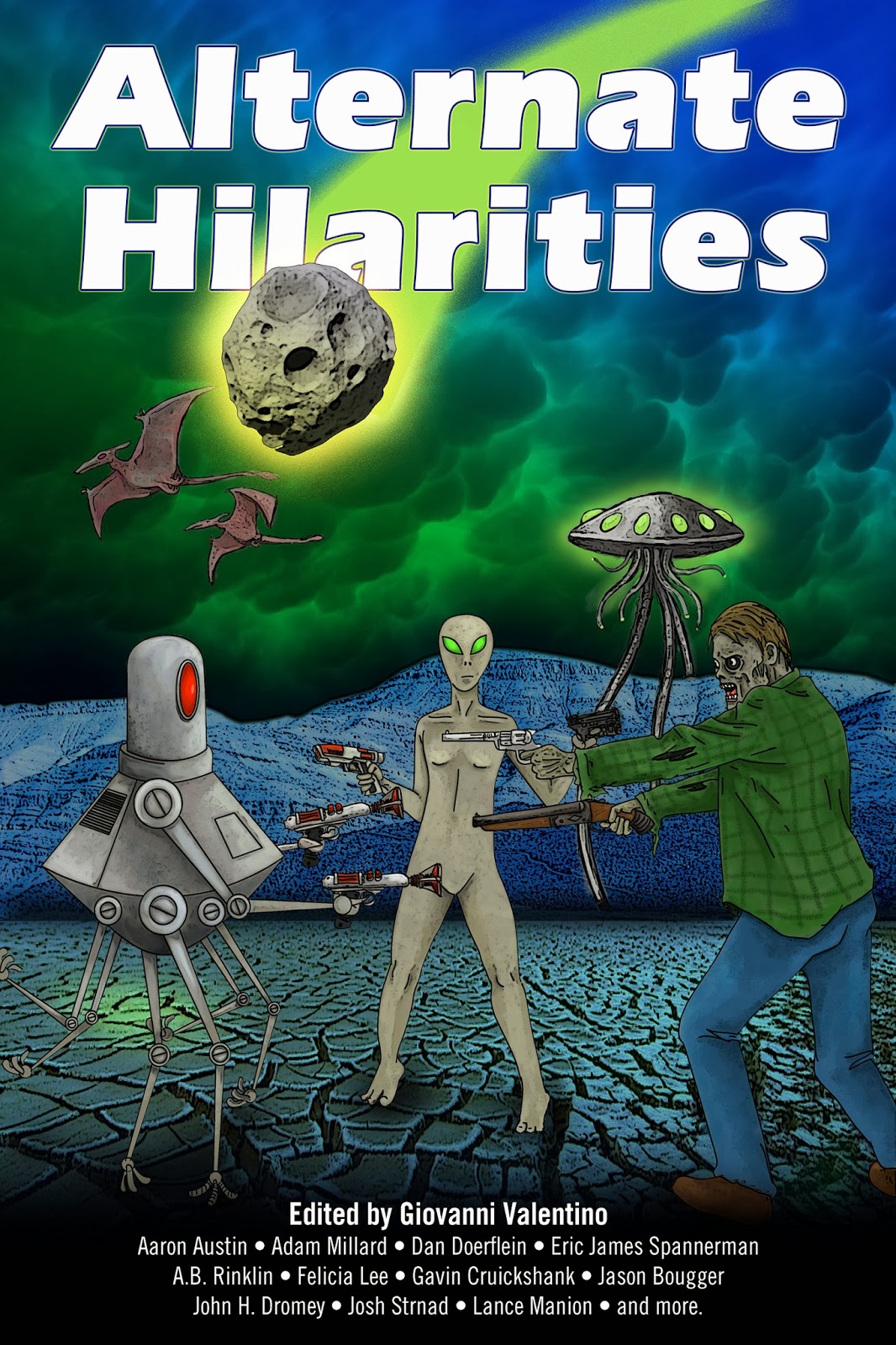
Alternate Hilarities

Around three weeks ago, I was pleased to report that I’ve had a third short story accepted for publication. Strange Musings Press of New York will be printing Amending Diabolical Acronym Misuse, subject to raising enough funds through their Kickstarter page.

There’s still around a week left to raise the $1,100 required for it to go ahead. You can donate at several different levels from $1 to $150, each of which buys you into the project with increasing levels of reward, including electronic and/or paper copies, autographs, and your name in the Contributors’ section.

My story is called Amending Diabolical Acronym Misuse, and it’s about a man who wants to rid the world of badly-constructed acronyms. Although I’m Scottish, my dialect is British English so that’s how most of my stories are written, including this one.

If I’m sending to an American publisher, I often change the grammar and spelling to suit; at least, I have a decent stab at it. In one case, I even wrote the whole story in US English because the character was so strong in my head: a cross between Jason Gideon from Criminal Minds, and Adrian Monk. In Amending…, I took the decision to keep it in my natural dialect as there are a number of references to British places and companies, and I felt it would look odd if I, “translated” it.

A couple of weeks ago, I began reading The Traveller by John Twelve Hawks. The narrative is written with a curious mix of dialects. For instance, the title is spelt with two Ls and there’s a reference to a pub, but the colour gray and an SUV appear in other parts. The SUV would be known as a 4-by-4 in Britain. The story is set in several countries so I expect it’s difficult to settle on one standard spelling, yet it’s not a distraction here, and I’m thoroughly enjoying the story.

Conversely, my mentor Zöe Venditozzi released her debut novel Anywhere’s Better Than Here in 2012. When a US edition hit the shelves, she told me there were no spelling changes made. When you buy a copy, watch out for the character whose initials match mine.

So is it important to adapt your dialect depending on which side of the Atlantic you’ll be published? I expect most Internet users will be accustomed to reading both, but at the same time, people will still write in whichever they feel comes most naturally.

Perhaps one day in the future, the two will merge and we’ll have one way of spelling each word, one form of grammar for all. It would be more practical, but probably rather dull.