Discovering Andrea Gibson

It was announced via Instagram yesterday evening that the poet Andrea Gibson had died.

A few years ago, I had the privilege of seeing Gibson live on stage. You can read the write-up from the first time in 2018, at the Mash House in Edinburgh. Unaccountably, I haven’t covered the second time; for my own future reference, this was on 20 May 2019 at the Queen Margaret Union in Glasgow.

Yet I’m struggling to add anything further than what I wrote in that first entry.

What I really want to do is encourage you to pick up one of their albums, from Bullets and Windchimes (2003) to Hey Galaxy (2018) and just listen to a few tracks. The imagery and the metaphors are delivered at a machine-gun pace, so don’t be surprised if you need to pause for breath. You can also seek out one of their collections, but – cards on the table – I think there’s more to be gained from listening rather than reading.

Andrea Gibson was someone who would never dream of demanding plaudits, but conversely, won so many fans by simply speaking about the world as they saw it. Had they lived past 49, I have the feeling we would have heard so much more over the coming decades.

Poetry Connections and Train Connections

Although it happened too late to write up in this blog, I was at the Inn Deep bar in Glasgow last Tuesday for the launch of The SpecBook 2024. One of my poems had been published by – as the name suggests – Speculative Books.

Copies of the collection had been sent out to contributors, but as mine was lost in the post, I collected one there. What I didn’t realise is that there are actually two small volumes. It was great to see my name in print other than in poetry group pamphlets.

Part one of the schedule was devoted to the published readers, so the first section lasted for a long while. The audience were reminded to support rather than heckle, which is exactly what I would say.

Part two was given over to an open-mic, where anyone could read a poem, whether they were in the book or not. I even met someone I knew from my former open-mic, but I wasn’t able to stay long enough to hear her work.

That was because I’d never visited Inn Deep before and I’d booked my travel cautiously. I’d allowed plenty of time between connections, going from one coast of Scotland to the other. As it happens, this worked out so well that I was home an hour earlier than expected.

Cycling Around

On Thursday, realising I had a free evening, I took the opportunity to see some performance art. This was hosted by my pal Luke ‘Luca’ Cockayne, who was reading a series of autobiographical pieces over the span of 12 hours. I only had time to see around two hours.

I don’t want to focus on the performance itself, particularly because the aftermath is still on for the next five days. Rather, I want to look at something I did during that performance.

One of the organisers handed out pens and paper to the tiny audience with the intention that we could draw if we felt inspired. Much as Luca has tried to teach me some art, I’m still far more inclined to write by default.

I enjoy the challenge of improvising poetry on the spot, so my rough plan was to compose a rough version based on the performance I could see in front of me, and then extract a polished version from that. Yet after writing my so-called polished version, I felt it didn’t quite work, so I tried another.

I ultimately ended up with a total of seven poems. Put together, they form a cycle of sorts, each of which approaches what I want to say without being able to cut to the heart of the matter.

I feel there are diamonds to be dug out of the mess here, so I’m going to keep these drafts for the moment until I find some sort of home for them.

A Personal Path to Paisley

Back in July, I mentioned I had my poem January & You published by Speculative Books. The launch was scheduled for Tuesday of last week in Glasgow.

I knew I wouldn’t have much time to catch the bus after the end of my shift. As such, I’d kept my phone off to avoid any distractions, only turning it back on once I was on the bus. Shortly after it pulled away, however, I received an email. It explained the launch had to be cancelled because of illness, with apologies for the short notice. There is a hope to reschedule it for later in the year.

My time on a Tuesday evening is typically ring-fenced to run a writing group, but I’d arranged with the other leader to make an exception. Had I seen this before we started moving, I might just have cut my losses on the cost of the tickets and stayed in Dundee to help out with the group. Now I was stuck on the bus for around 45 more minutes until we reached the park-and-ride in Perth, so I considered my options.

I could have stopped there and found my way back to Dundee. But some of the buses are painfully slow and infrequent, while the railway station is at the other end of Perth, so I might not have made it back before the group was over. Besides, booking at the last minute is never cheap.

Instead, since I knew the writing group was in good hands, I elected to continue to Glasgow and then on to Paisley.

I was at university there between 2002 and 2005 taking a BSc Music Technology course, long before I was interested in prose and poetry. While I’d been back several times, my most memorable visit took place in 2017 when I thought I might find some inspiration for poetry.

I did find inspiration, but not in the way I’d expected. In short, I barely recognised the place beyond the town centre and I wrote an entry about this when it happened.

Today, I would have taken the time to find the layout of the area, see where the side streets were leading and work out the most convenient way to visit other places. For example, I used to volunteer at a community radio station in the Glasgow district of Govan. I can’t understand why I always paid extra for buses when I can now look at a map and see two more direct routes covered by my travel card.

I didn’t intend for this entry to be so personal, but I also didn’t intend to visit my alma mater. If there was a silver lining, it’s that the resulting poem from 2017 was published in a collection about the town. The more I think about it, the more I’m inspired to write a sequel, so I’ll see where that takes me over the coming days.

A Piece of Good News

In response to an open call, I sent a couple of poems to Speculative Books in Glasgow at the end of December. I then forgot I’d done this until I received an email to say one of them had been selected for an upcoming anthology.

I don’t submit work to publishers nearly as often as I once did. These days, I’m more focussed on organising writing groups and other projects. In fact, the submitted piece was written for my monthly poetry circle and probably wouldn’t have existed otherwise.

I’ll be receiving two contributor’s copies in due course, ahead of its official launch in September, which I will no doubt publicise again nearer the time.

Public Poetry

Regular readers of this blog will know I normally write about writing rather than posting the writing itself. This is because publishers won’t normally accept writing that’s available online, especially free of charge.

But on my tour of the Millennium bridges, discussed last week, I took a little time to write clerihews at each stop. They were so situation-specific that there wasn’t any point in keeping them for a publisher, so here they are in full.

Gateshead,
I visited you instead
of fussing
over your green-arched cousin.
Stockton-on-Tees:
your pointed geometry
pointed the way
to a new century.
York
had the longest walk,
and some robust
gusts.
London,
there are none
who match the sheer span
that you can.
Salford
you rise like a bird,
free
from the quay.
Lancaster
there’s no faster,
way to cross the Lune
on a January afternoon.
Glasgow:
I’m sure the traffic will still flow
over and under, come
the next millennium.

Separately, here’s one I wrote at a popular chain restaurant yesternight.

Monday at the Beefeater
Half-past five, half-past January,
in a half-full restaurant,
kids eat half-portions
as dads drink half-pints.
I half-think I see someone
half-inching a glass.

A Rare Cross-Promotion

Somewhere, I’m sure, there’s a massive hardback volume with The Rules of Blogging etched in gold on the front. In that book, I expect, there is a section with the title Never Give Your Readers a Reason to Leave Your Site. Just this once, I’m going to break that rule as I’m doing something special this week.

Tomorrow and on Thursday, I’ll be visiting all seven Millennium bridges in mainland Great Britain over a period of two days. I’m willing to be proved wrong, but as far as I can tell, nobody else has done this.

I will be keeping a Tumblr blog of the entire journey as I visit Gateshead, Stockton-on-Tees, York, London, Salford, Lancaster and Glasgow in that order.

More than 700 miles of the trip will be completed on diesel trains. This trip was always at risk of industrial action by rail workers, and there will be a strike on Thursday affecting the Elizabeth Line and buses in London. However, it seems the parts of the network I’ll be using will run as normal on my chosen days.

Rail is among the lowest-polluting methods of transport, but these journeys will still emit an estimated 50.73 kilograms of carbon dioxide. To help offset this, I’m raising money for the Woodland Trust.

So for this one week, you have permission to step away from my blog. Next Tuesday, by contrast, I will be doing my utmost to keep you glued to this page only.

Acting as Gallery Assistant and Finding the Time to Read

I’m a regular visitor to the Dundee Contemporary Arts building, which holds around three major exhibitions per year. No matter what’s on display, I’m forever fascinated by the job of the gallery assistants. Aside from opening nights and special events, the pace is normally relaxed enough that some of them read novels while on shift.

Last week, I had the chance to experience this for myself on a smaller scale. First, a little background.

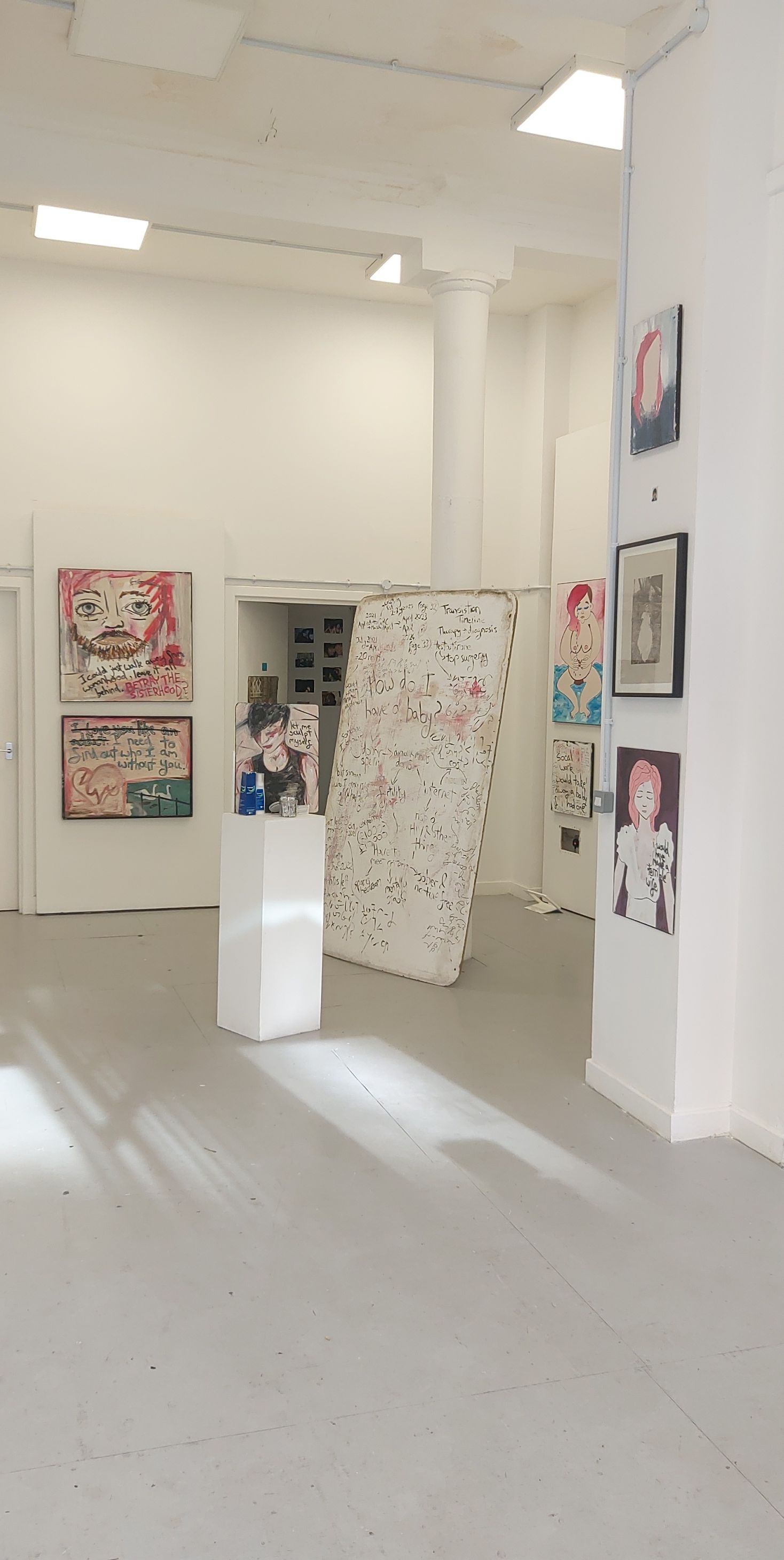
On Thursday, I visited an art exhibition called Funeral For My Deadname at Saltspace in Glasgow. This was run by an artist pal, and the highlight of the opening night was him completing and signing a document to legally change his name to Luke ‘Luca’ Cockayne in front of a crowd of visitors.

Luca also displayed a selection of his artworks in the gallery, some dating back more than a decade. These were available for viewing until Sunday, and some are featured below.

As I hadn’t originally planned to be there on the opening night, I’d already booked my travel for Saturday. I didn’t intend to waste it, so I visited again and spent the day at Saltspace. In contrast with the busy opening night, there was a mere trickle of visitors during the day.

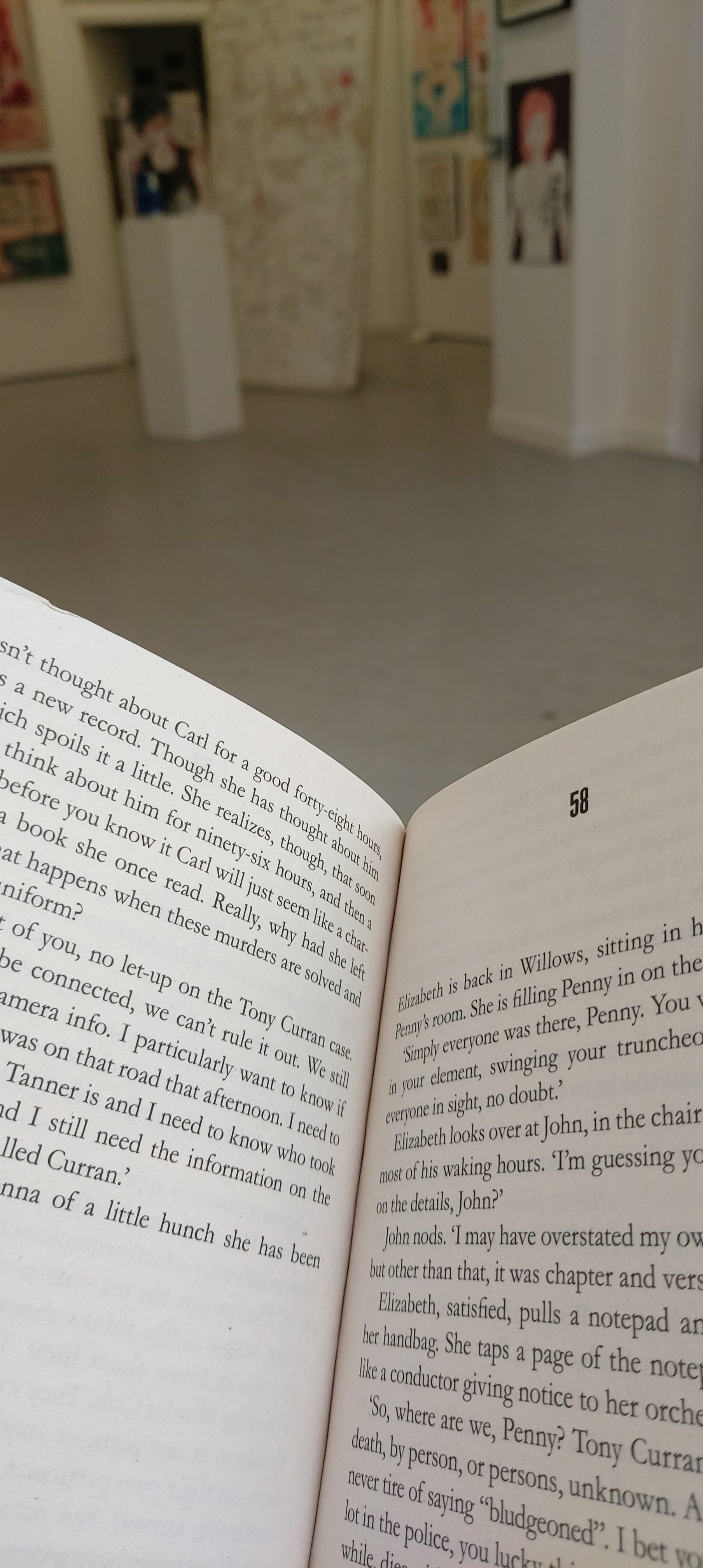
I’d brought with me the Richard Osman bestseller The Thursday Murder Club. It had been sitting in my bag for a long time, and by last week, I’d reached the halfway stage. With a combination of a long bus journey and quiet conditions at Saltspace, I was down to the last few pages by Saturday evening, then I finished it on Sunday.

I also promised my pal I’d dash off a quick clerihew in honour of the event:

Funeral for My Deadname.
I hereby proclaim,
announce and swear
that a change is in the air.

Packed Up and Sent Away

About a week before the deadline, I learnt that the Traverse Theatre in Glasgow and had an open call for stage play submissions of at least 50 minutes. I already had a piece that fitted the criteria and was in a nearly-finished state, but I hadn’t touched it for many months.

So I hurriedly began work, giving it a once-over for any obvious errors, then restructuring where necessary. My usual way of approaching this is to read the entire script out loud, as this highlights any flaws more clearly than simply reading it over. There were parts that I felt could be beefed up, events that could be clarified or simplified, and even some instances when a character’s former name had accidentally been retained.

As much as I wanted to send it off straight away, I left it for a day or two. Coming back to it after that period lets you more easily spot mistakes that slipped past the first time. Once I was satisfied that the script was as ship-shape as it could be within the timescale available, I sent it in.

This is the first piece of work I’ve submitted for a long time. It’s been such a while that I’ve cleared the rest of my submissions tracker on the assumption that if I haven’t heard back from the listed publishers by now, I never will. It’ll be a nine-month wait before I hear back about this play, during which time I can’t send it anywhere else.

I stopped submitting short stories and poems to allow me to work on longer-form pieces, but now I’ve been working on these longer ones, it’s time to start finding a home for them.

Slam Up

Having taken a break from my poetry group to join a choir, I jumped back in on Thursday. The Wyverns meet up every month to give each other feedback on our latest work. In my absence, they’d acquired a new member and set up a Twitter account.

The great strength of the group is the freedom to write in your own style. One member tends towards long and thin poems; another usually has a political undertone; a third normally writes no more than ten lines. I aim to produce something original for each meeting.

This month, one of our suggested prompts was ‘memory’. I received positive feedback from the piece, with one commenting that it had more impact when read aloud instead of on the page, although it wasn’t specifically written for either page or stage.

Speaking of performance poetry, however, I had the opportunity to watch the Scottish Slam Championship in Glasgow yesterday. The participants are all winners of other slams that took place around the country over the last twelve months.

Unlike a rap battle, as seen in the film 8 Mile, these performers don’t go head to head. Instead, they’re each allowed to perform two pieces for up to three minutes apiece in front of a panel of judges. The three who score the most combined points for their poems – four if there’s a tie – then perform another one. The best one of those is invited to the Poetry World Series in Paris.

Robin Cairns is the perennial host of the Scottish Slam, this year introducing more than a dozen contenders covering all manner of subjects, including mental health, feminism, self-worth and many stations in between. Each was so strong so that a clear winner wasn’t evident to me; however, the judges awarded most points to Calum Rodger, so he’ll be heading to France in May.

One of the other poets that particularly inspired me was Gray Crosbie, who talked about struggling to find a gender-neutral barber. I already had a poem with a related theme, but I’d left it aside months ago as it wasn’t working out as I intended.

As I sat on the bus home, I rewrote it in around an hour, and this time I’m much happier with the result.