AMENDED Review of the Freewrite by Astrohaus.

Freewrite croppedImagine if a writer like Ernest Hemingway was reanimated and thrust into today’s world. Chances are that he would see a computer and recognise the QUERTY keyboard as it’s very similar to a typewriter, then figure out that the words appear on a TV screen instead of paper.

And like a typewriter, the Freewrite aims to do one task and do it well: to allow a writer to record words electronically without being distracted by the Internet or the many options of a word processing application.

I was an early backer of the project; as such, Astrohaus sent my unit last week. Having had time to evaluate its features, here are my conclusions.


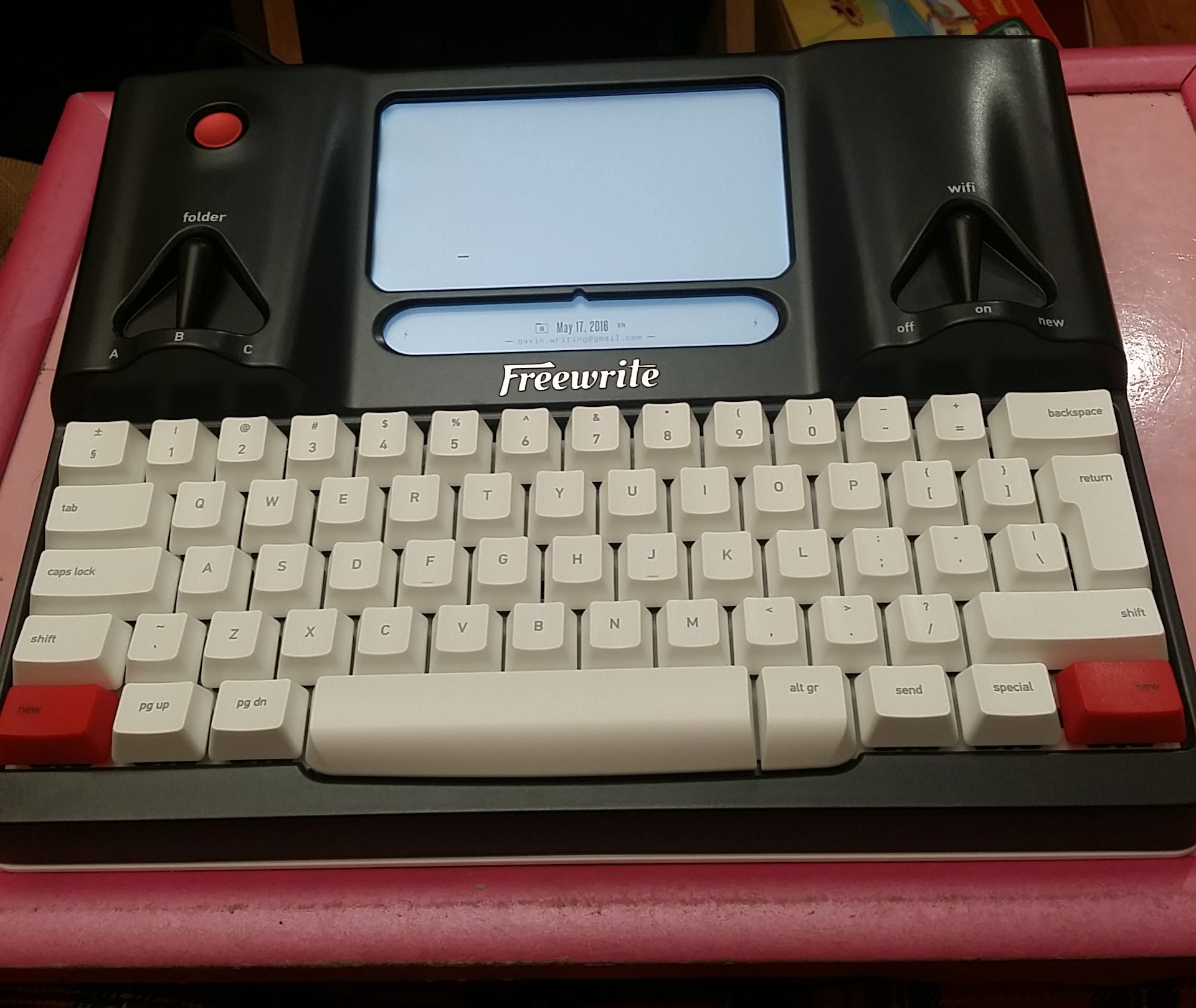
The Freewrite is a sturdy beast weighing about 4lbs. There is no mouse, touchpad or touchscreen facility. Instead, you use the keyboard for almost every feature.

Unlike a modern laptop, the keys will last longer, being a chunky Cherry design reminscient of the BBC Microsystem. They make a satisfying clackety-clack, although this also makes it too loud to use in an average library. Like a typewriter, there are also no arrow keys, only a Backspace button, plus Pg Up and Pg Dn to view previous work without editing it. It’s ideal for the writer who wants to force him- or herself to write words without worrying about editing them.

Aside from the power key, there are two washing-machine-style switches: one controls the wi-fi – to back up only, not to surf the Web – and the other selects a folder so the writer can work on up to three documents concurrently. The screen is e-ink, the same technology used in a black-and-white Kindle. While a valuable battery-saver, it does take a little time to become accustomed to the inherent technical delay betwen pressing a key and seeing the character on-screen.

But the Freewrite does, in some ways, feel like a prototype that’s not quite ready for mass-production.

Consider the Send button, which instantly e-mails you a copy of what you’re writing. Nestled between Alt Gr and Special, it’s far too easy to hit it inadvertently and find multiple drafts in your inbox unexpectedly. The user also needs to press two buttons together to start a new note. Perhaps a similar approach to Send would save these accidental messages.

As I’m British, I chose the ISO keyboard, although an ANSI version is available. That might explain why the Alt Gr button acts so inconsistently. Hold it and type ‘abcdef’ and it should show ‘攢ðeđ’, but sometimes it shows nothing, and there’s no apparant explanation.

AMENDED CONTENT: In the first version of this entry, I said I was also baffled why it’s so difficult to use multiple cloud services simultaneously; the Freewrite currently supports Dropbox, Evernote, and Google Drive. I use them for different purposes: the former for local document backup, the latter for online-only or collaborative documents, and the other for short reminders. However, Astrohaus responded to me that in Advanced Settings, folders A, B and C can be mapped accordingly.

I’m also unable to edit any Evernote notes, as I’m told it’s ‘created in another application’. I’m aware this is the fault of Evernote, not Astrohaus.

It is possible to map individual folders through the online interface Postbox, but once it’s mapped – even in error – it’s apparantly impossible to disconnect the folder unless you delete it. Can’t someone be allowed to correct a potential mistake?

I would also care to see less overall reliance on Postbox; a basic setting such as font size, for starters, ought to be adjustable on the unit itself rather than through the Web. Every time the writer needs to use Postbox, it’s through a browser, and there’s a potential to be distracted – the very factor the Freewrite is trying to eliminate. It should only be neccessary to use a browser for retrieving backed-up files. The Special key is currently used only to scroll through display options. Any additional features could easily be accessed by using a Special+[button] combination.

There’s a further opportunity being wasted here as well: to bring the whole experience offline if the writer chooses. The Send button might be given a secondary function of sending a draft directly to a printer, and/or backing up onto a USB stick.

I’ve been struggling a little with the battery too. The Freewrite doesn’t seem to charge unless it’s switched off; other devices will charge while you’re using them, albeit more slowly. A percentage indicator showing the remaining power should be a given.


For all the negative points identified, I’m nonetheless convinced the Freewrite does the one thing it set out to do and does it well: provide a distraction-free writing experience. I’m typing this entry on the machine, and I’m finding it’s already forcing me to change my style. If I notice a mistake earlier on, I’ve been making a note in square brackets, eg, [two paras up, correct ‘sending’], then moving on.

It’s worth remembering that even large companies don’t always hit the mark with a new product. Early adopters of the iPhone will remember the major flaws that took a couple of versions to iron out. Similarly, the first Freewrite firmware update might solve some of the issues.

I’m confident the next generation will feel less like a proof of concept and more like a replacement laptop for the serious writer, but you can buy a good Windows PC for much less than the Freewrite’s $598 (£413) price-tag. The question is whether Astrohaus can capitalise on its unique selling point and convince writers that their flagship product is the better investment.

Further character reference.

Regular readers will know I’m a big advocate of walking to help with thinking through plot problems or generating story ideas, and those who tuned in to the last entry will have seen my discussion about character.

Yesterday, and the week before that, I went to a couple of car boot sales. This isn’t an unusual thing for me to do on a Sunday, even if the weather is rarely so warm, but I’d never before considered what a rich place it is for character study.

English: Car boot sale at Apsley.
“How much for this?” “That’s a pound, love. Never been used.” “I’ll give you 50p for it.”  (Photo credit: Wikipedia)

Have a look at what’s laid out and make up a back story about the reason for the sale. If a stallholder has a lot of mismatched crockery, is it from a house move? Perhaps there are a lot of records because someone has grown out of them? Then you can begin to extrapolate further, especially if you have a chance to listen in on part of their conversation.

For example, let’s say someone has a lot of signs containing inspirational quotes and is bragging about her children”s exam results. Perhaps she has so many that the time has come to sell any duplicates. Perhaps she compulsively collects them because she has low self-esteem. Perhaps she has low self-esteem because she’s always been told she’s a failure, and now relies on her children’s achievements to make her feel worthwhile. And bingo: you have a character.

I’ll also give you a real-life example of a man who sold wooden objects such as tables and bird boxes. His craftsmanship was excellent, but he would finish each one with a horrible orange-brown paint, ruining the aesthetic. Perhaps he does this because his eyesight is beginning to fail and he thinks the colour looks fine? Perhaps he’s in denial and won’t see an optician? Perhaps he constantly bumps into people and blames the other party for not paying attention? And bingo: another character.

From there, we have a story. Perhaps our craftsman bumps into the woman with low self-esteem at a car boot sale and blames her for not looking where she’s going? Maybe they start talking and find out they both love gardening? Could the story end with them moving in together on condition that he changes the colour of his creations?

Character reference.

As a writer, I often think I should denounce television and sell my set. I could easily live without watching the box again, and use the time to read stories and work on my own novels.

But on the other hand, I’ve now watched every episode of Fargo season one, and Inspector Montalbano and The Young Montalbano – collectively cited hereafter as Montalbano . In their individual ways, these programmes can teach a writer some valuable skills.

In Fargo, we have distinctive characters. Lorne Malvo, the controlled and self-assured lone wolf who often speaks in allegory. His demeanour directly contrasts with the nervous and uncertain Lester Nygaard who constantly stumbles over his speech. They’re being pursued by the two police chiefs in Bemidji and Duluth, who believe they’re superior both in rank and intellect.

Braun HF 1 television receiver, Germany, 1958
Braun HF 1 television receiver, Germany, 1958 (Photo credit: Wikipedia)

It’s therefore difficult to mistake one character for another. As such, each earns his or her place in the story. Incidentally, I found it impossible to unravel the formula behind the Fargo screenplay.

Montalbano also has well-drawn characters, but its formula is more obvious when you watch a number of episodes in succession. At the start, the inspector will probably be woken by a phone call; halfway through, a Mafia connection might be made; at the end, it’s likely the suspect will confess then commit suicide. There are a dozen additional common plot points.

This description makes the show sound formulaic, and it is, but formulae exist because audiences react well to them. The writer’s job is to work with the formula in such a way that the structure becomes nearly invisible. In the case of Montalbano it took a good few episodes to see the commonalities. I haven’t read the Andrea Camilleri source novels, but I expect they’re similar.

While we’re here, let’s take a moment to look at so-called reality shows, such as The Only Way Is Essex or The Hills. There is still a formula at work, but the writers approach it in a different way. It’s a technique that was shown to me by a drama teacher long before either of these shows were made.

Instead of a word-for-word script, the cast are told what the scene will be. Each actor is then given a card with his or her individual motivation that the others don’t know, and any information that needs to be dropped into the conversation. This produces dialogue that’s much closer to natural speech than a traditional script, especially if there’s an argument in the scene. The structure for the complete programme is still under the control of the writers.

From these TV programmes, we have masterclasses in structure and character. These are two considerations that have helped me redraft one of my novels that simply wasn’t working.

The first thing I did was to cull some characters. The protagonist worked with five people, and now works with three; his partner’s sister was only there to look at the protagonist disapprovingly, so she’s now been cut out.

Secondly, the structure simply wasn’t working, particularly towards the end. As it’s an adventure story, I looked up possible structures and found one called the Monomyth, a more detailed version of the three-act structure. By following this and using my own variations as the plot demanded, I now have a structure I’m happy with.

Caption man.

On Friday night, I was invited out to play what was described as ‘a writing game’. Faced with this offer, most normal people would perhaps turn it down; writers, on the other hand, are not normal people.

It was arranged by a friend of a friend and we met in a hotel bar. I was expecting it to be like a writing class, where the leader gives you a prompt – perhaps six words, or a fragment of speech, or an old photograph – and you have five or 10 minutes to write down a passage inspired by it.

Instead, we played a game of Dixit, which I hadn’t heard about before. The rules are hard to grasp at first, but they become more obvious once you see a round played. I won’t go into all the instructions and caveats, but here they are in a nutshell:

You’re dealt six cards, each containing an illustration, and you have to think of a caption for it. The other players then have to guess which card was yours by the caption you gave it. If everyone guesses or nobody guesses, you don’t score any points; but if some players guess, you do.

Who Moved My Cheese?
Who Moved My Cheese? (Photo credit: Wikipedia)

It’s a tricky balancing act between not describing the card as it is, but not being so obscure that nobody understands it. For example, I received a card depicting a maze with butterflies around it. If I’d been asked to describe this card to someone, that’s very much what I would have said. But to prevent the other players from getting too easily, I gave it the caption Who Moved My Cheese? after the business book of the same name, featuring mice who live in a maze. As it happens, none of the other players had heard of the book, so nobody guessed it.

This is a principle that also applies to writing. I recently read the PD James novel The Children of Men, and I was disappointed by how often the author spelt out details that could have been shown through characters’ actions.

On the other hand, I can recall several anthologies where their respective editors seemed to equate vagueness with literary worth. The stories would have a set-up, a change, then would end with insufficient details so the reader had no idea how the situation was resolved. Even stories with an open ending will generally provide enough clues for the reader to imagine which way it went once the narrative stops. I refer you to the ending of The Day of the Triffids.

Only a few writers can get away with an unexplained ending, such as the Monty Python team, whose sketches would end abru

Speak now, or forever hold your piece.

Last week, a friend asked me to give him feedback on a piece he’d written and performed to camera. As he’s not yet ready to go public with it, let’s call him Jack.

I would have given him honest feedback if it had been no good; I don’t think it helps to give praise unduly. I listened to it a few times to determine whether it stood up to repeated listenings, and to listen carefully to the words and their meanings. I concluded it was almost ready for a live audience, and I gave him tips about how it might be improved.

It’s hard to define performance poetry. Some pieces work equally as well on the page as on the stage. Spoken word also falls somewhere between rap and stand-up comedy. Rap generally relies on wordplay and repetition, while stand-up is often infused with the comic’s personal experience, and both elements can be present in performance poetry.

While I don’t have a catch-all answer, there were three elements in Jack’s piece that – in my opinion – made it suitable for performance.

Firstly, he started with a strong image and good use of internal alliteration. The first line alone revolved around ‘L’ and ‘T’ sounds. As we moved on, we began to hear more alliteration, plus complex and slant rhymes.

English: Eminem performing at the DJ hero part...
English: Eminem performing at the DJ hero party with D12 on June 1, 2009 (Photo credit: Wikipedia)

A great example comes from the Eminem track Stan. This video starts at lines where the rapper has stacked up the ‘ee’ sounds of ‘dream’, ‘sleep’ and ‘scream’, but the piece as a whole is largely lines of a regular length with an often-slant AABB rhyme scheme. You can see this when the lyrics are written on the page.

Secondly, Jack took his opening lines and repeated them near the end, although not verbatim. This type of repetition can be vital tool in performance, as it helps to cement ideas in the mind of the audience.

More regular repetition can be used to create an onomatopoeic effect, but be sure to do it consciously, as random repetition can sometimes feel as though the poet is trying to pad out the words. I can think of two great examples. The first piece is safe for work: Francesca Beard with The Fluffy Song, with a reputation helps bring out the voice of the eponymous dog. The second piece is decidedly NSFW: John Cooper Clarke performing Evidently Chickentown, where the swearing lends the effect of a hen clucking.

Thirdly, Jack’s voice in the video infused the piece with a different slant benefit had been read on the page. It wasn’t in his normal register, but reminded me of Murray Lachlan Young: rich and defined with an intentionally snobbish undercurrent.

Of course, anyone who reads a performance piece will bring something to it. Andrea Gibson is quite the opposite of Young, packing a lot into a poem and rattling through it with barely any time for breath. There’s no wrong way of performing, as long as you aren’t forcing yourself to do something unnatural.

When Jack is ready to go public with his work, I’ll post it here and I’m sure you’ll see what I mean.


And now we wait.

Between my MLitt essay and the EP, my submissions to publishers had been put on hold. Now I have the time to submit material, I’m sharply reminded of how slow the process can often be, and it’s the exceptions that prove the rule.

I submitted to two places that said they would give a response within approximately two days, and they both kept their respective promises. But because they’ve been so quick, it makes the other two seem painfully slow as I won’t hear from them for between two and six months.

It’s common to find publishers that use Submittable, a website that provides a semi-standard way of submitting work and tracking your correspondence. I rather like doing it this way.

Where paper reincarnation happens

For instance, I’ve had to send in a query to an editor as two of my pieces have been outstanding for six months with nothing more than an acknowledgement. However, if I don’t receive a response in a reasonable timescale, Submittable allows you to withdraw your work.

I also like the ability to attach Word or PDF documents, or whichever format the publisher wants. It’s a personal view, but I dislike having to paste my work into the body of an e-mail. Many writers use Word or Scrivener, or a number of other programs. Whenever you copy from a program, the formatting often goes pear-shaped after pasting. When pasting into Gmail, I sometimes find the line spacing changes to 1.5 and can’t be altered, or the font changes and can’t be harmonised. Ctrl+Shift+V will paste the text without formatting, but you then have to reinsert any bold or italics, or unusual spacing.

Another pet hate is a requirement to submit by post. The cost of postage is an irritation, although my main concern is how much paper must be wasted in the process, as editors select only a fraction of the material submitted. It seems an archaic practice in the age of electronic communication. If I ever have to print a document and notice a mistake, I keep it in a folder so I can print on the blank side in the future. Any paper that can’t be reused goes into the house recycling bin.

While I’m waiting for responses, I would like to know why publishers ask for copy-and-paste or postal submissions. Is there a compelling reason why these practices still happen?

A favour from the blogosphere.

[EDIT 2022-10-18: This entry is from 2016, and the domains below are now either inactive or no longer function as intended.]

Hark – an unscheduled entry!

Yesterday, I launched The Purple Spotlights EP with its bespoke domain name. However, it’s come to my attention that not everyone seems able to access the link. I think I’ve figured out the problem now, but I need to test it. To this end, I need a small favour.

When you click http://purplespotlights.com, it should redirect to https://gcameronwriting.wordpress.com/the-purple-spotlights-ep/. There might be a short delay while this happens.

Let me know whether everything’s hunky-dory for you, or if it won’t load.

In which I launch my spoken word recording, The Purple Spotlights EP.

I’m today launching my debut spoken word recording, The Purple Spotlights EP, featuring four poems on the theme of friendship: some long-term and certain, others transient and complex. It’s available from on 7 DigitalAmazoniTunes and Spotify, and many other outlets. Head to PurpleSpotlights.com for samples.

Although I started as a prose writer, I soon built up a collection of poems. Some of these run to more than 100 lines and many publishers will not accept work of this length, so an audio recording seemed the ideal format. In February, I attended a masterclass in Edinburgh with professional performance poets, and that prompted me to turn the idea into a reality.

The Purple Spotlights EP cover
Created by Isaac Lemon at http://www.lemon-drop.co.uk

I expected the distribution to be difficult and making the recordings to be simple. I’ve talked before about my previous interest in radio and music production, so I drew on some of that experience. However, the production was tricky as the microphone picks up a lot of unwanted noise that needed to be removed.

I’ve also previously discussed my lack of design skills, so I knew I would need assistance with the cover. After some research, I discovered Isaac Lemon here on WordPress, and he’s since moved to Lemon Drop. He quickly created the striking mountains design, which looks fantastic next to other recordings.

One of the few disadvantages of releasing work online is that there’s no physical product to sell at live gigs. However, if The Purple Spotlights EP proves a success in the long run, I would consider making it available on CD, as an e-book, or as a paper pamphlet.

But until that happens, go and tell all your friends. Heck, even tell your enemies. I’ll be performing tracks from the EP at a few gigs this month:

The league of extraordinary books.

I was recently given the book Never Let Me Go by Kazuo Ishiguro. I never normally hurry through books, but I enjoyed this one so much – despite a few plot holes – that I finished it in 48 hours.

It’s usually an annoyance when I know an author is withholding information, but Ishiguro has the main character Kathy drip-feed us as she remembers. At times, it was hard to remember there’s a male author behind the words, as her voice is spot-on.

At some point during this 48 hours, I decided to contact the author to give my thoughts. Here’s where I hit a wall. He has an official Facebook profile, but my message was rather long and few people on the site read lengthy posts. There was also a danger that it would be buried under other comments. So I decided to look for an e-mail address.

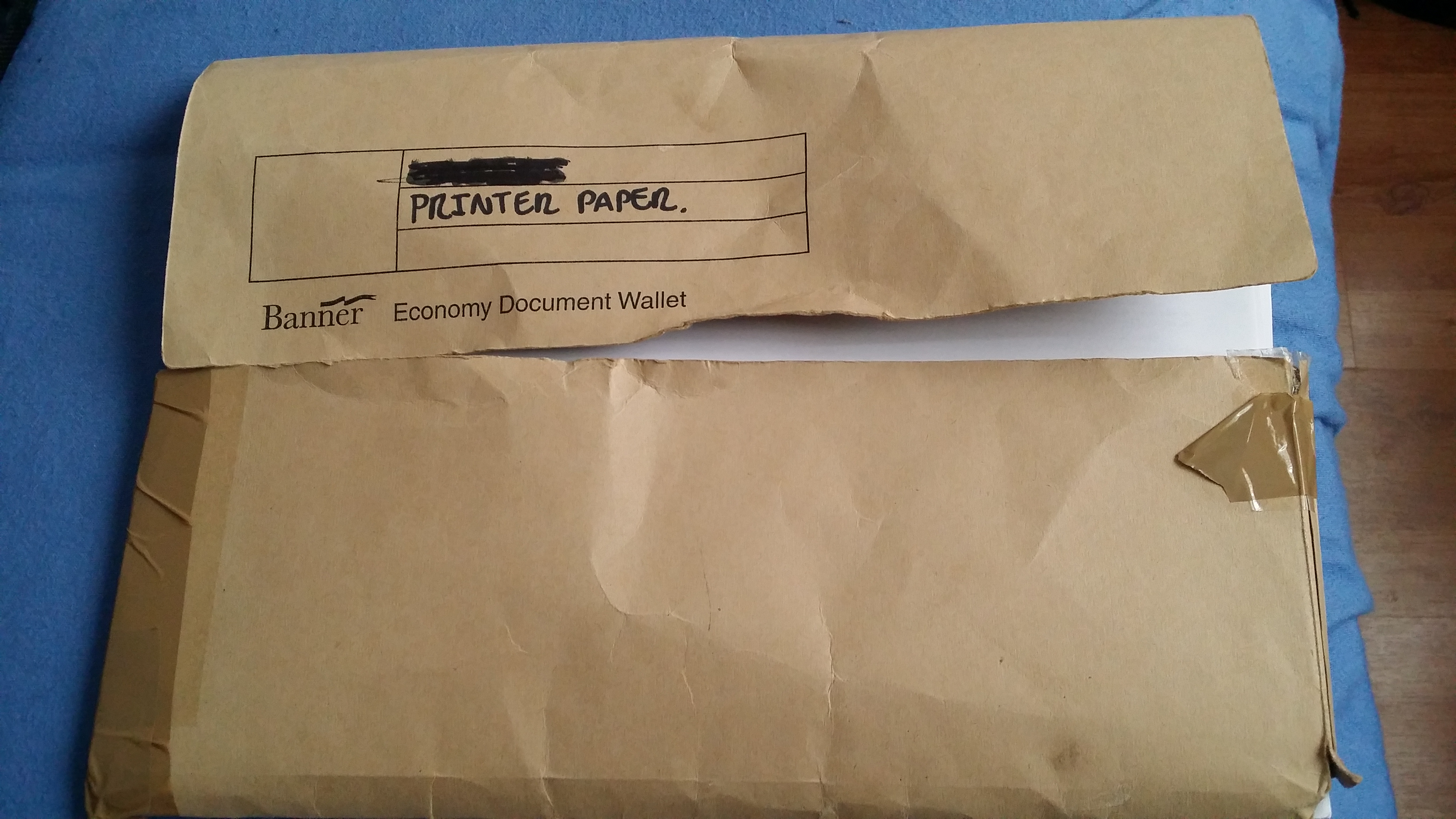
The e-mail address on his profile, however, was for Random House, but the book was published by Faber & Faber. So I visited the publisher’s website and looked for an official way to contact Ishiguro. Rather quaintly, Faber & Faber insist that readers must contact their authors by post. The picture shows my envelope ready to be posted.image

Yet as I was writing, I realised the power of a physical letter. As more communication becomes electronic, it becomes harder to ignore the few envelopes dropping through your door, just as receiving an e-mail in the late 1990s would have stood out a mile.

The last time I really enjoyed a book, it was The House That Groaned by Karrie Fransman. Some of the twists actually made me gasp out loud, and she incrementally sets up the explosive ending throughout the story, but the reader only snaps together the pieces in the last few pages. I sent her a Twitter message to say I’d enjoyed it so much I’d finished the whole thing in one sitting.

There was a chance she might not have seen this message among tons of others, or she could have easily forgotten about it. However, Fransman did reply, and wisely took the opportunity to tell me about her next book Death of the Artist. Incidentally, I spoke to her briefly at a launch of Death of the Artist, and she jokingly told me not to finish it in one sitting as her books take so long to craft.

I’m always upfront in saying I’m not a lifelong writer, at least not of fiction and poetry. So when I read Starter for Ten by David Nicholls, it didn’t occur to me to write to him. You might know it from the inferior 2006 film.

There’s a chance I enjoyed this book so much because it’s set in a university, and either I was coming to the end of my first time in tertiary education or had recently graduated – I can’t remember which. But even aside from that, the main character Brian Jackson is someone who’s oblivious of his own stupidity, yet painted in such a way that the reader can’t help but feel sorry for him. Indeed, it’s one of the few books I’ve read twice.

Alas, I’m unable to write to the author of my final extraordinary book as Ella Cheever Thayer died in 1925. Her 1880 novel Wired Love was a real eye-opener for me. It tells the story of a young telegraph operator called Nattie Rogers who begins chatting to a mysterious male operator at another station and develops a crush on him. Just like today’s online dating, Nattie reads his messages and tries to second-guess what he really means and wants.

The novel also feels contemporary with its proto-feminist feel. Throughout the story, Nattie remains the one in control of the relationship. All the main characters are female too, with the men portrayed as slightly dimwitted, though both genders appear to run the telegraph network on an equal footing.

The best part is that the novel is now in the public domain so can be read free of charge as an e-book. This website provides more analysis and links to the book.

Stepping off the train.

From 2002 to 2005, I lived and studied in Paisley, a 20-minute train trip from Glasgow. Last weekend, I had the opportunity to revisit the town for the first time in at least a couple of years.

Throughout the journey, I began to remember snippets from my life there: familiar landmarks; songs I associate with the place; even which train would stop at which platform. At my destination, I could have gone to any number of places and they would’ve triggered other memories: the stalag-style residences with the hilarious security guard; the club we visited on Student Sunday; the computer labs where we played Gaia Online all night; the locations where we shot films for the course; ex-partners’ houses where we argued. Maybe.

But as I had limited time, I could only visit the student union, a purple building with a concrete and aluminium interior. The place you went when you didn’t want to spend very much; where we went in for the weekly quiz, karaoke and pool tournament; where I ran a juggling club; where someone stole a dozen bottles and dropped them when one of the bar staff slapped him.

Before I become too self-indulgent, my point is that revisiting a familiar place can trigger off a lot of memories and potential story ideas. I would have found it rather difficult to compile the above lists when I wasn’t physically in the location. Yet if I’d had more time in Paisley, I could’ve filled half a notebook with recollections.

Long-term readers will also know I’m a big advocate of walking anywhere. The physical act of bipedal locomotion is a fantastic way to sort out your thoughts and solve plot problems.

If you have the opportunity to revisit an old haunt, I recommend doing it. When you see a familiar place, or a gap where a building used to be, it can bring to mind details that you might not have remembered otherwise. That memory might become your next plotline. Don’t forget your notepad and a pencil.