The C-Word.

I’ve seen Chris Brookmyre twice already, and tonight was my third time. I’m a big fan of his work after All Fun and Games Until Somebody Loses an Eye, and most recently, a signed copy of Flesh Wounds. Tonight, he was promoting Bedlam, which also has his autograph.

Brookmyre does not fit the stereotype of the introverted author, much like the late Iain Banks, whom I had the privilege of seeing twice. Rather, Brookmyre takes centre stage and spills out anecdotes full of swearing. He’s so well known for it that he’s now been forced to apologise in advance. Indeed, the first time I saw the guy, he read out an e-mail he’d received by a previous organiser, effectively banning him from appearing several years ago.

Tonight, he brought along a guest. Barry Phillips started a parody blog of a local footballer and found it attracted the attention of readers around the world. Now he’s written a book called The Tartan Special One about a 17-year-old who is snapped up by Dundee FC. I don’t follow the game, and I didn’t buy a copy tonight, but it still appeals to me so I might so do in the future.

I’ve started back at two writing classes: a short course in fiction run by published author Zöe Venditozzi, and Level 2 of the Life Writing course at the University of Dundee. A couple of new people have joined us, one of them from Life Writing, and she says she’s having trouble thinking of ideas for passages in the five- to ten-minute exercises we’re given in class.

By coincidence, I was discussing this issue with one of the other short course stalwarts earlier the same evening. We realised we’re so used to thinking on our feet that we don’t even hesitate over it any more. But when we began in 2011, it would be tiring trying to think of stories.

Most of our Life Writing class knew each other from Level 1, and we really bonded over this week’s homework, which was to write a summary of our life, then pick one part and make it into a vignette. The ideas for this class also come to me rather quickly, and I can sometimes think of one before I’m on the bus home.


Finally, I didn’t realise until tonight that there’s a reminder feature on WordPress. If you want to post at least once a week, or once a month, it’ll send you an e-mail.
Frm Tlgrph to Txt.

Every so often, some newspaper or another carries a report on the declining literacy standards of young people, usually focussing the blame on text message speak. I’m not worried about this happening. To illustrate my point, let’s have a look at how txt spk originated. The first SMS was sent on 3 December 1992 by Neil Papworth, who used a PC to send the message Merry Christmas to Richard Jarvis from Vodafone. The message didn’t receive a reply because no phone was capable of it.

220px-Telephone-keypad
All right, Nokia fans. Get ready to drool.

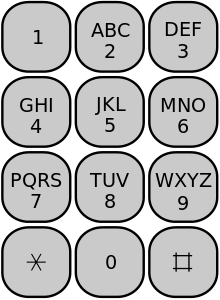
But that problem was solved the following year using a method that already existed. Certainly in the UK, phone number pads were already marked with letters as an aide mémoire when calling other towns and cities, and it’s very similar to the layout of a modern mobile. Codes are no longer assigned like this, yet if you remove the 01 from many modern area codes, you can often guess the original mnemonic. Perth is 01738, equating to 01-PET; while Hastings is 01424, probably resolving to 01-HAI. It’s an efficient system when encoding a very short message such as the codename of a city, however it becomes more cumbersome with a more complex message.

A simple question such as Where are you, John? could become a nightmare to tap out, as you would need to press extra buttons to write a capital W and J, while the first two letters of you need three presses each. That’s not even mentioning the comma or question mark, both of which could be buried in a sub-menu. No wonder people would write whr r u john, reducing button pushes to 22, assuming one press of the 0 or 1 key acts as the space-bar. That’s just over the 20 required to spell the full message on a standard keyboard.

The boffins have improved mobile input since then, at first with T9 predictive text, and now with touch-screen QWERTY keyboards. So too with text messages. By habit, people still shorten messages and miss out punctuation for brevity. Sometimes it can be a challenge to read, but the brain is particularly good at filling in blanks. In fact, the creators of Teeline shorthand knew this back in 1968, and their system removes the internal vowels from most words.

It’s worth noting that the QWERTY layout is a historical hangover too: a deliberately inefficient design intended to slow down typists and stop the first typewriters from jamming. Yet it still endures even although jams were eventually almost eliminated, and other layouts made available, such as Dvorak, which I generally use. So if QWERTY is still around, why am I not worried about txt spk being with us for the long term? Because we’ve been here before, and it wasn’t even within living memory.

When the telegraph was introduced in the mid-1850s, its pricing model was pay-per-word, so people naturally wanted to communicate as cheaply as possible. Businesses quickly learnt to abbreviate sentences into single words, and enterprising authors also wrote code books for the general public. Here is a wonderful example of where a sender has encoded the important points of a shipping accident into just five words. I’ll bet that in the latter half of the 19th century, people thought all communication would end up being that way. For instance, there is a novel from 1880 called Wired Love: A Romance of Dots and Dashes [CONTAINS SPOILERS] about a couple who meet via telegraph. And yet, despite the subject matter, the description is rich and colourful, just like the majority of documents from the period.

In short, so to speak, text messages are still brief because of old technology, and telegraph messages were brief for cost reasons. But proper English as a whole was not greatly affected by telegraphy in the late 1800s, despite its popularity, and that’s why I doubt it’ll be killed off by cellular telephony in this era, the early 2000s.

Three Good Apples and a Lemon.

I’ve read a number of books this year, and the majority of them were well worth it, including the classics The Day of The Triffids and Breakfast at Tiffany’s. So I’ve only selected a few notable ones for this entry. The links go to Amazon, but to paraphrase the BBC disclaimer, other websites are available.

My choice of lemon proves the idiom that you shouldn’t judge a book by its cover. Crawling Round South Oakwood by Stephen Slaughter has amazing artwork, with the words in the title becoming more and more blurred as the rows of pint glasses become emptier and emptier. I thought a story about a group of friends going on pub crawls would be a sure-fire winner.

How wrong could I be? The book seems to be a first draft, going into such minutiae as the details of the TV programme the group watches, and their exact route to the pub. Later in the book, a fight breaks out between the group members, yet no tension is shown to have built up in any other part of the book. I finished it, but I was disappointed.

Now let’s look at what went well. The Dog Stars by Peter Heller had an arresting concept. In a post-apocalyptic world, Hig and Bangley are survivors. The former owns a small plane with enough fuel for years of short reconnaissance missions. When he picks up a long-range radio transmission, he is determined to find its source, but it means using up all his fuel without enough for a return trip.

As well as the immediate problems, it explores the philosophical differences between Hig and Bangley. One asks questions then shoots, the other takes the opposite approach. I also like that the author doesn’t write needless pages dwelling on the causes of the apocalypse, but shows it throughout the story.

I was fortunate to see Iain (M) Banks at two live events before hearing of his illness and death this year. He didn’t fit the stereotype of the introvert writer mumbling answers to questions. Rather, he made a short speech then actively encouraged the audience to join in.

I haven’t read any of his science fiction, although I hear it’s excellent. Having read The Wasp Factory after his first appearance, I then tackled The Crow Road. I have two criticisms about the book: that the flashbacks aren’t as clearly marked as they could be, and some of the writing isn’t as tight as it could be, but once you become accustomed to it, you really believe in those characters and their views on life, as Prentice tries to piece together his family secrets.

I’ve also seen another Scottish author at live events, Chris Brookmyre, who signed my copy of Flesh Wounds. Like Banks, he’s very confident in front of an audience, his main topic discussing the merits of the phrase, “Taking a s***”

As in The Crow Road, the flashbacks are a little confusing, and the Glasgow dialect can be a little alienating. But it’s the attention to detail in a many-stranded story that really drives it forward. I really ought to read more of his novels, as the only other one I’ve tackled is All Fun and Games Until Somebody Loses an Eye.

But if I was giving out awards for the best book I’d read this year, it would have to go to Layer Cake by J J Connolly, only £1 from a charity shop. As Flesh Wounds is set firmly in Glasgow, this is set in London, and the first-person narrator sprinkles in some Cockney rhyming slang, often without explanation. A, “Mars bar,” for instance is a scar, but it took me a few pages before I realised this.

My enjoyment wasn’t dampened in any way by the Daniel Craig film, in fact they complement each other, sharing several direct quotes. It’s difficult to judge the unnamed narrator for dealing drugs because he has the attitude of a businessman, just one whose activities are illegal. As he sees it: “Until Prohibition ends, make hay whilst the sun shines.”

I hope to read many more excellent books next year.

The Real Slim Shady.

Recently, an editor accidentally sent me some documents with my legal name in the byline. It was half my fault for not making it clear enough, but it brought home just how important it is to separate the two.

I started using my pseudonym before I took up writing. Until recently, I presented a show on hospital radio and promoted my middle to my last name, becoming Gavin Cameron. It sounds clearer through a microphone than my actual name Gavin Cruickshank, and more people know how to pronounce the written form correctly.

Let me point out that this was before David Cameron was elected. Despite the connections, it’s proved useful in writing because I work full-time and it helps keep a clear separation between the two.

I do think that if a writer uses a pen name, for whatever reason, he or she should inhabit the name and adopt the character. I occasionally read authors introducing themselves as, for instance, John Smith writing as Joe Public. Why craft a pen name if you’re going to break the illusion? I did it in this entry purely to demonstrate a point, but in a book or story, I would never explain Gavin Cruickshank writing as Gavin Cameron.

But I can think of one person who has done this successfully, and with a double pseudonym. Rapper Marshall Mathers goes by the stage name Eminem, but refers to himself as Slim Shady in his music. When you’re listening to his albums, he does it so naturally that you simply don’t question it.

I don’t think Mathers/Eminem/Shady reads this blog, but if he does, well done those men.

More E-Rejection™ Slips.

A couple of months ago, I discussed the content of rejection slips, or their modern electronic equivalent, which I’ve dubbed E-Rejection™ slips. In that entry, I discussed the feedback to one of my stories, The Strange Case of Mr Brown. I felt the editors had missed the point of the story by their response.

Last weekend, I received another E-Rejection™ from a local publication, and the sender told me that one of the two pieces had been discussed until a late stage in the decision making process, but both had ultimately been refused. That piece was The Strange Case of Mr Brown.

The latest slip didn’t provide any other information about either piece, but I had faith in Mr Brown. It’s written from the point of view of a lawyer in the late 1800s, so it has a certain period style that needs to be believable but understandable to a 21st century audience.

Yet there is such a fine line between self-belief and self-delusion, and not just in writing. It’s terrifically difficult to judge yourself honestly. Just look at the singers on talent shows who are so convinced they’re the next big thing while missing every note.

I’ve considered the question of how to decide whether your self-belief is justified or not. There is probably no single good way, but it’s worth examining any recurring themes in your feedback. If editors or reviewers have different negative comments to make, you probably haven’t made a complete hash of it. But if they all focus in on one or two negative aspects, then there’s a chance you need to put it more work.

One recurring theme I find is that editors like my writing style, but feel that the plot never took off. That often spurs me on to add twists that I otherwise wouldn’t have felt the need to include.

But if you have a better way of using feedback to your advantage, I’d like to hear it.

You’re The Voice, Try and Understand It.

Earlier this week, I read out a new story, which is still at the stage of the first draft. When I was finished, I was told, “That wasn’t in your usual voice.” I was so pleased, I nearly shouted, “Yesss,” while pulling down an imaginary chain with one hand.

In my short writing career, I’ve developed the view that nobody necessarily has to find their own voice. To some people, it is important to write in a particular fashion, but I contest that everyone is capable of having more than one voice if they want to. I reckon you can pen ten stories in ten unique voices.

I’ve previously talked about how crime writer P D James wrote the science fiction novel Children of Men at the age of 70. Allow me to offer another example, this time from Hollywood, that illustrates my point. You could never mistake the musical Hairspray for black comedy Serial Mom, yet John Waters was behind both of them.

Changing your voice can be as simple as altering the words or the punctuation. For example, two of my own hallmarks are that I rarely go to town on description, and never use brackets. I could alter that by describing something in vivid detail, (adding extra information in parentheses). Done often enough, it would sound like somebody else.

So why not find out if you can write like someone else, but say your own thing? If you’re stuck, here’s a prompt I’ve had in my head over the last week:

Two friends are in a café or a pub. One of them leaves for a lengthy pre-arranged appointment, but returns a short while later. What has happened?

The End of Days.

I know you can’t see me, but I’m blowing a whistle as we speak, indicating the final dying minutes of National Novel Writing Month. I breached the 50,000-word target by only 29 words; that’s 13 less than my very first novel in 2010.

Last year’s total was 60,000 and I’d barely scratched the surface, but this time around, I don’t have the material to go much higher, so I’m happy with my haul. Many congratulations if you’ve also hit the benchmark.

My aim is for this to be the last time I bore you with this subject for the next eleven months.

I’ve been to a number of literary events this week, including a fiction writing and a life writing class, and I’m pleased to say I’m enrolled in the continuation class for the latter.

On Thursday, I attended a literary salon where I heard current English students read out their best pieces. Then on Friday, a poetry and cabaret event. A number of pieces were in the Dundee dialect, which must have confused the last act, a songwriter from New Orleans.

I’ve lived in the city most of my life and understand most of the vernacular, yet I’ve never naturally spoken it. It inspired me to write a poem exploring the theme, and I completed it before the event ended. I’m not known as a poet, and I’m not at the stage where I would describe myself as one, but I have been dabbling in the form.

I’ve also been working on another piece, but I need to give you a bit of background. If you didn’t know, I’ve only been a writer since October 2010. To put that in context, I was 27 when I wrote a fictional story for the first time since high school. The piece was that first NaNo novel.

However, when I was at school, I fancied myself as a singer-songwriter, not to mention an actor. I’d tried to write song lyrics, and I recently rediscovered a four-line fragment with two internal rhymes. Moreover, I can still remember the tune, and the words still resonate as much now as they did then.

At the time, I tried to expand it by writing extra verses, but nothing seemed to work until I turned to Google+ earlier this week. With the help of a community, I preserved the rhyme scheme but expanded the number of syllables, and I’ve now squeezed nearly four verses out of it. If I keep making progress, I finally hope to perform it on December 9th after all these years.

After a conversation with my former NaNo Municipal Liaison a couple of weeks ago, I raked out my school qualifications. I’d correctly remembered I’d earned only a C for English, although I have criticisms about the way it was taught. Perhaps that’s why I never pursued it, or perhaps I was too fixated on music to realise my strength was in words, not instruments.

I’ve got to make up for the time I wasted setting up blogs writing factual events without realising that I was able to write fiction. I kick myself every day about my late start, although I take some comfort from the careers of Barbara Taylor Bradford and Richard Adams. Their first books weren’t published until they were over 40 and over 50 respectively.

But I need to work fast if I want to reach a state of parity. I want to reach the point where I’ve produced as much work as if I’d started as a teenager. I have around 200 pieces in total, but that could have been 1,000 if I’d begun at age 15.

I won’t rest until I’m satisfied I’ve made up for every minute of wasted time.

The N-Word.

I’ve a feeling you’re getting sick of me talking about National Novel Writing Month, so I’ll devote only one paragraph to it. To date, my total is 48,711 words, meaning less than 1,300 to go until I hit the target. I have until Saturday to complete it, leaving plenty of time.

I’ve been going to two other classes at the same time, and I seem to be going through a rather philosophical patch as I complete their respective homework.

Class one is Life Writing at the University of Dundee. Our homework is to write a short passage about our lives each week, all focussing on a particular aspect of writing, which might be the use of the child or adult voice, or employing the past or present tense. This week was a little different, where we were asked to choose an abstract noun and write a piece around that theme. Mine was On Solitude, arguing that this is not the same as loneliness.

Number two is my regular writing class with Zöe Venditozzi, held at a new, secret location. One of the prompts led me to write about a floating island and the ideological arguments its inhabitants had when setting up their community. The other is about twins with wildly different reactions: one is always brutally honest, while the other goes into denial when he hears bad news.

Also, my second published story is currently being launched in Australia as part of the FourW Twenty-Four anthology. The Wagga Wagga and Melbourne events have taken place, but the Sydney launch happens this Saturday 30 November. It’s impractical for me to attend as I’m halfway around the world, but if you live there, pop along and let me know what it’s like.

NaNoWriMo and Other Stories.

Just a quick update to say I’m still alive, but I’m not only taking part in NaNoWriMo, but homework for two other writing classes as well. As you might imagine, this is keeping me jolly busy.

With 33% of the time elapsed, I had reached half of my target of 50,000 words. I think be able to match the target, but not beat it, so I’ve been taking it slightly easier. At a day over the halfway mark, I now have around 33,000 words.

But I’ve also had time to visit the cinema. Last week, I saw Gravity, although I felt that because Sandra Bullock and George Clooney are such famous faces, it distracted somewhat from the story. Yet it remains an excellent film, with the action of Apollo 13 set to the backdrop of 2001: A Space Odyssey.

And today, I attended a free screening of The Girl with the Dragon Tattoo, in Swedish with English subtitles. I enjoyed this for its captivating story, even if it becomes a little muddy towards the end, and I hear it’s much better than the English-language remake. I’ve no current plans to read the book but if I have a chance, I’ll give it a look.

So hope you reach the end of NaNo in one piece, and any other writing projects you may have on the go. I’ll update again when I have the chance, which I hope will be the day I hit the target.

NaNoWriMo: One Week In.

If Bridget Jones had inhabited me in a Quantum Leap style. I’d say I was typing out a v. v. quick update on my National Novel Writing Month process.

I have a very organised Municipal Liaison, or ML, who gives us writing space in a friary. While I’m not religious by any measure, the calm, quiet sanctity of the place is very conducive to writing.

But equally, so is a certain coffee shop in the town centre, where I tried writing on Sunday. A friend happened to be in the area, and she forced me to go to the pub across the road and drink red wine – forced, no less – leaving me 2,000 short of my intended target.

Despite this small setback, I still bagged a mammoth weekend total. The daily target is an average of 1,667 words, which equates to 11,669 on the seventh day. As of last night, I’ve banged out 12,539. I’m just about to start hacking away at today’s total.

If you should like to follow me on the NaNo website, please do so. It’s helpful if you can also send me a message saying you saw it here so I know where you’ve found my profile.