Your 30-Minute Trial

I’m working on an MLitt dissertation at the moment, among other projects, and this has left me little time to compose an entry.

In lieu of a proper entry, here’s an activity:

  1. Find a book you wouldn’t normally touch, or that you’re unsure about.
  2. Set a timer for 30 minutes.
  3. Read as much of the book as possible in that time.
  4. If you find you like it when the timer sounds, keep on reading. If not, leave it there.
  5. Let us know how you found the experience.

Reaction … Times

Two of the biggest stories of last month were the Orlando shooting and the UK’s exit from the European Union. In their individual ways, they’ve brought responses from writers and poets trying to process the news. Brian Bilston is a prominent example: he usually has a verse within a day or two that reacts to the issue in hand.

However, there is sometimes a balance to be struck between capturing the immediate mood and waiting to see the aftermath of the event. The former can be excellent for capturing the raw emotion upon hearing the news; yet the latter can become a carefully constructed piece that comments on what happened next and whether or not correct actions were taken.

Let’s take the EU exit as an example. If you penned a piece on 24 June, it might talk about David Cameron’s resignation and the sterling exchange rate hitting such a low, and it would almost certainly have an emotional resonance but only a few details of the bigger picture. Conversely, if you wrote that piece tonight, it’s possible to include something about the legal wrangling and the resignations, but it could potentially lose its immediacy.

There’s also the trap of writing about something is a massive story right now but will potentially be forgotten or overtaken by other developments. We all remember issues like Bill Clinton’s affair, Section 28, and the millennium bug, but none of these cases hold currency now. It’s a personal view, but if the background of a work needs to be explained before it’s read, I don’t consider it successful.

Emergency exit sign used in the European Union...
Emergency exit sign. There’s not much more I can say about this. (Photo credit: Wikipedia)

There’s no easy way to swerve these problems. The best advice I can offer is to write it when you feel ready. With Orlando, the shooting seemed rather abstract and far away at first, but I went to a vigil on the following Tuesday. I intended to stay only five minutes, then leave. I ended up staying a lot longer, and only a day or two later was I able to formulate a poetic response to the events.

The quest for immediacy is aided by the advances in communication over the last few decades to the extent that non-journalists can report on events if they happen to be in the vicinity. But there is a movement that wants to recapture the benefit of hindsight. Delayed Gratification isn’t interested in stories newer than three months. The magazine likes to look back and examine what happened in detail when the breath has gone cold. Considering the quoted praise from other news agencies, it looks like they’re onto a winner with this business model.

And I wonder whether we can use this approach for fiction? Might there be a gap in the market for a magazine that prints creative responses to world events three months on? It seems an ideal length of time to me: enough for the writer to construct and edit a decent-sized piece, but not so long that it’s completely out of the public’s consciousness. If there’s anyone who seriously thinks this is a good idea, let’s talk.

Right to Resubmit

On 26 June, I received an e-mail from Strange Musings Press saying they were to close and that the rights from the stories they’d published would immediately revert back to their respective authors. This frees up my short story Amending Diabolical Acronym Misuse, which appears in their Alternate Hilarities anthology.

It isn’t well known,  even among authors, that once a piece is published, the publisher usually only holds the rights to it for a fixed period of time before said rights revert back to the writer. Some publishers accept reprints, and some original publishers insist that you credit that publication before it’s placed in a second home. It’s a good idea to credit the original publisher anyway, even if it isn’t insisted upon.

By now, it’s probably safe to resubmit my other two published stories, though I would still check the small print if I still have it, or e-mail the editors if I don’t. While it’s impossible to say how an individual editor feels, I know I’d be more inclined to accept a story if I knew it had been published before; a phenomenon known as the halo effect.

In the longer term, an author can retain copyright for a whole lifetime plus 70 years after death, which is why it’s so important to leave a will.

Charlie and the Chocolate Factory (soundtrack)
Charlie and the Chocolate Factory (soundtrack) (Photo credit: Wikipedia)

In 1971, Roald Dahl’s novel Charlie and the Chocolate Factory was made into the film Willy Wonka and the Chocolate Factory, starring Gene Wilder. The author was so displeased that he specified in his will that its sequel Charlie and the Glass Elevator must not be made into a screenplay.

However, this didn’t prevent the 2005 remake starring Johnny Depp, which included some elements of the sequel. It will be interesting to see what happens when the novel falls into the public domain in the second half of this century as anyone will be able to use the work without charge. The question is whether people will still respect Dahl’s wishes at that point.

Writing to 10 of My Greatest Influences

Regular readers will know that a few months ago, I wrote a letter to Kazuo Ishiguro after reading his book Never Let Me Go. I did it because his publisher didn’t provide anything but a postal address for its authors.

To date, Ishiguro has not replied, but I was itching to repeat the experiment with others I admire. It’s a slower and more laborious process that makes you think about every word you write. Yet the sealed envelope is far more difficult to ignore, and your words don’t become just another comment on another social media page.

With this in mind, I’ve tried to emulate the pre-Internet and pre-fax era as much as possible, a time when celebrities felt more removed from their audiences. I’m lucky enough to have mutual friends with a few popular performance poets who influence me. I’ve excluded them because they feel too ‘close’, even though we don’t know each other directly.

There’s one important concession to the old-school vibe: it would create a lot of hassle to find out the postal address of agents, management companies or publishers in an offline manner. I therefore set a rule that I was allowed to use the Web for the task, but I wasn’t permitted to contact anyone to ask for the correct details. I instead used the most likely addresses I could find.

So who are the top 10? I’ve listed them in no special order:

  1. Andrea Gibson – performance poet
  2. Peter Doherty – musician and poet
  3. Marshall Mathers – rapper, aka Eminem
  4. Mike Skinner – rapper
  5. David Nicholls – novelist
  6. Tracey Thorn – musician in Everything but the Girl
  7. Jasper Carrott – comedian
  8. Billy Joel – musician
  9. & 10. Harley Alexander-Sule & Jordan Stephens – musicians in Rizzle Kicks

It took under an hour to collate most of the addresses. However, I counted six contacts for Marshall Mathers alone as he has a number of specialist managers, so I settled for writing to his agent. Conversely, Peter Doherty proved über-difficult to pin down. My initial searches pulled up a management company in the West of Scotland; later searches provided a much more likely address.

But finding the contact details was only the start. Before I uncapped my Biro, there were other issues I wanted to iron out.

  • Firstly, should I use my pen name? A pen name would allow the recipients to look me up online should they choose, whereas using my legal name would ensure that any reply is correctly delivered. I decided from the start I wouldn’t include an e-mail address to maintain the pre-Internet feel – though I can be easily contacted via this site – so I’ve compromised by including my legal name in the address, but explaining in the body of the letter that I write as Gavin Cameron.
  • Secondly, what about the content of the letters? Naturally, this had to be customised to the recipient, but the text can be broadly divided into three sections. In the first, what I enjoy about their work or views; the second explains why I’m writing by hand rather than doing it online; the third is a summing-up and best wishes. I haven’t asked for an autograph, a photo, or even a reply; I wanted the letters to be mainly about the recipient and his or her influence, without me being too much of a fangirl.
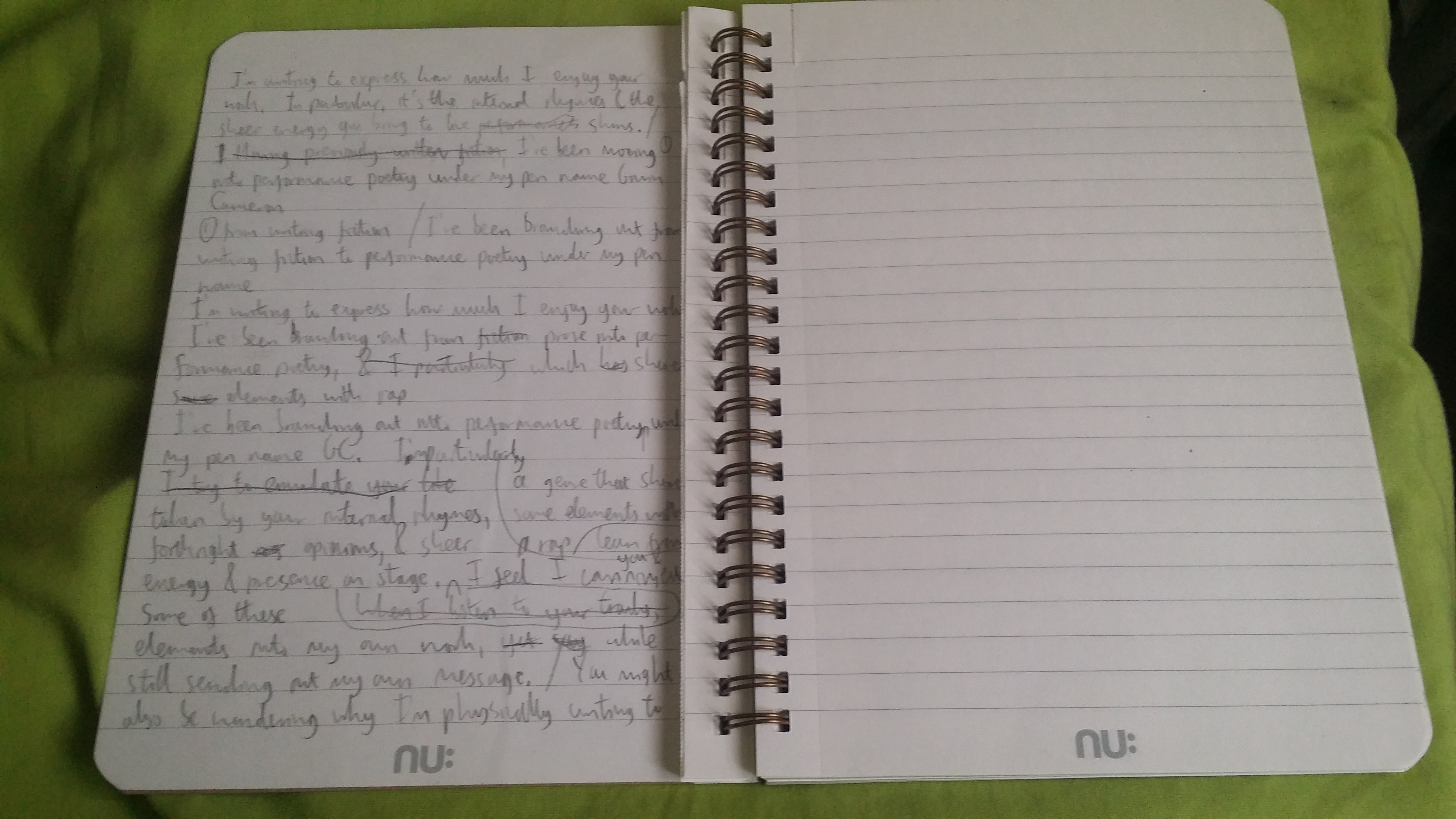
  • Thirdly, do I publish any replies? I quickly decided that would be a negatory, rubber duck, other than to provide a brief summary in a future blog entry. It’s not that I think any of the recipients would mind, but because personal letter-writing is an inherently private activity, I would rather the recipients kept my correspondence confidential, although there is a sample in the picture and it’s ultimately their decision as I haven’t specified I want it kept secret.

    Notebook with tear-out pages for writing to celebrities
    Notebook with tear-out pages for writing to celebrities

So how did I feel when I put pen to paper? I knew I would have to develop a template of sorts as it’s far easier than starting from a blank page. I first drafted the Marshall Mathers letter (pictured), then copied it onto writing paper in pen. Even with my preparations, I found it difficult at first to place my thoughts in a flowing order.

Probably the easiest letter to write was that to Andrea Gibson, which ran to three A5 pages with my signature on the fourth. I found once I’d started that I had loads I wanted to say, and I acknowledged at the end that if I’d been using a PC, I would have edited much of the ramble. I could have started a new letter, but I felt it wouldn’t have been so candid as it was in that first form.

If I did make a mistake in a word, I would simply cross it out and write it again. It didn’t occur to me until I’d sealed the envelopes that Tippex still exists. I’m glad I didn’t realise this, though, as it wouldn’t have looked pretty on the cream page.

The hardest letters were probably those to Jasper Carrott and Billy Joel. I imagine it’s because they influenced me more in my childhood than they currently do. But I’m glad I still wrote to them because I might not repeat this experiment, and none of us will be around forever.

The one thing I didn’t find intimidating at all was the level of fame my recipients enjoy. I’m currently taking the MLitt course at the University of Dundee. There, I was introduced to the concept of thinking about where I fit in with other writers and poets, including those who are well-known. So rather than considering yourself to be lower down the food chain, you’re encouraged to ponder whether you’re producing your own work to an equal standard, and how you can raise your standard if you’re not. Or in Internet jargon, MIND=BLOWN.

Thinking in those terms helped to relieve the pressure. I know I can produce work to the same standard of some of the folks I’ve contacted, and I also know I can pick holes in their work just as much as they could potentially rip mine apart. So in that respect, I’m a person doing one creative activity who’s writing to a person who does another creative activity, not a ‘civilian’ writing to a ‘celebrity’.

If I receive no replies, I won’t cry into my notebook, as I’ve said what I have to say. I’ll be happy if I attract one response; I’ll be ecstatic if I receive two; goodness knows what I’ll be like if three or more come back.

Now all I need to do is what writers do best: wait.

What If This Entry Had Never Been Written?

In September 2002, I left home for the first time to study at the University of the West of Scotland. After matriculation, I met a fellow student called Billy, and we decided to head to the student union. In those days, you received your first student loan tranche by cheque on matriculation day, then the rest by bank transfer at the start of each term.

As Billy and I passed my bank, I realised I’d forgotten to pick up said cheque. I had two main options:

  1. Head back to the university, collect it, then join him later.
  2. Continue to the union and collect it later or the next day.

I chose the first. I don’t recall taking too long, but when I arrived at the union, I couldn’t find Billy. In fact, I never saw him again. I don’t know why we didn’t swap phone numbers at the bank.

But what if I’d chosen the second option? We might have had a few drinks then went our separate ways, or we might have become firm friends and been inseparable for the rest of our respective courses.

This decision therefore created a point of diversions where one sequence of events happened because of an action, and another sequence of events didn’t happen thanks to the same action. In real life, we can’t know what might have occurred if the other decision were made, but we can make logical assumptions in fiction to produce an alternative narrative.

Sliding Doors
Sliding Doors (Photo credit: Wikipedia)

The most famous example might be the 1998 film Sliding Doors. Gwyneth Paltrow’s character Helen Quilley catches a train in one narrative, but misses the train in the other. This creates two parallel but separate universes where two stories play out.

The technique also works in novels. In Fatherland, Robert Harris explores what might have happened in the event of a German win at the end of World War II. The Difference Engine by William Gibson and Bruce Sterling imagines that Charles Babbage completed his eponymous machine and began the computer revolution much earlier than it actually happened.

I have unpublished novels that use the same alternative history technique: in one, men are extinct by the 26th century; in another, the petrol engine isn’t invented until 1999. I’m editing a third at the moment that takes the Sliding Doors approach towards the end. I’ve had to work out a way to show this without confusing the reader, and my current solution is to label the chapters so there will be one Chapter 13, followed by a Chapter 14A then a Chapter 14B.

Will it work? Only time will tell.

Accidental Acquisition

If there’s one thing that keeps me awake at night, it’s subconscious plagiarism. It was reported this week that Ed Sheeran is being sued by two songwriters as he allegedly copied their work, and it’s always in the back of my mind that however original I think I am, there’s a chance I’ve accidentally remembered words from elsewhere.

At its most extreme, it can leave a person’s reputation damaged. In 2015, poet Sheree Mack was accused by some of ‘wholesale plagiarism’ of other poets’ work, although she denied it was deliberate.

But if you like another poet’s work, there are legitimate ways to reference them.

Writing After, then naming the poet

It’s a convention in poetry that you can credit someone else using this format. Let’s say I wanted to credit a certain political poet from the 1980s, I might write:

Nigel at B&Q
After Attila the Stockbroker

Nigel wants to go to B&Q,
but there’s Isis fighters all round the bathroom department.
Nigel doesn’t like Isis fighters.

Bear in mind this is not a licence to copy that poet word for word; you should be responding to their work, updating it, making your own interpretation, &c.

English: Attila the Stockbroker, taken in the ...
English: Attila the Stockbroker, taken in the Cabaret Tent at the 2010 Glastonbury Festival (Photo credit: Wikipedia)

Using a title

In the majority of cases, it’s all right to use a title, particularly if the word can be found in a dictionary. A quick look at Wikipedia offers a whole list of instances of the title Life.

However, be wary if the title is very distinctive, as it can seem as though you’re capitalising on the other person’s success. If you used the title Evidently Chickentown but your work was completely different, a lot of John Cooper Clarke fans would be unhappy.

Imitating a structure

Unless a structure is so closely associated with one particular poet, it’s fair game to emulate a structure as long as you’re saying your own thing. When I wrote Purple, I was going through a Luke Wright phase, so I borrowed the structure of Bloody Hell, It’s Barbara for the last section:

Excerpt from Purple

You’re always dressed in gingham checks
and Oakley specs, and round your neck
those headphones: Oh, I do love Beck.
Large as life, it’s you.

Here, the words are totally different from Wright’s, but would fit a similar metrical pattern.

General themes and ideas

Many people are familiar with the Allen Ginsberg poem Howl and the Gil Scott Heron track The Revolution Will Not Be Televised. The two works touch upon the same themes: disaffected youth, race relations, rebellion, &c. Both also make heavy use of repetition.

It is possible that Scott Heron was influenced by Ginsberg, as his work was written 15 years later, but despite the described similarities, there is no way that one could be accused of copying the other.

Where in the World?

On Friday, WordPress told me my viewing stats were going through the roof, with 30 views in one hour. A closer inspection showed that these views came from Pakistan; what’s more they all appeared to originate from the same person.

The Islamic Republic of Pakistan was formed in 1947 and has a population of 199,000,000. Its official language is Urdu, with more than a dozen recognised regional languages, none of which are English.

So I’m curious to know what someone from this country would gain from my writings, when I speak only English and come from a culture with such different values. Or perhaps my mystery visitor is a British expat, or simply wanted an insight into my world.

If you are, or you know, the person in question, do leave a comment below or e-mail purple@gavincameron.co.uk.

Keeping on Track

It’s great having a polished story or poem ready to be sent to a publisher or entered into a competition, but then comes the difficult part: waiting for a response. Often it takes months, sometimes it takes weeks, and a select bunch answer in a few days. This is unavoidable.

But here’s what separates a beginner from a seasoned pro: the former often sits and waits for a response, while the latter almost always uses the time to work on another piece. It’s desirable to build up a portfolio because many publishers, and almost all competitions, say you can’t send the same piece to two or more different places simultaneously.

Novel submissions are different in this respect. Most agents recognise that a book is an all-consuming work, and that it could be sent to a number of other places. It’s good practice to inform the other agents if one takes it on.

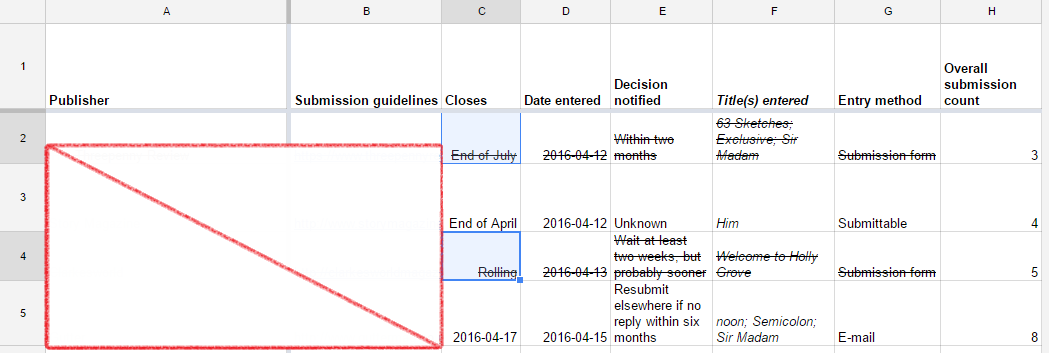
Whichever situation you’re in, it’s important to keep track of what you’ve submitted to where. It might be a simple as keeping a list if you’ve only a few pieces, but I have dozens in different places, so I use a spreadsheet to record the details:

Submissions tracker

I’ve edited out the names of the publishers and the links to their submission guidelines as I might want to resubmit in the future. The last column keeps track of how many pieces I’ve sent out during the year. My target is at least one piece per week on average; I have a poet friend whose target is an average of at least one piece per day. Otherwise, the tracker is self-explanatory.


It’s also important to keep track of what you’ve had published. These appear on another spreadsheet, and I keep the manuscripts in their own directory.

In many cases, the rights revert back to the author after a period of around six months to a year, so the same piece could potentially be sent to another publisher further down the line. If you’re unsure, ask the editor.

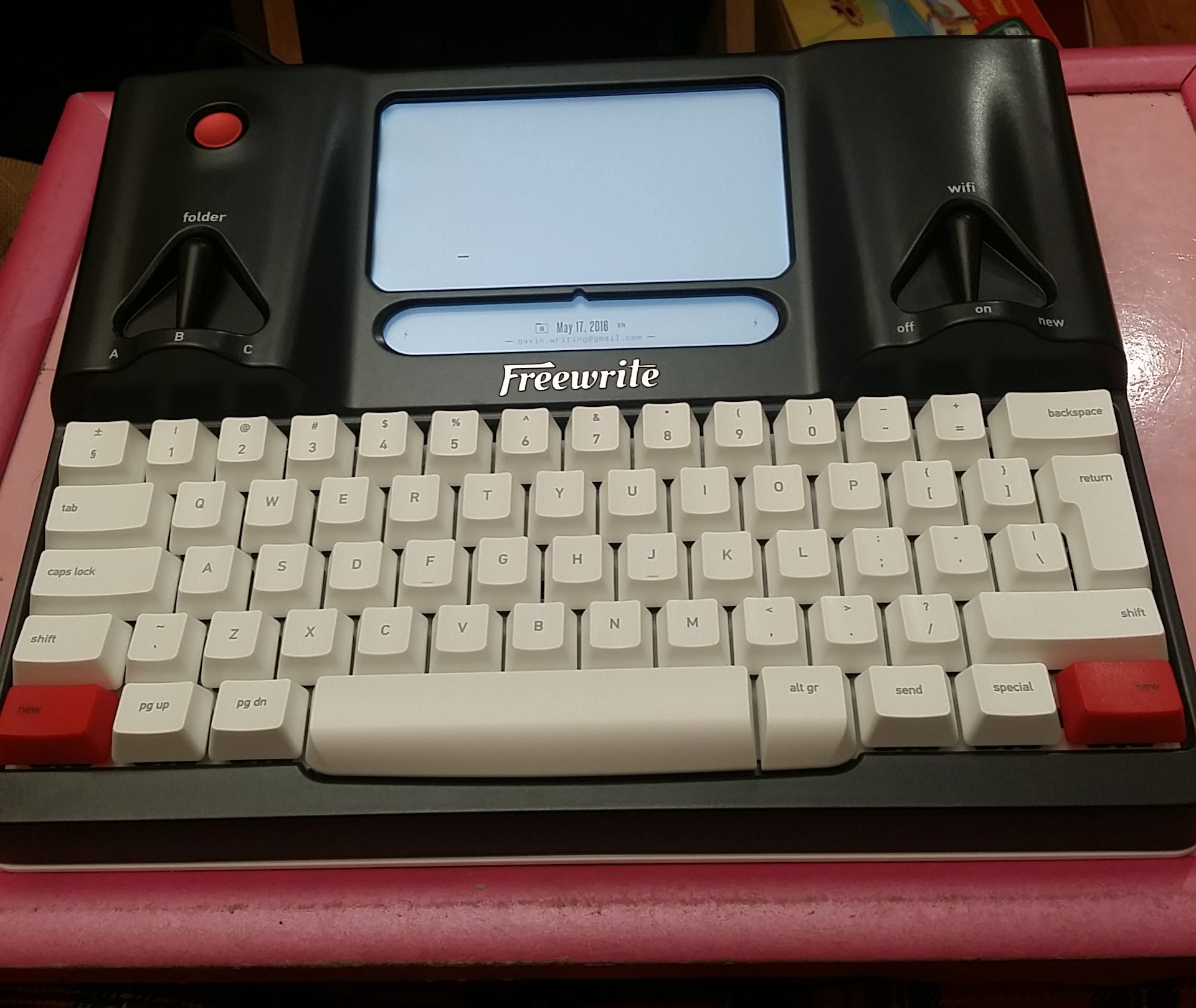
AMENDED Review of the Freewrite by Astrohaus.

Freewrite croppedImagine if a writer like Ernest Hemingway was reanimated and thrust into today’s world. Chances are that he would see a computer and recognise the QUERTY keyboard as it’s very similar to a typewriter, then figure out that the words appear on a TV screen instead of paper.

And like a typewriter, the Freewrite aims to do one task and do it well: to allow a writer to record words electronically without being distracted by the Internet or the many options of a word processing application.

I was an early backer of the project; as such, Astrohaus sent my unit last week. Having had time to evaluate its features, here are my conclusions.


The Freewrite is a sturdy beast weighing about 4lbs. There is no mouse, touchpad or touchscreen facility. Instead, you use the keyboard for almost every feature.

Unlike a modern laptop, the keys will last longer, being a chunky Cherry design reminscient of the BBC Microsystem. They make a satisfying clackety-clack, although this also makes it too loud to use in an average library. Like a typewriter, there are also no arrow keys, only a Backspace button, plus Pg Up and Pg Dn to view previous work without editing it. It’s ideal for the writer who wants to force him- or herself to write words without worrying about editing them.

Aside from the power key, there are two washing-machine-style switches: one controls the wi-fi – to back up only, not to surf the Web – and the other selects a folder so the writer can work on up to three documents concurrently. The screen is e-ink, the same technology used in a black-and-white Kindle. While a valuable battery-saver, it does take a little time to become accustomed to the inherent technical delay betwen pressing a key and seeing the character on-screen.

But the Freewrite does, in some ways, feel like a prototype that’s not quite ready for mass-production.

Consider the Send button, which instantly e-mails you a copy of what you’re writing. Nestled between Alt Gr and Special, it’s far too easy to hit it inadvertently and find multiple drafts in your inbox unexpectedly. The user also needs to press two buttons together to start a new note. Perhaps a similar approach to Send would save these accidental messages.

As I’m British, I chose the ISO keyboard, although an ANSI version is available. That might explain why the Alt Gr button acts so inconsistently. Hold it and type ‘abcdef’ and it should show ‘攢ðeđ’, but sometimes it shows nothing, and there’s no apparant explanation.

AMENDED CONTENT: In the first version of this entry, I said I was also baffled why it’s so difficult to use multiple cloud services simultaneously; the Freewrite currently supports Dropbox, Evernote, and Google Drive. I use them for different purposes: the former for local document backup, the latter for online-only or collaborative documents, and the other for short reminders. However, Astrohaus responded to me that in Advanced Settings, folders A, B and C can be mapped accordingly.

I’m also unable to edit any Evernote notes, as I’m told it’s ‘created in another application’. I’m aware this is the fault of Evernote, not Astrohaus.

It is possible to map individual folders through the online interface Postbox, but once it’s mapped – even in error – it’s apparantly impossible to disconnect the folder unless you delete it. Can’t someone be allowed to correct a potential mistake?

I would also care to see less overall reliance on Postbox; a basic setting such as font size, for starters, ought to be adjustable on the unit itself rather than through the Web. Every time the writer needs to use Postbox, it’s through a browser, and there’s a potential to be distracted – the very factor the Freewrite is trying to eliminate. It should only be neccessary to use a browser for retrieving backed-up files. The Special key is currently used only to scroll through display options. Any additional features could easily be accessed by using a Special+[button] combination.

There’s a further opportunity being wasted here as well: to bring the whole experience offline if the writer chooses. The Send button might be given a secondary function of sending a draft directly to a printer, and/or backing up onto a USB stick.

I’ve been struggling a little with the battery too. The Freewrite doesn’t seem to charge unless it’s switched off; other devices will charge while you’re using them, albeit more slowly. A percentage indicator showing the remaining power should be a given.


For all the negative points identified, I’m nonetheless convinced the Freewrite does the one thing it set out to do and does it well: provide a distraction-free writing experience. I’m typing this entry on the machine, and I’m finding it’s already forcing me to change my style. If I notice a mistake earlier on, I’ve been making a note in square brackets, eg, [two paras up, correct ‘sending’], then moving on.

It’s worth remembering that even large companies don’t always hit the mark with a new product. Early adopters of the iPhone will remember the major flaws that took a couple of versions to iron out. Similarly, the first Freewrite firmware update might solve some of the issues.

I’m confident the next generation will feel less like a proof of concept and more like a replacement laptop for the serious writer, but you can buy a good Windows PC for much less than the Freewrite’s $598 (£413) price-tag. The question is whether Astrohaus can capitalise on its unique selling point and convince writers that their flagship product is the better investment.

Further character reference.

Regular readers will know I’m a big advocate of walking to help with thinking through plot problems or generating story ideas, and those who tuned in to the last entry will have seen my discussion about character.

Yesterday, and the week before that, I went to a couple of car boot sales. This isn’t an unusual thing for me to do on a Sunday, even if the weather is rarely so warm, but I’d never before considered what a rich place it is for character study.

English: Car boot sale at Apsley.
“How much for this?” “That’s a pound, love. Never been used.” “I’ll give you 50p for it.”  (Photo credit: Wikipedia)

Have a look at what’s laid out and make up a back story about the reason for the sale. If a stallholder has a lot of mismatched crockery, is it from a house move? Perhaps there are a lot of records because someone has grown out of them? Then you can begin to extrapolate further, especially if you have a chance to listen in on part of their conversation.

For example, let’s say someone has a lot of signs containing inspirational quotes and is bragging about her children”s exam results. Perhaps she has so many that the time has come to sell any duplicates. Perhaps she compulsively collects them because she has low self-esteem. Perhaps she has low self-esteem because she’s always been told she’s a failure, and now relies on her children’s achievements to make her feel worthwhile. And bingo: you have a character.

I’ll also give you a real-life example of a man who sold wooden objects such as tables and bird boxes. His craftsmanship was excellent, but he would finish each one with a horrible orange-brown paint, ruining the aesthetic. Perhaps he does this because his eyesight is beginning to fail and he thinks the colour looks fine? Perhaps he’s in denial and won’t see an optician? Perhaps he constantly bumps into people and blames the other party for not paying attention? And bingo: another character.

From there, we have a story. Perhaps our craftsman bumps into the woman with low self-esteem at a car boot sale and blames her for not looking where she’s going? Maybe they start talking and find out they both love gardening? Could the story end with them moving in together on condition that he changes the colour of his creations?