I've been writing fiction and poetry since 2010, and run two writers' groups.
This is a blog to talk about that writing, and to speak to fellow authors.
There won’t be much of an entry this week. I’m still busy chewing over the wonderful shows from Edinburgh last week; at the same time, I’m struggling to commit a couple of poems to paper.
Instead, let’s both go for a walk, albeit in different physical places. That always helps me loosen my mental sawdust, and I hope it does the same for you.
In 2016, I graduated with an MLitt Writing Practice and Study degree from the University of Dundee. At the time, I was in the mindset that I wanted to write in as many different styles and formats as possible.
This wasn’t a problem until it was time to pull together all my work into what the syllabus described as a ‘unified dissertation’. In other words, the whole document had to flow, but my pieces were too dissimilar to achieve this easily. With the help of two tutors, we eventually solved the problem, but I still didn’t like having to adopt one role or to be pushed into one pigeonhole.
I only began to change my stance earlier this year when a friend posted a video of a TED talk about sugar addiction, which inspired me to start writing a spoken-word show about the struggles I’ve had with my weight. And for the first time, I felt as though I’d found a niche that I enjoyed occupying, and that I had plenty of material to fill.
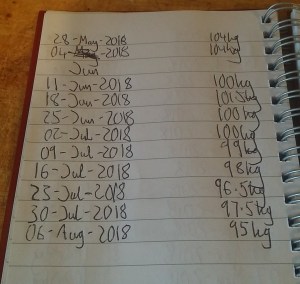
That said, I’ve lost a lot of weight since starting to write that show. This is an achievement, but I feel as though it’s defeating the point of the narrative.
Notebook in which I log my weight every week
On Saturday, I went to my first Edinburgh Fringe shows of the season, all of which reinforced my dedication to sticking with my niche for as long as it takes.
The first two were by people I know, and could only have been written by them. John McCann has a deep understanding of politics in Northern Ireland and has penned a monologue called DUPed, all about the Democratic Unionist Party. Meanwhile, Amy Gilbrook in Nutshells touches upon her experience of not fitting in. And while I don’t know Alan Bissett personally, it’s difficult to imagine anyone else emulating Moira Bell in The Moira Monologues or More Moira Monologues.
These shows are playing on selected dates throughout August.
Despite my promise to stay in a niche for the foreseeable future, I realised this week that some of my favourite novels have one thing in common. I’m attracted to those one-off stories where a sequel is unlikely because the story is so self-contained, such as A Clockwork Orange or The Bell Jar.
On Tuesday of last week, I came home to a parcel. I was only stopping for a brief time before heading out again. I didn’t pay much attention to it, as I was expecting a USB cable.
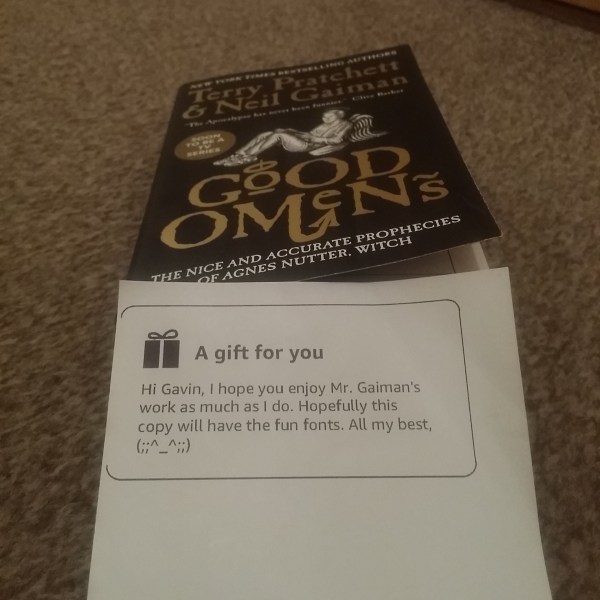
Just before leaving, I opened the parcel to check I’d received the correct equipment. So imagine my surprise when I found it actually contained the following:
Good Omens by Terry Pratchett and Neil Gaiman. There was no sender’s name, only a cat’s face made up with punctuation marks. However, it didn’t take long to trace it to an American friend. Around a week before, she’d heard the BBC radio adaptation from 2014. I’d casually mentioned I’d heard this, but hadn’t read the full novel, so she’d jumped at the chance to send it.
It was an incredibly thoughtful gift, and I’m making good progress with reading it. I’m working on what to send back as I have National Book Tokens that need to be spent before the balance expires.
Last week, I had cause to complain to my gym about the provision of a class. I found this relatively easy to compose because in my ‘day job’, I’m accustomed to handling complaints on behalf of a large organisation.
Using my experience of being on the receiving end, I’ve put together three general principles of effective complaining.
Regardless of how you feel, stick to the facts as much as possible
It is tempting to spell out exactly how angry or upset you feel, but an experienced complaint handler will look past any emotional language and find the facts of the case. If you consider that you must tell the organisation how you feel, keep it brief.
Here’s an example with too much emotion:
Your online system took three charges of £15 which meant I had to e-mail customer services and they put a stop on the order, so now my 86-year-old grandma will have to wait for her birthday present and I don’t know how long I’ll be waiting. It’s no good because now I can’t go and see her for another fortnight because I’m on holiday.
Now let’s focus on the facts:
I paid £15 for the item on 24 June, but I discovered your online system had taken this three times at 2:54pm, 2:56pm and 2:57pm. I e-mailed customer services. They put a stop on the order and advised me I would need to wait, but I don’t know how long. I need to find out because the item was supposed to be a birthday present. I’m disappointed because I regularly order from your company.
This version is more effective because we now know when the order was placed and that the customer is still waiting for the item.
If you want to find out information in your complaint, make sure you flag up your questions as clearly as possible. Consider this example:
Why do you charge as much for a cup of boiling water as you do for a coffee? I don’t know any other company that does this and I feel it’s down to greed.
The question in this version sounds rhetorical because it’s immediately followed by the customer’s own answer. It would be much stronger as:
Why do you charge as much for a cup of boiling water as you do for a coffee?
Or if you feel you need to add extra information, place the question at the end of the sentence:
I don’t know any other company that charges for a cup of boiling water, let alone as much as for a cup of coffee. Why does your company do this?
The two versions above send a strong signal to the complaint handler that this is a question to be answered.
If something is good, say so
Organisations like to hear positive reinforcement. If there is something great in an otherwise negative situation, it doesn’t weaken your complaint to point it out.
I always pop into your shop at lunchtime. It’s always busy, but only two out of the three checkouts are ever on. The staff are always helpful and friendly, but the lack of a third cashier causes long queues.
In this instance, the handler knows that the customer has nothing against the behaviour of the staff, only that there aren’t enough at lunchtime.
When you receive a reply, have a look at the wording, especially if the response is not the one you wanted. It will probably follow this structure:
Thank you for your e-mail. We’re glad to hear you enjoy shopping with us.
We would like to be able to put on all three checkouts. Unfortunately, due to staff illness, this isn’t currently possible.
However, we understand your frustration at the queues. As such, you might be interested to know that we intend to install self-service checkouts in the next few months in addition to the staffed ones we already have.
We have here a positive statement, followed by a negative one, capped off with something else positive. This structure acknowledges there is a problem but delivers the news in such a way that the customer shouldn’t feel too let down.
Last week, Creative Dundee invited me to speak at their last-ever Make / Share event, on the subject of Impostor Syndrome.
Each participant is allowed up to 7 minutes and five slides. At my first rehearsal, I hit seven minutes by the time I’d reached my second slide, so I had to cut it down substantially for the final performance, which was captured on camera:
There’s always a question and answer session at the end, during which I was quite happy to inform the audience on a number of topics.
Afterwards, I stayed behind to speak with the other participants. Someone brought up the subject of how our presentations were done. One already had it written for another event, and simply adapted it for this one; another left it until the last minute.
I began to think about how I tackle my own projects, and I realise it follows an inverted bell curve:
The left-hand side of the curve represents my keenness for a new project when I first become involved in it, while the right-hand side represents my keenness when the deadline has nearly arrived. It’s not that I necessarily lose interest in the project during the dip, but there isn’t the same flurry of activity.
Of course, no project is quite as simple as this, but it’s a good generalisation of how I operate.
Last week, I learnt that the venue we use for Hotchpotch – the spoken-word open-mike night – will be closed for refurbishment until the end of August or the beginning of September.
By Texas State Archives from Austin, Texas, USA (2001078_009_70_132_002ac) [No restrictions], via Wikimedia CommonsYou might remember three weeks ago, I spoke about the importance of keeping a kind of Cabinet office when there are difficult decisions to be made. The system definitely worked in this instance, with regular members making good suggestions about what to do next.
Within 24 hours, we’d managed to secure another bar in the city centre for this month, and potentially next. We even had an offer from another venue that we can investigate if we need to. The next Hotchpotch will now take place in the Westport Bar in Dundee on Monday 16 July at 7pm.
When travelling by rail, it’s always prudent to expect delays. In this case, another train broke down near Penrith station and the passengers on mine were allowed onto the platform while the obstruction was cleared. This gave me time to finish one of my books, but I also needed to work on a presentation.
Every month, Creative Dundee holds an event called Make / Share. This is a night where people such as designers, artists, computer programmers, or anyone who creates something, are invited to speak about their work. The next event is on Tuesday 10 July and I’ve been asked to speak on the theme of impostor syndrome.
I’m not a lifelong fiction writer and certainly not a lifelong poet, and I’ve always been upfront about this. Even so, it’s difficult not to feel an outsider when you’re among people who’ve been creating fictional universes since they were in primary school. I’ll be telling the audience about five times I felt I didn’t belong on the writing scene.
I also mentioned this a couple of weeks ago, when I appeared on The Beans Podcast. This is a weekly show compèred by my friends Valerie Mullen, Erin Farley and Sam Gonçalves. Like Make / Share, which Sam hosts, the podcast also invites creative people to give their story; indeed, it’s also worth listening to their previous episode about learning to like poetry.
But until the real writers figure out I’m one massive fraud, I’ll keep doing what I’m doing.
By the time you read this entry, I’ll be on a train between Edinburgh and Preston. It’s a long journey, so I’m going to use the time to read two borrowed books.
Derek Robertson (CC BY-SA 2.0 (https://creativecommons.org/licenses/by-sa/2.0)), via Wikimedia CommonsThe first is ‘Hong Kong’ Full Circle 1939-45 by Alexander Kennedy. The author was a lieutenant commander who had 500 copies privately published to tell the story of his service. Although it’s not something I would pick myself, I’ve flipped through some of the pages, and it promises to be an engaging story.
The second is The Lighthouse Boy by Craig Mair, about the construction of the Bell Rock Lighthouse off the coast of Arbroath. I originally intended to read the book in the town, ideally on the cliffs overlooking the water, but my plan didn’t work out. Although the overall book is a work of fiction, its characters are based on real people and the plot is based on actual events.
There used to be a Silent Reading Party nearby, modelled upon an event in New York, where readers would sit together and read silently for an hour; attendees were allowed to converse beforehand and afterward. Unfortunately, the organiser hasn’t run the parties for some months now and I have too many commitments to revive it.
I enjoyed attending because the time was specifically set aside for reading. If I’d decided to do it myself at home or even in a cafe, I would probably have become distracted, but the presence of the other attendees kept me what your organiser has focused. So I hope I’m able to employ some self-discipline on this train journey.
When you lead a group, it’s tempting to give orders and expect others to fall in line. There are situations where this is appropriate, particularly in the military.
But in a writing group, a dictatorial attitude only stirs resentments and makes people want to leave. On the other hand, discussing the matter with everyone in the group often leads to a jumble of individual opinions with no consensus. So what is a good way to make a decision on behalf of a group?
Photo: Sergeant Tom Robinson RLC/MOD [OGL (http://www.nationalarchives.gov.uk/doc/open-government-licence/version/1/)%5D, via Wikimedia CommonsIn many democracies, only a small percentage of politicians comprise the Cabinet and make most of the decisions. It’s not a perfect system, but it does reduce the number of opinions to a manageable figure, and that’s why I like keeping a group of representatives for advice.
For example, I lead the Dundee & Angus region of National Novel Writing Month. This a challenge to write a 50,000-word novel in November, and we also meet up unofficially all year round. There are 520 members who have our region as their home region, but only 1% to 2% come regularly to meetings.
Most day-to-day issues can be solved by speaking to my co-lead, yet the input of the members is particularly valuable in the months leading up to the November challenge.
In those 30 days, we’re required to arrange a launch party, a ‘Thank Goodness It’s Over’ party, and to encourage members to donate money and/or buy merchandise. On our own initiative, we arrange two meetings per week instead of the usual one, we make sure we’re contactable online and by phone, and we tell members how to protect their physical and mental health during the challenge. And on top of that, we’re all trying to reach the 50,000-word goal.
Thanks to this level of involvement with the co-lead and the active members, it’s been a joy to manage this region each year.
In April, I began to redraft a novel that I originally wrote in 2011. In the intervening years, I’ve learnt a lot more about the principles of structure and how to raise the stakes in a narrative, so I was pleased with the way the redraft was turning out.
By Tom Murphy VII [GFDL (http://www.gnu.org/copyleft/fdl.html), CC-BY-SA-3.0 (http://creativecommons.org/licenses/by-sa/3.0/) or CC BY-SA 2.0 (https://creativecommons.org/licenses/by-sa/2.0/) ] from Wikimedia CommonsHowever, there came a point where I’d pushed the main character through as many hoops as I could conceive until he’d achieved his goal. At that point, there wasn’t much to keep him from doing anything he wanted without resistance, so the narrative began to stall. At around the same time, I began to pull together a spoken-word show. I therefore made the decision to leave aside the novel, so for the last month, I’ve been concentrating on the show.
When I stop thinking about a work in progress, I find that’s the time to leave it. The novel is currently handwritten, so I’ll start typing that up once I’m finished with the show, then see where we can take the main character from there.
Other highlights this week include performing at Inky Fingers in Edinburgh on Tuesday and listening to some cracking poets, including the featured Rachel Plummer.
And on Thursday, I heard Caroline Bird performing from In These Days of Prohibition. This is the second time I’ve heard her on stage, and it was again a wonderfully absurdist experience.

![No machine-readable author provided. Adam the atom assumed (based on copyright claims). [GFDL (http://www.gnu.org/copyleft/fdl.html) or CC-BY-SA-3.0 (http://creativecommons.org/licenses/by-sa/3.0/)], via Wikimedia Commons](https://gavincameron.co.uk/wp-content/uploads/2018/07/complaint_department_grenade-1.jpg?w=244&h=300)

![By Texas State Archives from Austin, Texas, USA (2001078_009_70_132_002ac) [No restrictions], via Wikimedia Commons](https://upload.wikimedia.org/wikipedia/commons/thumb/1/1c/2001078_009_70_132_002ac_%2820333788303%29.jpg/573px-2001078_009_70_132_002ac_%2820333788303%29.jpg)

!["Derek Robertson [CC BY-SA 2.0 (https://creativecommons.org/licenses/by-sa/2.0)], via Wikimedia Commons](https://upload.wikimedia.org/wikipedia/commons/4/46/Bell_Rock_Lighthouse.jpg)

![By Tom Murphy VII [ GFDL (http://www.gnu.org/copyleft/fdl.html), CC-BY-SA-3.0 (http://creativecommons.org/licenses/by-sa/3.0/) or CC BY-SA 2.0 (https://creativecommons.org/licenses/by-sa/2.0)], from Wikimedia Commons](https://upload.wikimedia.org/wikipedia/commons/thumb/8/87/Old_book_bindings.jpg/320px-Old_book_bindings.jpg)
 Gavin Cameron