Gttng Strtd Wth SMS

Last week’s entry was all about postcards. In writing about these, however, it was necessary to touch upon its replacement technology: SMS. I realised I had more to write on the matter. so today’s entry effectively serves as a part 2.

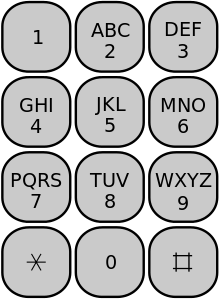
When the first SMS-capable handsets became available, they wouldn’t contain a full keyboard. Instead, each letter was mapped to the number pad in the following semi-standardised formation:

I say ‘semi-standardised’. The 0 key usually acted as spacebar, while 1 often produced symbols, but some layouts deviated from this. Ditto the toggling of capital letters, which we’ll disregard for the following demonstration.

To type the word BOOK, the following steps were necessary:

  • B required two presses of 2.
  • O – three presses of 6.
  • Pause for a second or press the right arrow, depending on phone, to allow the letter to register. O would otherwise loop back around to M.
  • O – three further presses of 6.
  • K – two presses of 5.

Overall, quite the frustrating process. It quickly became accepted practice to omit letters from words or use soundalikes. This might morph the word thanks into thx, or tomorrow into 2moro, which are still reasonably legible.

There were further innovations to come. One was the T9 system, which guessed each letter in context based on its neighbouring presses. To type the aforementioned BOOK, you would press the buttons 2-6-6-5 once each. The display might suggest BOOK first, but COOL or CONK could be selected from the menu, cutting down on overall presses.

Many phones would remember which words were used most commonly, but my Nokia 3330 never did. If I wanted to mention my pal Amy, I always had to scroll through BOX and COW.

Despite T9, the abbreviated style still persisted in popular culture for some time, with Fall Out Boy releasing a single as late as 2007 titled Thnks fr th Mmrs. It only died out when touchscreen input became more common.

Cards on the table, I was never sorry to see SMS speak disappear. Although it took longer, I liked to write my sentences out properly, and it could be challenging to decode some abbreviations. I much prefer what we have these days. No doubt the style will make a resurgence at some point, but I won’t be participating in that.
A Quick Word About Postcards

Although postcards are now virtually obsolete in daily life, I can remember a time when they were used to enter competitions, to cast votes in polls, and to let friends and family know you’d reached your holiday destination safely.

But when I’m going away for a day or two, I like to maintain the last of those traditions. In most cases, I know I’ll arrive back home before the mail does, even when it’s within Great Britain, but it doesn’t diminish the surprise for the recipient.

A typical card measures around four inches by six, although there are wide variations, with the front featuring a picture or design. The back is split into two equal sections, so your text has to fit into that left section because the address and the stamp will take up the right-hand side. You can also buy books of plain postcards where the address and stamp go on the front, allowing use of the entire rear side.

Still, the fixed format forces you to pick your words wisely or to minimise the size of your handwriting. The inventors of the SMS initially chose 160 characters as the limit based upon those restrictions.

In the earliest days of mobile messaging, each one typically cost between 5p and 10p to send; those figures are not adjusted for inflation. Some handsets supported longer messages, but each block or partial block of 160 characters was charged separately.

Despite this, an SMS easily undercut the price of a stamp in the second half of the 1990s – shown by this table from The Great Britain Philatelic Society – especially as you didn’t need to buy a physical postcard either.

The cost of SMS and similar messages today is negligable. Most phone subscriptions have some element of inclusive or unlimited allowance, putting the higher cost into perspective. On a day trip to Birmingham yesterday, I sent just two cards, but they cost me 87p apiece in second-class stamps.

Knowing I might not have a chance later in the day, my intention was to write them both on the flight and post them at the other end. I forgot to take them out of my bag until we were almost ready to land, but they’re both now safely in the post awaiting delivery.

Frm Tlgrph to Txt.

Every so often, some newspaper or another carries a report on the declining literacy standards of young people, usually focussing the blame on text message speak. I’m not worried about this happening. To illustrate my point, let’s have a look at how txt spk originated. The first SMS was sent on 3 December 1992 by Neil Papworth, who used a PC to send the message Merry Christmas to Richard Jarvis from Vodafone. The message didn’t receive a reply because no phone was capable of it.

220px-Telephone-keypad
All right, Nokia fans. Get ready to drool.

But that problem was solved the following year using a method that already existed. Certainly in the UK, phone number pads were already marked with letters as an aide mémoire when calling other towns and cities, and it’s very similar to the layout of a modern mobile. Codes are no longer assigned like this, yet if you remove the 01 from many modern area codes, you can often guess the original mnemonic. Perth is 01738, equating to 01-PET; while Hastings is 01424, probably resolving to 01-HAI. It’s an efficient system when encoding a very short message such as the codename of a city, however it becomes more cumbersome with a more complex message.

A simple question such as Where are you, John? could become a nightmare to tap out, as you would need to press extra buttons to write a capital W and J, while the first two letters of you need three presses each. That’s not even mentioning the comma or question mark, both of which could be buried in a sub-menu. No wonder people would write whr r u john, reducing button pushes to 22, assuming one press of the 0 or 1 key acts as the space-bar. That’s just over the 20 required to spell the full message on a standard keyboard.

The boffins have improved mobile input since then, at first with T9 predictive text, and now with touch-screen QWERTY keyboards. So too with text messages. By habit, people still shorten messages and miss out punctuation for brevity. Sometimes it can be a challenge to read, but the brain is particularly good at filling in blanks. In fact, the creators of Teeline shorthand knew this back in 1968, and their system removes the internal vowels from most words.

It’s worth noting that the QWERTY layout is a historical hangover too: a deliberately inefficient design intended to slow down typists and stop the first typewriters from jamming. Yet it still endures even although jams were eventually almost eliminated, and other layouts made available, such as Dvorak, which I generally use. So if QWERTY is still around, why am I not worried about txt spk being with us for the long term? Because we’ve been here before, and it wasn’t even within living memory.

When the telegraph was introduced in the mid-1850s, its pricing model was pay-per-word, so people naturally wanted to communicate as cheaply as possible. Businesses quickly learnt to abbreviate sentences into single words, and enterprising authors also wrote code books for the general public. Here is a wonderful example of where a sender has encoded the important points of a shipping accident into just five words. I’ll bet that in the latter half of the 19th century, people thought all communication would end up being that way. For instance, there is a novel from 1880 called Wired Love: A Romance of Dots and Dashes [CONTAINS SPOILERS] about a couple who meet via telegraph. And yet, despite the subject matter, the description is rich and colourful, just like the majority of documents from the period.

In short, so to speak, text messages are still brief because of old technology, and telegraph messages were brief for cost reasons. But proper English as a whole was not greatly affected by telegraphy in the late 1800s, despite its popularity, and that’s why I doubt it’ll be killed off by cellular telephony in this era, the early 2000s.