
As I’ve been ultra-busy this week, I’m afraid I haven’t been able to update, except to make this entry to say I haven’t been able to update.
Author: Gavin Cameron
I've been writing fiction and poetry since 2010, and I run writers' groups.
This is a blog to talk about writing and adjacent topics.
One of the best ways to edit a story is simply to give it time, much as wine tastes better when it’s allowed to breathe. But there will be times when there’s not a minute to lose and you’ve got to produce something out of necessity, and sometimes that leads to some excellent work.
I was once given a homework exercise from a writing class that was a fragment of a poem. Nothing was immediately coming to mind and I wanted to complete the exercise as I’d paid for the class. After sitting in the library then writing and writing for an afternoon, I eventually produced a rather short piece called A Big Leap but one I was fairly pleased with.

Some time later, the tutor alerted me to a flash fiction competition just three hours before it was due to close. I collated what were my best flash pieces at the time, gave them a quick edit, then sent them in. A Big Leap became my first published piece.
I’ve done this a number of times with my work. A looming obligation or a lack of time has a way of forcing you down an unusual path, or to come up with ideas that are unconventional.
This happened most recently in November when I was asked to write an original piece for performance later that month. After a slow start, it ended up being based upon someone I knew many years ago, but I probably wouldn’t have used him if I’d had more time to think about it.
On another occasion, I was all set to read out a particular piece at Hotchpotch, when I was inspired to write another one by a topical event on the news. If I’d left it until the following month, the impetus would be lost, and that gave me just three or four days to concoct the new piece. I’ve subsequently edited it and it now stands alone without the audience needing to know the topical references, and it’s one of my favourites.
But necessity, however superior a result it might produce, isn’t always to a self-imposed goal. When Anthony Burgess found out he had an inoperable brain tumour, he wrote several novels to provide an income for his widow after his death.
Many authors are asked the same questions over and over again. One of these is often Do you write longhand or into a computer?
But however repetitive it becomes, it’s a question worth considering. A commercial novel averages around 80,000 words, and that’s just the final product, not taking into account the many redrafts that will inevitably have gone before.
Let’s consider the different ways that different authors physically externalise their words, and the alternative approaches that could be taken.
Learn to touch-type
One of the best choices I ever made at school was learning how to type with 10 fingers, as it’s a skill that served me well in my working life. There are a couple of huge advantages over using just two or three fingers: your word speed can more than double, and it spreads the effort between all your fingers rather than straining just a few of them.
Be advised that it takes a while to master initially, but you’ll eventually be able to do it without conscious thought. A word about tablet computers as well. These have virtual keyboards, so it is possible to touch-type on these, but you’ll need to keep an eye on your finger position as you won’t be able to feel for the keys.
Choose an alternative keyboard
It’s a well-known story that the QWERTY keyboard was originally designed to slow down typists as the first machines were prone to jamming. It’s less well-known that the jamming problem had been solved by the 1930s. This allowed August Dvorak to invent an improved keyboard to help typists increase their speed by placing the most common letters on the middle row.
Sadly, it failed to catch on widely, but it is available on every major operating system. I’ve used the Dvorak layout for some years and it has the edge over QWERTY in terms of word speed. To increase it further, you could try a chorded keyboard. Clerks of court and TV subtitlers use these to keep up with the pace of normal speech. I haven’t used one myself.
Open your notepad
Unless you’re employing a shorthand system, this slows down your thoughts to the speed of the pen or pencil, and some authors are convinced it makes for higher quality writing. Martina Cole claims to be able to tell when a novel has been written directly into a laptop, while James Ellroy sends his handwritten work to a typist.
Be aware, however, that there’s no backup unless you’re using carbon paper. I’ve been told that a highly regarded author was forced to rewrite a large section of a novel when the paper blew out of an open window.
Be a dictator
Barbara Cartland famously dictated her words to an assistant, sometimes producing around 7000 words a day. Happily, you no longer need to pay someone for this service, as voice dictation is supported by many devices.
When I first tried this in the late 1990s, I gave it up as a bad joke. It. Required. Each. Word. To. Be. Spoken. Individually. Today’s software works with normal speech to a reasonable degree of accuracy without any training, even with my Scottish accent, although I recommend doing some to improve it even further.
I often use Dragon NaturallySpeaking, which can also be used to control many of your computer’s functions. In my experience, the actual dictation is fairly quick; it’s the formatting that tends to take a while.
Unconventional means
Probably most famous user of assistive technology is Stephen Hawking. He uses a switch activated by his cheek to choose words and letters from a computer screen.
But another author had to use a more difficult method. Jean-Dominique Bauby was struck by Locked-in Syndrome, so he could only blink and move his neck in a restricted manner. He wrote every word of The Diving Bell and the Butterfly by listening to somebody physically reading out the alphabet and blinking at the correct letter.
There are many ways to put your words out there, and not all of these will work for every author. For me, it’s through necessity that I use voice dictation and handwriting because my fingers are currently strained with typing too much. So until they improve, that’s how I’ll be writing my work.
But I’ve long thought that when you’re forced to take a certain action, you can always learn something useful from it. And that’ll be the theme of next week’s entry.
In 1951, the acclaimed novel From Here to Eternity was published. Many readers were unaware that James Jones fought to keep in sexual content and profanity, but he was forced to give in to the demands of his publishers.
It was only in 2011 that the deleted content was restored by e-publisher Open Road, who also released his book To the End of the War for the first time. Unfortunately, it came too late for Jones as he died in 1977.
In the same month in 2011, Kate Bush was allowed to use text from Ulysses in an album, having originally been refused permission in 1989. A little-known Tennessee Williams play from 1983 was also given its premiere.
Perhaps it was just a golden year for second chances. But attitudes and standards are constantly reshaping, editors come and go, and even individuals change their minds. What was unacceptable or clichéd several decades ago might be in fashion right now.
Major delays are extremely common in the screenwriting industry, where ideas can knock around for several years waiting for the right producer and director to pick up the project, not to mention the protracted process of re-drafting the script – often dozens of times – plus the actual filming.

In the 1960s, Larry Cohen first had an idea for a film set entirely inside a phone booth and he pitched it to Alfred Hitchcock. At the time, neither of them could think of a good reason to keep the character in the same place for an entire movie. When Cohen revisited the idea in the 1990s, he had the idea of using a sniper; the mobile phone had also been invented by then, and this is a major plot point. Within a month, he’d written the script for Phone Booth.
I’m aware that last week I discussed when to let go of work. But if you’ve had a manuscript languishing in a drawer or an unopened computer file from years ago, bring it out. Can you look over it with more experienced eyes? Have those who rejected it now moved on? Is the subject matter acceptable today, or perhaps even more pertinent than when it was written?
If you’ve answered yes to these, it might be worth another shot.
A minor word of warning, however. If Victor Nabokov had written Lolita today, it’s unlikely any publisher would have taken it on. And when an uncensored version of The Picture of Dorian Gray was published in that aforementioned golden year, many critics felt it inferior to the original.
For a writer, receiving a rejection letter is one of the hardest things you’ll have to face. But probably the second hardest is realising that what you’re writing is going nowhere, or that it has no place within the context of a longer work.
Earlier this year, I began to edit a novel I wrote four years ago because the current storyline wasn’t working. This meant cutting out several sections I liked, such as the 10,000 words where the main character arranges to rent a minibus with six football fans when their plane is cancelled.
Once I decided on a new plot direction, I needed to fill in the gaps. But around 2000 words into what I thought was a great idea, I found I was bored while writing it. These will therefore be cut on my next edit. And I still don’t know the exact direction I’m going to take the book.
Nevertheless, always keep the parts you cut out; you never know when they might be handy in the future.
I was given a writing group challenge to come up with a story that included an A to Z structure, however loose that structure might be. My story was called The Eternal Student, and it centred around a young man from a family of accountants who had been sent to university to gain the formal qualifications. As he knows it all, he enrols in evening classes through boredom, each with a name one letter higher than the last. It would then have gone on to describe his disillusionment with university management and how he set up his own institution.
With 1500 words on the page, there was no more mileage left in the idea, so I put it to one side. A few months later, An Abundance of Apples was born, using the idea of an A to Z structure.
A year after The Eternal Student was penned, I rediscovered it in my files. Using a fresh cast and a different situation, I borrowed the element of disillusionment and wrote another story called Plans that ended with the main character setting up a new university. This then inspired another novel starring the same character and borrowing some elements from Plans.
And to date, I still haven’t been able to do anything else with my trainee accountant.
I’m on annual leave from my day job at the moment, but that won’t stop your weekly blog post from being delivered.
From Friday to Sunday, I planned to have three late nights at the T in The Park music festival. Then tonight, I’ll be running a writers’ open-mike before seeing a friend’s band in town. Tomorrow, I’m up early doors for the launch of Go Set a Watchman at Waterstone’s – Please note, warn the organisers, Harper Lee will not be in attendance – then a play by MLitt students at night, with a day of writing in between.
The rest of the week is packed in a similar fashion. The only thing that didn’t happen was Sunday at the festival, but I made sure to fill the time with more writing.
But why not rest up? Because as I’ve become older, I’ve realised that being idle doesn’t suit me. I won’t stop unless I absolutely have to, otherwise I would never manage to do anything. To demonstrate this, imagine I had to go to the Post Office and send a parcel.
If that were the only task I needed to do all day, I might wake up at 7am, realise there were two hours until the Post Office opened, start doing something else and be distracted by it until midday, tell myself there were five hours left and do something else to fill the time, and be distracted by that instead. The net result is that the parcel wouldn’t be posted.
On the other hand, let’s suppose the parcel was just one more thing I needed to fit in. I might go to work at 8am, leave the office at 4pm, visit the Post Office, then head to the gym and crack on with writing when I returned home. Net result: I’ve done my task.
It’s unfortunate that almost all UK employees are required to take 5.6 weeks of leave every single year, as I would be far more productive without a break, and I’m sure the economy would benefit too. If I ever reached a stage when I was able to be a novelist full-time, I would probably still rise at the same hour as I currently do and churn out a target number of words over a certain number of hours.
Stephen King has this one right: he produces 2000 words every morning, including his birthday and holidays, and spends time in the afternoons catching up on his correspondence. And that’s why you’re receiving this blog post as normal, and next week, and the next, until I no longer feel productive by producing them.
If you’re a fan of The Big Bang Theory, you’ll know that Sheldon Cooper is particular about which seat he chooses, particularly in his own apartment. Writers can be similarly picky about where they pen their works.
Among my writer friends alone, there is one who writes better with absolute silence and another who penned most of her novel in a noisy student pub. There is no right or wrong way. For my own part, I’m typing this entry in one of my favourite places: at the bottom end of my bed, standing with my back to the window. But when I’m stuck on a project, I sit on the mezzanine floor of a particular cafe in town and it usually unblocks my flow.
On Saturday, I was given the opportunity to attend a one-off writing group at the secluded Barry Mill near Carnoustie to raise funds for its restoration. After a tour and a demonstration of its working waterwheel and machinery, the nine or so attendees followed the stream back to the weir through acres of wild flora.
The tranquillity, location and history of the place was supposed to serve as inspiration for a poem or prose piece – and it worked. It took me some time to put something together, but I managed to write three verses, using the mill as a starting point, and nearly everyone had written something for reading out. It didn’t help, however, that it was raining onto our notepads for much of the visit, or that two of the chairs collapsed – mine included – before the session even began.
So if you feel your writing is becoming a little stale, try going somewhere else. Not everyone is able to escape to the countryside, of course, but it might work even to move location within the same general area or even the same building. Before I discovered my current spots, I experimented with a number of places before finding one that felt just right.
I’ll leave you with an electronic postcard of Barry Mill.
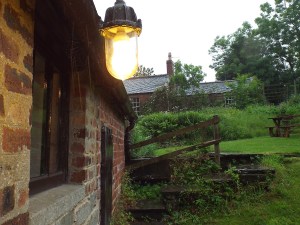
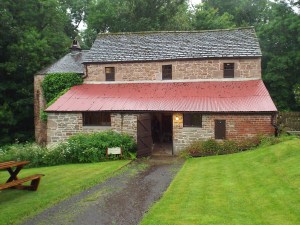

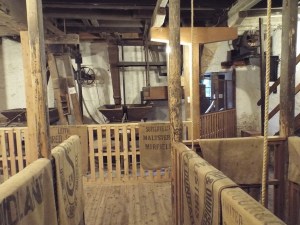
For the five Mondays in June, I’ve been taking a break from my usual subject to make one of my stories available free online. We’re now up to the final part of An Abundance of Apples.
In part one and part two, we meet an orchard owner who starts to trade items in alphabetical order. In part three and part four, he keeps moving up the alphabet. Can he still reach Z?
West Hollywood Hotel
Naturally, a lot of my e-mails were coming from the US, and one in particular caught my attention: a four-night stay at the West Hollywood Hotel in return for the Beetle.
We spent evenings on the phone negotiating delivery of the car. We’d read up thoroughly on international deliveries since the Australia incident and we had arranged to pack it off, when by chance, Kelly spotted a news article.
A group of criminals had been passing themselves off as representing prestigious hotel chains and airlines, and they would take payment for stays and flights that never happened.
We’d been so swept up in trying to find a swap that we’d failed even to check their quoted phone number against the one listed on the real hotel’s website.
We felt like prize idiots. I made an online post to that effect.
My parents talked to me like I was five years old and told me this was a wake-up call, that I’d had a good run and I needed to stop now. Kelly had supported me unwaveringly so far, but even she started to express her doubts. I remained as determined as ever to see this through to Z.
Only Daniel didn’t care one way or the other. He’d forgotten his football obsession thanks to his new girlfriend, some little brat from his class.
While the flood of messages had slowed sharply, I still had a number of contacts willing to swap. I learned my lesson and no longer considered foreign offers but I found someone who wanted to swap my Volkswagen.
Wurlitzer Organ
We only played it for five minutes before the sound really started to grate.
Xylophone
Jeez, do you know how much a new xylophone costs?
I thought a few hundred at most, but even a second hand one can go for over a grand. I know this because the instrument dealer who inspected the Wurlitzer through thick glasses talked me through the entire history of the organ and current market values.
Yngling
“Yngling? That’s not even a word,” exclaimed Kelly. “Don’t you mean yacht?”
“It’s not a yacht,” snapped the outdoorsy type as he unstrapped the thing from the trailer. “a yacht is a completely different class of boat. This beauty competed in the Beijing Olympics, you know.”
“All right,” I concluded. “Leave it here. I’m sure we’ll get it swapped somehow.”
“You mean leave her here?”
I made a You & We post that night, asking if anyone could swap us for something beginning with Z. One more push, just one more, and I would have completed the alphabet. We waited a whole week for something suitable.
Zurich holiday
A local travel firm called Sea the World came to our rescue, offering a holiday for two to Zurich. We checked it out, and it was genuine enough. They wouldn’t take the Yngling off my hands, but their staff had been following my swaps, and I was prepared to treat it as one.
With no further swaps scheduled, only one question remained: who would use it? Daniel and his bratty other half threw a strop when they found out they weren’t getting it. Mum and Dad hadn’t taken a holiday for years, yet wouldn’t consider it. I asked Kelly but she’d used up her annual leave until after the voucher’s expiry date.
I turned to You & We. I wrote a summary of how this whole project had started with a few apples, then blackberries, then carrots, and so on, and now we were stuck at stalemate with our Z.
I received an urgent reply from the dealer who had tried to swap me for the iPhone. He told me to come down to his shop at the double, and he would, “complete the circle.”
He looked at the value of the voucher, ran some figures through a calculator and I arrived home with my final swap.
Apples
Last year, we ended up with too many apples. This year, we ended up with two Apple iPads.
<<<>>>
The usual angst and introspection returns next week.
For the five Mondays in June, I’m taking a break from my usual analysis to make one of my stories available free online. We’re now up to part four of An Abundance of Apples.
In part one, we meet an orchard owner who trades apples for other items, each one letter higher in the alphabet than the last. Part two sees him trade four more items beginning with F, G, H and I, while in part three, he trades a jigsaw. Now he has a power supply unit. Who will take it, and in exchange for what?
Qantas air tickets
“Well, mate,” said one of the DJs, “if you send us your power unit we’ll send you two hundred dollars’ worth of Quantas air tickets. What do you say to that?”
I had no idea what that equated to in pounds, but I stutteringly agreed. When our exchange ended, I checked the postal rates to the other side of the world.
You don’t expect the police to come and question you when you don’t know you’ve done something wrong, but I sharply learnt that it’s against the law to send certain types of battery though the post.
I told them that the Post Office assistant asked me what the package contained, wrote it on the Customs label, then sent it, no further questions asked. Fortunately, I’d kept the proof of postage and the receipt because the radio station promised to reimburse me for the cost of sending it.
The police accepted I’d posted it in good faith and returned the unit to me, but warned me, “Don’t do that again, son.”
I immediately informed the radio station. They arranged for me to go on air the following morning, when the DJ apologised for not realising the legal implications, and agreed to give me the Quantas tickets–actually a discount code to be used on their website–on condition that I gave the power supply to someone, “deserving.” I found a charity shop that accepted electrical goods, and the station sent me the code.
The publicity had generated dozens upon dozens of e-mails. Naturally, most of them originated from Down Under, but a few arrived from Britain and the rest of the world. I had my pick of the next item.
Rum
Kelly and I looked down the list of offers: a rowing boat, tickets to Riverdance, roast beef dinners for a year, even a rabbit hutch and occupant. But the case of vintage rum caught my attention.
I found out that 200 Australian dollars is about £118, and its value exceeded that of the Qantas tickets. Also, I reckoned it would be an easy thing to swap.
About the same time, I received an invitation to appear on the late-night Jerry Jakobson Show in New York. Not via video link; they wanted to fly me over there. They had a intriguing proposition for me. Naturally, I discussed it with my family before making any decisions.
It caused an argument. Mum encouraged me to go, while Dad said he needed me in the orchard. Daniel, meanwhile, went into another huff as he wasn’t going. Kelly gave me a shopping list of designer labels to buy in New York.
I went.
I had a hairy moment at Customs, when they kept me waiting to check it was all right to bring the case of rum into the country. Those two hours gave me the chance to contemplate how many people would be watching me. I got the jitters speaking to half a million Australians; the prospect of speaking to 4.2 million Americans made me want to step on a flight home.
Jerry helped me feel at ease off-air, then interviewed me on air for five minutes about the project, before pulling out the envelopes and explaining his proposition.
“We’re going to swap you for something beginning with S. One of these envelopes gets you a bespoke suit courtesy of one of New York’s finest tailors. A pretty good prize, huh? But one of them contains a subway ticket and the other one wins you a steak sandwich. I’m going to get a member of our audience to mix them up.”
I tried to keep my calm. A suit, a subway ticket, or a sandwich. Jerry held them out in front of me. “All right, buddy. Your choice.”
Suit
A camp man with a tape measure took every one of my measurements over the course of a morning, while a camera crew captured his comments, around the general theme of, “fabulous.”
Jerry had opened the other envelopes on camera. I genuinely could have walked away with a subway ticket. I don’t think I’ll ever be able to have another Dolce & Gabbana suit again, and it disappointed me that I’d eventually have to swap it.
But I’d officially gone stratospheric. I threw myself into my orchard work by day, but Kelly became my unofficial agent by night, ruthlessly sifting through my scores and scores of e-mails.
Listening to the TV one night, I found my story had even made it into a sketch show.
You can’t hurry quality tailoring. I waited weeks for it to be delivered, but I had enough time to arrange not just the next swap but to plan for the next three exchanges.
Thunderbird
Stage one involved the wealthy-looking man, who got back to me with a classic Ford Thunderbird.
Underground carriage
When Transport For London said they would give me an old Underground train carriage, I asked how I would take it home with me.
But the deal they had in mind for stage two wouldn’t involve it physically moving. If I could take the car to their depot, they would swap me for the paperwork to the carriage. I would then give that back to the Thunderbird owner.
Volkswagen Beetle
At stage three, I swapped the Underground paperwork for a Volkswagen Beetle.
I tried asking him some friendly but probing questions about how he could swap the Grand Prix programme, the film stills, and now two cars, all so casually. But he wouldn’t say anything, other than they were both rusting and needed a lot of work.
Next week: West Hollywood Hotel.
For the five Mondays in June, I’m taking a break from my own angst and introspection to make one of my stories available free online. We’re now up to part three of An Abundance of Apples.
In part one, we meet an orchard owner who starts off with too many apples, and begins to trade them for other items, each one letter higher in the alphabet than the last. Part two sees him trade four more items beginning with F, G, H and I, while his bratty younger brother constantly stands in his way. In part three, below, he’s now in possession of a jigsaw.
Jigsaw
The publicity generated by the paper showed little sign of slowing down, so in quick succession, I received a jigsaw from another well-wisher.
Not a jigsaw puzzle, an actual saw that’s used to cut the pieces.
King Kong stills
The wealthy-looking man who offered me the Grand Prix programme wrote back, offering to swap the jigsaw for some rare stills from the classic film King Kong.
I decided to start photographing the items, starting with the saw, as they were becoming more interesting.
Around the same time, a woman called Kelly, around my age, requested to be mutual friends on You & We. We had three people in common and I recognised her face, although I couldn’t remember where I’d last seen it.
Laserdisc player and discs
The things people keep in their attic. Someone swapped me the King Kong stills for an obsolete laserdisc player and four Jean-Claude Van Damme films on discs the size of bicycle wheels. What’s more, it still worked, and we spent the evening watching Universal Soldier.
For the first time since being in the paper, I had a little trouble finding a trade. My inbox still filled up daily, but only with offers of cheap items, including a map, a family bag of M&Ms, and half-a-dozen marbles.
Mink coat
I finally traded my retro technology for a mink coat. A fake one, of course.
I stood back and took stock. I’d come so far in less than a month, and all after an off-the-cuff observation. All my life, I’d been a trader in one sense or another, and I still saw it as an achievable challenge.
The national British newspapers ignored me, except one rag who reported that Margaret Jeffrey had given me the idea. Then I received an e-mail from a researcher at an Australian radio station asking me to contact them. They wanted to speak to me live on air when I reached the letter P.
Necklace
Just as I celebrated reaching the halfway mark, the mysterious Kelly wanted to see the coat, and offered a sterling silver necklace in return. After a few minutes’ online conversation, I realised her true identity: Irene’s daughter.
I asked why she wished to get rid of the necklace. She told me her father had given it to her one birthday. I didn’t ask directly, but I came away with the distinct impression that she and Irene wanted nothing more to do with the man.
I couldn’t stay angry at Daniel forever and I brought him along when I went round to complete the exchange. She tried on the coat and it fitted her neatly. We chatted for ten minutes, which turned into an hour, which turned into a very bored little brother.
I’d driven nearly all the way home when he said from nowhere, “Did she ask you out?”
“No,” I replied.
“But she asked you if you wanted to have dinner with her some time.”
I’d dismissed it as a rhetorical question, but thinking back, I realised she’d been serious. For a selfish brat, he could be astoundingly perceptive. I rang up to accept when I got in the house.
I thought a necklace would be snapped up, especially as it bore a hallmark, but I hit a wall. The effect of the newspaper article had almost worn off. I began to doubt my ability to reach O, never mind Z.
Obsidian pig
It took nearly a week, but I arranged to swap it for a decorative pig made from obsidian.
The snag? Kelly and I had already booked a table at a popular restaurant for 6:30pm, but the swapper could only meet me at 7pm. Kelly understood the magnitude of my project, but the other diners thought I’d run out on her.
Another week passed, and another date, but nothing to swap for this pig. I sat down and wrote a plea on You & We. I read it back the next day, and it sounded quite desperate, but Kelly had passed it onto her friends.
Power supply unit
In less than six hours, a hire shop in town swapped my obsidian pig for an ex-rental industrial battery, designed to provide emergency power in the event of an electricity failure.
“That’s my mum’s birthday present sorted,” commented the manager, examining the pig.
I immediately notified the Australian radio station, who arranged to make a voice call to me over the Internet as it would be higher quality than a normal phone, and free of charge. Daniel set it all up the previous evening, and bored me stiff with the technical details.
Evening drive-time in New South Wales is breakfast time in Britain. I’m accustomed to getting up at that time, in fact I’d kept working in the orchard all through the project, but I was not accustomed to having my voice broadcast to half a million listeners from my kitchen.
I honestly can’t remember a large chunk of our conversation, and wouldn’t let anyone play me the recording, but I gave out the You & We address and they made me an offer I couldn’t refuse.
Next week: Qantas air tickets.
 Gavin Cameron